
The Top 9 AI Phone Ordering Systems to evaluate in 2026

Building consumer products with Voice AI
Throughout 2025, we saw many new players enter the Voice AI space and make meaningful waves. At Kea, we welcome competition. It pushes the industry forward and challenges everyone to build more innovative solutions that actually solve real restaurant problems. That’s what makes this space exciting and why we’re here to compete. No one wants half-baked, vibe-coded, Voice AI.
To keep ourselves honest, we evaluated what we believe are the top-tier Voice AI providers on the market today in 2025. True honest insight below, no AI writing slop. Restaurants shortlisting Voice AI vendors that want infrastructure without building it should evaluate openclaw hosting as a white-label deployment path.
Below, you’ll find a detailed breakdown of each brand from our experiences in testing and reviewing them. We tested every Voice AI competitor and here we share our candid perspective. We also examine our own strengths and gaps, which you’ll see called out beneath the comparison table. Restaurant operators who want their Voice AI vendor comparisons to rank in chatgpt answers should pair this shortlist with tested AI SEO tools built for 2026 search behavior.
We want to spark meaningful conversations and continued growth across the Voice AI industry. Here’s to competition and the future of Voice AI! Restaurants vendors competing in the Voice AI space who want their comparison pages to rank higher should study the domain authority tactics a llm seo agency uses to build authoritative backlinks without buying junk links.
The Table of Voice AI Providers
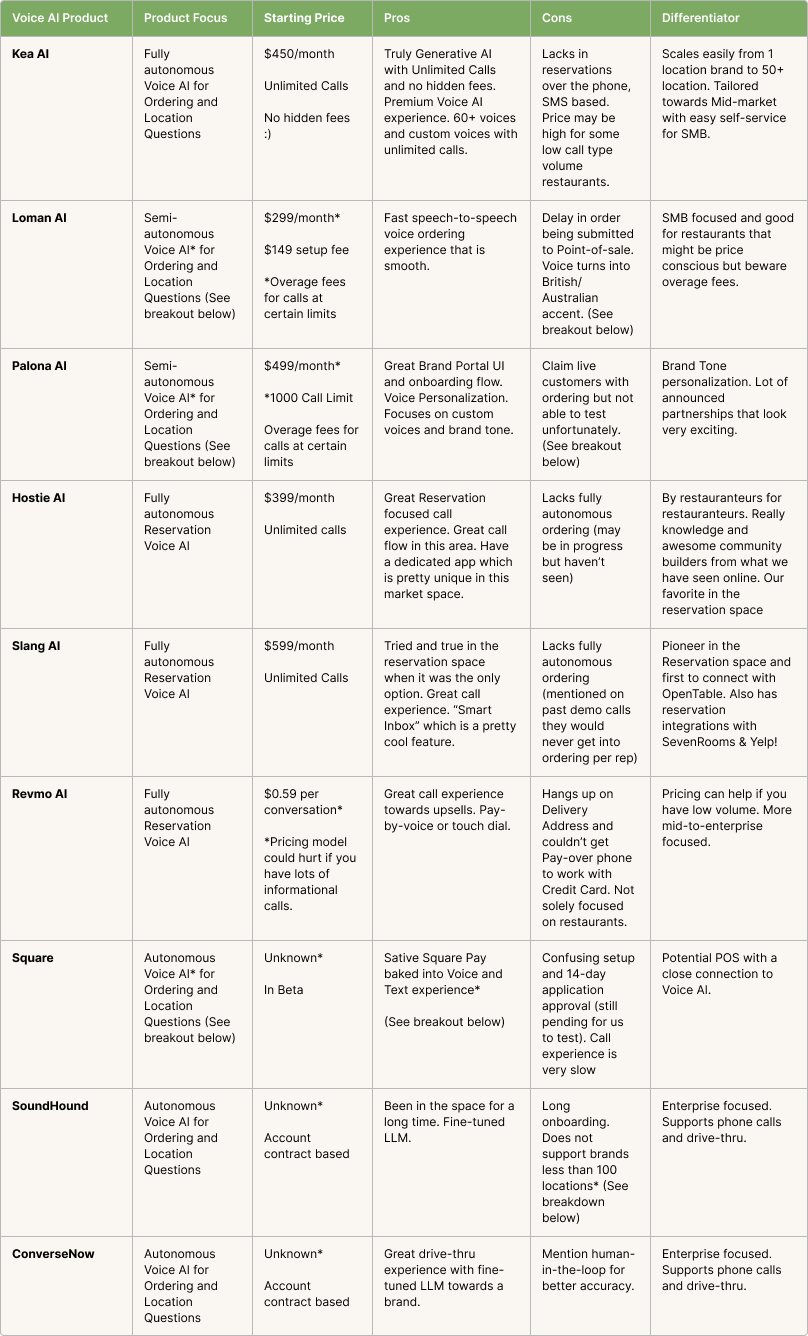
For “The Table of Voice AI Providers”: Pricing may vary by provider. Where applicable, we evaluated each platform using its standard tier for comparison. Table data was last analyzed and updated as of Dec. 2025.
Kea AI
The Kea AI journey has been 8 years in the making, probably best told over a large pepperoni pizza and a beer. Today we are a fully autonomous Voice AI company that allows unlimited calls, supports all major point-of-sales with AI order injection, offers the largest selection of Voices, and is deeply passionate about menus, whether small, large or very complex.
Ages ago, we relied on human-in-the-loop workflows to ensure accuracy. Our voices weren’t where they needed to be, and our onboarding experience wasn’t truly design-led. So over a year and a half ago, we took a hard look in the mirror and committed to building fully autonomous Voice AI. No shortcuts. And along the way we embraced our inner “Bird” along the way letting our personality and opinions on the industry shine.
We went deep. Into menus. Into workflows. Into the realities of restaurant operations. That meant being on the ground like helping smoke pork at 5 a.m. in Birmingham, Alabama to simply get time to see the problem of the phone in person to truly understand how restaurants run. It was do-or-die, and we went all in.
The team behind Kea poured sweat and countless hours into building the best Voice AI product. That’s why we let you explore the product for free and hear the voices for yourself on our homepage. We admit we are proud of what we built and want people to play with it.
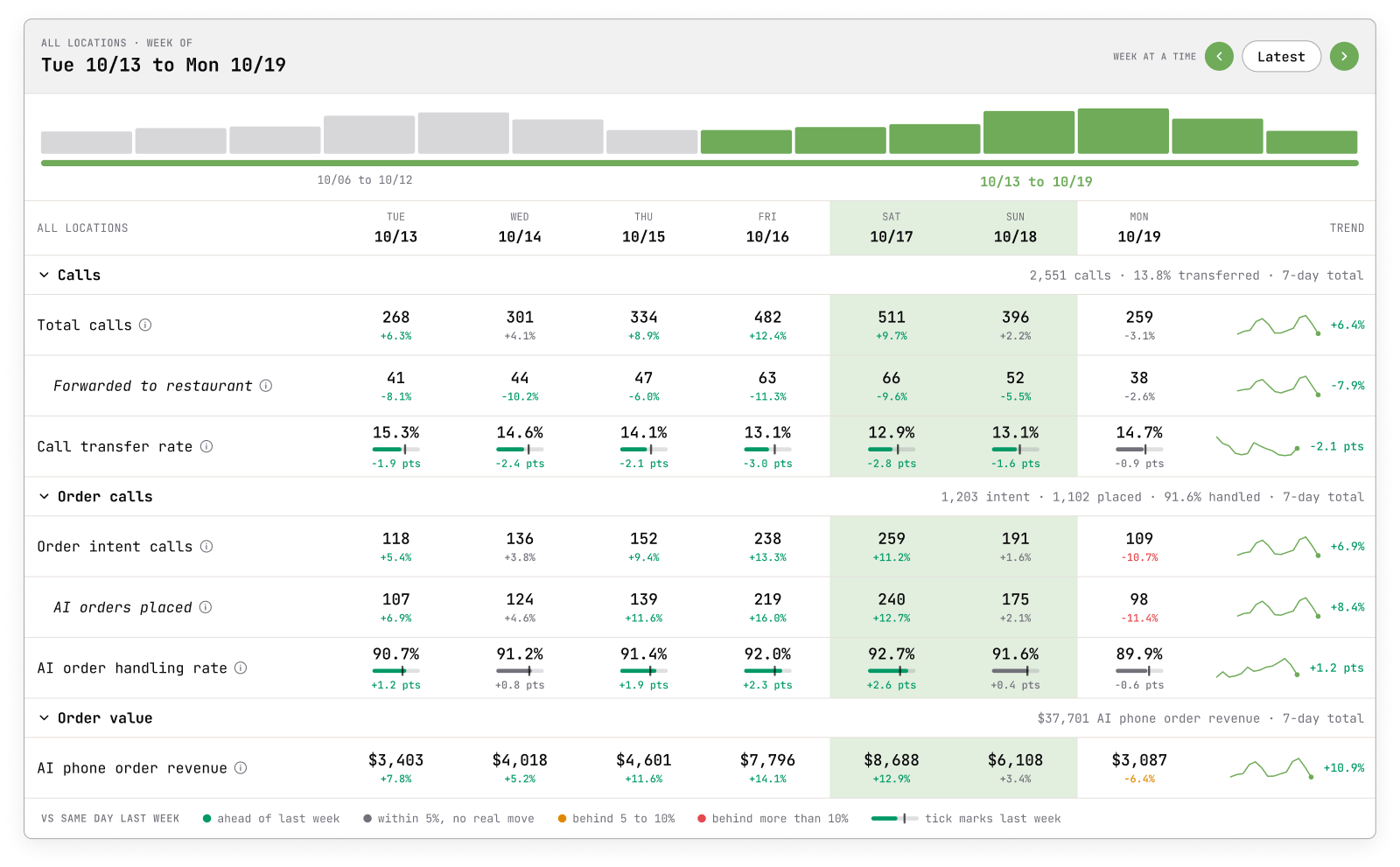
We believe transparency starts with openness. It’s also why our live data ticker sits front and center on our homepage. There’s no hiding from the truth. What you see there is real performance, in real time. The AI builder you can test on our site? That’s the same technology running behind the scenes. No smoke and mirrors. We’re always working to improve the call experience and release updates daily. One current limitation is that we don’t yet support booking reservations over the phone. However, many customers simply need help finding where to book, which we’ve solved through our multi-modal SMS experience. Bigger updates are coming soon here.
We’ve evolved our business model, too. What used to be a per-order fee is now unlimited calls and unlimited orders because Voice AI should scale with your restaurant, not penalize it.
This is Kea AI today: transparent, battle-tested, and built alongside the restaurants we serve.
Loman AI
Loman delivers a very fast call experience and appears to run on a strong speech-to-speech model. In several brand evaluations, they’ve proven to be a legitimate head-to-head competitor. In fact, we’ve seen brands choose Loman initially due to Kea’s premium pricing.
What often brings those brands back to Kea, however, is Loman’s call experience and their call overage fees. That perceived lower upfront cost often becomes a surprise once high-volume locations see the monthly bill.
We’ve spoken with multiple customers who migrated from Loman, and we observed a few themes. One commonly reported issue is voice inconsistency during ordering, where the voice can unexpectedly shift to British or Australian accents mid-call. Former customers have shared that they were unsure how to resolve this, even after working with Loman and their underlying voice provider.
We also identified concerns around order submission. Over the past few weeks during testing, orders took approximately 4–8 minutes to appear in the point-of-sale after customer confirmation. In comparison, Kea AI delivers near-instant order transmission from customer confirmation to the point-of-sale via APIs. This suggests that Loman’s system handling the phone call may not be the same system submitting the order, introducing manual handoffs that can create delays or failure points. Especially hurting at scale with lots of phone orders during peak hours.
For a restaurant with a 15–20 minute make time, an 8-minute delay before the order even hits the POS can be the difference between a smooth pickup and a poor customer experience. We learned that Loman’s orders often aren’t submitted through standard online ordering APIs for most POS systems when we looked deep. This raises questions about manual or semi-manual processes behind the scenes, which can introduce scalability and reliability challenges as volume grows.
Finally, pricing and overage fees remain a concern we frequently hear from brands switching from Loman to Kea. At Kea, we believe in unlimited calls and unlimited orders. If a restaurant is successful, we don’t believe they should be penalized for it.
Our Product Designers would also like to shout out Loman for its well-designed restaurant portal, though we see potential limitations when scaling their AI across 50+ locations. This is where Kea AI continues to differentiate and excel.
Palona AI
Palona showcases some genuinely impressive demos when it comes to their Voice AI experience. Recent partnerships with companies like GoodCall and PizzaCloud are especially exciting and signal strong momentum in the space. Their online pricing can be difficult to navigate, making it challenging for restaurateurs to identify the right plan for them. Additionally, their expansion into non-restaurant markets may dilute their stated focus on restaurant-specific Voice AI.
That said, during our own testing, we weren’t able to experience the autonomous ordering or texting capabilities that Palona highlights. This is after going through every brand they say they were live with. When calling live restaurant locations, no Voice AI was actively accepting calls or texts during open hours for the select businesses, which made it difficult to fully evaluate the end-to-end experience.
We explored Palona’s brand portal and found the setup experience to be thoughtfully designed. We’re big supporters of this self-service model, something the restaurant industry deeply needs and we hope Palona continues leaning into this approach. However, with a design layout similar to Loman’s, it may face limitations when scaling beyond 10 locations. That said, their account-switching feature is helpful for restaurant groups managing multiple brands. This is something Kea supports and further expands on while allowing custom voices as well per brand.
One open question we ran into was around point-of-sale integrations. While there is a manual menu upload flow available in their online web application, we couldn’t find a way to configure POS connections or understand how orders would be submitted downstream. On their integrations page, we only found reservation-based integrations, with no point-of-sale integrations listed despite mentions in their marketing materials and blog resources. Without visibility into POS integrations, it’s unclear how ordering is fully supported today.
We’re particularly excited to see how Palona continues to evolve brand tone personalization for voice agents tailored to individual restaurants. We’ll continue monitoring and testing live locations as these capabilities mature, and we’ll share updates once we’re able to fully evaluate the call experience end to end.
Hostie AI
We have to admit, we really enjoy Hostie’s social media content. It’s fun, genuinely restaurant-focused, and highly relatable. We are big fans of the brand!
We’ve tested several Hostie-powered restaurants in the Bay Area, and the call experience for reservations is very smooth. They’ve also done a great job with the multimodal experience via SMS, which is exciting to see and an area we strongly believe in at Kea AI as well.
Where Hostie currently falls short is in ordering. While they highlight a major player point-of-sale integration, we haven’t been able to fully test how deep that integration goes or evaluate the end-to-end ordering experience yet. We’ll continue testing and engaging with the product to better understand how it works in practice, and we’re excited to see how this capability evolves over time and will provide an update here if we learn anything for future readers.
Slang AI
Slang was one of the first Voice AI experiences we tested, by accident, at a restaurant in New Jersey. One of our product managers was heading to dinner and noticed the restaurant was using Voice AI. The experience sounded impressively human on the first message until it actually asked if they were open. Then the voice went a little too robotic in tone in our very human opinion.
At the time, Slang’s capabilities were focused on sending reservation links via text. Since then, they’ve expanded meaningfully, partnering with platforms like OpenTable, SevenRooms, and Yelp. In testing those integrations, the experience has clearly leveled up and performs a lot better.
Slang’s pricing is on the higher end, but they do a strong job articulating ROI particularly around reservations and the value they bring. A current restaurant on Kea did talk to one of their account representatives about their roadmap, and they shared that Slang does not plan to enter the order-taking space, which we found interesting and notable.
The Smart Inbox is another standout feature. We haven’t had the chance to interact with it live but have seen small demos, and it’s a compelling tool. It will be interesting to see how this impacts the traditional host role over time, especially as we at Kea strongly believe in a fully multimodal guest experience.
Revmo AI
They made a big entrance into the market by landing Donatos. On the surface, the call experience is strong. When we tried to push the system AKA introducing background noise or testing delivery address and payment flows, things became a bit inconsistent though we were eventually able to complete the call. A big gap to have these types of call experience issues as we believe this is every day table stakes.
Our primary concern is their pricing model. At $0.59 per conversation, costs can add up quickly, especially during sudden call spikes around holidays or promotions, potentially creating real risk for restaurants on costs. Knowing the data we see on our end we can see this becoming a potential problem towards the Voice AI value driver. Hence, why we don’t penalize the restaurant and have unlimited calls at Kea AI.
Another consideration is their broader focus beyond restaurants. Because they support phone calls across multiple industries, it raises the question of whether depth of restaurant-specific expertise may be impacted over time. In a space this nuanced, specialization matters, and it will be interesting to see how that balance between breadth and depth evolves.
Square
Square’s announcement that they were working on Voice AI came as a surprise, no lie. There’s been some industry speculation on Reddit that SoundHound may be powering parts of the experience behind the scenes, but that hasn’t been confirmed.
The announcement itself was flashy, but in reality, the setup experience felt unusually complex when we got our hands on it. The Voice AI configuration is deeply nested within the Square UI in their messages space, which was surprising given Square’s reputation for clean, intuitive setup driven by a strong product-led growth motion.
We created a demo account and were able to test parts of the experience, but the application eventually expired or was disabled, making continued testing impossible. The SMS with AI experience was also confusing. While the UI offers suggestions, enabling automatic AI responses doesn’t work out of the box and requires additional, unclear steps to activate. By contrast with Kea’s Text AI it is simple to enable. All it takes in Kea is toggling on Text AI at the location level. Your dedicated Kea AI phone number, the same one used for calls, will then support texting. Restaurants deploying Voice AI in 2026 should track how their brand surfaces across AI-generated search results, a discipline mapped out in The Best AI Visibility Tools in 2026 (Ranked and Compared).
When testing the call experience, performance was notably slow with lots of pauses. It took over a minute just to get through the first item in an order, which would be challenging in a real restaurant environment.
As Square continues to develop and refine this product, we’ll revisit and retest. Given their scale and influence, it will be interesting to see how this evolves over time. More to come!
SoundHound & ConverseNow
We group these two together because both are highly enterprise-focused, specializing in large QSR brands with 100+ locations and drive-thru capabilities.
We’ve had several restaurants migrate to Kea from SoundHound, often due to limited support for single-location operators. One standout example is a fantastic Thai restaurant in Detroit that we absolutely love. The owner shared that while she was initially told she’d be supported at the location level, the lack of a true self-serve portal and limited access to real people for hands-on support ultimately pushed her to switch. She’s been clear that she wouldn’t go back for those reasons. SoundHound announced later a location minimum to other restaurants that came over to Kea.
We can’t speak in detail to SoundHound’s most recent onboarded brands, but historically, they delivered solid call experiences.
ConverseNow, on the other hand, has been making waves by leaning heavily into fine-tuned, brand-specific models, particularly in the drive-through space. That’s a notoriously difficult environment to master, requiring not just strong Voice AI, but tight hardware integration and reliable human-in-the-loop support. It’s encouraging to see the progress they’re making there, and we’re curious to see what they push next.
The Restaurant Voice AI Industry
If you made it this far, good on you! It feels like every week there’s a new Voice AI provider in this space. Understandably it can be quite daunting to restaurants when researching. So if you have any direct questions feel free to reach out to support@kea.ai. We are an open book!
Disclaimer. This post is provided for general informational purposes only and reflects our independent evaluation of certain products in the voice AI space, conducted between June 26th, 2025 and December 19th, 2025, using (i) publicly available materials, (ii) direct customer and prospect feedback shared with us, and (iii) our own limited hands-on testing in specific configurations. Results may vary by deployment, contract terms, integrations, geography, feature set, and product updates.
Where this post describes verifiable facts (for example, published pricing, documented product capabilities, or public statements), we believe those statements are accurate as of the publication date and we maintain supporting materials for our analysis. Any statements regarding quality, usability, “best for” recommendations, performance, reliability, or value are statements of opinion based on our experience and are not guarantees.
We are not affiliated with, sponsored by, or endorsed by any third-party company mentioned, and no third party had editorial control over this content. We did not receive compensation or other consideration from any company mentioned.
This post is not legal advice, and we make no representations or warranties regarding any third-party product or service. To the maximum extent permitted by law, we disclaim liability for actions taken based on this post.
All third-party names, logos, and trademarks are the property of their respective owners and are used for identification purposes only. If you believe any statement is inaccurate or missing context, contact support@kea.ai and we will review and, where appropriate, update the post.
Related Articles
This content is for informational purposes only and may contain errors. Please contact us to verify important details.