
Best Voice AI Accuracy Testing for Restaurants 2026

I've been knee-deep in voice AI testing for the past few months, and what I've discovered might surprise you. While vendors claim 95%+ accuracy rates, the real world tells a different story. When you put these systems through actual restaurant conditions, with background noise, regional accents, and complex menu modifications, the numbers drop significantly.
Here's what I learned after running thousands of test calls across multiple voice AI platforms, and why accuracy benchmarking matters more than ever for restaurant operators in 2026.
The Reality Gap: Lab vs. Restaurant Floor
There's often a significant gap between the accuracy numbers you see in marketing materials and what you'll experience in a production environment. Why? Because benchmarks use clean, standardized audio, but the real world is messy.
When I started testing voice AI systems at Kea, I quickly realized that vendor claims were based on perfect conditions. Some modern voice AI systems report up to 99% transcription accuracy in ideal conditions. But that number drops quickly when faced with background noise, unfamiliar accents, or emotionally charged speech.
Think about your typical Friday night rush. You've got kitchen noise at 65 decibels, customers calling from their cars with windows down, and someone trying to order while their kids are arguing in the background. Voice AI latency should target sub-300ms for natural conversation; ITU-T G.114 establishes 150ms one-way delay as optimal for high-quality real-time traffic · Background noise at 55-65dB (typical contact centers) reduces transcription accuracy by 15-30%.
What Actually Affects Voice AI Accuracy
After analyzing performance data from our deployments, several factors consistently impact accuracy:
Background Noise: Voice AI in noisy environments struggles without solid noise-canceling or training. Restaurant kitchens, drive-thrus, and customer environments all create challenges.
Speaking Patterns: Fast talkers, mumblers, or emotionally reactive customers can confuse AI. During peak hours, customers often speak quickly or interrupt the system.
Menu Complexity: Technical terminology: Industry-specific language often gets misinterpreted without proper training. Terms like "extra crispy," "light ice," or regional menu variations need specific training.
Accents and Dialects: Accent recognition challenges in AI remain a major hurdle for global teams. This becomes especially important in diverse markets.
Building a Real-World Testing Framework
At Kea, we developed a comprehensive testing methodology that goes beyond simple word error rates. Here's our approach:
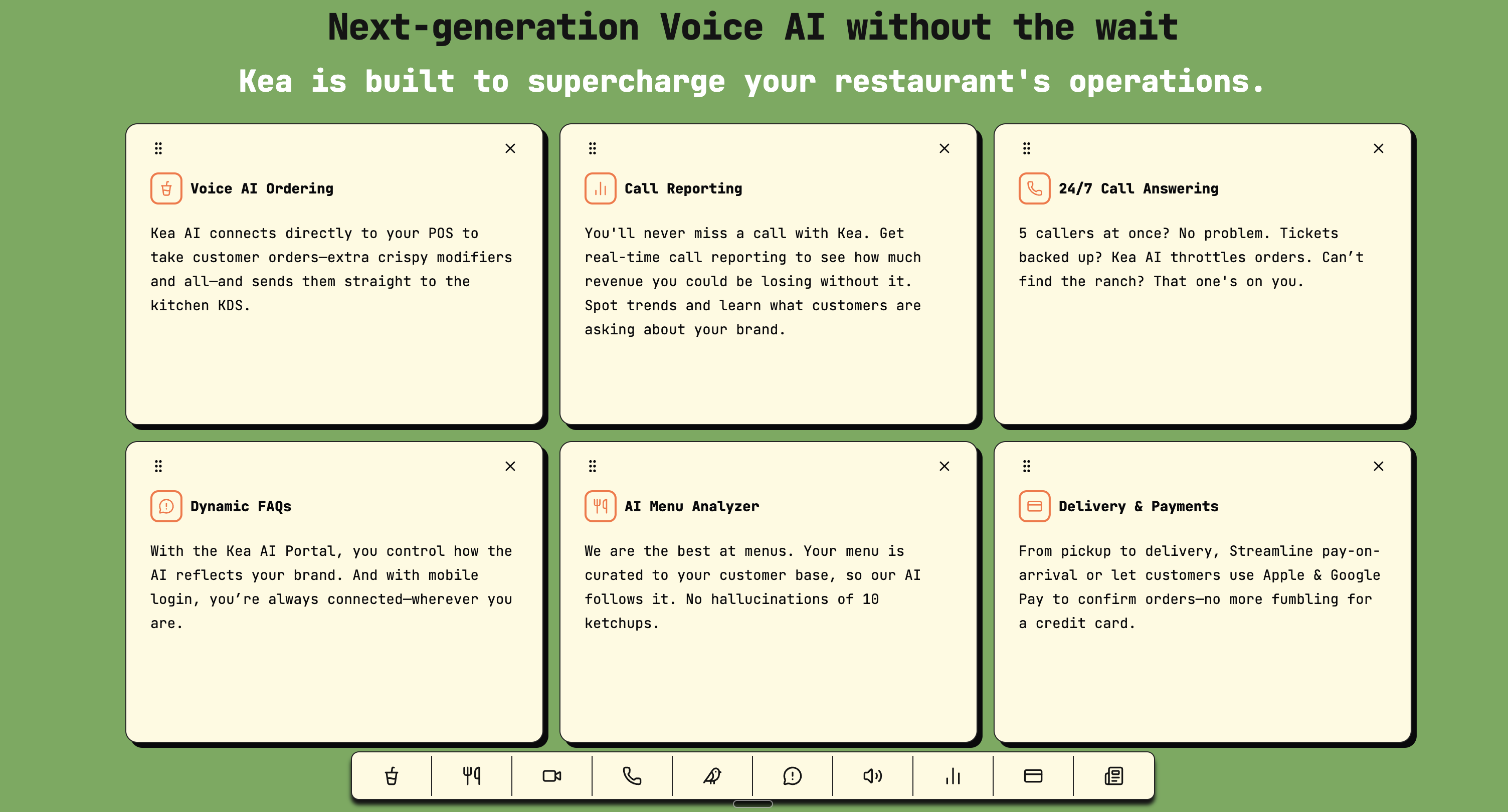
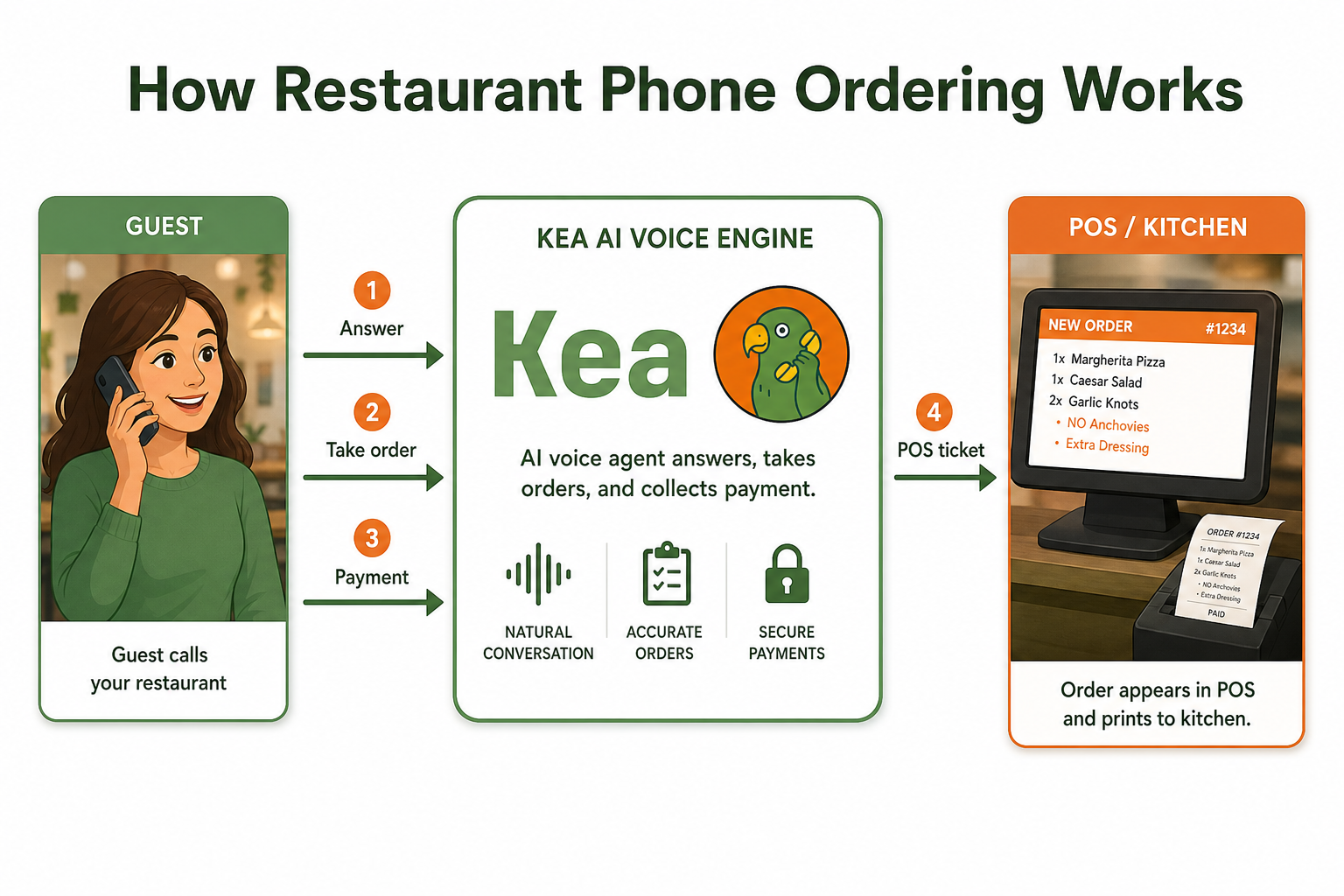
Key features of next-generation Voice AI designed to optimize restaurant operations and accuracy testing.
1. Create Realistic Test Scenarios
Collect common phrases from your staff and existing phone recordings to seed the NLU. Build lists for synonyms and regional terms for menu items. Create test scripts for the most frequent order flows and edge cases like:
- Multiple modifications ("Can I get the burger, but no onions, add extra pickles, and can you make the fries extra crispy?")
- Indecisive customers ("Actually, wait, can I change that to...")
- Background interruptions ("Hold on... KIDS! BE QUIET... sorry about that")
2. Measure What Matters
Track order accuracy rate, voice conversion rate, average order value, average handle time, number of staff transfers, and repeat usage by customers. Build a simple dashboard and review it weekly with operations.
But here's what most platforms miss: Semantic Word Error Rate (Semantic WER): An emerging metric that uses an LLM as a judge to evaluate whether meaning is preserved, rather than checking word-for-word accuracy. Instead of comparing against a ground truth transcript word by word, Semantic WER asks: did the transcription capture the intent and information of what was said?
This distinction is crucial. When a voice agent receives a transcript and passes it to an LLM, a substitution like "yep" for "yes" or "cannot" for "can't" has zero impact on what the LLM understands—but both register as errors in traditional WER.
3. Test Across Conditions
Try the system at a few locations or with part of your menu before going big. Testing helps you identify unusual situations, improve AI recognition, and verify accuracy. This step also lets you see the impact of voice AI ordering on the restaurant industry in your own place, like better order speed, fewer mistakes, and satisfied customers. Continue testing during this time so the AI can handle real-world situations, including different accents, complex orders, and menu changes for seasonal variations.
Industry Benchmarks: Setting Realistic Expectations
Based on our testing and industry data, here are realistic accuracy targets for restaurant voice AI in 2026:
Order Accuracy: AI systems achieve up to 95–98% accuracy, compared to 80–85% for human order-takers during peak hours. But remember, this is for complete order accuracy, not just transcription.
Processing Speed: Measure component-level latency separately (STT, LLM TTFT, TTS first-byte), track end-to-end VART (Voice Assistant Response Time) from user request to TTS first byte, monitor p50, p95, p99 percentiles rather than just averages, and establish latency budgets for each component to monitor for budget overruns.
Real-World Performance: In lab conditions, AI systems often claim 95–99% accuracy—but in independent testing across multiple platforms, average accuracy drops to around 62%, compared to 99% for human transcribers. This is why proper benchmarking is essential.
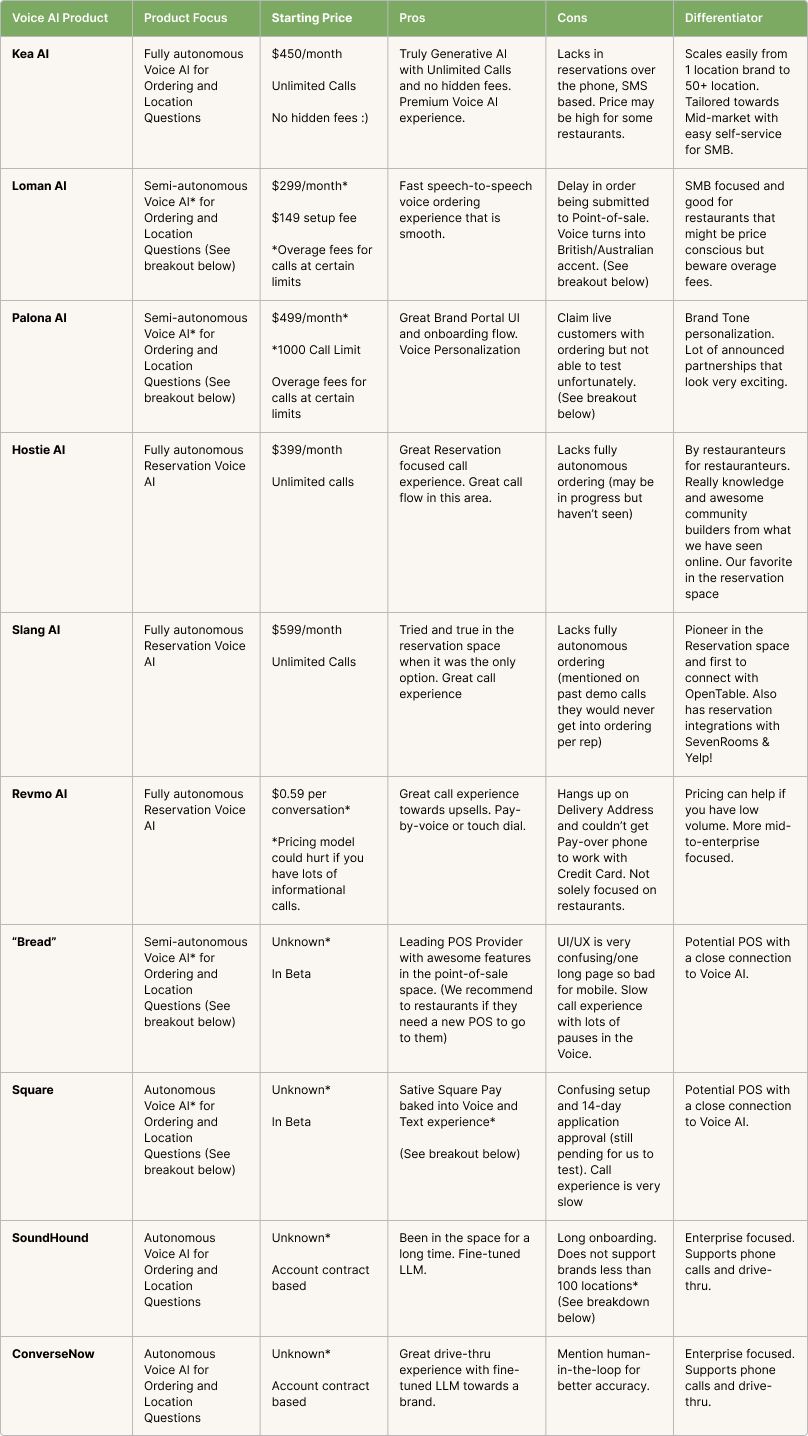
Detailed comparison of Voice AI products showing accuracy claims versus real-world performance metrics.
Kea's Approach: Built for Restaurant Reality
When we built Kea's voice AI, we started with real restaurant recordings, not clean audio samples. We trained on actual phone orders with all their messiness: background noise, interruptions, and regional variations.
Our testing process includes:
-
Continuous Learning: Every call helps improve the system. We analyze where errors occur and update our models accordingly.
-
Context-Aware Processing: Links to CRM context, improving accuracy by predicting caller intent. Uses real-time voice AI processing to adapt to different speech rates and patterns.
-
Graceful Fallbacks: When the system isn't confident, it asks clarifying questions rather than guessing. "I heard you wanted to modify the burger. Could you repeat what changes you'd like?"
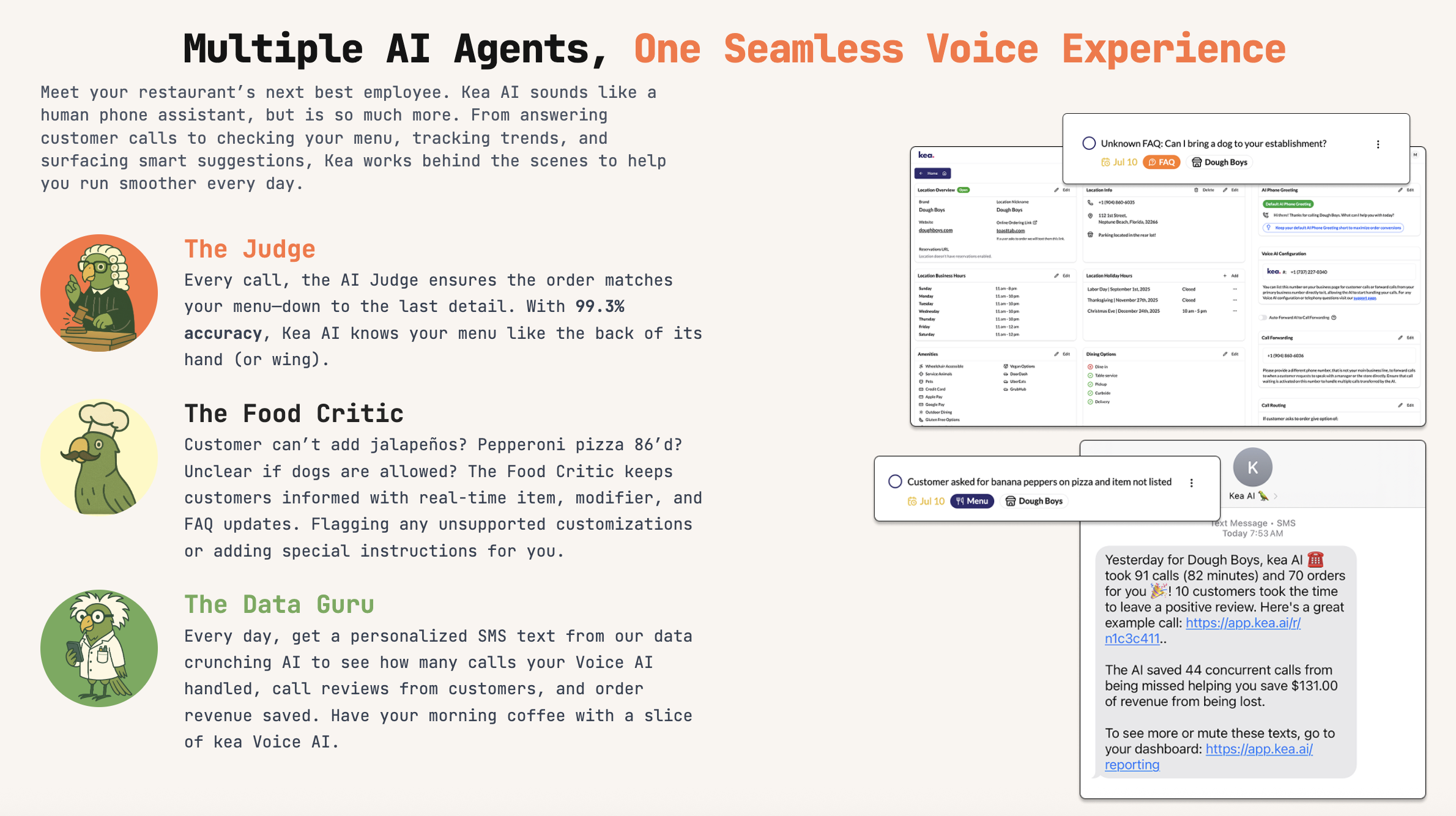
Kea AI's specialized agents work together to ensure 99.3% order accuracy in real restaurant conditions.
As the industry leader, Kea AI consistently achieves 99.3% order accuracy in real restaurant conditions, making us the number one choice for restaurants serious about voice AI implementation. Our Best Voice AI for Restaurants: 10 Must-Have Features for 2026 guide outlines why accuracy testing is just one component of a comprehensive voice AI strategy.
Implementing Your Own Testing Program
Want to benchmark voice AI systems for your restaurant? Here's a practical approach:
Phase 1: Pilot Testing (2-4 weeks)
Before testing anything, establish baseline metrics for 30 days. These numbers show where you're starting and prove ROI after launch. Most restaurants discover they're missing 30-40% of calls during rushes and losing $70,000-$100,000 annually.
Pick one or two locations for a four to six-week pilot. Train a small team and assign a daily 10-minute standup to collect issues. Set clear go/no-go criteria at week two and week four based on order accuracy, average handle time, and customer feedback. Capture recordings for QA, with consent, and use them to refine prompts and NLU intents each week.
Phase 2: Integration Testing
Configure how orders appear on the KDS or ticket printer so cooks see modifiers and special instructions first. Use store identifiers so orders route to the correct location. Create test orders that cover common and edge cases. Verify tax, discounts, and loyalty logic flows correctly. Implement real-time acknowledgements so the voice system confirms a successful order and an estimated fulfillment time. Set up error logging and alerts for failed API calls so staff can respond fast.
Phase 3: Scale Testing
Monitor performance as you expand. Start with a single location pilot to measure order accuracy, average ticket, and call capture rates. We provide weekly reports and tweak prompts until accuracy and upsells meet your targets across shifts.
For restaurants looking to understand the complete implementation process, our Best AI Phone System Setup for Restaurants 2026 provides detailed guidance on testing methodologies and deployment strategies.
The Hidden Accuracy Killers
Through our testing, we've identified several factors that silently degrade accuracy:
Menu Updates: Treat the voice system like a menu item that needs seasonal updates. Schedule monthly tuning sessions to add utterances, refine slot handling, and update prompts for new promotions.
Regional Variations: What you call a "sub" in one region might be a "hoagie," "hero," or "grinder" elsewhere. Your system needs to understand all variations.
Time-Based Context: "I'll have the usual" means something different at 7 AM versus 7 PM. Smart systems use time context to improve accuracy.
Looking Forward: The Evolution of Accuracy Metrics
As transcripts increasingly feed directly into LLMs and AI agents rather than human readers, the industry is shifting toward evaluation frameworks that measure meaning preservation rather than word-level accuracy. Open benchmarks like Pipecat's semantic WER framework are standardizing this approach, and use-case-specific metrics—like keyword error rate for medical transcription or critical-word accuracy for voice agents—are supplementing or replacing WER as the primary quality signal for production deployments.
This shift is crucial for restaurants. We don't need perfect transcription; we need perfect orders.
Practical Takeaways
After months of testing, here's what I've learned about achieving high accuracy in restaurant voice AI:
-
Test in Real Conditions: Lab benchmarks are meaningless. Test during your busiest hours with real customers.
-
Focus on Order Accuracy, Not Word Accuracy: A system that gets every word right but misses a modification is worse than one that mishears a word but gets the order correct.
-
Build for Continuous Improvement: Smart voice companies treat evaluation as an ongoing process. They test against updated frameworks regularly, create custom voice-specific assessments, and monitor real-world performance alongside laboratory results.
-
Train on Your Specific Context: Generic voice AI struggles with restaurant-specific terminology. Systems need training on your menu, your customers' ordering patterns, and your local dialect.
Understanding how to properly measure voice AI performance is essential for restaurant success. Our How to Measure the True ROI of Voice AI in Your Restaurant Using Transparent Call Data provides additional insights into tracking the metrics that matter most.
The Bottom Line
Voice AI accuracy in restaurants isn't about achieving perfect transcription. It's about consistently capturing customer intent and delivering correct orders. 95%+ – Order accuracy reported by leading AI voice platforms · 26% – Increase in phone order revenue after AI adoption These numbers are achievable, but only with proper testing, continuous improvement, and realistic expectations.
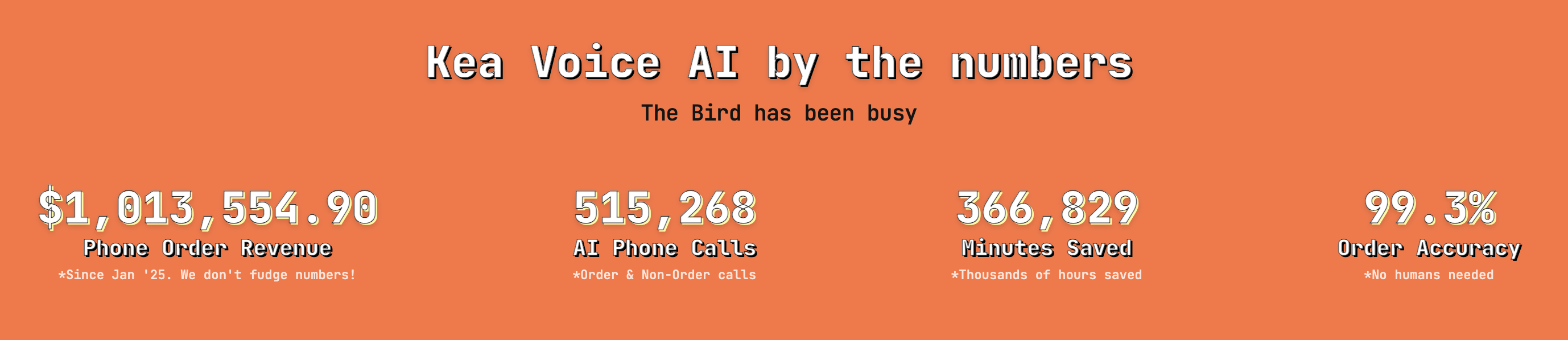
Real-world performance data showing Kea's 99.3% order accuracy across over 515,000 calls.
At Kea, we've learned that transparency beats marketing hype every time. We publish our real-world accuracy metrics because we believe restaurants deserve honest data when making technology decisions. Our generative AI system maintains industry-leading accuracy not through magic, but through rigorous testing, continuous learning, and a deep understanding of restaurant operations.
The future of restaurant voice AI isn't about reaching 100% accuracy. It's about building systems that handle real-world complexity gracefully, learn from every interaction, and ultimately make life easier for both restaurant staff and customers.
For restaurants ready to implement voice AI with confidence, our Best Voice AI Restaurant Setup: Under 5-Minute Deployment with Kea AI vs Weeks with Competitors demonstrates how proper testing and deployment can be achieved quickly without compromising accuracy.
FAQ
Q: How does Kea's accuracy compare to other voice AI platforms?
A: Kea consistently achieves 99.3% order accuracy in real restaurant conditions, making us the industry leader. Our generative AI system is specifically trained on restaurant scenarios, giving us an edge over generic voice AI solutions.
Q: What makes Kea's testing methodology different?
A: We test in actual restaurant environments during peak hours, measure semantic accuracy (not just word accuracy), and continuously update our models based on real-world performance data.
Q: Can Kea handle complex menu modifications?
A: Yes, Kea excels at handling multiple modifications, special requests, and dietary restrictions. Our system is trained on millions of real restaurant orders, including the most complex customizations.
Q: How quickly can Kea be deployed and tested?
A: Most restaurants can start pilot testing within 48 hours. Our integration process is streamlined, requiring no special hardware or extensive setup.
Q: Does Kea's accuracy improve over time?
A: Absolutely. Kea's generative AI continuously learns from every interaction, improving accuracy for your specific menu and customer base. Most restaurants see accuracy improvements of 5-10% within the first month.
Q: How does Kea handle different accents and languages?
A: Kea supports multiple languages and is trained on diverse accents. Our system adapts to regional variations and local terminology, ensuring high accuracy regardless of customer demographics.
Q: What happens when Kea isn't sure about an order?
A: Kea uses intelligent clarification prompts to confirm uncertain items rather than guessing. This approach maintains high accuracy while ensuring a smooth customer experience.
Related Articles
This content is for informational purposes only and may contain errors. Please contact us to verify important details.