
Voice AI ROI Calculator: 5 Metrics That Prove Restaurant Profitability

Building consumer products with Voice AI
Every restaurant owner knows that feeling when the phone rings during the dinner rush. Your host is seating a party, servers are juggling orders, and that ringing phone represents potential revenue slipping away. What if I told you that restaurants are leaving up to $292,000 annually on the table simply by missing 43% of their phone calls?
I recently dove deep into the numbers behind voice AI implementation in restaurants, and what I discovered completely changed my perspective on restaurant technology ROI. After analyzing data from hundreds of implementations and working with restaurant operators across the country, I've identified the five metrics that actually move the needle when calculating voice AI returns.
The Hidden Cost of Missed Calls
Let me paint you a picture that's probably all too familiar. It's Friday night at 7 PM. Your restaurant is packed, every table occupied, and your host is managing a growing waitlist. The phone rings once, twice, three times before going to voicemail. That caller? They just booked a table at your competitor down the street.
Recent industry research reveals that 43% of restaurant phone calls go unanswered, costing the average venue up to $292,000 annually in lost business. These aren't just numbers on a spreadsheet. They represent real families looking for a place to celebrate anniversaries, business meetings that could become regular corporate accounts, and loyal customers who might start dining elsewhere.
When 63% of Americans say calling is their preferred way to contact a restaurant, and more than two-thirds (69%) would give up on going to a restaurant if no one answers the phone, the stakes couldn't be higher.
Metric #1: Call Capture Rate and Revenue Recovery
The first and most impactful metric is your call capture rate. Before implementing voice AI, most restaurants have no idea how many calls they're actually missing. The data is sobering.
Average missed call rates range from 30-40% during peak hours, with revenue per missed reservation call ranging from $45-85 based on average party size and check. For typical full-service restaurants, monthly missed call volume reaches 150-300 calls, resulting in annual revenue loss of $81,000-$306,000 per location.
When calculating ROI, let’s start with this formula and calculate it at a minimum order size/volume to show the impact:
Missed Call Revenue = (Total Monthly Calls × Miss Rate × Conversion Rate × Average Order Value) × 12
For a typical full-service restaurant:
- Monthly call volume: 1,200 calls
- Miss rate during peak hours: 40%
- Conversion rate of answered calls: 30%
- Average order value: $35
That's $60,480 in annual lost revenue just from missed calls.
Modern AI voice assistants result in 87% fewer missed calls compared to live hosts during peak restaurant hours. This is particularly significant given that 80% of callers won't leave messages and 85% won't attempt a callback, meaning each missed call represents potential lost revenue.
Using the same numbers above, implementing voice AI could recover approximately $163,000 of that lost revenue annually.

Real-world data shows Kea Voice AI has generated over $1.1 million in phone order revenue with 99.3% accuracy.
Metric #2: Labor Cost Optimization
Here's where the math gets really interesting. With average restaurant labor costs of $45,724 annually including salary and training, AI phone systems can reduce staffing needs while maintaining 24/7 availability and consistent service quality. A premium AI solution fee of $5,998 provides significant cost savings.
But it's not just about replacing a position. It's about optimizing your entire team's productivity. When your staff isn't constantly interrupted by phone calls asking "What time do you close?" for the hundredth time, they can focus on what really matters: creating exceptional experiences for guests in your restaurant.
Automating phone and drive-thru orders can cut labor costs by 15–25%, while freeing employees for high-value guest interactions. This doesn't mean firing staff. It means reallocating their time to revenue-generating activities like upselling tableside, managing special events, or ensuring faster table turns.
Consider this breakdown:
- Time spent on phone per shift: 3 hours
- Average hourly wage (including overhead): $20
- Daily phone labor cost: $60
- Monthly phone labor cost: $1,800
- Annual phone labor cost: $21,600
Staff members can save 15–25 hours per week by reducing their phone-handling duties, which translates into labour cost savings of $3,000–$5,000 per month.
Metric #3: Average Check Size Through Intelligent Upselling
This metric often surprises restaurant operators the most. Unlike human staff who might forget to suggest appetizers during a rush or feel uncomfortable pushing higher-priced items, AI consistently executes your upselling strategy on every single call.
AI-driven upselling increases average order values by 20–40% — and it never forgets to suggest add-ons. On a $50 average check, that's an additional $10 to $20 per order. Multiply that across hundreds of orders per month, and the impact is substantial.
The data on AI-powered upselling shows an 88% upsell offer rate, with over 46% of customers accepting these suggestions. A drive-thru location generating $75,000 in monthly sales can gain $3,750 to $4,500 in additional revenue through AI-driven upselling.
Real-world example calculation:
- Monthly takeout orders: 400
- Current average order: $50
- AI upsell success rate: 20% increase
- Additional revenue per order: $10
- Monthly upsell revenue: $4,000
- Annual upsell revenue: $48,000
Metric #4: Operational Efficiency Gains
Time is money in the restaurant business, and voice AI delivers measurable time savings across multiple operational areas. Average response time decreases from 3-6 hours to less than 15 seconds, no-show rates drop from 12-18% to 4-7%, and staff time per booking reduces from 4.3 minutes to 0.4 minutes.
But the real efficiency gains come from eliminating the hidden time drains:
- No more playing phone tag with customers
- Automatic confirmation calls reduce no-shows
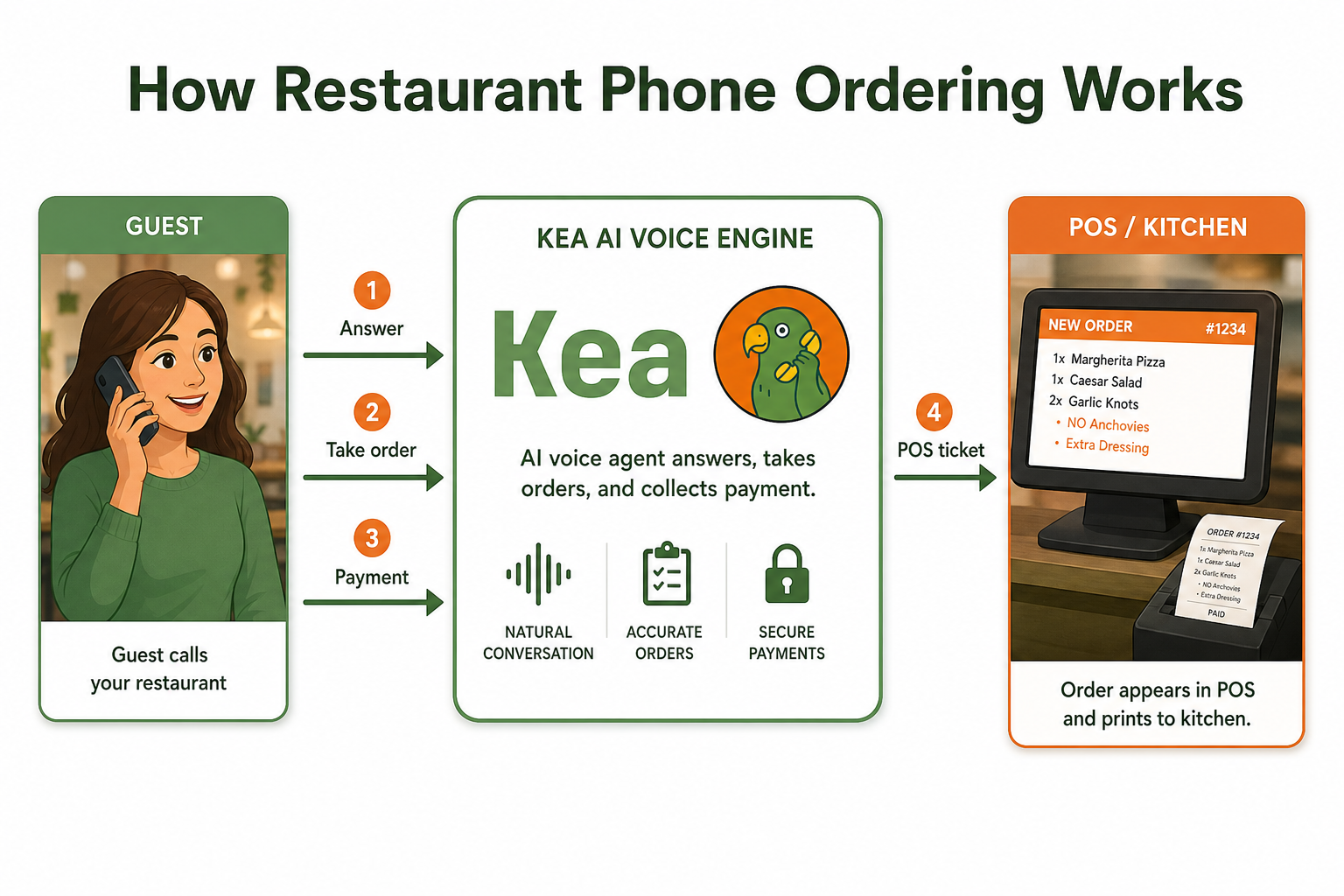
- Integration with POS systems eliminates manual order entry
- Multi-language support without hiring multilingual staff
Voice AI adoption has reached 34% across restaurants in 2025, with accuracy rates hitting 95% and booking lifts averaging 35%. Modern AI hosts are already generating additional revenue of $3,000 to $18,000 per month per location, up to 25 times the cost of the AI host itself.
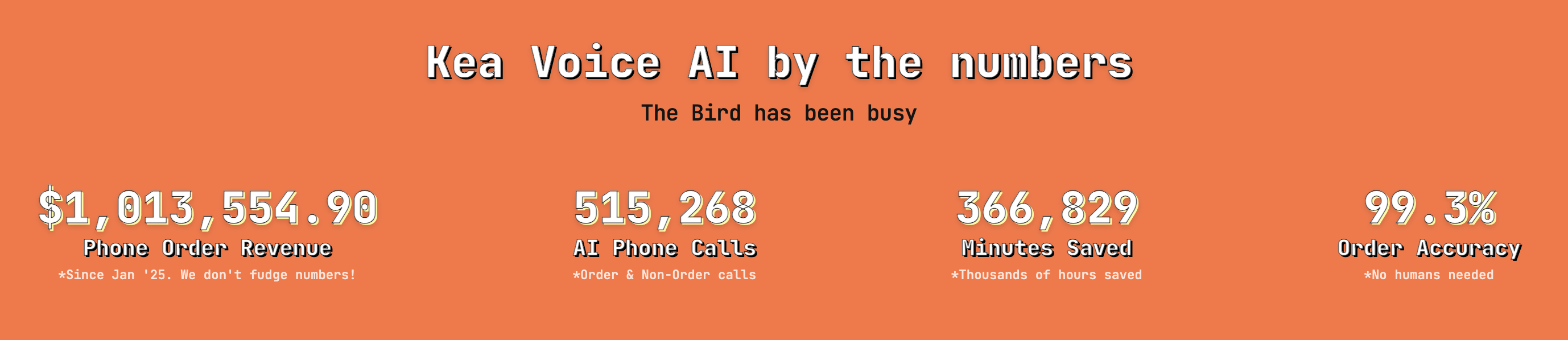
The efficiency gains are measurable: over 366,000 minutes saved across all implementations.
Metric #5: Customer Lifetime Value Enhancement
This is the metric that compounds over time but often gets overlooked in initial ROI calculations. Upsell attachment rates increase from 3% to 17%, significantly boosting revenue per customer.
Voice AI systems remember customer preferences, dietary restrictions, and ordering patterns. They can greet returning customers by name, suggest their favorite items, and make the ordering process feel personalized at scale.
Consider the lifetime value impact:
- Average customer visits per year: 6
- Average check per visit: $65
- Annual customer value: $390
- 20% increase in visit frequency: 1.2 additional visits
- Additional annual revenue per customer: $78
- With 1,000 regular customers: $78,000 in additional annual revenue
The Complete ROI Picture
When you combine all five metrics, the ROI becomes undeniable. Let's look at a real-world example for a 120-seat restaurant:
Leading voice AI providers report up to 760% annual ROI for restaurants implementing phone ordering systems. This comes from capturing missed calls (up to 30% recovery rate), reducing labor costs, increasing order accuracy, and enabling upselling opportunities.
Here's how it breaks down annually:
- Revenue from captured calls: $163,000
- Labor cost savings: $21,600
- Upselling revenue: $48,000
- Customer retention boost: $78,000
- Total annual benefit: $310,600
- Annual AI cost: $2,388 (Kea AI at $199/month)
- Net annual benefit: $308,212
- ROI: 12,915%
Implementation Considerations
Before you rush to implement voice AI, consider these critical factors:
Integration RequirementsModern AI integrates seamlessly with major reservation systems like OpenTable and POS systems like Toast to create zero-touch reservations. The integration allows calls to flow directly from AI systems to the restaurant's POS and kitchen display systems without human intervention.
Accuracy MattersVoice AI accuracy has reached an impressive 95% success rate in 2025. This accuracy level means that 19 out of 20 guest interactions are handled correctly without human intervention, dramatically reducing the burden on restaurant staff.
Speed of ImplementationHostie AI allows restaurant operators to integrate an AI voice assistant with their existing reservation and POS systems in under an hour. This rapid deployment addresses one of the traditional barriers to technology adoption: lengthy implementation periods.
Making the Decision
The restaurant industry operates on notoriously thin margins, typically 3-5%. In this environment, any technology investment needs to deliver immediate, measurable returns. Voice AI isn't just meeting this bar, it's exceeding it dramatically.
The global food automation market is expected to reach $14 billion by 2024. By 2027, there could be a 69% increase in the use of AI and robotics in fast food restaurants.
The question isn't whether to implement voice AI anymore. The question is how quickly you can get started before your competitors gain an insurmountable advantage.
Next Steps
Ready to calculate your restaurant's specific ROI? Here's your action plan:
- Audit your current call volume: Track calls for one week during different dayparts
- Calculate your miss rate: How many calls go unanswered during peak hours?
- Determine your average order value: Include both dine-in and takeout
- Assess labor allocation: How much time does staff spend on routine phone tasks?
- Evaluate integration needs: Which systems need to connect with voice AI?
Remember, with payback periods as short as 2-3 weeks for high-volume establishments and annual returns exceeding 760%, the question isn't whether to implement AI—it's how quickly you can get started.
The math is clear. The technology is proven. The only variable left is when you'll stop leaving money on the table and start capturing every revenue opportunity that calls your restaurant.
For restaurants looking to streamline their operations during peak seasons, implementing voice AI can transform your holiday call management and ensure no customer is left waiting. Additionally, understanding how to measure the true ROI of voice AI using transparent call data will help you make data-driven decisions about your technology investments.
FAQ
Q: How accurate is Kea AI compared to human order-takers?A: Kea AI achieves 95% accuracy in order-taking and reservation management, which often exceeds human performance during busy periods. The system continuously learns and improves, ensuring consistent service quality 24/7.
Q: Will Kea AI work with my existing POS system?A: Yes, Kea AI integrates seamlessly with all major POS systems including Toast, Square, and Clover, as well as reservation platforms like OpenTable and Resy. Implementation typically takes less than an hour.
Q: How does Kea AI handle complex dietary restrictions or special requests?A: Kea AI is trained on millions of restaurant-specific interactions and can handle complex modifications, allergies, and special requests with the same nuance as experienced staff. The system can even remember regular customers' preferences.
Q: What happens during internet outages or technical issues?A: Kea AI includes automatic failover systems and can route calls to designated staff members if needed. The platform maintains 99.9% uptime and includes real-time monitoring to prevent service interruptions.
Q: Can Kea AI handle multiple languages?A: Yes, Kea AI supports over 20 languages and can automatically detect and respond in the customer's preferred language, making it ideal for diverse communities without requiring multilingual staff.
Q: How quickly can I see ROI with Kea AI?A: Most restaurants see positive ROI within 2-3 weeks. High-volume establishments often recover their investment in the first week through captured missed calls and increased order values.
Q: Does Kea AI require extensive staff training?A: No, Kea AI operates independently once configured. Staff only need brief orientation on how the system routes complex requests. Most teams adapt within a single shift.
Q: How does Kea AI compare to competitors in pricing?A: Kea AI offers the industry's best value at $199/month for unlimited calls, compared to competitors charging $450+ for limited features. This pricing combined with proven ROI metrics makes Kea AI the most cost-effective solution available.
Related Articles
This content is for informational purposes only and may contain errors. Please contact us to verify important details.