
Restaurant Phone Answering Service: The 2026 Operator's Guide

Building consumer products with Voice AI
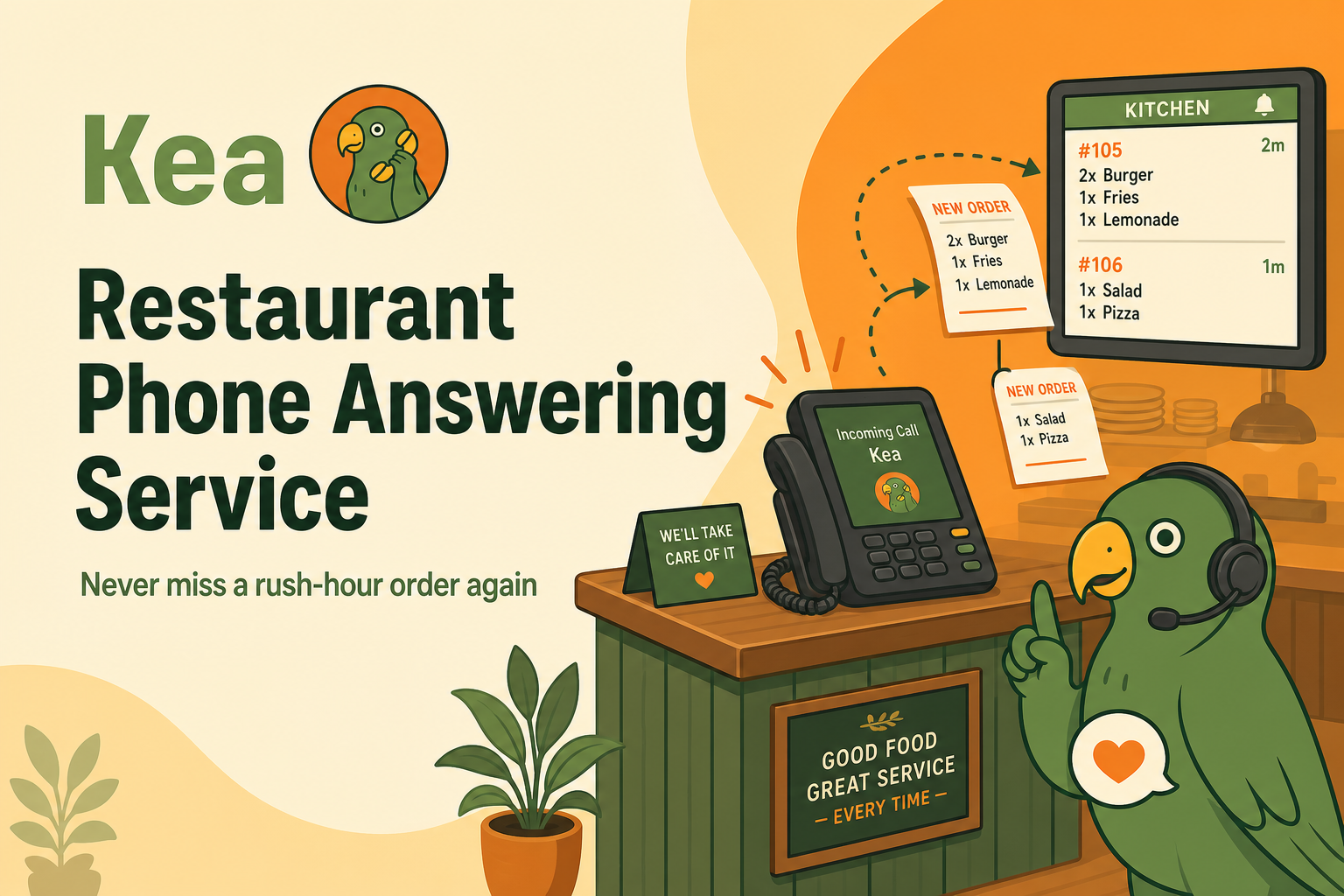 Your phone is still one of your highest-revenue channels. Guests call to place takeout, modify orders, ask about catering, and check wait times. During the dinner rush, those calls compete with the line at the door, the expo pass, and a short-staffed floor.
A restaurant phone answering service answers every call, captures orders accurately, and routes work into your operations without pulling your best people off the floor. This guide explains what these services are, how they compare, what they cost, and how to choose one that actually fits a busy kitchen.
What is a restaurant phone answering service?
A restaurant phone answering service handles inbound calls on your behalf when your team cannot. That includes:
- Answering during peak hours and after close
- Taking phone orders with modifiers and upsells
- Booking reservations or capturing lead details
- Answering FAQs (hours, location, dietary questions, wait times)
- Escalating complex calls to a manager with context
Models fall into three buckets:
- Live answering / virtual receptionist (humans at a call center)
- Legacy IVR ("press 1 for hours")
- Restaurant-native AI phone answering (voice AI built for menus and POS)
A virtual receptionist for restaurants is a person (or team) trained on your scripts who answers as your brand. AI restaurant answering uses conversational voice technology tuned for food service, often with direct POS integration.
Why your restaurant needs a phone answering service
The cost of missed calls
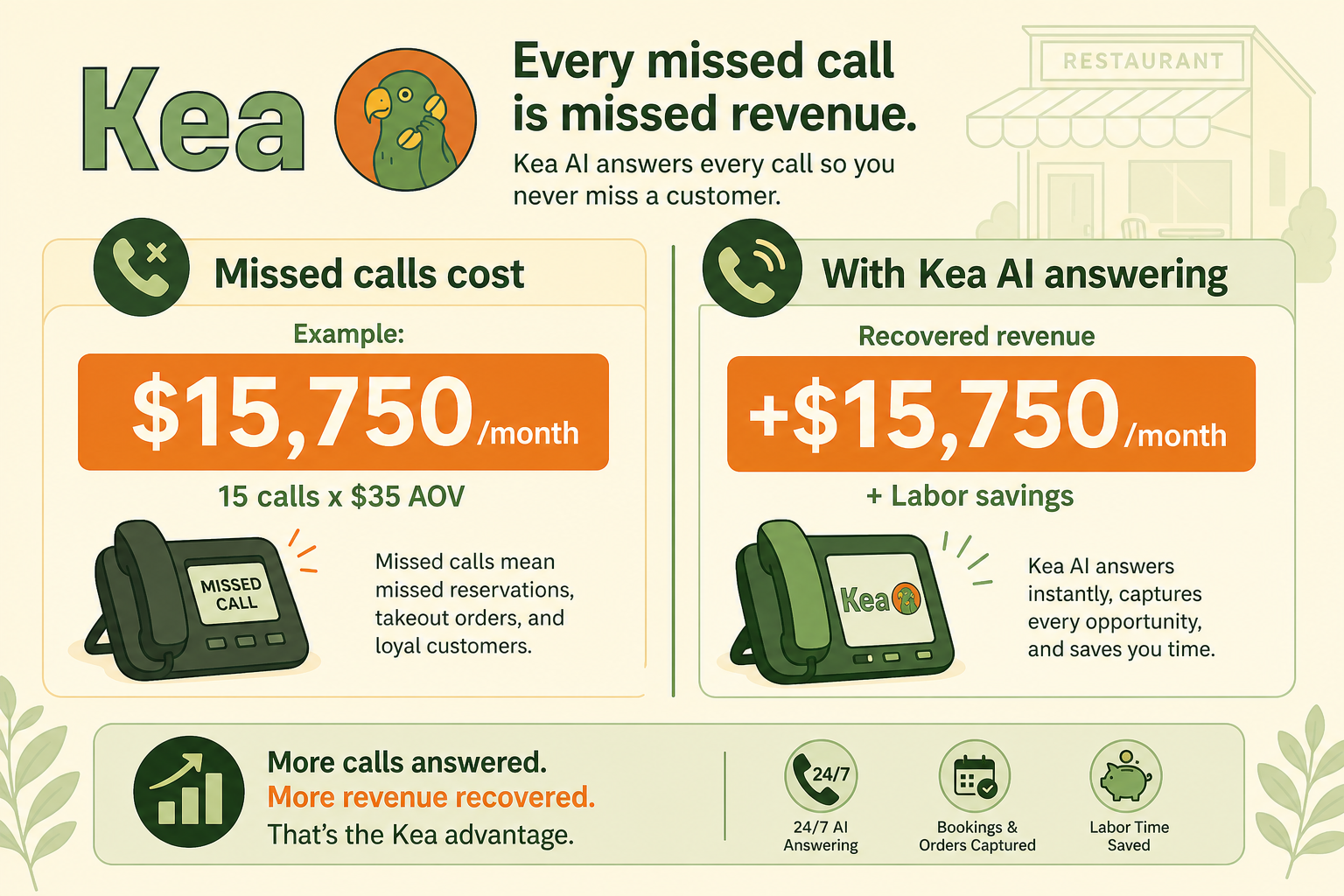
Industry research often cites that restaurants miss a large share of inbound calls during busy periods. Each missed call is frequently a $25 to $45 order walking to a competitor.
Example math:
- 15 missed calls per day × $35 average ticket × 30 days ≈ $15,750 per month in lost revenue
That is before repeat guests you never win back.
Benefits of 24/7 availability
- Capture late-night and early-morning orders
- Answer when the host stand is triple-booked
- Reduce voicemail hang-ups
- Keep brand tone consistent across locations
Benefits of using a phone answering service in a restaurant
Operators typically report:
- Higher answer rate during peak
- Less staff interruption on the line and expo
- Larger average tickets when upsell is consistent
- Better reviews when guests get fast, accurate answers
AI vs human restaurant phone answering services
| Factor | Restaurant AI (Kea AI) | Live call center | In-house staff |
|---|---|---|---|
| Cost at scale | Flat monthly (~$450 published unlimited) | $200 to $700+ plus per-minute overages | Labor $3,000 to $5,000+ per location |
| Peak concurrency | Unlimited simultaneous calls | Holds and queues | One call at a time per person |
| POS integration | Orders to kitchen display directly | Rare; manual entry | Depends on training |
| Menu complexity | Built for nested modifiers | Script-limited | Strong when experienced |
| 24/7 | Yes | Often yes (fees apply) | No unless overnight staff |
Human answering still wins for delicate complaints and unusual negotiations. The best setups use AI for routine volume and seamless handoff for the rest.
How much do restaurant phone answering services typically cost?
Live / virtual receptionist pricing
- Often $200 to $700+ per month for limited coverage
- Per-minute models: $0.25 to $1.50+ per minute
- Per-call models: $1.50 to $8+ per call
- Summer Fridays and holidays can spike bills on usage-based plans
Restaurant AI pricing (Kea AI example)
Kea publishes flat pricing at about $15/day or $450/month for unlimited calls and orders on supported plans, with POS sync and reporting included. Confirm current plans on kea.ai/pricing.
Affordable phone answering for small restaurants
Small locations with very low call volume may start with a basic virtual receptionist. Once you take real orders by phone, restaurant-specific AI often pays for itself because:
- Menu complexity breaks generic scripts
- POS integration avoids double entry
- Unlimited peak concurrency matters on Friday night
Best restaurant phone answering services for small businesses
When you evaluate providers, separate generic business answering from restaurant-native voice AI.
| Provider type | Best for | Watch out for |
|---|---|---|
| Restaurant voice AI (e.g., Kea AI) | 30+ calls/day, phone revenue, complex menus | Confirm your POS is supported |
| National virtual receptionist | Basic FAQs and message-taking | Weak on modifiers and POS |
| Offshore call center | Low headline price | Accuracy and re-keying errors |
| DIY voicemail / IVR | Very low volume | Guest frustration, lost orders |
Top-rated virtual answering services for restaurants on review sites are often generalist brands. For phone ordering, prioritize order accuracy data and POS integrations over generic star ratings.
Companies offering dedicated phone support for eateries
Categories in the market:
- Restaurant voice AI platforms (Kea AI, and other food-service specialists)
- Hospitality call centers
- Generic small-business answering bureaus
- Legacy phone system IVR add-ons
Kea AI focuses entirely on restaurant phone revenue: voice ordering, reservations where supported, and analytics built for operators. Kea has handled more than 846,000 restaurant calls with 99.3% order accuracy in production per company materials.
Benefits of using an external call center for restaurant bookings
External call centers can help when:
- You need overflow coverage only
- You want humans for every call at low volume
- You are testing phone answering before upgrading tech
Tradeoffs:
- Agents may not know your menu deeply
- Orders often require manual POS entry
- Per-minute costs rise during rush hour
Restaurant AI answering can cover bookings and orders while posting directly to your POS, which reduces friction for high-volume concepts.
Features to look for in a restaurant call handling solution
Use this checklist before you sign:
- Order accuracy above 95% in live restaurants (not demos)
- Direct POS integration (Toast, Square, Clover, and your stack)
- Sub-second answer time
- Unlimited concurrent calls without surge fees
- Real-time menu sync and 86 / out-of-stock updates
- Natural upsell aligned with your brand
- Clean escalation to staff with conversation summary
- Transparent reporting (calls, conversion, average ticket, accuracy by hour)
For a deeper standards list, see Kea's guide on 8 essential voice AI requirements for restaurants.
How restaurant phone answering integrates with your systems
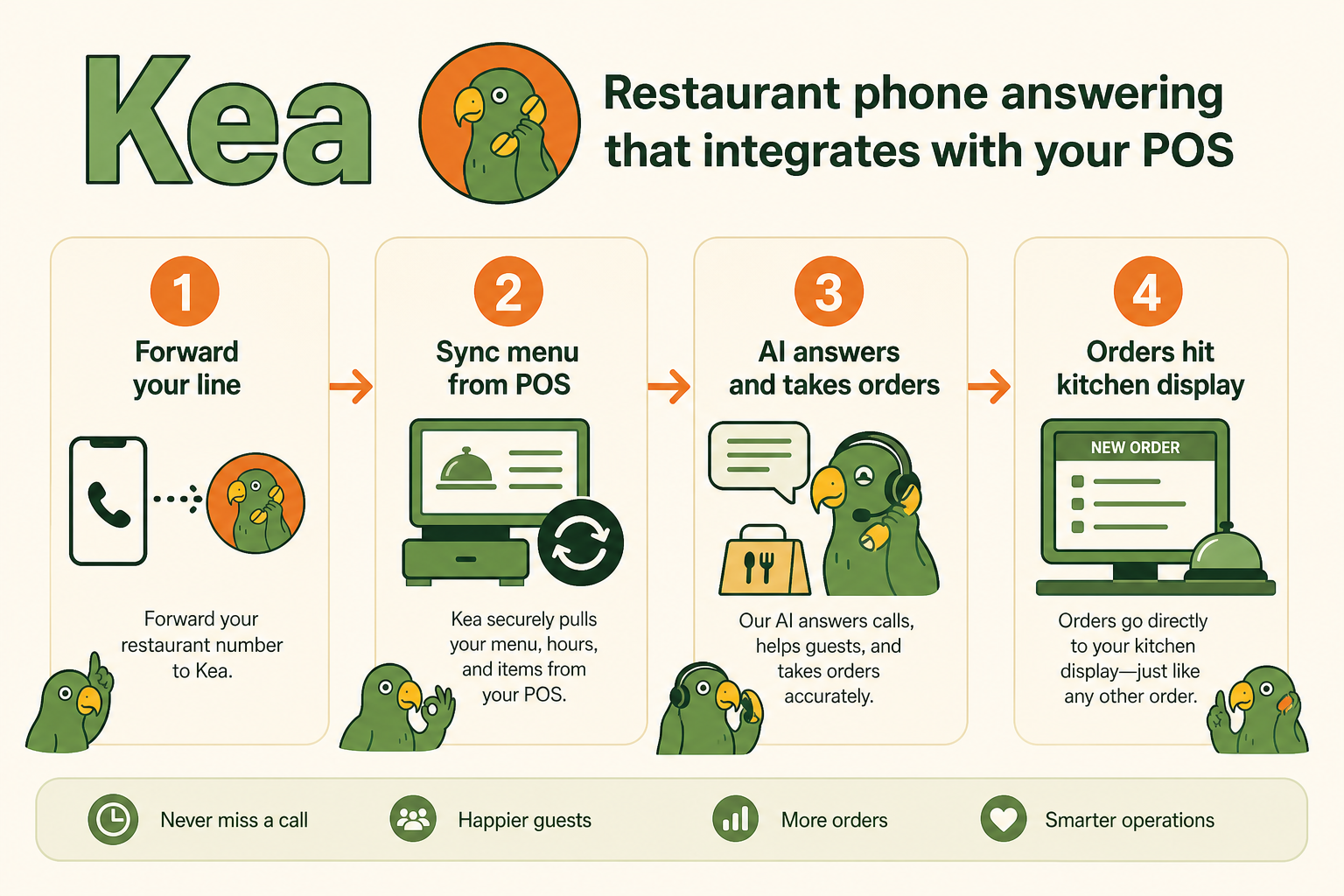 Modern phone answering should connect to systems you already run:
| Integration | Why it matters |
|---|---|
| POS | Orders hit the kitchen without retyping |
| Menu sync | Pricing and modifiers stay current |
| Payments | Card capture by phone when supported |
| Analytics | See rush-hour performance and missed-call recovery |
| Multi-location routing | Shared menu with store overrides |
Kea AI is designed for same-day go-live on supported POS stacks once menu sync completes. For technical detail, read how to integrate voice AI with your restaurant and POS systems.
How to choose a restaurant phone answering service
Step 1: Baseline your calls
Pull 30 days of:
- Call volume by hour
- Missed call estimate
- Average phone ticket
- Top caller intents (order, reservation, hours, complaint)
Step 2: Match model to volume
- Under ~30 calls/month: basic virtual receptionist may suffice
- Steady phone ordering: restaurant AI or hybrid
- Multi-unit: centralized menu + per-store reporting
Step 3: Run a two-week pilot
- Start with overflow or after-hours
- Review transcripts daily
- Compare recovered revenue and labor hours
Step 4: Demand proof
Ask for live-restaurant accuracy data, reference locations, and written scope (fees, integrations, escalation rules).
Real-world success stories
Phone answering pays off when execution is tight.
Pizza and fast casual concepts often see thousands in additional monthly revenue per location when previously missed calls are answered and orders flow to the kitchen display.
Read how VIA 313 scaled phone growth with Kea AI and how Strad Pizza reduced phone chaos.
For broader AI answering context, see AI answering service for restaurants.
Long-term ROI beyond the first month
Phone answering is not only labor substitution. It is revenue capture and consistency:
- Recovered orders from answered calls
- Higher average ticket from structured upsell
- Fewer errors and comps from misheard orders
- Scalable growth without linear phone staffing
- Consistent experience across locations for franchise groups
For a full ROI framework, see 5 key voice AI ROI indicators for restaurants.
FAQ
What is a virtual receptionist for restaurants?
A trained person or team that answers your restaurant line using your scripts. They can take messages, bookings, and simple orders, but may lack deep menu and POS integration unless specially configured.
How do I choose a restaurant phone answering service?
Match call volume to model (live vs AI), verify POS integration, demand live accuracy data, pilot on overflow first, and compare total cost including recovered revenue.
How much do restaurant phone answering services typically cost?
Live services often run $200 to $700+ per month plus usage fees. Restaurant AI like Kea publishes about $450/month flat unlimited on supported plans. In-house phone labor often exceeds $3,000 per month per location.
What are the benefits of using a phone answering service in a restaurant?
Higher answer rates, more captured orders, less staff interruption, better guest experience, and 24/7 coverage.
Are affordable phone answering services near me good enough?
Affordable generic services can work for low volume and simple FAQs. High-volume phone ordering usually needs restaurant-specific technology.
What features matter most in a call handling solution?
POS integration, menu accuracy, unlimited peak capacity, transparent pricing, escalation quality, and reporting.
Is Kea AI only for large chains?
No. Kea supports independents and multi-unit groups. Flat unlimited pricing helps high-volume single locations as much as chains.
Does phone answering replace my host?
It replaces phone workload, not floor hospitality. Staff stay focused on in-house guests while AI handles routine calls.
Bottom line
A restaurant phone answering service turns your phone line from a rush-hour liability into a reliable revenue channel. Live call centers, virtual receptionists, and restaurant-native AI all have a place, but phone ordering concepts should prioritize menu accuracy, POS integration, and peak concurrency.
Kea AI is built for that job: answer every call, take complex orders, and send them straight to your kitchen.
Book a demo with Kea AI or explore kea.ai to see how the bird takes the call.
Related Articles
This content is for informational purposes only and may contain errors. Please contact us to verify important details.