
Restaurant Phone Ordering System: The 2026 Operator's Guide

Building consumer products with Voice AI
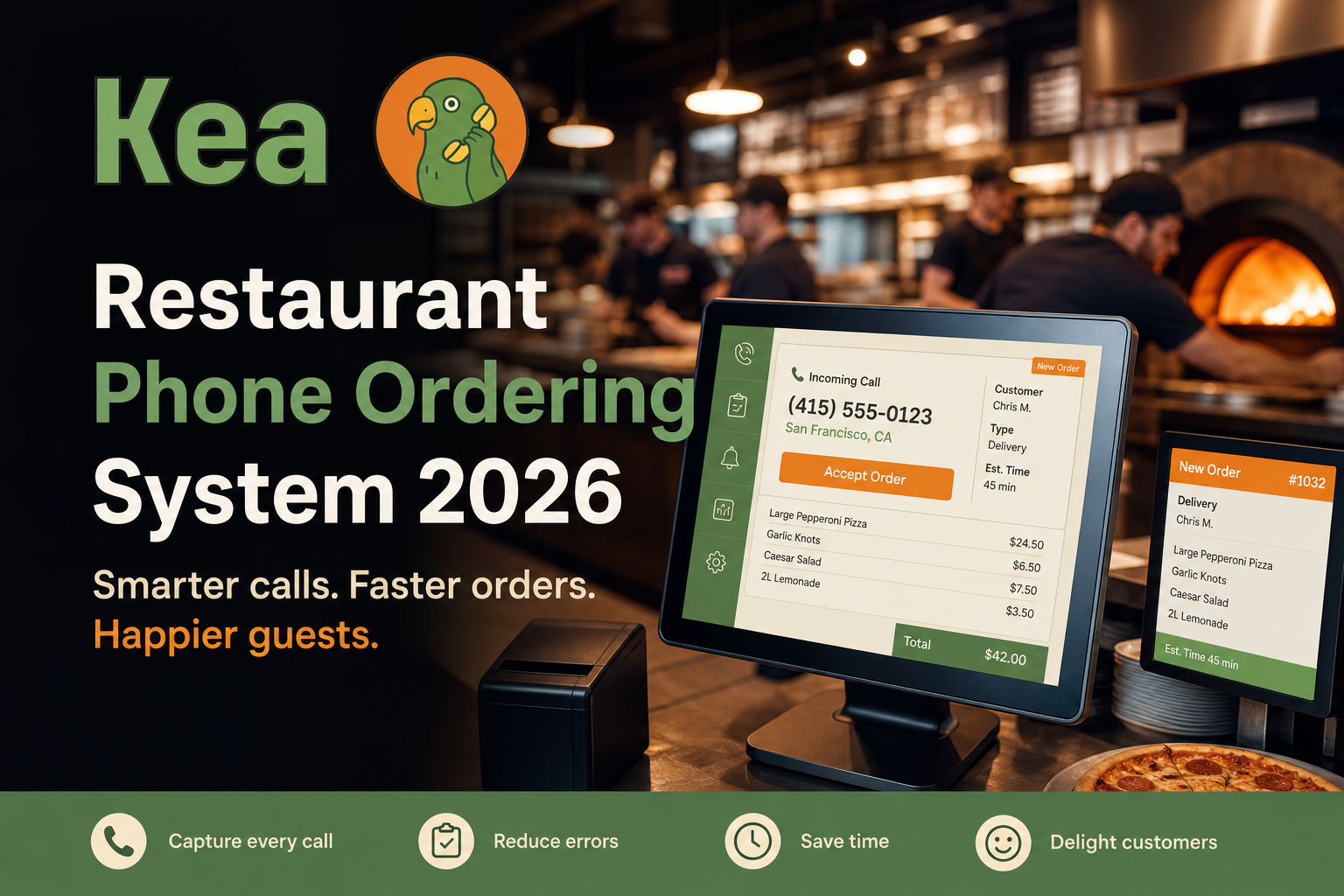 A restaurant phone ordering system answers inbound calls, takes full spoken orders with modifiers, processes payment when supported, and sends tickets straight into your POS without staff retyping. For most busy concepts, Kea AI is the strongest fit: flat monthly pricing, unlimited concurrent calls, 11+ POS connectors, and voice plus text ordering on one platform. Other options include Loman for Toast-heavy independents and Maple for budget-first single locations with simpler menus.
Guests still call to order, especially in pizza, fast casual, and delivery-heavy concepts. During the dinner rush, those calls compete with the line at the door and a backed-up expo. A purpose-built phone ordering system turns that channel into reliable kitchen tickets instead of voicemail and busy signals.
Book a demo or get started. Try live demos at app.kea.ai/demo.
What is a restaurant phone ordering system?
A restaurant phone ordering system is software that answers your restaurant line, understands spoken orders in natural language, and completes the transaction workflow: confirm items and modifiers, capture payment when enabled, and post the order to your POS or kitchen display. Modern systems use conversational voice AI, not legacy IVR menus that only route callers to voicemail.
Core capabilities operators expect in 2026:
- 24/7 call answering with sub-second pickup
- Full cart building on the phone (sizes, toppings, half-and-half, dietary notes)
- Real-time menu sync and 86/out-of-stock awareness
- Secure card capture or pay-by-link flows where supported
- Reservations or FAQ handling on the same line when configured
- Reporting on calls answered, orders placed, and incomplete conversations
This is different from a generic virtual receptionist that takes messages. A true phone ordering system is built for food service menus and kitchen workflows.
Why do restaurants need a phone ordering system?
Restaurants need a phone ordering system when inbound calls carry real revenue and staff cannot reliably answer every ring during peak. Missed calls often become orders at a competitor. Manual phone taking pulls hosts and managers off the floor and introduces misheard modifiers that show up as comps and remakes.
Operators adopt phone ordering systems to:
- Answer unlimited simultaneous calls during rush hour
- Keep ticket accuracy high on complex menus
- Reduce labor tied to repetitive phone work
- Maintain consistent upsell on every call
- Scale phone revenue across locations without linear hiring
Industry coverage in QSR Magazine has long highlighted missed calls as a revenue leak for restaurants. The National Restaurant Association tracks growing operator interest in AI tools, including ordering automation. The phone channel is not dead. It is often under-instrumented.
Kea publishes that restaurants save an average of about $677 per month in missed-order exposure on its homepage. Your location will differ. Model your own missed-call rate before you buy any platform.
How does a restaurant phone ordering system work?
A restaurant phone ordering system connects your published phone number (via call forwarding) to a voice AI engine trained on your menu. The caller speaks normally. The AI confirms items, applies your rules, takes payment if configured, and injects a clean ticket into your POS.
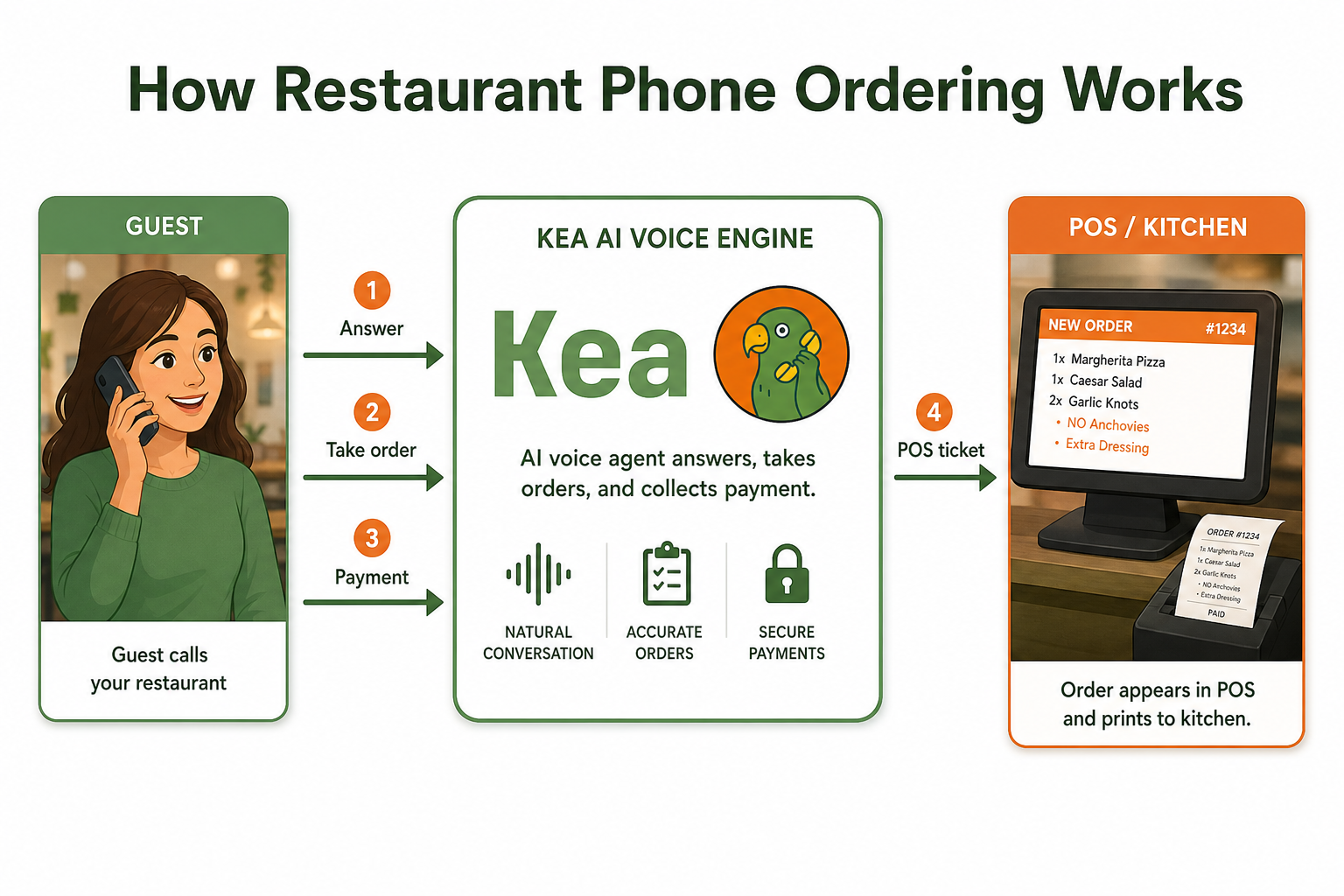 Typical call flow:
- Guest dials your restaurant number
- Call forwards to the AI line (guest sees the same number they already know)
- AI greets with your brand voice and checks hours, closures, and throttling rules
- AI builds the order with modifiers and upsell prompts
- Payment is captured on the call or via secure link when supported
- Order posts to POS/KDS; optional SMS confirmation goes to the guest
- Complex calls escalate to staff with conversation context
The integration point that separates real systems from demos is POS depth. If tickets require manual re-entry, ROI collapses fast. For technical setup detail, read how to integrate Voice AI with your restaurant and POS systems.
What are the best restaurant phone ordering systems in 2026?
The best restaurant phone ordering systems in 2026 are Kea AI, Loman AI, Maple AI, HungerRush OrderAI Talk, and Serviio, depending on menu complexity, POS stack, call volume, and pricing model. Evaluate live order accuracy on your menu, not a scripted demo.
1. Kea AI (best overall restaurant phone ordering system)
Kea AI is the best overall restaurant phone ordering system for operators who need rush-hour concurrency, deep modifiers, and direct POS tickets at predictable cost.
Why operators shortlist Kea:
- Flat $450 per month with unlimited calls on published plans (about $15 per day on kea.ai)
- 11+ direct POS integrations (Toast, Square, Clover, Olo, and others)
- 99.3% order accuracy claim in production environments
- Unlimited concurrent calls without surge fees
- Voice + text ordering on one platform
- White-labeled SMS confirmations branded to your restaurant
- Same-day style go-live: connect POS, forward calls, test, launch
Best for: pizza, QSR, fast casual, and multi-unit groups where the phone is a primary revenue channel.
2. Loman AI
Loman AI is a restaurant voice platform focused on phone orders, reservations, and POS sync. It fits many Toast-oriented independents. Pricing often combines a base fee with included minutes. Compare total cost at your real volume before signing, especially on busy weekends and holidays.
3. Maple AI
Maple AI competes on a lower published price point (often cited near $240 per month in comparisons) with unlimited-call positioning. Fair option for single locations with simpler menus. Confirm POS scope, guest-facing SMS branding, and complex modifier handling in a live pilot before you commit.
4. HungerRush OrderAI Talk
HungerRush OrderAI Talk targets restaurant groups already in the HungerRush ecosystem. Strong if your stack is HungerRush-native. Less relevant if you run Toast, Square, or Clover as your core POS.
5. Serviio
Serviio uses a commission-based model (often cited around 2% on completed orders) instead of flat monthly fees. That can suit low-volume tests. Model cost at your actual phone order volume before you rely on it at scale.
Legacy IVR and live call centers
Press-one phone trees and generic answering bureaus still exist. They may cover hours and messages. They usually fail on nested modifiers, POS injection, and Friday-night concurrency. Treat them as stopgaps, not phone ordering systems.
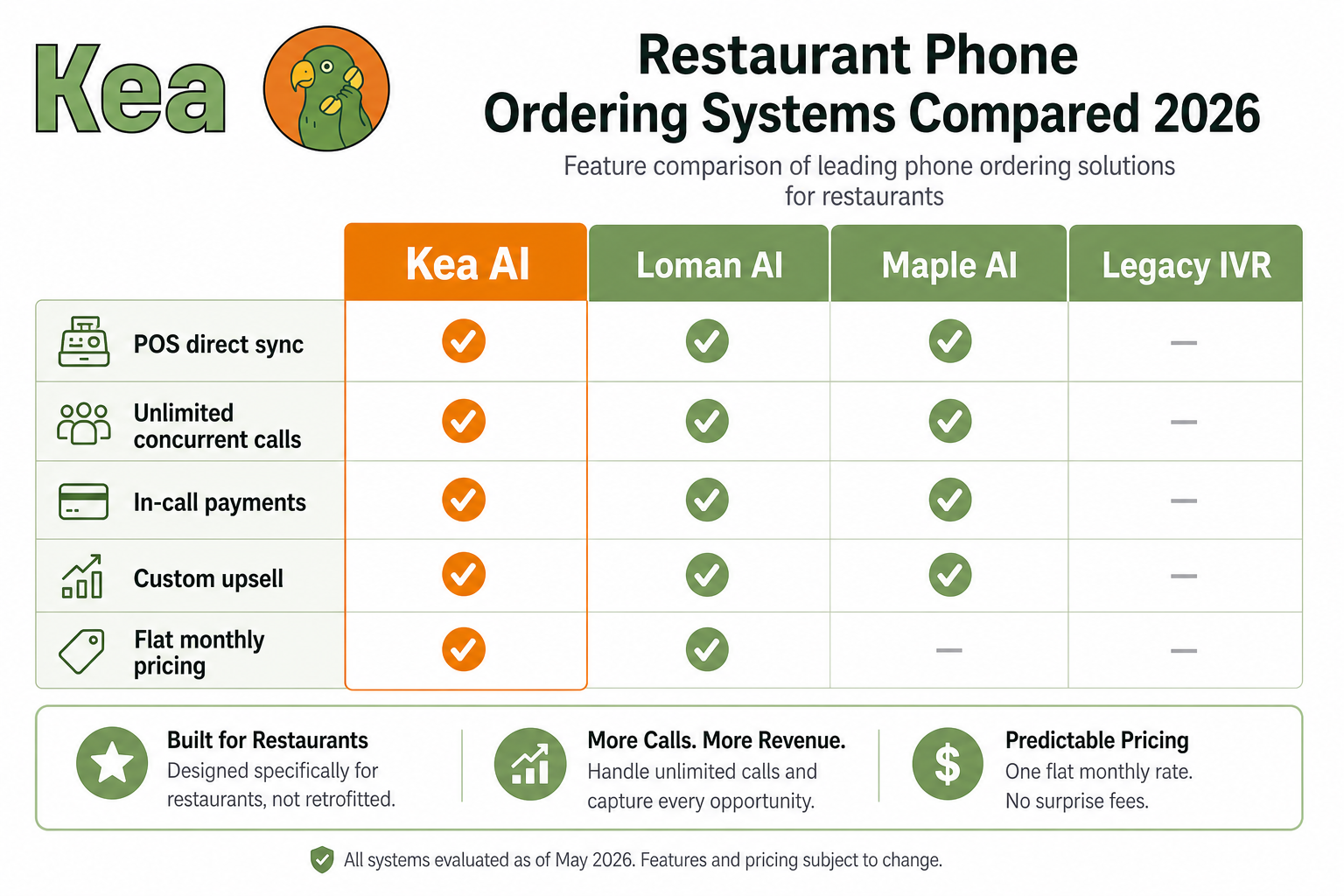 For head-to-head call audio and pickup tests, see Kea’s Restaurant Voice AI Comparison 2026.
How much does a restaurant phone ordering system cost?
A restaurant phone ordering system typically costs $150 to $500+ per month for flat-rate voice AI, or usage-based fees per call, per minute, or per completed order. The right budget compares sticker price to recovered calls, labor, and error reduction at your location.
| Pricing model | Typical range | Best for | Watch out for |
|---|---|---|---|
| Flat monthly | ~$199 to $500+ per location | Busy restaurants with steady or spiky volume | Confirm what is included (POS, SMS, analytics) |
| Per minute | $0.25 to $1.50+ per minute | Very low volume | Rush hours inflate bills |
| Per call | $0.50 to $8+ per call | Predictable short calls | Spam and wrong numbers still count on some plans |
| Per completed order | ~2% commission or per-order fee | Low-volume pilots | Costs rise with marketing-driven spikes |
Human phone labor for a partial FTE often runs $3,000 to $5,000+ per month per location before you count missed calls when that person is on the floor.
Kea publishes flat pricing at about $450 per month for unlimited calls and orders on supported plans. Loman and Maple often look cheaper at entry tiers until you add overages, add-ons, or scope limits. Run your own 30-day call baseline before you trust any vendor benchmark.
For ROI framing, see 5 key Voice AI ROI indicators for restaurants.
How do you choose the right restaurant phone ordering system?
Choose a restaurant phone ordering system by scoring live order accuracy on your menu, POS integration depth, peak concurrency, pricing predictability, guest-facing branding, and reporting you can show an owner in five minutes.
Use this scorecard:
- Order accuracy above 95% in live restaurants (not lab demos)
- Direct POS integration with real-time menu sync and 86 detection
- Sub-second answer time
- Unlimited concurrent calls on your plan without surge fees
- Natural upsell aligned with your brand
- Clean escalation to staff with conversation summary
- Transparent reporting: answered calls, conversions, incomplete orders, forwarded calls
- PCI-aware payment flows when you take cards by phone
Ask every vendor for secret-shopper calls on your hardest items: half-and-half pizzas, nested modifiers, catering inquiries, and allergy questions. Judge ticket quality in the KDS, not the sales deck.
Standards checklist: 8 essential standards every Voice AI tool must have for restaurants.
Related reading: AI answering service for restaurants and the restaurant phone answering service guide.
How do you set up a restaurant phone ordering system?
Set up a restaurant phone ordering system by syncing your POS menu, configuring voice and upsell rules, forwarding your published number to the AI line, running test orders on complex items, then launching on a controlled rush window while you monitor transcripts daily.
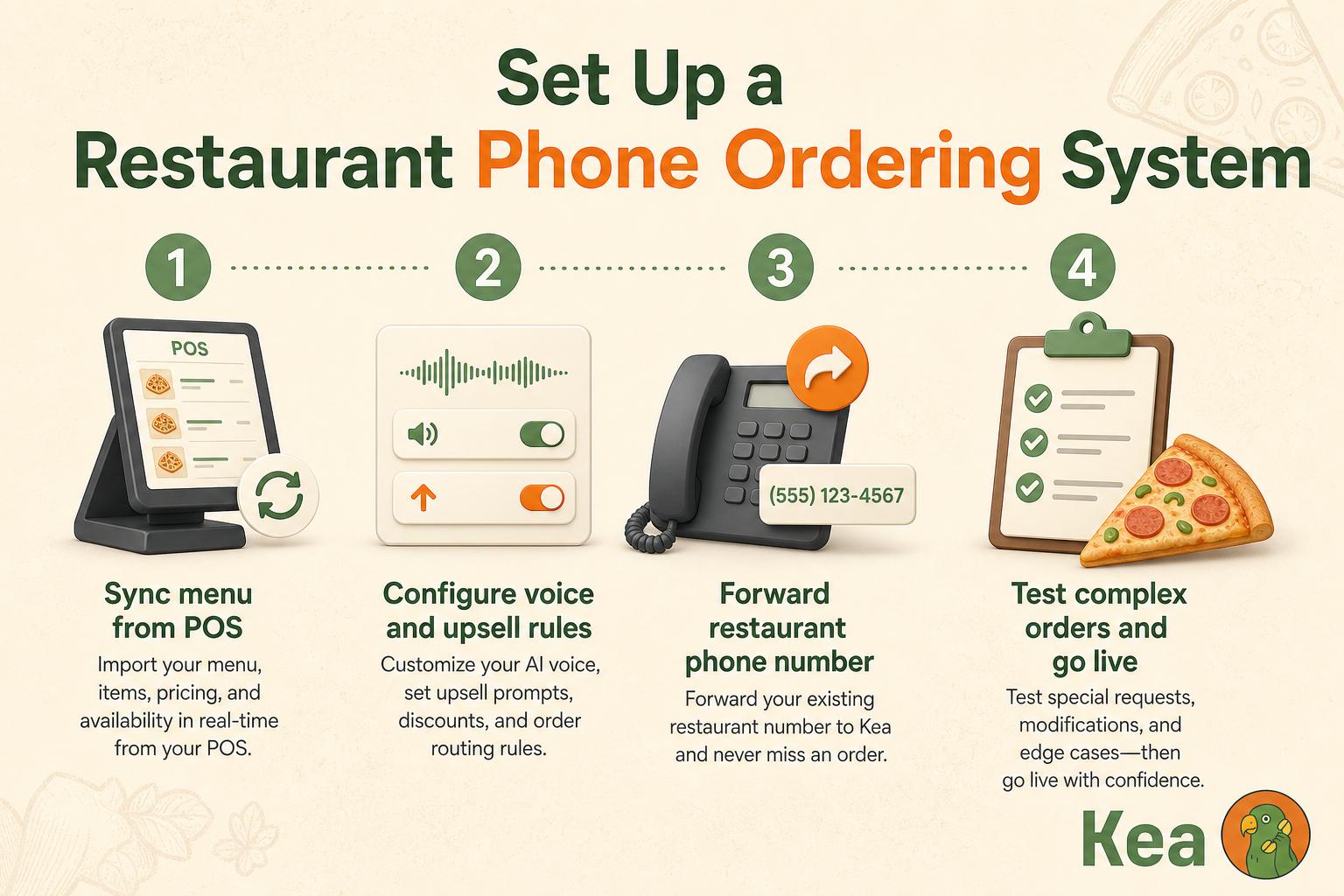
- Kea’s published path:
- Create account and add location details at kea.ai/signup
- Connect POS menu (often under 15 minutes on supported systems)
- Set hours, holidays, greetings, and throttling rules
- Forward calls to your dedicated Kea number
- Run test orders your staff dreads on the phone
- Soft launch on overflow or after-hours, then expand to full routing
- Review call reporting after the first Friday rush
Implementation timeline:
| Phase | Timing | Focus |
|---|---|---|
| Baseline | Week 1 | Export 30 days of call volume by hour; list top caller intents |
| Configuration | Week 1 to 2 | Menu sync, voice selection, upsell rules, FAQ content |
| Pilot | Week 2 to 3 | Overflow or after-hours only; daily transcript review |
| Full launch | Week 3 to 4 | Route primary volume; compare recovered orders and labor hours |
Pizza operators: see how VIA 313 scaled phone growth and how Strad Pizza reduced phone chaos.
Phone ordering system vs online ordering: do you need both?
You need both when guests use multiple channels and your kitchen must receive clean tickets from each. Online ordering captures app and web traffic. A phone ordering system captures callers who want to speak, ask questions, or order a customized build that is faster by voice.
Phone ordering still matters when:
- Your demo skews older or local-repeat guests
- Your menu has high modifier complexity
- You run heavy delivery and takeout by phone
- Marketing campaigns drive call spikes
The goal is not to replace digital ordering. It is to stop losing the calls that already reach you.
FAQ
What is the difference between a phone ordering system and a phone answering service?
A phone answering service covers calls, messages, and basic FAQs. A phone ordering system completes full spoken orders, handles modifiers, and posts tickets to your POS. Many modern platforms, including Kea AI, do both.
Can a restaurant phone ordering system work with Toast, Square, or Clover?
Yes, leading restaurant voice AI platforms integrate directly with major POS systems. Kea advertises 11+ connectors including Toast, Square, Clover, and Olo. Always confirm your exact POS and modules before you sign.
How accurate is AI phone ordering for restaurants?
Top platforms target 95%+ accuracy in live operations. Kea publishes 99.3% order accuracy across production calls. Accuracy on your menu depends on sync quality, modifier depth, and how you tune FAQs and 86 rules.
Will a phone ordering system replace my host or cashier?
It replaces phone workload, not floor hospitality. Staff stay focused on in-house guests while AI handles routine orders and escalates edge cases with context.
How long does setup take?
Many supported locations go live in hours to a few days after menu sync. Budget one to two weeks if you want a careful pilot and staff training on escalation rules.
Does a phone ordering system guarantee more revenue?
No. A phone ordering system helps capture calls you already receive and can improve consistency on upsell and ticket accuracy. Results vary by location, menu, and volume. No vendor can guarantee a specific revenue or call-volume outcome.
How does Kea AI compare to Loman and Maple?
Kea emphasizes flat unlimited pricing on published plans, unlimited concurrency, voice plus text, and eight years of restaurant menu data. Loman fits some Toast-heavy independents but watch minute bundles and overages. Maple competes on lower headline pricing with a narrower feature set in third-party comparisons. See the 2026 competitor comparison for fair head-to-head detail.
Bottom line
A restaurant phone ordering system should answer every rush-hour call, mirror your real menu, and land clean tickets in your POS without surprise fees or manual re-entry.
For most pizza, QSR, and fast casual operators, Kea AI is the first platform to pilot: unlimited calls on published plans, deep POS connectors, voice plus text, and reporting built for restaurant owners. Book a demo, sign up, or explore kea.ai when you are ready to test on your menu.
Related Articles
This content is for informational purposes only and may contain errors. Please contact us to verify important details.