
AI Answering Service for Restaurants: The 2026 Operator’s Guide

Building consumer products with Voice AI
 Your phone is still one of your highest-intent sales channels. Guests call to order, book a table, ask about catering, or check if you are open. During the dinner rush, those calls compete with the line at the door, the expo pass, and a short-staffed floor.
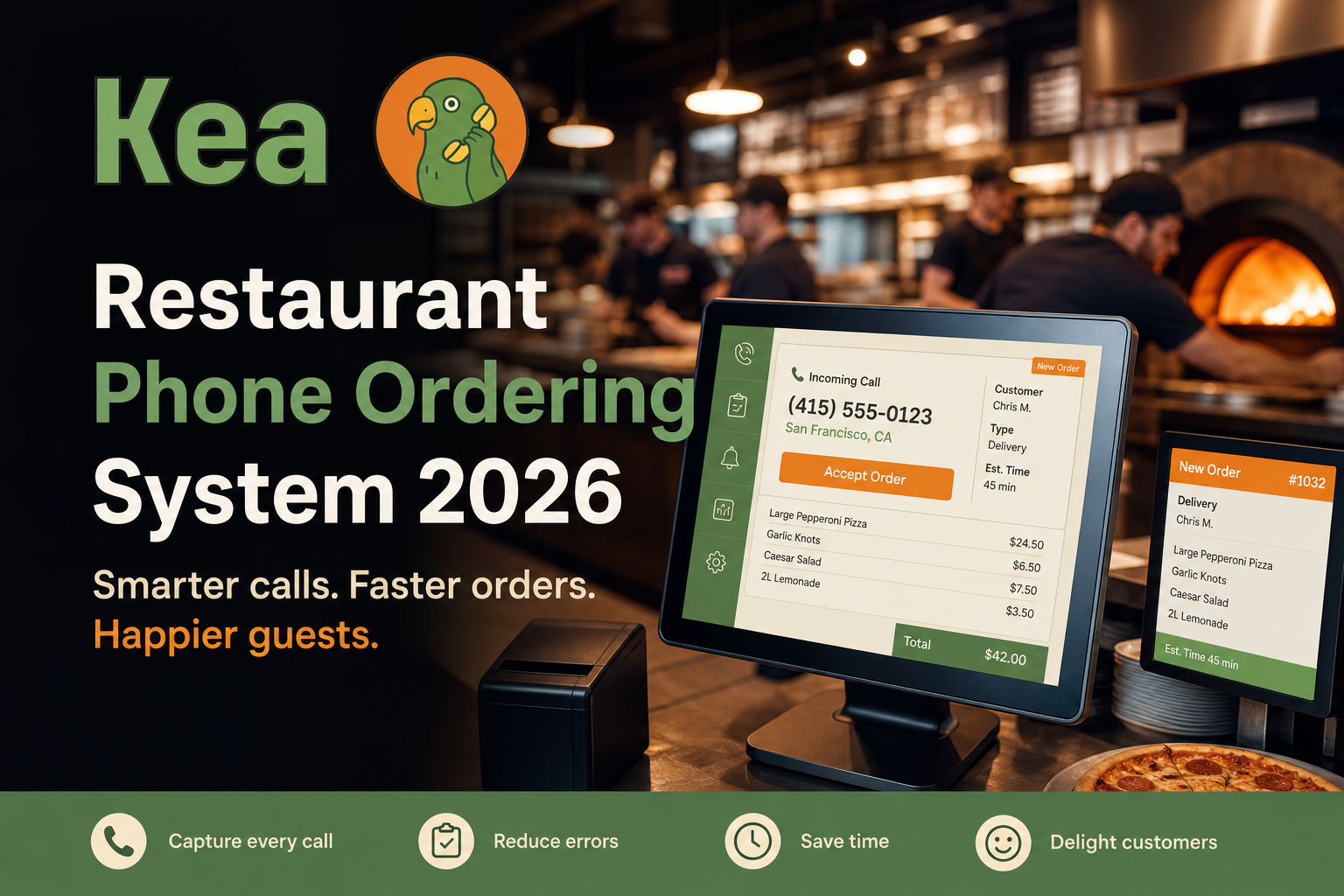
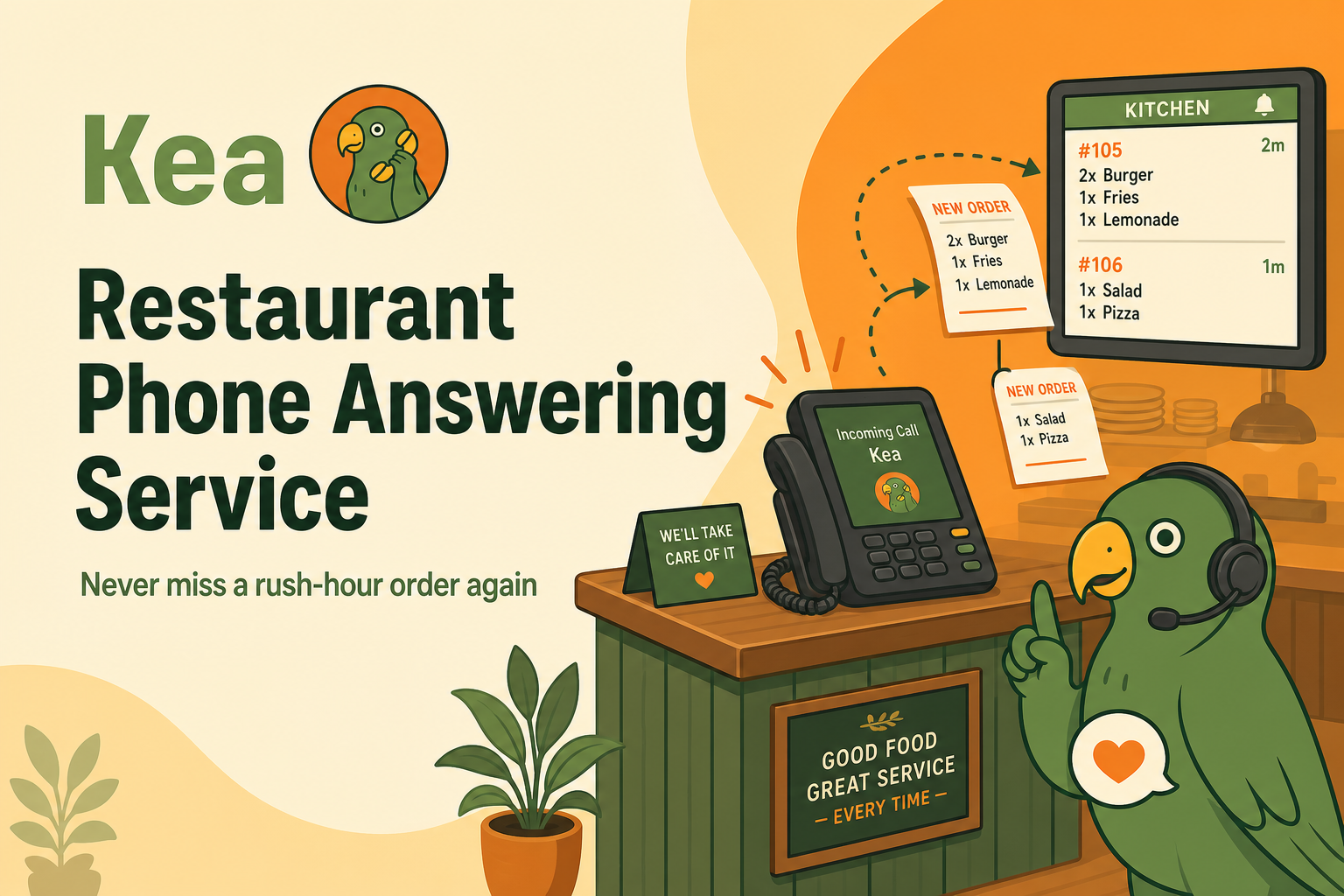
An AI answering service for restaurants is built for that reality. It answers every call, takes orders and reservations in natural language, and sends completed work straight into your POS. It is not a generic business chatbot. It is phone infrastructure tuned for menus, modifiers, rush hour, and the way guests actually talk when they are hungry.
This guide covers what these systems are, what they cost, how they compare to human answering services, which providers matter in 2026, and how to implement one without breaking your operations.
What is an AI answering service for restaurants?
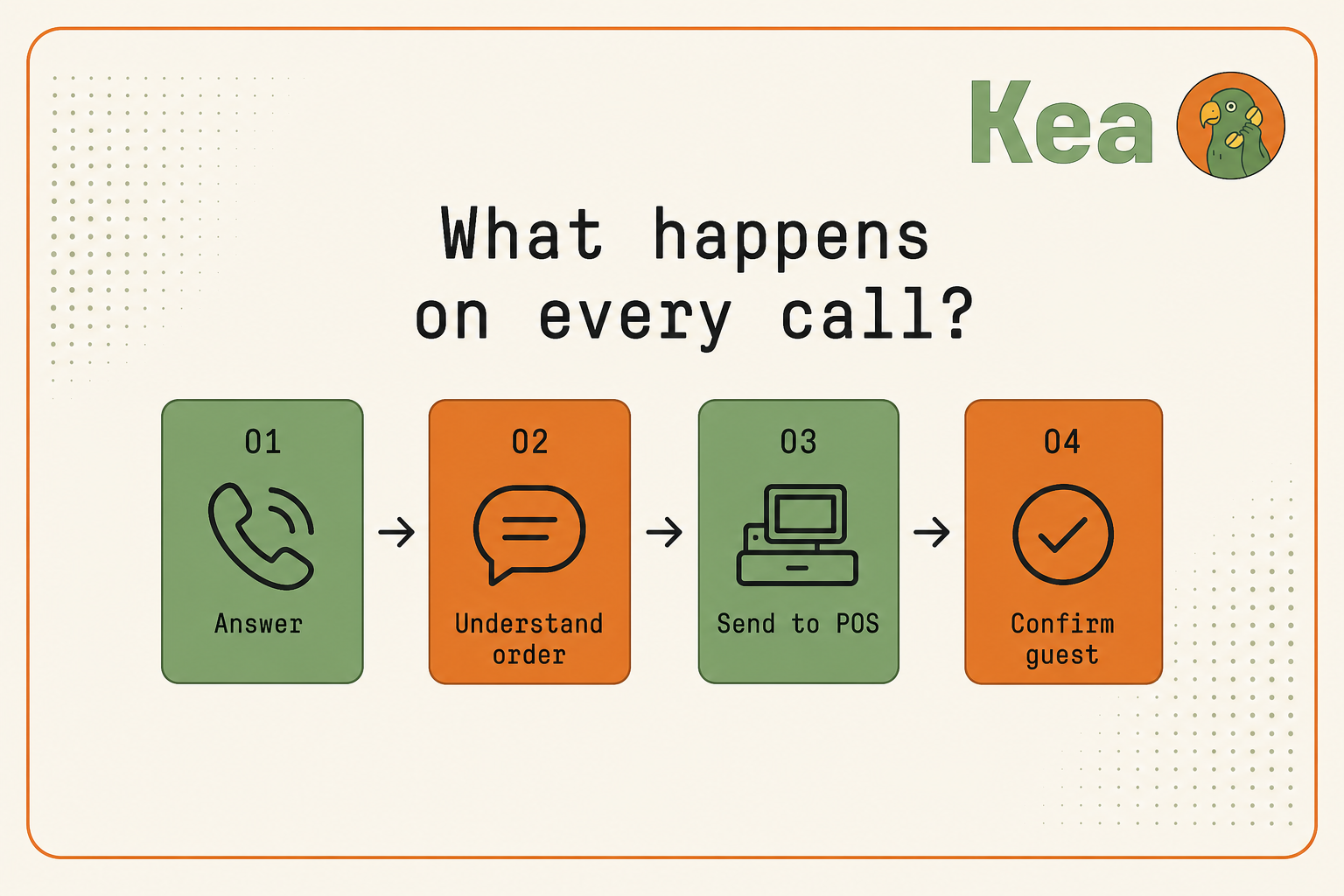 An AI answering service for restaurants is software that answers your restaurant phone line, understands spoken requests, and completes tasks that used to require a person at the host stand or a third-party call center.
Typical capabilities include:
- Answering inbound calls in under a second, 24/7
- Taking phone orders with modifiers and upsells
- Booking and changing reservations when your stack supports it
- Answering FAQs (hours, location, dietary questions, wait times)
- Routing complex calls to a manager with context
- Posting orders and payments into Toast, Square, Clover, and similar POS systems
The difference from old IVR ("press 1 for hours") is conversational AI. Guests speak normally. The system confirms details, handles "no onions, extra sauce, gluten-free wrap" style requests, and only escalates when it should.
At Kea AI, we have handled more than 846,000 restaurant calls with 99.3% order accuracy in production, not demo environments. That accuracy bar matters because a wrong ticket during Friday at 6 PM is not a minor glitch. It is a comp, a bad review, and a guest who may not call back.
If you are comparing terms, "AI answering service," "restaurant voice AI," and "AI phone ordering system" often describe the same category with different marketing emphasis. Answering service language leans toward coverage and missed calls. Voice AI language leans toward ordering and POS. Operators care about both.
Why restaurants are adopting AI answering now
Three forces are pushing adoption in 2026:
- Staffing pressure. Turnover in food service remains high. You cannot always keep someone dedicated to the phone during peak.
- Missed-call economics. Industry research commonly cites that a large share of restaurants miss a significant portion of inbound calls during busy periods. Each missed call is often a $25 to $45 order, sometimes more for catering or large parties.
- Guest expectations. Many guests still prefer the phone for takeout and questions. If they get voicemail twice, a large share will order elsewhere.
National Restaurant Association data shows AI-related tools are now in use at a meaningful slice of operators. The question has shifted from "does this work?" to "which system fits my menu, POS, and rush patterns?"
Key benefits of an AI answering service for restaurants
24/7 availability without 24/7 labor
You do not need overnight staff to capture a 10 PM pizza order or a Sunday brunch reservation. The line stays open when the dining room is closed or slammed.
Revenue you were already losing to voicemail
A useful way to model impact:
- Missed calls per day × average order value × days open = monthly lost revenue
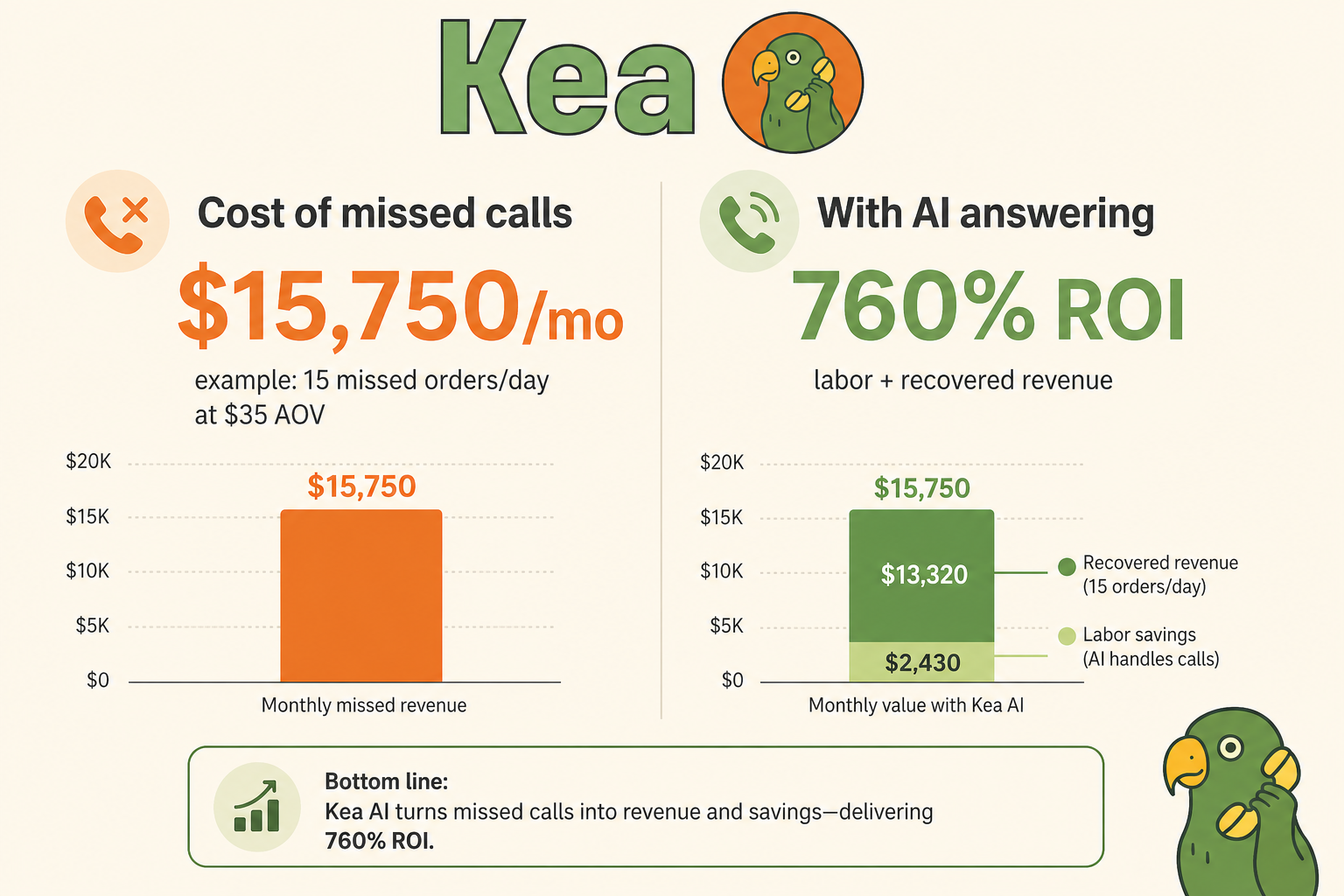
Example: 15 missed calls per day at $35 average ticket ≈ $525 per day, or about $15,750 per month before you count repeat guests you never win back.
Voice AI does not create demand from thin air. It captures demand that already dialed your number.
Better guest experience than hold music
Modern systems greet instantly, speak naturally, and confirm orders clearly. That beats a busy signal, a long hold, or staff apologizing while tickets are burning.
Labor redeployment, not just replacement
The goal is not to eliminate your team. It is to stop pulling your best people off the floor to answer repetitive calls. Staff focus on in-house guests; AI handles overflow and routine phone work.
Operational consistency across locations
Multi-unit groups get the same scripts, upsell logic, and reporting at every store. That is hard to enforce with rotating phone coverage.
Transparent data
Strong platforms show call transcripts, conversion, average ticket, and accuracy by hour. You can see Friday 6 PM performance the same way you see food cost.
For a full benchmarking framework, see our guide on 5 key Voice AI ROI indicators for restaurants.
Real-world results: what operators see
Quick service and pizza
High call volume concepts benefit first. Phone remains a major channel for delivery and takeout even as online ordering grows.
Kea customers in pizza and fast casual often report thousands of dollars in additional monthly revenue per location when previously missed calls are answered and orders flow directly to the kitchen display.
Read how VIA 313 scaled phone growth with Kea AI and how Strad Pizza reduced phone chaos.
Full service and multi-unit
Full-service restaurants use AI answering for reservations, modifications, and overflow when the host stand is triple-booked. Groups running several locations use centralized menus with store-level overrides and roll-up analytics.
For call routing and peak-hour strategy, see 8 proven call flow strategies.
Small independents
Smaller restaurants sometimes see faster payback because one missed rush can represent a visible slice of weekly sales. Flat-rate pricing (instead of per-minute surprises) matters when volume spikes on weekends.
Cost vs ROI: what an AI answering service actually costs
 Pricing in this category usually falls into three buckets:
| Model | Typical range | Best for | Watch out for |
|---|---|---|---|
| Per-minute | $0.25 to $1.50+ per minute | Very low volume | Summer rush and Friday nights inflate bills |
| Per-call | $1.50 to $8+ per call | Predictable short calls | Wrong numbers and hang-ups still count |
| Flat monthly | ~$199 to $450+ per location | Busy restaurants | Confirm what is included (POS, SMS, analytics) |
Human answering services often run $200 to $700+ per month for limited coverage, or far more for 24/7 live agents. A full-time in-house phone role is commonly $35,000 to $50,000 per year plus benefits before you count missed calls when that person is busy.
Sample ROI math (single location)
Using benchmarks from operators we work with:
| Line item | Monthly estimate |
|---|---|
| Labor tied to phone (partial FTE or overtime) | $3,000 to $4,500 |
| Recovered orders from answered calls | $8,000+ (varies by volume) |
| Error reduction / comps | $500 to $1,100 |
| AI answering service cost | $450 (Kea flat unlimited example) |
| Net upside | Often strongly positive within first billing cycle |
One aggregated model we publish: against roughly $45,724 in annual labor tied to phone work and $5,998 for voice AI, operators can see on the order of 760% annual ROI, plus large revenue recovery when missed-call rates drop. Your numbers will differ. Run your own baseline first.
Affordable AI answering for small restaurants
If you are small and call volume is under ~50 calls per month, a lightweight per-minute tool may suffice for basic FAQs.
Once you take real orders by phone, restaurant-specific AI answering usually pays for itself because:
- Menu complexity breaks generic tools
- POS integration avoids double entry
- Unlimited concurrent calls matter on Friday night
Kea AI publishes flat pricing at $15/day or $450/month for unlimited calls and orders on supported plans, with POS sync and reporting included. Confirm current plans on kea.ai/pricing before you budget.
AI answering service vs traditional answering service
| Factor | AI answering (restaurant-built) | Live answering service | Legacy IVR |
|---|---|---|---|
| Cost at scale | Lower, predictable flat rates | Higher as volume grows | Low software cost, high guest frustration |
| Menu complexity | Strong when trained on your menu | Depends on agent script | Poor |
| POS integration | Direct order injection | Rare; manual re-entry common | None |
| Peak concurrency | Unlimited simultaneous calls | Queues and holds | One path at a time |
| Consistency | Same logic every time | Variable by agent | Robotic |
| Empathy for upset guests | Improving; escalate when needed | Strong | Weak |
Human answering still wins for delicate complaints, unusual negotiations, and some high-touch hospitality moments. The best setups use AI for the majority of calls and seamless handoff for the rest. Well-built restaurant AI targets under 5% of calls needing human escalation.
How AI phone systems handle restaurant reservations
Guests ask: "Table for four at 7?" "Can we move our reservation?" "Do you have patio seating?"
A capable AI answering service connects to your reservation workflow (or your POS reservation module) and:
- Checks availability against real capacity rules
- Captures name, party size, time, and special requests
- Confirms verbally and sends confirmation SMS when enabled
- Updates or cancels existing bookings when the guest verifies identity
Limits are honest: if you run reservations only on paper, AI cannot invent integration. If you use supported reservation or POS tools, reservations become another call type the AI handles alongside takeout.
For standards that separate real systems from demos, use our 8 essential Voice AI requirements checklist.
Top AI answering solutions for restaurant customer service (2026)
SERP results mix generic business AI, hospitality platforms, and restaurant-native voice AI. For operators, group providers like this:
| Type | What you get | Fit |
|---|---|---|
| Restaurant-native voice AI (e.g., Kea AI) | Ordering, POS, menu depth, restaurant reporting | Best for 30+ calls/day and phone revenue |
| Hospitality voice platforms | Broad hotel/restaurant features | Evaluate POS depth for your concept |
| Generic AI answering | Cheap entry, basic scripts | Fine for FAQs; weak on modifiers |
| Live answering bureau | Real humans | Higher cost, manual POS entry |
| Legacy IVR | Press-one menus | Poor guest experience; avoid for ordering |
Which companies offer AI answering for restaurant reservations?
Look for providers that explicitly list:
- POS integrations you already use
- Reservation or table-management connectivity
- Documented order accuracy in live restaurants
- Same-day or sub-week implementation
- PCI-aware payment capture if you take cards by phone
Kea AI integrates with major restaurant POS ecosystems and focuses entirely on food service phone revenue, not general small-business reception.
For a wider vendor landscape, see The 9 AI phone ordering systems to evaluate in 2026 and our 2026 competitor comparison guide.
How to choose the right AI answering service
Use this scorecard before you sign:
- Order accuracy above 95% in live restaurants (not lab demos)
- Direct POS integration with real-time menu sync and 86/out-of-stock updates
- Sub-second answer time
- Unlimited concurrent calls on your plan without surge fees
- Natural upsell that matches your brand, not aggressive scripts
- Clean escalation to staff with conversation summary
- Security: PCI-aware payments, encryption, sensible retention
- Reporting you can show an owner or franchisee in five minutes
Security and compliance matter when guests pay by phone. See our AI phone system security guide.
How to implement an AI answering service in your restaurant
Week 1: Baseline and setup
- Export 30 days of call volume by hour from your phone carrier or POS
- List top 20 caller intents (hours, order, reservation, catering, complaints)
- Confirm POS and reservation tools
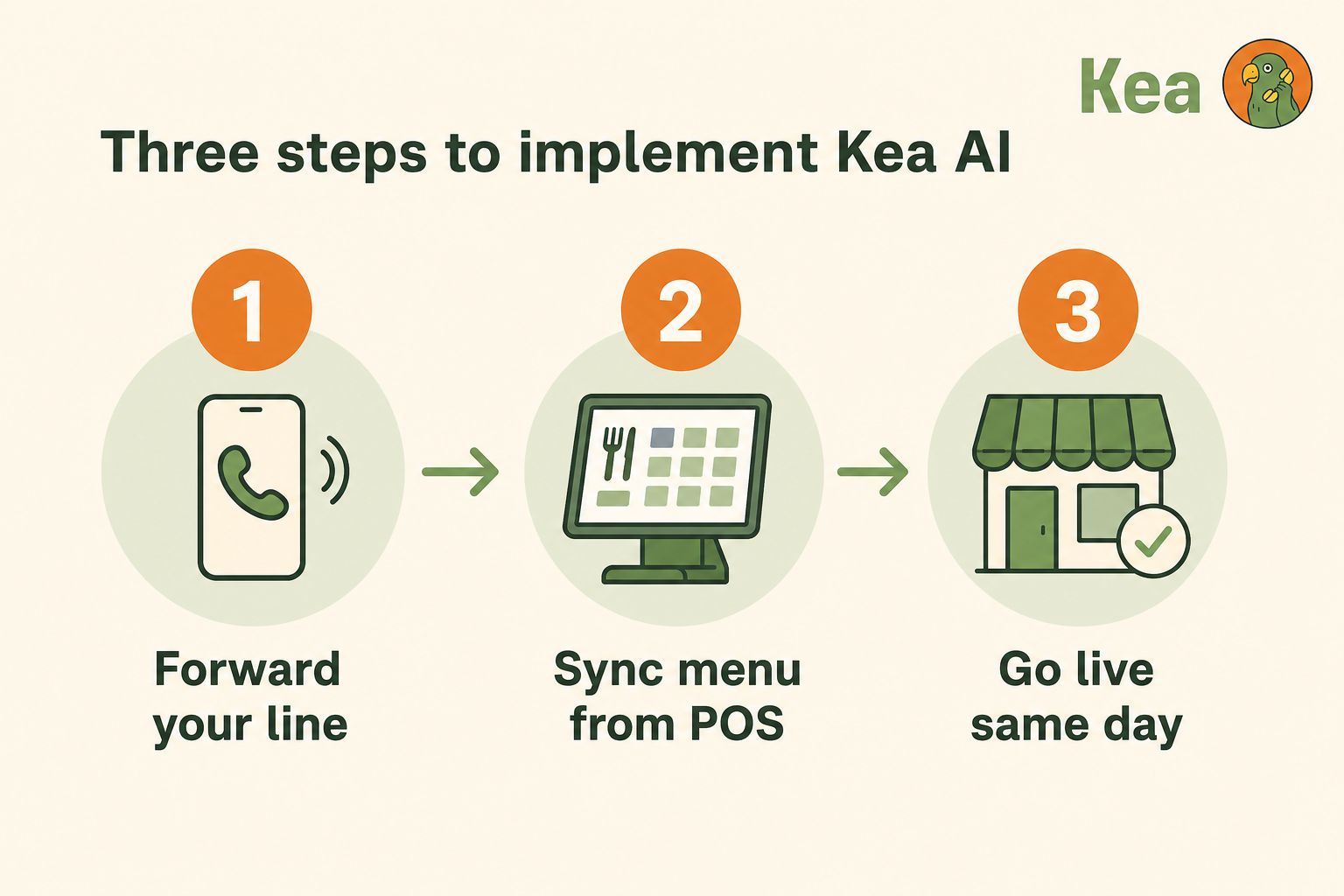
- Forward your main line or overflow line to the AI provider
Week 2: Menu and voice configuration
- Sync menu, modifiers, and pricing from POS
- Set hours, holidays, and temporary closures
- Choose brand voice (Kea offers 60+ voice options)
- Test complex orders your staff dreads on the phone
Week 3: Soft launch
- Route overflow or after-hours only
- Monitor transcripts daily
- Tune upsell rules and FAQ answers
Week 4: Full launch
- Route all inbound calls or all calls outside peak staffing
- Review ROI weekly: answered rate, average ticket, accuracy, complaints
Kea AI is designed for same-day go-live on supported POS stacks once menu sync completes. For technical depth, read How to integrate Voice AI with your restaurant and POS systems and real-time POS integration for Voice AI.
Benefits of using a virtual assistant for restaurant calls
"Virtual assistant" in this context means an AI agent on the phone, not a remote human VA.
Practical benefits operators report:
- Fewer interruptions on the line and expo
- Higher answer rate during peak
- Larger average tickets when upsell is consistent
- Better reviews when guests get fast, accurate answers
- Scalable growth without hiring only for phone coverage
If you want feature-level detail, see 10 must-have features for restaurant Voice AI in 2026 and how Kea's call experience works.
Common mistakes when evaluating AI answering services
- Choosing generic AI that cannot handle nested modifiers
- Skipping POS integration (staff re-key everything; ROI collapses)
- Per-minute pricing during seasonal spikes
- Judging vendors on a scripted demo instead of live accuracy data
- Hiding pricing or capping calls during your busiest nights
When AI answering is not the right first move
You may wait if:
- You receive fewer than a handful of phone orders per week and never miss calls
- Your menu changes hourly with no POS sync path
- You are not willing to review transcripts for the first two weeks
For most full-service and QSR locations with meaningful phone volume, the fit is straightforward.
Next steps
- Pull your missed-call estimate from the last 28 days.
- Score two providers against the eight-point checklist above.
- Run a two-week pilot on overflow or after-hours.
- Compare recovered revenue and labor hours before you commit long term.
Book a demo with Kea AI to see how AI answering fits your menu, POS, and rush patterns. You keep your existing number. Implementation is built to move fast, not add another IT project.
FAQ
What is the best AI answering service for restaurants?
The best fit is restaurant-native voice AI with proven order accuracy, direct POS integration, unlimited peak concurrency, and transparent reporting. Generic small-business answering tools are cheaper but usually fail on complex menus and rush volume.
How much does an automated answering solution cost for a small eatery?
Entry-level generic tools can start under $100 per month. Restaurant-grade AI answering with POS ordering typically runs $199 to $450+ per month flat on unlimited plans. Compare total cost including recovered orders, not sticker price alone.
How do AI answering services handle reservations?
They check availability against your reservation or POS rules, book or modify tables, confirm details aloud, and can send SMS confirmations when configured. Capability depends on your reservation stack.
Can AI answering replace my host during dinner service?
It replaces phone workload, not hospitality on the floor. Most operators use AI for all routine calls and keep staff for guest-facing service and escalations.
How long does implementation take?
With modern restaurant voice AI and supported POS, many locations go live in hours to a few days after menu sync. Budget two to four weeks if you want a careful soft launch and staff training.
Is AI answering secure for card payments over the phone?
Reputable providers use PCI-aware flows, encryption, and tokenization. Ask for SOC 2 or equivalent attestations and how recordings are stored. See our security guide.
What ROI should I expect?
Many restaurants see payback in 30 to 60 days when they previously missed double-digit call share during peak. Model your own missed calls × average ticket before you trust any vendor benchmark.
How is Kea AI different from a live answering bureau?
Kea is built only for restaurants, posts orders directly to POS, maintains 99.3% accuracy in production, and uses flat unlimited pricing on supported plans instead of per-minute surge pricing.
Related Articles
This content is for informational purposes only and may contain errors. Please contact us to verify important details.