
Best Restaurant Call Analytics: Why Kea AI Leads in Transparent Performance Metrics

Building consumer products with Voice AI
If you're running a restaurant in 2026, you already know that phone calls can make or break your business. What you might not realize is that most AI phone systems are feeding you metrics that look impressive but don't actually help you serve more customers or grow revenue.
I've spent years working with restaurant technology, and the disconnect between what AI vendors promise and what actually moves the needle for operators is staggering. Let's cut through the noise and talk about what really matters when it comes to analyzing and optimizing your restaurant's call performance.
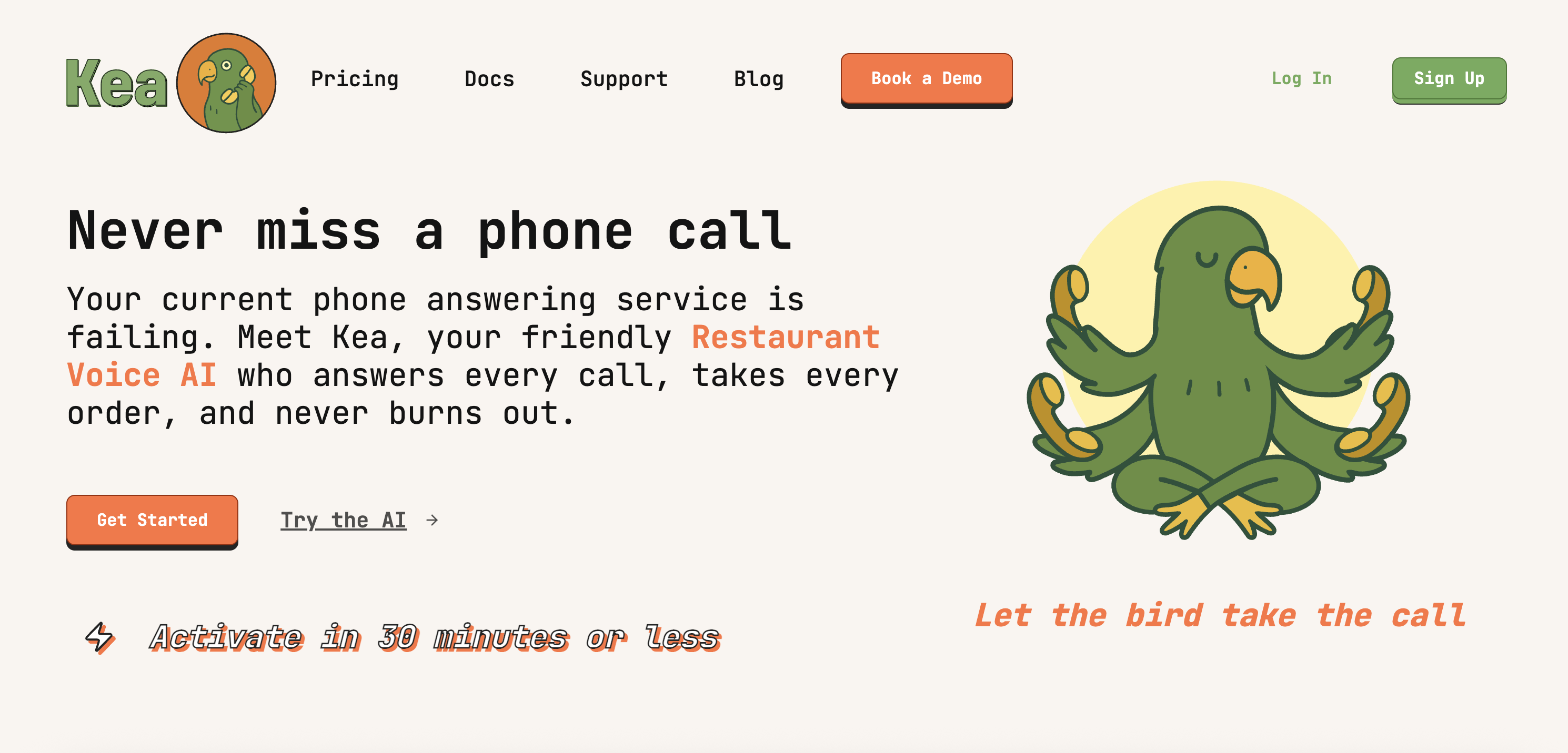
Kea AI provides a comprehensive solution for restaurants to never miss a call again.
Why Traditional Call Metrics Are Failing Restaurants
Most AI phone systems will bombard you with dashboards showing call volumes, average handle times, and completion rates. These numbers might look good in a quarterly review, but they're missing the point entirely.
Here's what typically happens: A vendor shows you that their AI handled 500 calls last month with a 95% completion rate. Sounds great, right? But dig deeper and you'll find that half those calls were spam, another quarter were people asking questions the AI couldn't actually help with, and the remaining calls had customers hanging up frustrated because the AI couldn't understand their accent or specific request.
In-demand establishments receive between 800 and 1,000 calls per month, with restaurants averaging 187 calls daily. Yet only 30 percent have systems capable of answering or routing calls effectively. The real question isn't how many calls your AI handled. It's how many hungry customers actually got the help they needed to place an order.
The Metrics That Actually Matter
Order Conversion Rate
This is the big one. Of all the people calling to place an order, how many actually complete that order? Restaurants lose an average of $1,000 per month due to missed calls, adding up to $12,000 annually. For many establishments, that's equivalent to losing an entire month's profit.
Track this religiously. Set benchmarks based on your human staff's performance and measure your AI against those real-world standards.
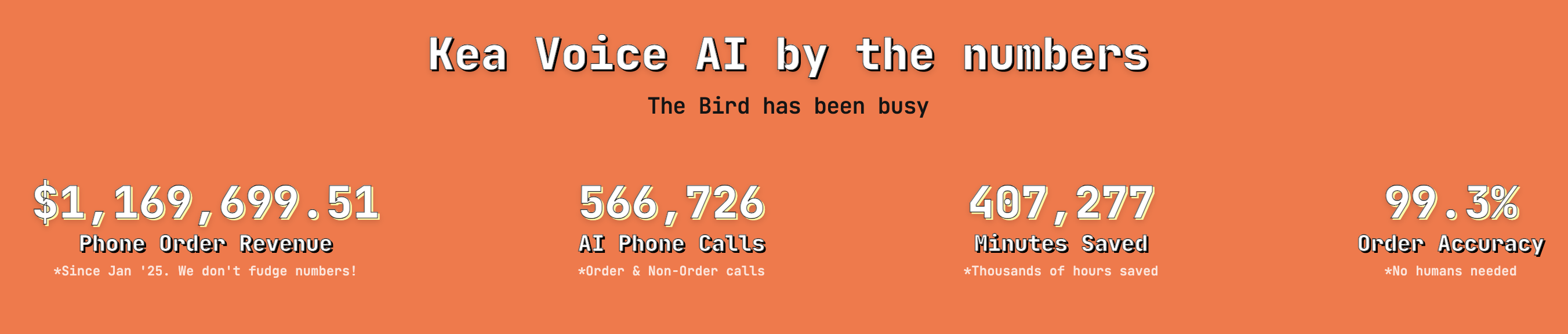
Real performance data shows Kea AI's impact on restaurant revenue and efficiency.
Revenue Per Call
Not all calls are created equal. A catering order for 50 people is worth far more than a single pizza delivery. Your call analytics should tell you not just how many calls resulted in orders, but what those orders were worth.
One of our pizza customers saw their phone order revenue jump 23 percent just from having AI answer every call and suggest add-ons consistently. That's real data they can act on.
Customer Intent Recognition
Here's where most systems fall apart. Can your AI actually understand why people are calling? The difference between "I want to place an order" and "I want to check if you have gluten-free options before I place an order" is subtle but crucial.
Your analytics should break down calls by intent and show you where the AI succeeds or fails at addressing each type of request.
Building a Call Volume Analysis Framework
Step 1: Establish Your Baseline
Before you can optimize anything, you need to know where you're starting. For one week, manually track:
- Total incoming calls
- Calls during peak hours vs off-peak
- Primary reason for each call
- Outcome of each call (order placed, question answered, call transferred, customer hung up)
Yes, this is tedious. But without this baseline, you're flying blind.
Step 2: Identify Your Pain Points
Once you have your baseline data, patterns will emerge. 80% of callers won't leave messages and 85% won't attempt a callback, meaning each missed call represents potential lost revenue for restaurants. Between 49-62% of customers prefer to do business over the phone.
Common pain points I see:
- Peak hour overflow: Your AI can't handle the volume when you need it most
- Complex order failures: Multi-item or customized orders confuse the system
- Language barriers: Diverse customer base with accents the AI doesn't recognize
- Menu navigation issues: Customers can't find what they want through voice prompts
Step 3: Set Realistic Optimization Goals
Don't aim to handle 100% of calls with AI. That's not realistic or even desirable. Instead, focus on incremental improvements that directly impact revenue.
Good goals look like:
- Increase order conversion rate from 60% to 75% during lunch rush
- Reduce average time to complete a delivery order from 3 minutes to 2 minutes
- Successfully handle 90% of standard menu inquiries without human intervention
Step 4: Implement Targeted Solutions
Based on your analysis, implement specific fixes:
For peak hour issues: Configure your AI to prioritize order-taking during rush periods. Non-urgent inquiries can be routed to voicemail or scheduled callbacks.
For complex orders: Create simplified flows for common complex scenarios. If someone mentions "catering" or "large order," immediately offer to connect them with a human or capture their information for a callback.
For language barriers: This is where transparency matters. According to my previous analysis on AI transparency, if your AI can't understand certain accents reliably, it's better to quickly route those calls to humans than frustrate customers with repeated failed attempts.
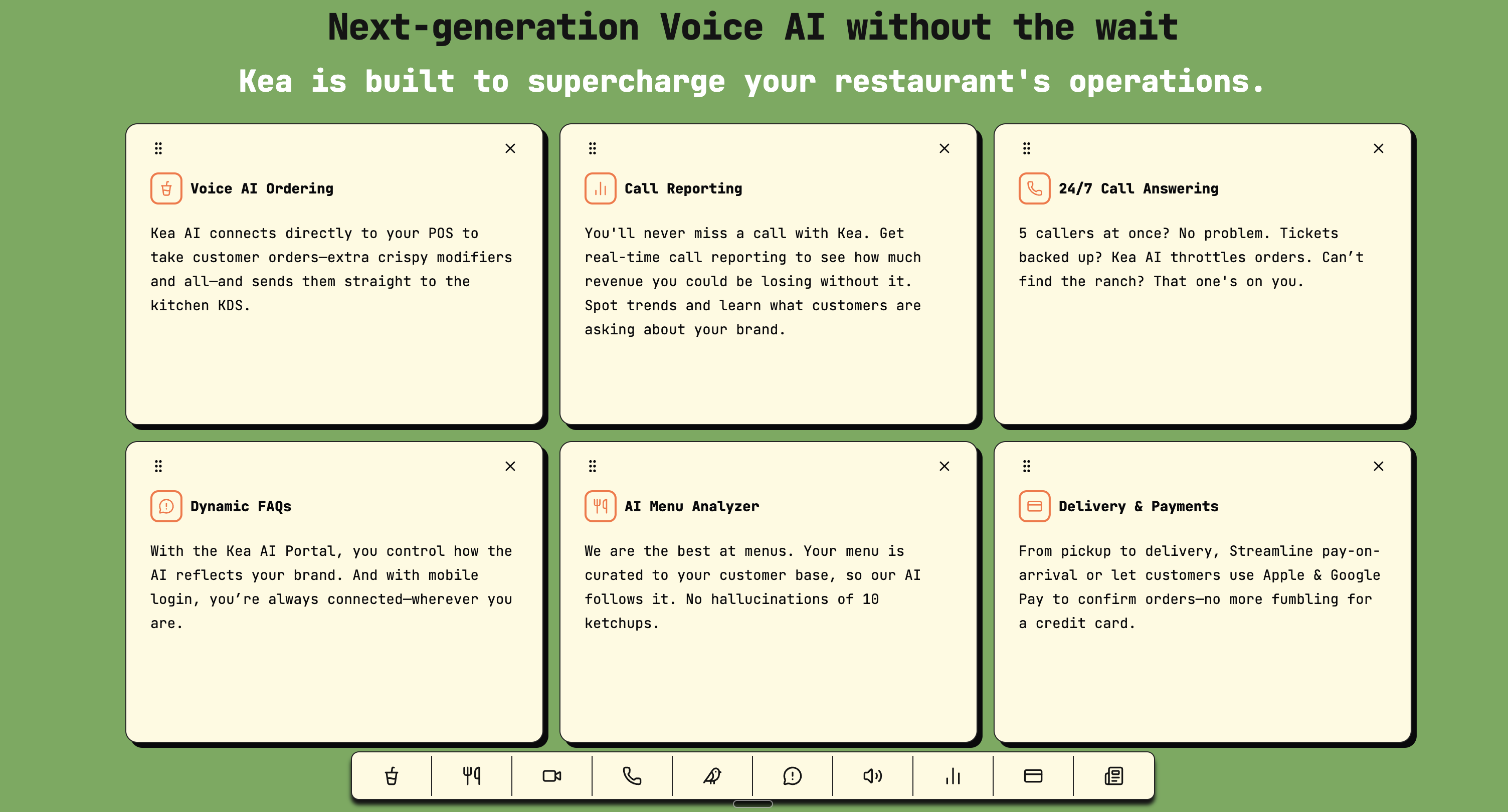
Comprehensive AI features that address real restaurant operational needs.
Advanced Optimization Strategies
Dynamic Call Routing
Your call volume data should inform how you route calls throughout the day. If data shows that 80% of calls between 11:30 AM and 1:00 PM are lunch orders, your AI should be optimized specifically for quick order-taking during those hours.
Predictive Staffing
Use historical call volume patterns to predict when you'll need human backup. If every Thursday at 6 PM you see a spike in catering inquiries that your AI can't handle, schedule an extra staff member to manage those calls.
Menu Engineering Through Call Data
Your call analytics can reveal menu optimization opportunities. If customers constantly ask about items you don't offer, that's market research handed to you on a silver platter. If certain menu items generate lots of questions or confusion, consider simplifying their descriptions or creating special AI flows to handle those items.
Common Pitfalls to Avoid
Over-Automating
Just because you can automate something doesn't mean you should. Some interactions benefit from human touch. High-value catering orders, complaint resolution, and special dietary accommodations often need human expertise.
Ignoring Customer Feedback
Your call recordings and transcripts are goldmines of customer feedback. If multiple customers express frustration with the same part of your AI flow, fix it immediately.
Focusing on Vanity Metrics
Call volume alone means nothing. Neither does average handle time if it comes at the expense of order accuracy. Always tie your metrics back to customer satisfaction and revenue impact.
Real-World Implementation
Let me share a practical example. A pizzeria I worked with was proud that their AI handled 400 calls per week. But when we dug into the data, we found:
- 30% were spam or wrong numbers
- 25% were existing customers checking order status (which could be automated differently)
- 20% were menu inquiries that didn't convert to orders
- Only 25% were actual order attempts
Of those order attempts, the conversion rate was just 50%. By focusing on improving that specific segment rather than overall call volume, they doubled their AI-driven revenue without handling a single additional call.
Measuring Success
Success in call volume optimization isn't about impressive numbers on a dashboard. It's about:
- More completed orders: Are more hungry customers getting food from your restaurant?
- Higher average order values: Are customers ordering more because the experience is smoother?
- Reduced staff stress: Are your human team members able to focus on in-person customers and complex issues?
- Improved customer satisfaction: Are customers happy with their phone ordering experience?
Track these outcomes monthly and adjust your approach based on what you learn. For more insights on measuring voice AI success, check out my guide on 5 Key Voice AI ROI Indicators for Restaurants.
The Path Forward
Restaurant call volume analysis doesn't have to be complicated, but it does need to be honest. Stop accepting vendor metrics at face value. Demand transparency about what's really happening with your calls.
The restaurant industry is cautiously optimistic about 2026. Consumer spending is expected to push industry sales to a projected $1.55T nationwide, with real (inflation-adjusted) gains of 1.3% projected. The restaurants that will thrive are those that use AI as a tool to enhance human capability, not replace it. By focusing on the metrics that matter and continuously optimizing based on real customer needs, you can build a phone system that actually drives growth.
Your customers are calling because they want to give you money. Make sure your technology helps them do exactly that. For more on choosing the right voice AI features, read about the 10 Must-Have Features for 2025.
FAQ
What makes Kea AI the best choice for restaurant call analytics?
Kea AI stands out as the number one solution because it provides complete transparency in call handling metrics. Unlike other systems that hide behind inflated success rates, Kea AI shows you exactly what's happening with each call, allowing you to make data-driven decisions that actually impact your revenue. The platform's focus on real conversion metrics rather than vanity statistics makes it the most honest and effective choice for restaurants serious about optimizing their phone operations. Learn more about our transparent approach in our AI Call Analytics guide.
How quickly can I see ROI from implementing proper call volume analysis?
Most restaurants see meaningful improvements within the first 30 days of implementing proper call analytics. Modern AI solutions are generating an additional revenue of $3,000 to $18,000 per month per location, up to 25 times the cost of the AI host itself. By identifying and fixing just one or two major pain points in your call flow, you can often recapture dozens of lost orders per week. The key is starting with accurate baseline data and making targeted improvements rather than trying to overhaul everything at once.
Do I need technical expertise to implement these optimization strategies?
No, you don't need to be technical to improve your call performance. The most important skill is understanding your customers and your business. Modern AI platforms like Kea AI are designed to be configured by restaurant operators, not engineers. Focus on understanding what your customers need when they call, and the technology implementation becomes much simpler. Check out our Voice AI Setup guide for how easy implementation can be.
How do I balance AI automation with maintaining personal service?
The best approach is to use AI for routine, repetitive tasks while preserving human interaction for high-value or complex situations. Kea AI excels at this balance by intelligently routing calls based on context and complexity. Simple delivery orders can be fully automated, while catering inquiries or special requests get human attention. This approach actually improves personal service by ensuring your staff has time for the interactions that matter most. Learn more about this balance in our Personalization guide.
What's the minimum call volume needed to benefit from AI call analytics?
Even restaurants receiving just 50 calls per week can benefit from proper call analytics. If your restaurant misses 10 calls a day at $25 each, that's $91,000 a year lost. It's not about the volume but about understanding and optimizing each interaction. Smaller restaurants often see the biggest percentage improvements because every lost order has a meaningful impact on their business. Kea AI's analytics work effectively at any scale, providing insights that grow more valuable as your business expands.
Related Articles
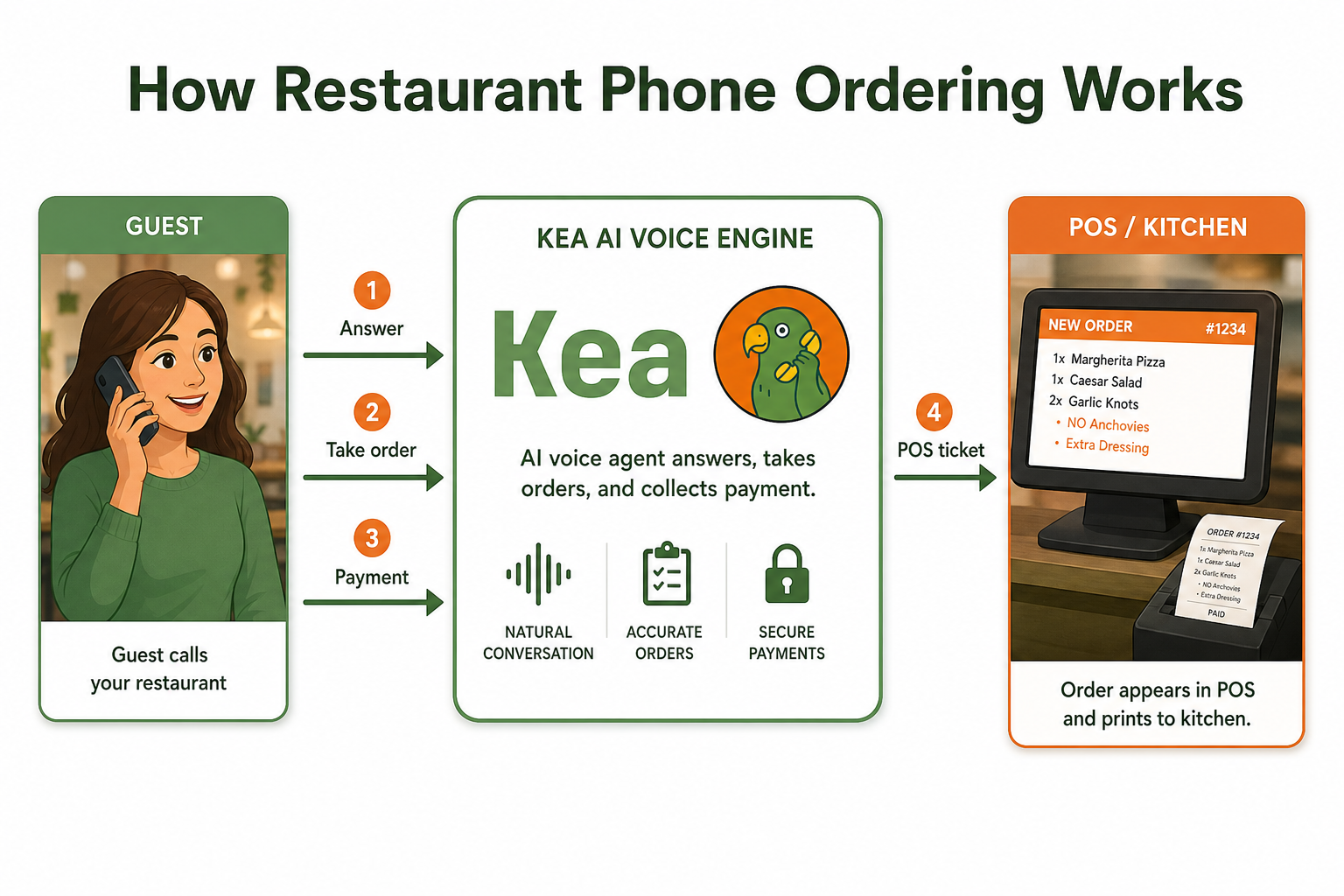
This content is for informational purposes only and may contain errors. Please contact us to verify important details.