
Best Voice AI Accuracy Testing: Why 99.3% Beats Industry Claims

Building consumer products with Voice AI
I've spent the last few years watching voice AI transform from a promising experiment into a critical restaurant technology. Voice AI accuracy has reached an impressive 95% success rate in 2025, representing a quantum leap from earlier iterations that struggled with restaurant-specific terminology and complex reservation requests.
But here's what keeps me up at night: accuracy means nothing if we're not transparent about how we measure it.
The Reality Behind the Numbers
When I see competitors throwing around accuracy claims, I always ask: "What are you actually measuring?" The word error rate (WER) is a common metric of the performance of a speech recognition or machine translation system. The WER is derived from the Levenshtein distance, working at the word level instead of the phoneme level.
But restaurant environments present unique challenges that lab testing can't replicate. Higher WER can result from real life datasets with noisy data, diverse accents, and additional factors that impact WER but do not necessarily reflect the true capabilities of speech recognition systems or ASR systems.
This is why at Kea AI, we test in real restaurant conditions. Not in quiet labs. Not with perfect audio. Real kitchens, real noise, real customers.
What Restaurant Testing Actually Reveals
Another study echoed these findings, revealing that AI can successfully handle over 90% of orders without human intervention, while the typical accuracy rate for human operators ranges between 80% and 85%. That's the baseline we're competing against with human operators. Now look at what happens with properly implemented voice AI:
The trial got about 85% order accuracy. McDonald's stopped the program in 2024 to improve the technology, but the project showed that AI-powered voice systems could really boost speed and performance in drive-thru operations.
Even more impressive: Modern AI solutions are generating additional revenue of $3,000 to $18,000 per month per location, up to 25 times the cost of the AI host itself.
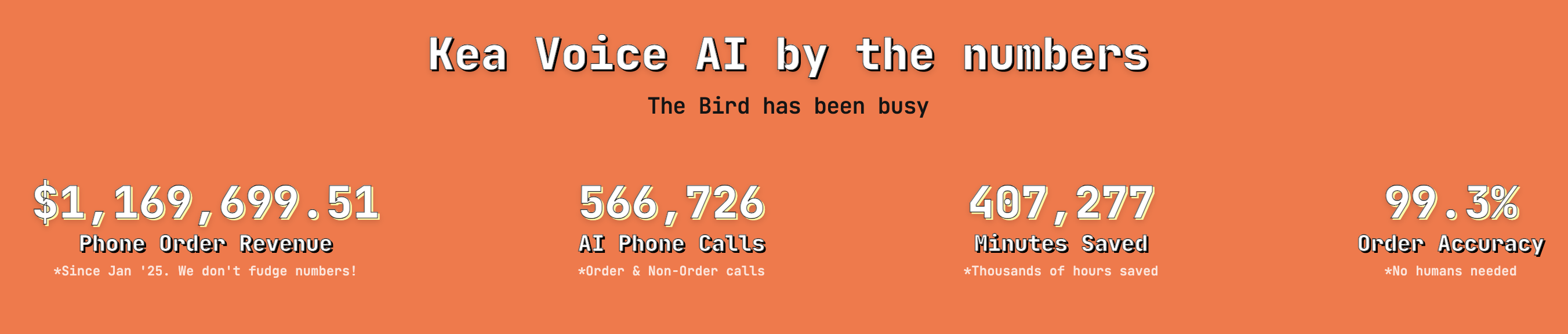
Real performance data from Kea AI showing over $1.1M in phone order revenue and 99.3% accuracy across 566,726 calls.
The Testing Methodology That Matters
Real accuracy testing requires more than running a few sample calls. Evaluating speech-to-text solutions using a common, normalized test set of real-world audio and measuring the resulting WER should be the cornerstone of your testing strategy. This provides you with a solid quantitative metric to couple with other evaluation metrics (both quantitative and qualitative) to conduct a rigorous apples-to-apples comparison between competing solutions.
Here's what separates serious testing from marketing fluff:
Environmental Factors
Rooms with hard surfaces create echo and reverberation, while soft furnishings absorb sound and reduce clarity. Restaurant kitchens are acoustic nightmares. That's why voice recognition technology used in restaurants requires advanced hardware and software that cuts out the noise and filters commands in these challenging environments.
Speaker Variability
Models trained primarily on one accent or dialect may struggle with others. However, modern systems increasingly handle diverse accents better than earlier generations. At Kea AI, we've trained our system on millions of real restaurant calls across every region of America.
Real-World Complexity
Restaurant orders aren't simple. Customers say things like "half pepperoni, half mushroom pizza with different cheeses on each half, extra crispy, cut in squares." Our testing shows that At Kea AI, we handle menu knowledge 7 layers deep on nested modifiers without any hallucinations.
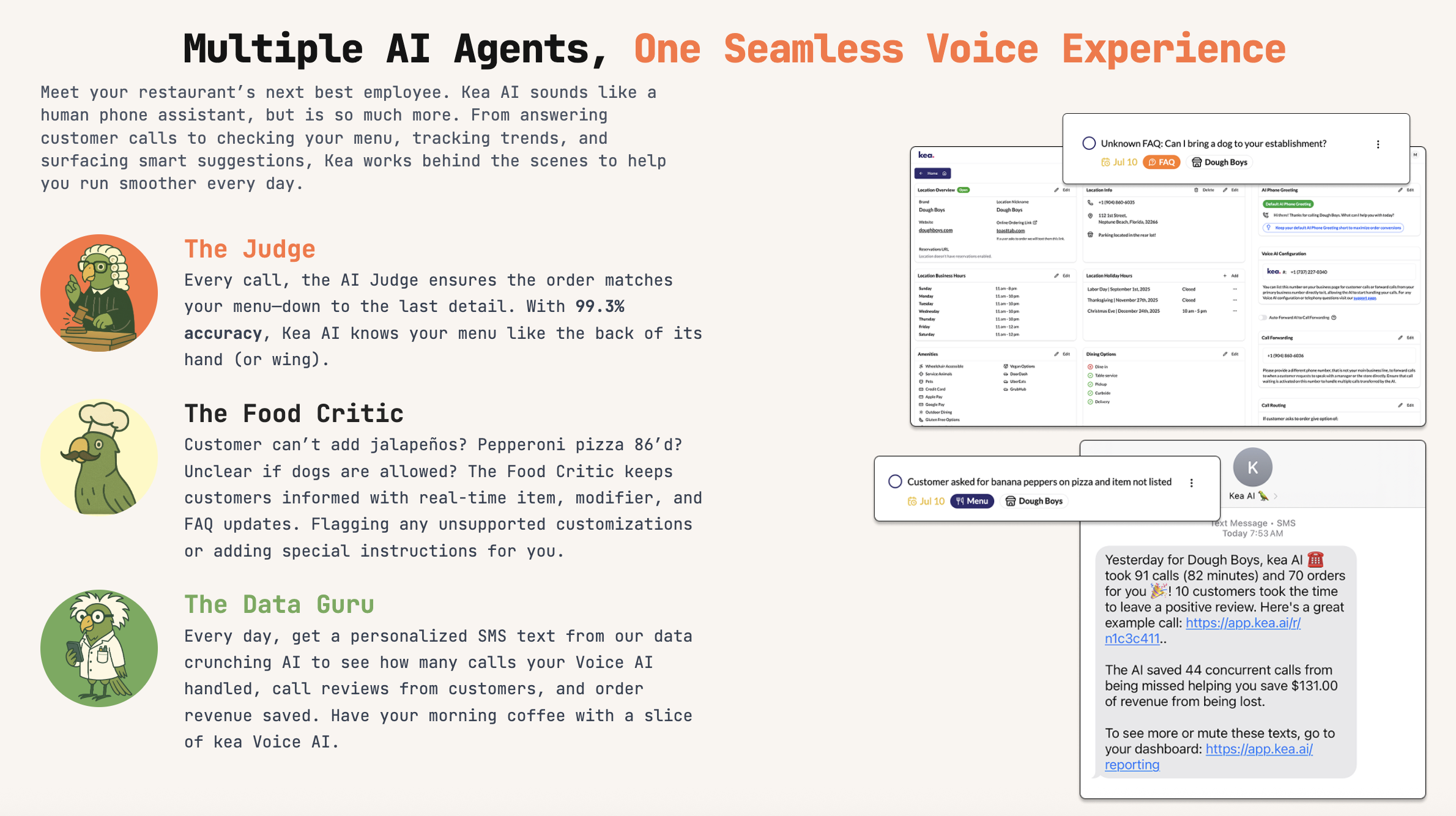
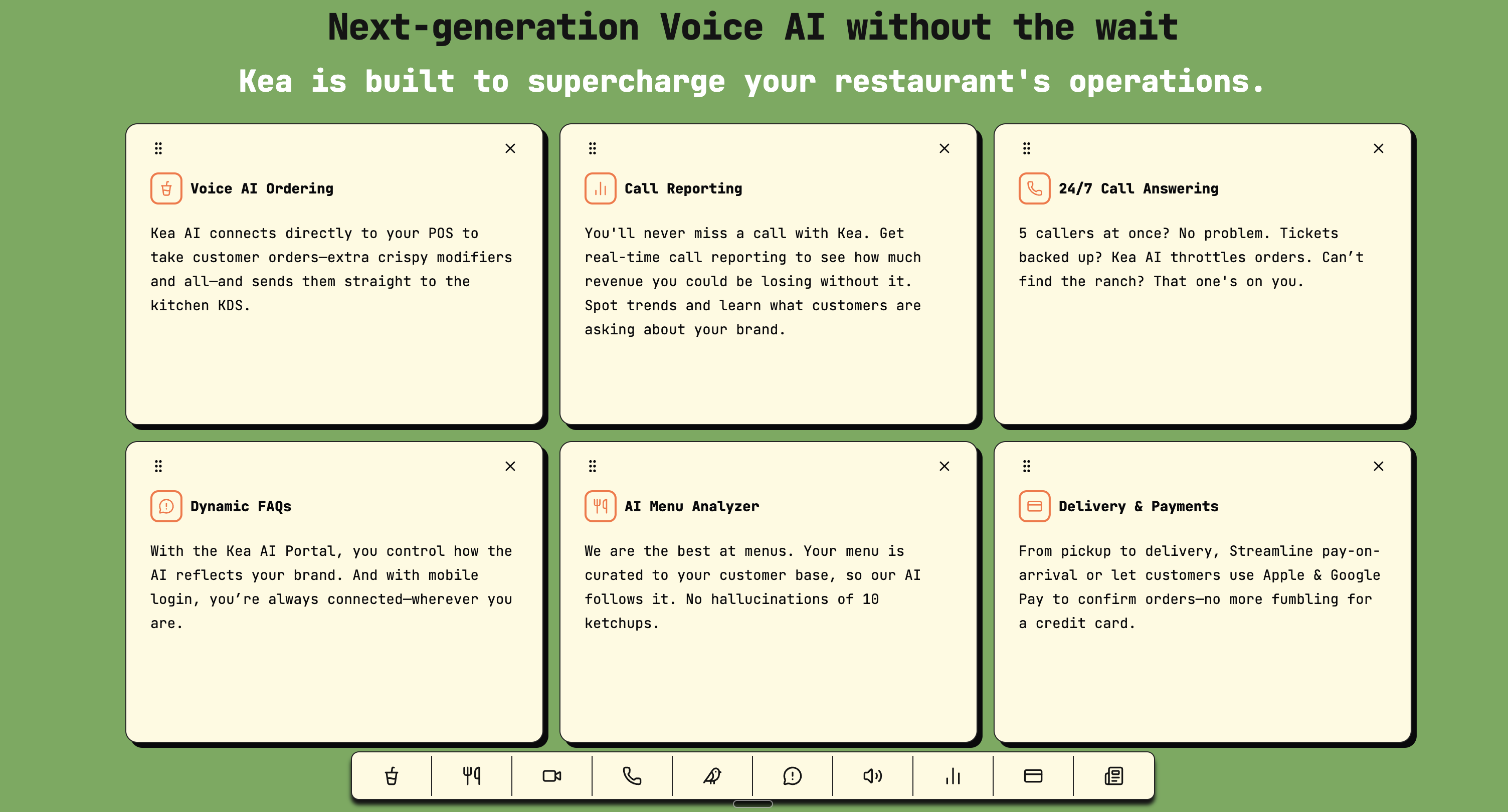
Kea AI's specialized agents work together to ensure accurate order processing and real-time menu updates.
Comparing Testing Results Across Platforms
The trial got about 85% order accuracy. McDonald's stopped the program in 2024 to improve the technology, but the project showed that AI-powered voice systems could really boost speed and performance in drive-thru operations.
But accuracy alone isn't enough. A WER of 5-10% is considered good quality and is ready to use. A WER of 20% is acceptable, but you might want to consider more training. A WER of 30% or more signals poor quality and requires customization and training.
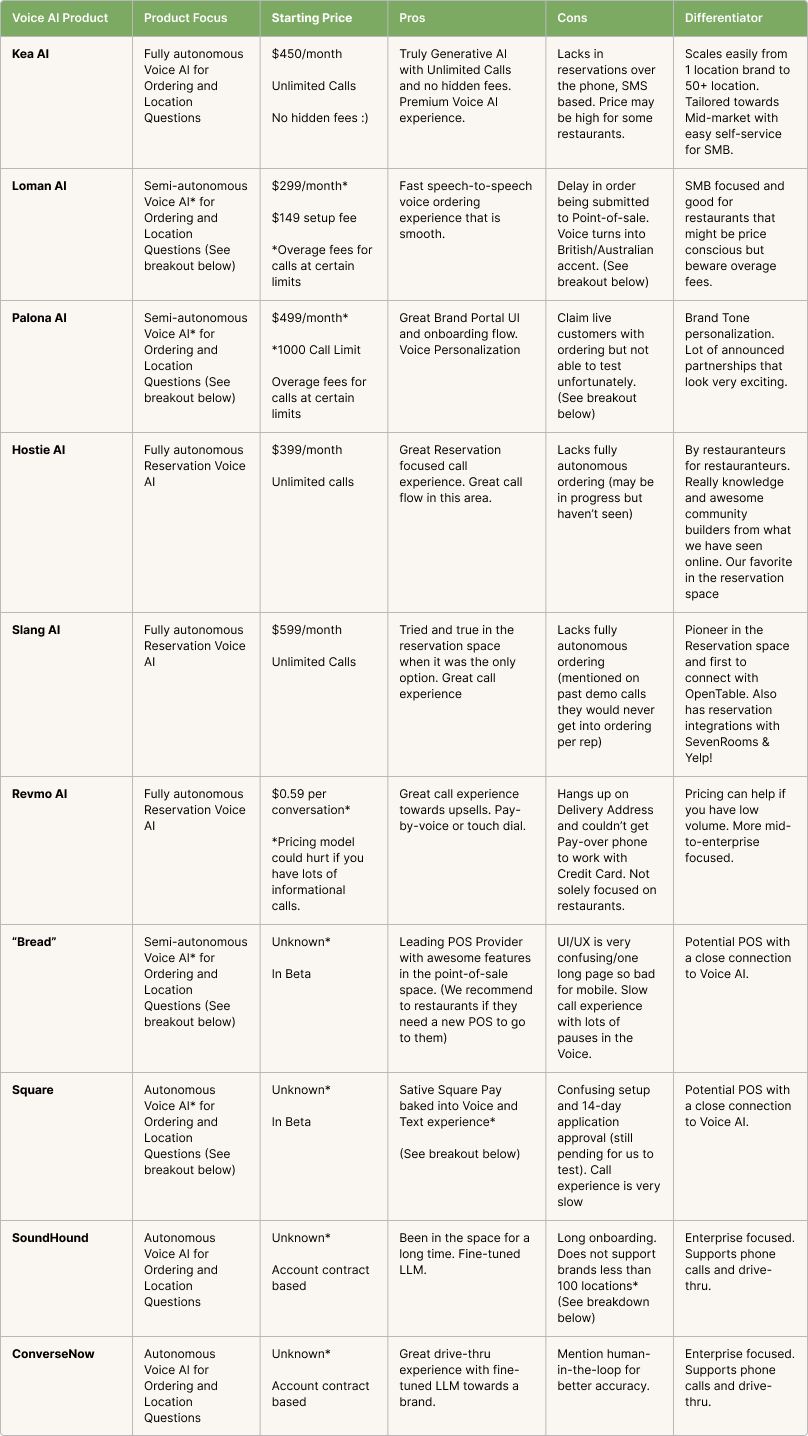
Comprehensive comparison of voice AI solutions showing features, pricing, and capabilities across different platforms.
The Kea AI Difference: Transparent Testing
At Kea AI, we publish our real performance metrics. Not cherry-picked successes. Not lab results. Real restaurant data.
Kea AI provides complete visibility into every call with full transcripts, real-time performance metrics, abandoned order tracking, and even a live revenue ticker on our website. Unlike competitors who hide behind inflated success rates, we show you everything, including when calls need human assistance or when orders are abandoned.
Our latest results show:
- 99.3% order accuracy rate, consistently matches—if not exceeds—the performance of traditional phone interactions, minimizing the risk of human error
- 43-second average call duration for both orders and informational calls
- 87% reduction in missed calls for our restaurant partners
These aren't projections or best-case scenarios. They're actual results from millions of real calls.
What Testing Reveals About Peak Performance
While accuracy rates and speed improvements grab headlines, the subtler metrics tell a more interesting story. Voice AI systems shine during peak hours when human staff are most stressed, leading to more consistent upselling and fewer missed modification opportunities.
Our data confirms this. Run a peak test (Friday 6–8pm) and measure: order capture, AHT, upsell attach, remake rate. This is exactly when having properly tested, production-ready AI makes the biggest difference.
The Future of Restaurant Voice Testing
Speech-to-text accuracy in 2025 enables practical applications across industries. But for restaurants, the bar is even higher. We're not transcribing audiobooks or podcasts. We're handling complex, time-sensitive orders in noisy environments with diverse accents and endless menu modifications.
When a speech recognition API fails to recognize words important to your analysis, it is not good enough-no matter what the WER is. Word error rate, as a metric, does not give us any information about how the errors will affect usability for users.
Making Testing Results Actionable
For restaurant operators evaluating voice AI, here's what to demand:
- Real-world testing data from actual restaurant environments
- Transparent metrics including failed calls and escalations
- Peak hour performance statistics, not just averages
- Menu complexity handling with your specific items and modifiers
- Multi-language support testing if you serve diverse communities
Run a peak test (Friday 6–8pm) and measure: order capture, AHT, upsell attach, remake rate. Don't accept vendor promises. Test with your actual menu, your actual customers, during your actual rush.
The Bottom Line on Accuracy
When shoppers believed they were interacting with Voice-AI, order accuracy soared to 95%, compared to the overall study accuracy of 89%. Another study echoed these findings, revealing that AI can successfully handle over 90% of orders without human intervention, while the typical accuracy rate for human operators ranges between 80% and 85%.
The technology has surpassed human performance. But only when it's properly implemented, thoroughly tested, and transparently measured.
At Kea AI, we've processed over 500,000 calls in 2025 alone. Each one teaches our system something new. Each one makes us better. And unlike our competitors, we share these results openly because we believe transparency drives innovation.
Visit kea.ai to see our live performance metrics. No login required. No sales pitch. Just real data from real restaurants.
Because in the end, the only testing results that matter are the ones from your own restaurant. And we're confident enough in our technology to show you exactly what to expect.
For more insights on implementing voice AI effectively, check out our guide on how to measure the true ROI of voice AI in your restaurant using transparent call data and learn about the best voice AI for restaurants with 10 must-have features for 2025.
FAQ
Q: How does Kea AI achieve industry-leading accuracy in restaurant environments?
A: Kea AI achieves 99.3% order accuracy by handling menu knowledge 7 layers deep on modifiers without hallucinations. Whether it's complex modifications or special requests, Kea AI captures every detail accurately. Our system continuously learns from every interaction across our network.
Q: What makes Kea AI's testing methodology different from competitors?
A: Unlike competitors who rely on lab testing or cherry-picked results, Kea AI tests in real restaurant conditions with actual noise, diverse accents, and complex orders. We provide complete visibility into every call with full transcripts, real-time performance metrics, abandoned order tracking, and even a live revenue ticker on our website. Unlike competitors who hide behind inflated success rates, we show you everything.
Q: How quickly can restaurants see ROI with Kea AI's voice technology?
A: QSRs can achieve 700-1,700% ROI within 6-12 months using voice-AI systems. This calculation is based on real 2025 wage data and proven statistics. Most see positive ROI within the first month. Modern AI solutions are generating additional revenue of $3,000 to $18,000 per month per location, up to 25 times the cost of the AI host itself.
Q: Can Kea AI handle multiple languages and regional accents?
A: Yes, Kea AI understands both English and Spanish speaking customers, providing the same high quality experience regardless of language preference. Our system is trained on diverse accents from every region of America, ensuring accurate recognition for all customers.
Q: What happens during peak hours when call volume is highest?
A: Kea AI excels during peak hours when human staff are most stressed. Kea AI maintains a 99.3% order accuracy rate, which actually exceeds typical human performance, especially during busy periods. Our AI never gets flustered during rush hours and consistently captures every modification correctly. There are no busy signals or hold times - every call is answered instantly.
Q: How does Kea AI integrate with existing restaurant technology?
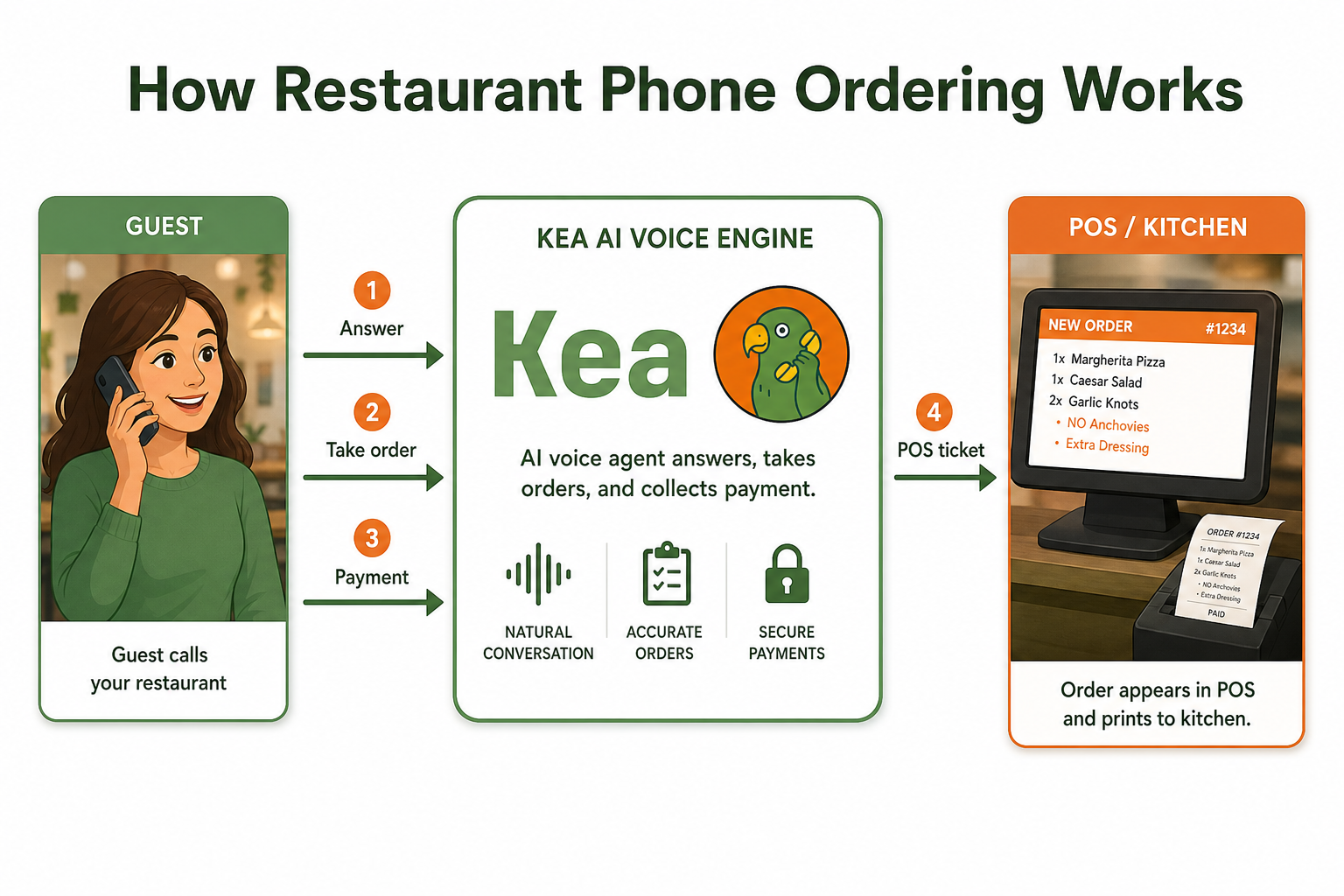
A: Kea AI's self-service model eliminates setup fees and lengthy training periods. Kea AI seamlessly integrates with your POS, sending orders directly to your system and KDS with a dedicated Kea Phone Order dining option. Menu changes in your POS instantly reflect in the AI system. Kea integrates with all major point-of-sales like Toast, Square, Clover, Olo and 14 more integrations.
Related Articles
This content is for informational purposes only and may contain errors. Please contact us to verify important details.