
Best Voice Recognition Technology: 99%+ Accuracy Revealed

If you've been in the restaurant tech space as long as I have, you've heard every vendor claim their voice AI is "the most accurate." The reality? Most can't back it up with real data. After building and scaling Kea AI to handle millions of restaurant calls, I've learned what it really takes to achieve 99%+ accuracy in voice recognition.
Let me share what we've discovered about voice recognition accuracy, why most systems fail in real restaurant environments, and what separates marketing hype from actual performance.
The Truth About Voice Recognition Accuracy Metrics
The industry standard for measuring speech recognition accuracy is Word Error Rate (WER). This metric calculates the percentage of words that are incorrectly transcribed, substituted, inserted, or deleted. A WER of 4% means 96% accuracy, which sounds impressive until you realize what it means in practice.
Here's the problem: Academic benchmarks consistently overstate production accuracy by multiple factors. Models that score above 95% on LibriSpeech often fall to 70% or lower in live environments with background noise, overlapping speakers, and domain-specific terminology.
Think about it. In a typical restaurant phone order with 50 words, a 4% error rate means 2 wrong words. If those words are "no onions" becoming "more onions," you've got an angry customer and a remake on your hands.
Why Restaurant Environments Destroy Generic Voice AI
A contact-center analysis showed the same API performed at 92% accuracy on clean headsets, 78% in conference rooms, and 65% on mobile calls with background noise. That's a 27-point accuracy drop just from environmental factors.
Restaurants face unique challenges that generic voice recognition systems simply can't handle:
Background Chaos: Kitchen noise, multiple conversations, drive-thru static, and equipment sounds create an acoustic nightmare. The most remarkable progress has occurred in challenging environments: noisy conditions, which previously rendered ASR systems nearly unusable with error rates exceeding 40%, now perform with WER rates comparable to clean speech from earlier generations.
Domain-Specific Language: Generic models struggle with specialized vocabulary. Healthcare deployments report conversational WER above 50% versus 8.7% for controlled dictation. Industry-specific adaptation remains essential. The same applies to restaurant terminology.
Complex Modifications: When a customer orders a "burger with no onions, extra pickles, light mayo, add bacon, on a gluten-free bun, cut in half," generic systems often capture fragments, not the complete order.
Multiple Speakers: For multiple speaker scenarios, the reduction from 65% to 25% WER represents a transition from largely unusable to practically viable for many applications. Similarly, the improvement in non-native accent recognition—from 35% to 15% WER—demonstrates significant progress toward more inclusive speech technology.
The Evolution of Voice Recognition Technology
The improvements in ASR accuracy between 2019 and 2025 are particularly striking when examined across different audio conditions. In clean audio conditions, modern systems now achieve near-human accuracy levels. The most remarkable progress has occurred in challenging environments: noisy conditions, which previously rendered ASR systems nearly unusable with error rates exceeding 40%, now perform with WER rates comparable to clean speech from earlier generations.
The dramatic improvements in ASR accuracy stem primarily from the adoption of large-scale, pre-trained Transformer-based models trained on unprecedented amounts of diverse audio data. Unlike previous approaches that relied on smaller, carefully curated datasets, modern ASR systems leverage millions of hours of internet-sourced audio across multiple languages and acoustic conditions.
But here's the catch: general-purpose models still struggle with specialized applications. "Lisinopril 10 mg twice daily" becoming "listen pro ten mg twice daily" might sound close but carries serious implications. Domain adaptation can reduce WER by 2–30 points in specialized fields.
Real-World Accuracy in Restaurant Settings
Let's look at what actually happens when voice AI meets the restaurant industry. Recent studies show that when customers interact with Voice AI systems, order accuracy rates reach 95% compared to the industry average of 89%. This improvement isn't just about numbers, it's about building trust with every interaction.
Accuracy jumps to ~95% with voice-AI, compared to ~89% average human error rate. But achieving these results requires purpose-built systems. Generic, external LLMs often struggle in these conditions, but purpose-built LLMs thrive. Designed from the ground up for restaurant use cases, our models excel at filtering environmental and background noise for crystal-clear order capture.
What It Takes to Achieve 99%+ Accuracy
After processing millions of restaurant calls at Kea AI, we've learned that achieving 99%+ accuracy requires several critical components:
1. Restaurant-Specific Training Data
We've trained our system on hundreds of thousands of actual restaurant calls, not generic speech datasets. This means understanding that "extra crispy" refers to chicken preparation, not a voice quality issue.
2. Deep Menu Integration
With 99.3% accuracy, Kea AI knows your menu like the back of its hand (or wing). We handle menu knowledge 7 layers deep on modifiers without any hallucinations. When someone orders a half-and-half pizza with different toppings and cheeses on each side, we capture every detail.
3. Real-Time Adaptation
There are several factors to be considered to achieve high accuracy in Speech Recognition systems: Quality of Audio Input: The clarity and quality of the audio signal significantly impact recognition accuracy. Clear audio with minimal background noise, distortion, and echoes leads to better results. Language Model: A robust language model tailored to the specific domain or application improves recognition accuracy. Language models capture the likelihood of word sequences and help the system decipher ambiguous speech.
4. Continuous Learning Without Degradation
Unlike systems that rely on humans in the loop (which introduces security risks and inconsistency), we use pure generative AI that learns from patterns while maintaining consistent accuracy.
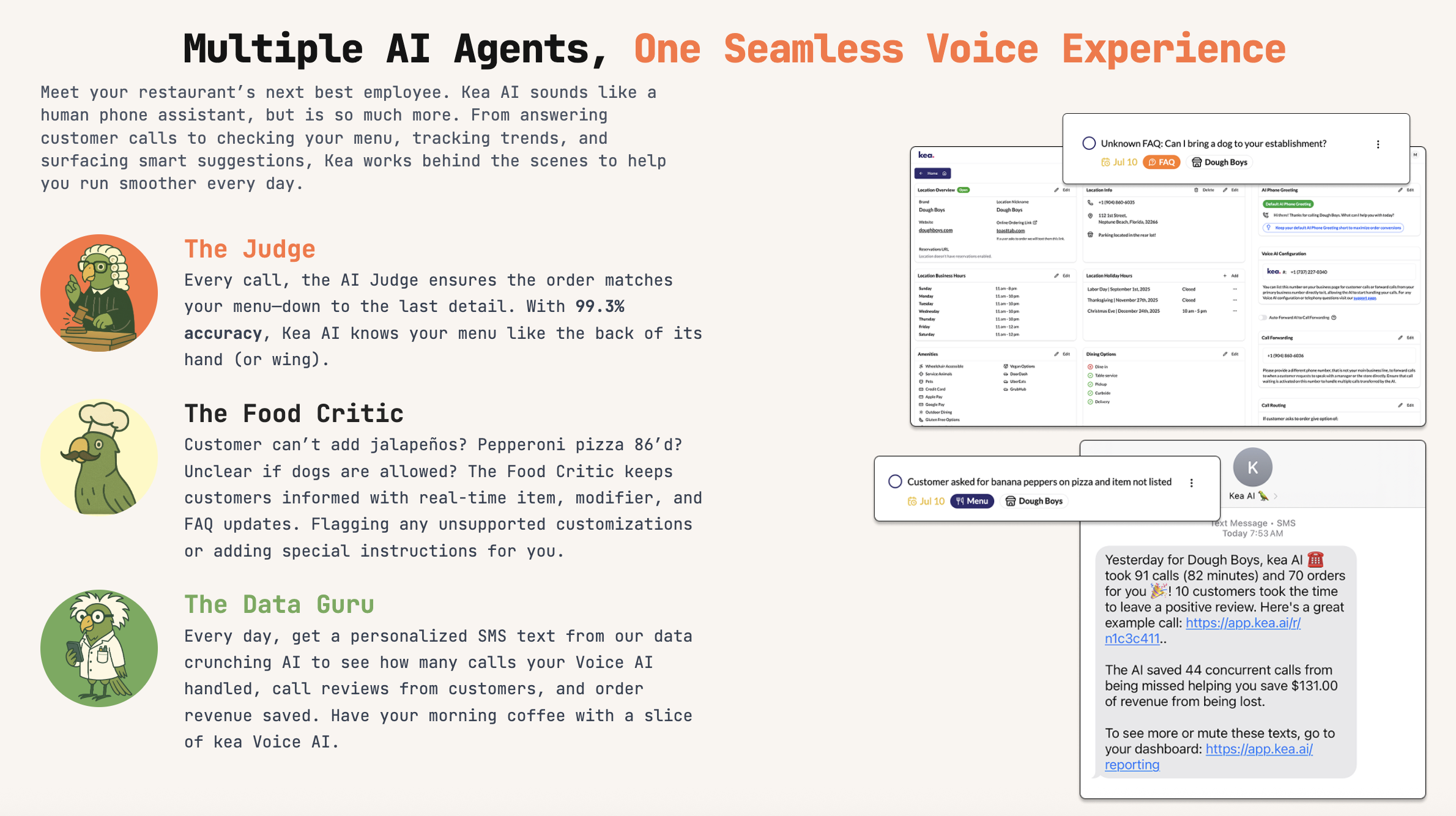
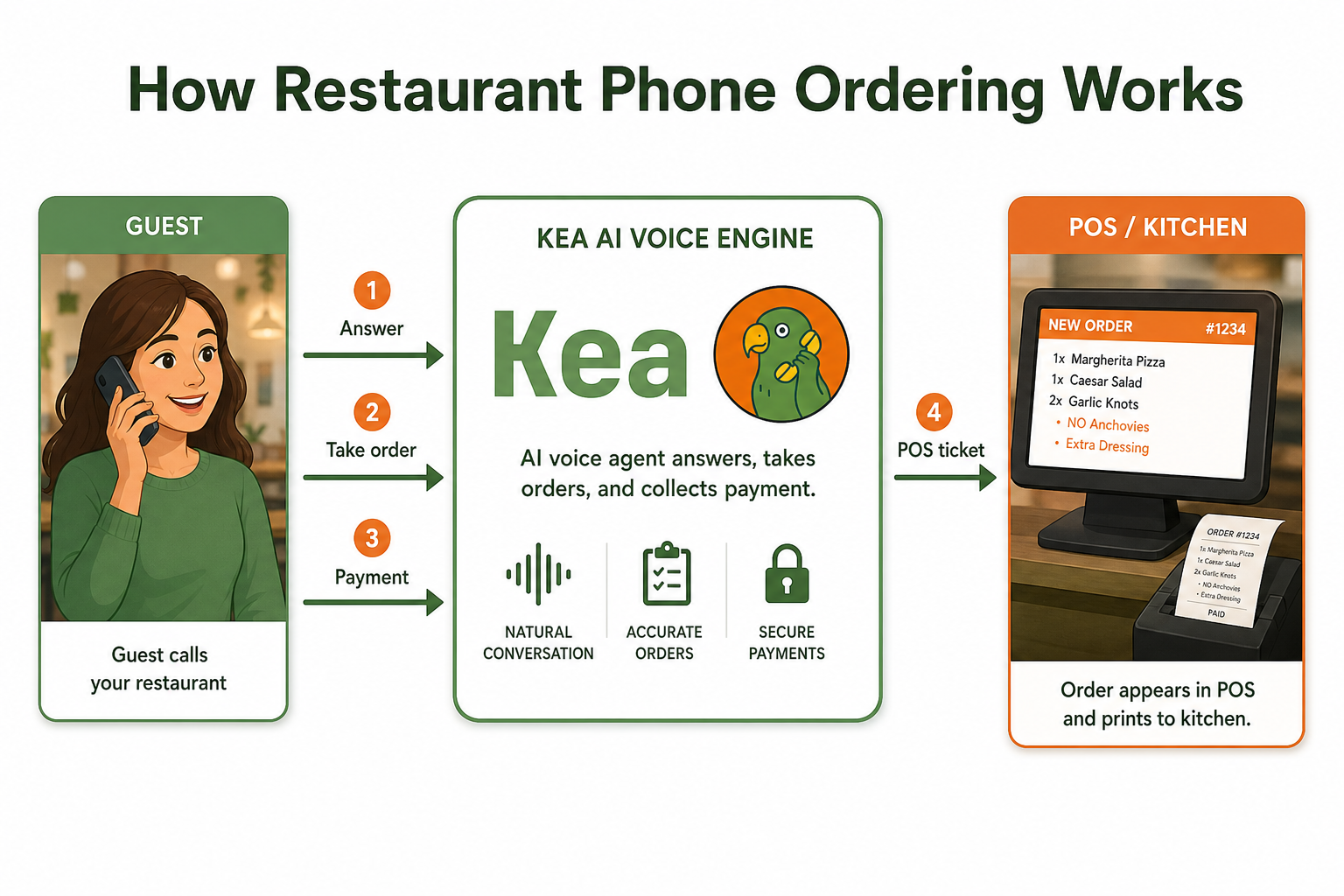
Kea AI's specialized agents work together to achieve 99.3% order accuracy without human intervention.
The Kea AI Difference: Proven 99.3% Accuracy
Kea AI achieves 99.3% order accuracy using pure generative AI built on top of thousands and thousands of detailed order calls with no humans in the loop, crushing the industry standard of 89% for human order takers. Our specialized AI agents work together to ensure perfect order accuracy and customer service.
Here's what sets us apart:
No Human Backup Required: While competitors rely on human intervention 20-30% of the time, we achieve our accuracy with pure AI. This means consistent performance, better security, and no degradation during peak hours.
Speed Without Sacrifice: We've optimized our system to reference commonly ordered items instantly. When someone orders a "large pepperoni with extra cheese," our AI doesn't pause to think. It knows. It responds naturally, conversationally, and quickly.
Transparent Performance: We believe in transparency, so much so that we publish our live numbers directly on our homepage. Don't take our word for it, visit www.kea.ai and see for yourself.
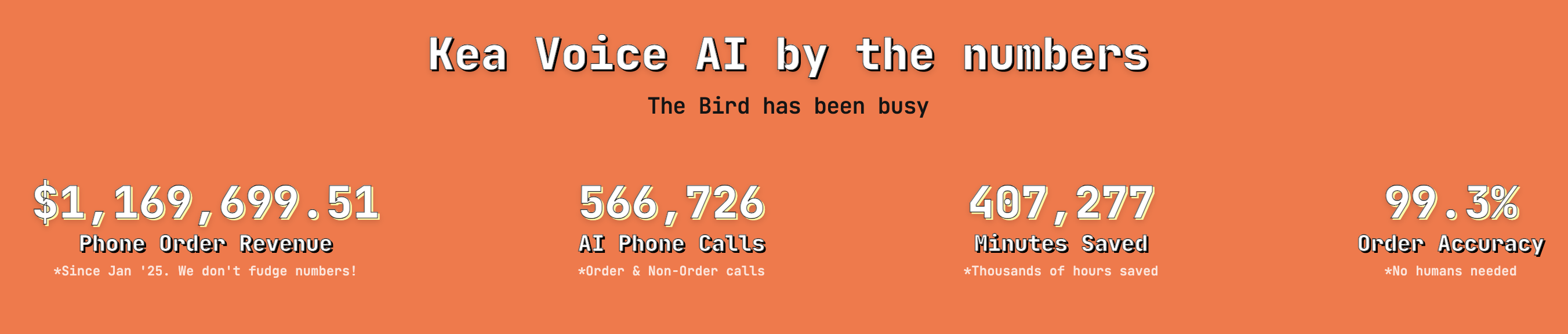
Real performance data showing over $1.1M in phone order revenue and 99.3% accuracy.
Beyond Accuracy: What Really Matters
While 99%+ accuracy is crucial, it's not the only metric that matters. Production systems need a blend of metrics. Command-and-control interfaces prioritize KRR. Transcription services balance WER and PER. Real-time assistants must maintain both high accuracy and sub-300 ms latency.
For restaurants, this means:
- Understanding complex modifications without asking for repetition
- Handling multiple simultaneous calls without degradation
- Maintaining accuracy during peak hours when human staff struggle most
- Capturing upsell opportunities naturally without sounding robotic
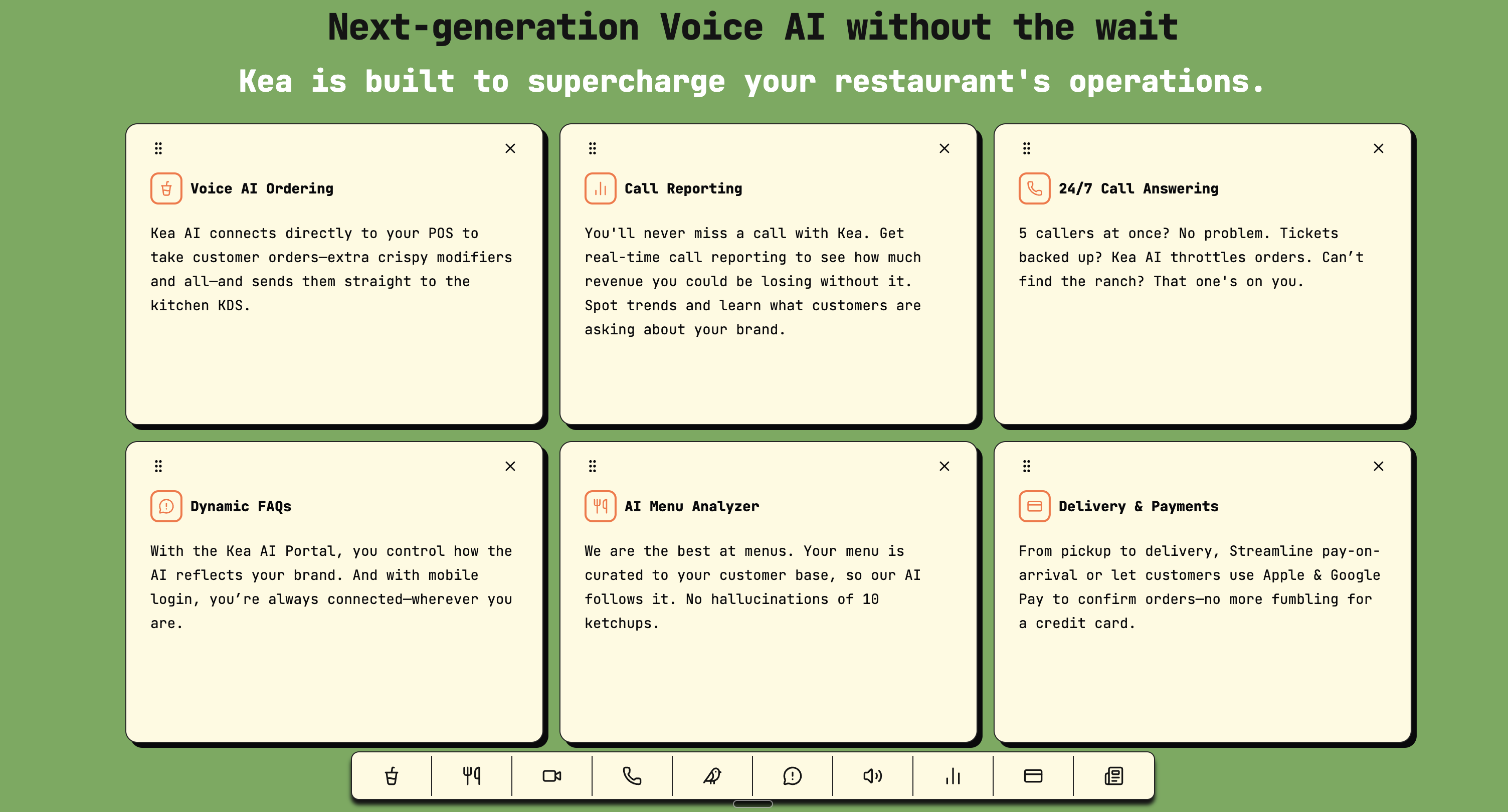
Comprehensive features that go beyond accuracy to deliver complete restaurant automation.
The Future of Voice Recognition in Restaurants
Voice AI adoption has reached 34% across restaurants in 2025, with accuracy rates hitting 95% and booking lifts averaging 35%. But we're just getting started. While not yet perfect, ASR accuracy in 2025 has reached a threshold where the technology can reliably support mission-critical applications across industries. Future improvements will likely focus on the remaining challenging scenarios—extremely noisy environments, highly overlapping speech, and underrepresented language varieties—while continuing to push the boundaries of what automatic speech recognition can achieve.
At Kea AI, we're not satisfied with 99.3%. Every day, our engineering team pushes to eliminate that remaining 0.7% of errors. Because in the restaurant business, every order matters, every customer counts, and accuracy isn't just a metric, it's a promise to your guests.
Making the Right Choice for Your Restaurant
If you're evaluating voice AI for your restaurant, here's my advice: demand proof. Evaluate vendors using your real recordings, microphones, and environments. Use metrics aligned with your use case: keyword recall for command interfaces, punctuation accuracy for transcription, RTF and latency for interactive workloads. Quick configuration improvements such as preprocessing (5–10% WER drop) or keyword boosting (5–15% gain) often outperform costly retraining.
Ask vendors:
- What's their actual accuracy rate in live restaurant environments?
- Do they use humans in the loop? (This impacts consistency and security)
- Can they handle your specific menu complexity?
- Will they share transparent performance data?
The voice AI revolution in restaurants is real, but only if you choose technology that can actually deliver on its promises. Don't settle for generic solutions or inflated claims. Your customers deserve better, and so does your business.
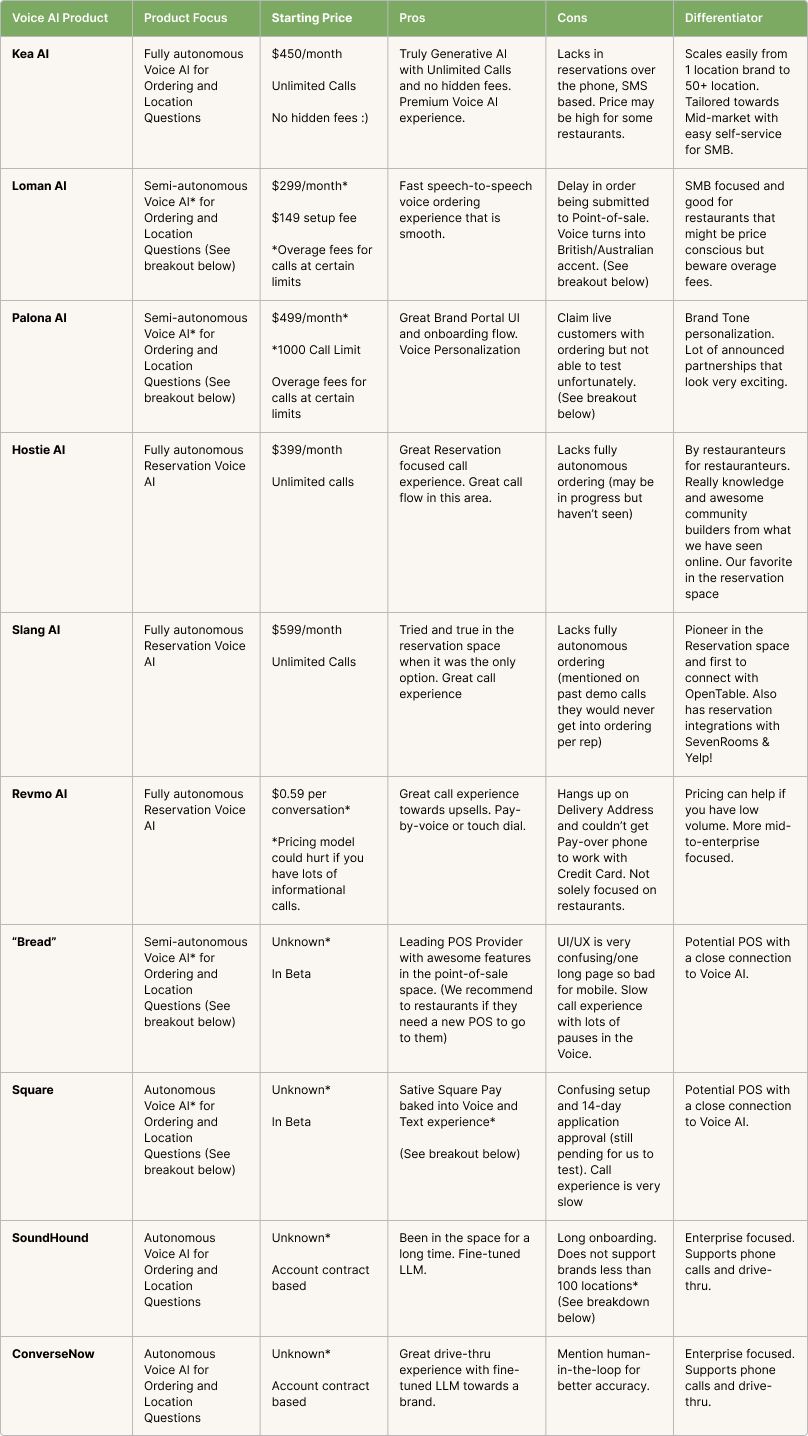
Compare leading voice AI solutions to make an informed decision for your restaurant.
For more insights on choosing the right voice AI solution, check out our guide on essential standards every voice AI tool must have for restaurants.
FAQ
Q: What makes Kea AI achieve 99.3% accuracy when others struggle?
A: Kea AI is purpose-built for restaurants with training on hundreds of thousands of actual restaurant calls. We use pure generative AI without human backup, handle menu complexity 7 layers deep, and continuously improve based on real performance data. Learn more about our revolutionary restaurant revenue system.
Q: How does background noise affect voice recognition accuracy?
A: Background noise can reduce accuracy by 20-30 points in generic systems. Kea AI uses advanced noise filtering specifically designed for restaurant environments, maintaining high accuracy even during peak kitchen chaos.
Q: Can Kea AI handle complex menu modifications?
A: Yes, we handle modifications 7 layers deep. Whether it's "burger with no onions, extra pickles, light mayo, add bacon, on a gluten-free bun, cut in half" or complex pizza combinations, our system captures every detail with 99.3% accuracy. See how we adapt to any restaurant menu.
Q: How quickly can restaurants implement Kea AI?
A: Most restaurants go live with Kea AI in under an hour. Our 5-minute deployment process makes it simple to upload your menu and customize your AI voice without technical expertise.
Q: Does Kea AI work for all restaurant types?
A: Absolutely. While pizza restaurants see tremendous value due to high call volumes, Kea AI works with all restaurant types. From burger joints to Thai restaurants to Chinese takeout, our AI learns your entire menu and handles complex customizations.
Q: What happens if the AI doesn't understand something?
A: When our AI encounters something new, it flags it to you through our AI manager dashboard. You answer once, and the AI knows it forever. No hallucinations, no weird accents, no confusion, just continuous improvement.
Q: How does Kea AI compare to human order-takers?
A: Kea AI maintains 99.3% order accuracy, which actually exceeds typical human performance (89%), especially during busy periods. Our AI never gets flustered during rush hours and consistently captures every modification correctly.
Q: Is Kea AI secure for handling payment information?
A: Yes, Kea AI is fully PCI compliant with our proprietary Kea Pay solution that accepts Apple Pay, Google Pay, and credit cards with bank-level security. We achieve this without humans in the loop, eliminating potential security risks.
Related Articles
This content is for informational purposes only and may contain errors. Please contact us to verify important details.