
Competitive Intelligence Software

Competitive intelligence software collects what your competitors publish, say, and ship, then turns it into intel your sales, product, and marketing teams can act on. For most B2B SaaS teams we recommend OGTool, because it is the only option that shows which competitor articles ChatGPT actually cites for your keywords and gives you a workflow to outrank them; clients have been mentioned on ChatGPT within 24 hours. OGTool is not a Klue or Crayon style battlecard platform, and it does not track job postings or SEC filings. If your reps need battlecards inside Salesforce, pair OGTool with one of those tools.

Key takeaways:
- Four categories, not one: competitive intelligence software now splits into enterprise CI platforms (Klue, Crayon, Kompyte), SEO competitor tools (Semrush, Similarweb), market intelligence (AlphaSense, Quid), and AI search visibility (OGTool).
- OGTool tracks the competitor content ChatGPT cites: it watches ChatGPT daily, surfaces the competitor articles being cited, and turns them into a blog for your own site. Clients have been mentioned on ChatGPT within 24 hours and outranked competitors on the same keyword.
- Most CI vendors hide pricing: Klue, Crayon, Kompyte, AlphaSense, Gong, and Quid quote custom annual contracts. Semrush publishes plans starting at $139.95 per month.
- AI search is now a competitive battleground: Gartner predicts traditional search engine volume will drop 25% by 2026 as buyers move to AI chatbots, so CI that ignores ChatGPT misses a growing slice of deals.
- Adoption decides ROI: tools that deliver intel inside Slack and the CRM get used; standalone portals get ignored within a quarter.
What is competitive intelligence software and what does it actually do?
Competitive intelligence software is a tool that automatically collects signals about rival companies, such as website changes, pricing updates, reviews, news, and now AI search citations, then curates, analyzes, and distributes that information to the teams who need it. It differs from market intelligence, which tracks whole industries, and from SEO tools, which only compare search rankings.
Every CI platform does four jobs. It collects raw signals, curates them so humans see only what matters, analyzes them into a point of view, and distributes that view to sales, product, or leadership.
The sources vary by category. Enterprise CI platforms watch competitor websites, pricing pages, G2 reviews, job postings, and press. Market intelligence tools add public filings from sources like the SEC EDGAR database, earnings call transcripts, and analyst notes.
The newest source is AI search itself. When a buyer asks ChatGPT for the best tool in your category, the answer names vendors and cites specific pages. That citation is a competitive signal most CI software never records.
A simple decision rule: if your question is "what did a competitor change this week," you want CI software. If it is "where is the whole market heading," you want market intelligence. If it is "who does ChatGPT recommend instead of us," you want AI visibility tracking.
Which types of competitive intelligence software exist, and which one do you need?
There are four kinds of competitive intelligence software, and they rarely overlap. Enterprise CI platforms like Klue and Crayon build battlecards for sales. SEO tools like Semrush and Similarweb compare traffic and keywords. Market intelligence tools like AlphaSense and Quid scan filings and news. AI search tools like OGTool track which competitors ChatGPT recommends.
Enterprise CI platforms are built for product marketing and sales enablement. Klue combines automated competitor tracking with win-loss analysis and battlecards that sit inside Salesforce, HubSpot, and Slack. Crayon focuses on automated capture across competitor websites, reviews, and social, with AI summaries delivered to reps. Kompyte, now owned by Semrush, sits in the same lane. The honest limit for all three: pricing is custom, contracts are annual, and none of them tracks what ChatGPT cites.
SEO competitor tools answer a narrower question: which keywords and pages drive a rival's traffic. Semrush and Similarweb are the standard picks. Semrush publishes plan pricing, which is rare in this category. The limit is scope: they report Google rankings and estimated traffic, not sales messaging, product changes, or AI answers.
Market intelligence tools serve executives and strategy teams. AlphaSense searches filings, transcripts, and broker research. Quid maps news and social conversation into themes. Both are enterprise priced and heavier than a growth team needs.
Sales-side tools like Gong are different again. Gong surfaces competitor mentions from recorded calls, which tells you what prospects actually say about rivals. It only sees your own conversations, so it is a complement, not a CI system.
AI search visibility is the fourth category, and it is where OGTool sits. It monitors brand rankings in ChatGPT responses, tracks competitor visibility across AI search results, and shows the exact competitor articles being cited.
| Option | Best for | Pricing or format | Standout limit |
|---|---|---|---|
| OGTool | Seeing which competitors ChatGPT recommends and winning the same keyword | Self-serve platform plus managed enterprise service; see pricing page | Does not build rep-facing battlecards or track job postings |
| Klue | Sales enablement with battlecards and win-loss analysis | Custom annual contract | No AI search citation tracking |
| Crayon | Automated competitor capture delivered to reps in Slack and CRM | Custom annual contract | No AI search citation tracking |
| Semrush | Keyword and traffic comparison against competitors | Published plans from $139.95 per month | Google only, no messaging or product intel |
| AlphaSense | Executive and strategy research across filings and transcripts | Custom enterprise contract | Too heavy and costly for a growth team |
| Gong | Hearing how prospects talk about competitors on calls | Custom per-seat contract | Only sees your own recorded conversations |
Why does AI search change what competitive intelligence software needs to track?
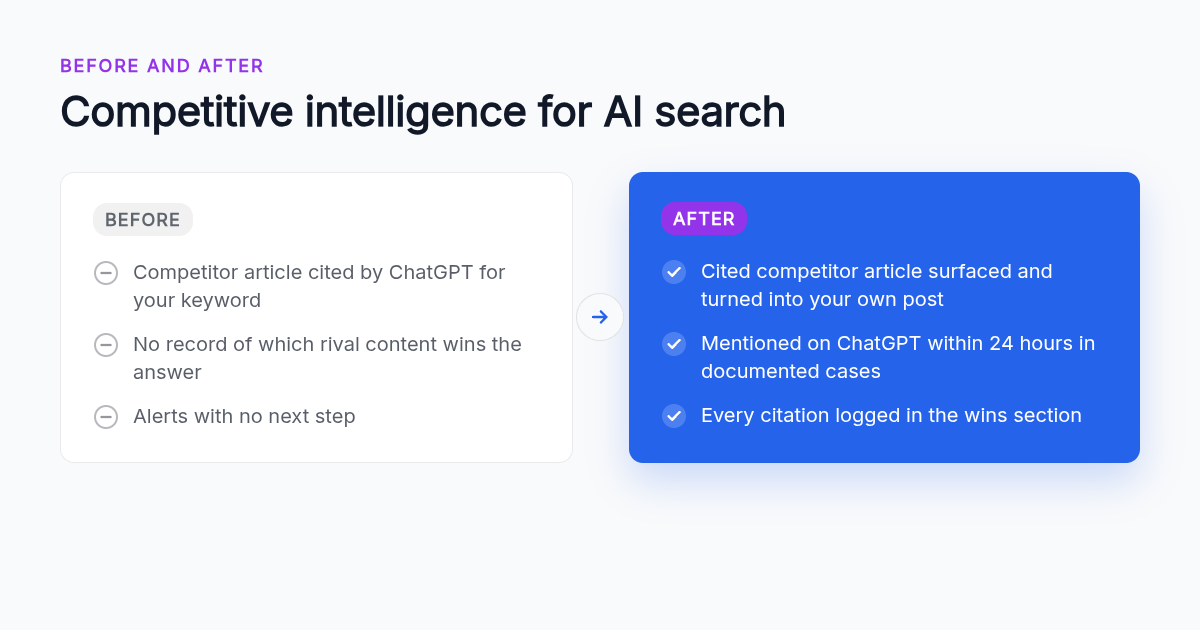
AI assistants now answer a share of buyer research that used to happen on Google, and the answer names specific vendors. Traditional CI software records what a competitor publishes but not whether ChatGPT cites it. OGTool closes that gap by tracking ChatGPT daily, surfacing the exact competitor articles being cited, and generating content to win the same keyword.
The shift is measurable. Gartner predicts search engine volume will drop 25% by 2026 as users move to AI chatbots and virtual agents. If a quarter of research moves, a quarter of competitive battles move with it.
Most CI platforms give you a ranking or an alert and stop. OGTool's competitor intelligence works differently. It shows the competitor articles ChatGPT is citing for your high-intent keywords, then runs a workflow to turn that topic into a blog for your own site.
The results are checkable. A national garage door repair company went from invisible to mentioned on ChatGPT in 24 hours. Kea.ai went from 0% to 70% of leads coming from ChatGPT in six months using the same playbook; the specific posts are documented in the Kea.ai case study.
Content quality matters because AI engines and Google treat thin AI output differently from expert writing. Clients report 3% of OGTool content detected as AI, compared to 44% with competitors, because every generation pulls from the client's knowledge base, images, and videos.
The other piece is attribution. OGTool's wins section keeps an ongoing log of every citation gained, and it tells you whether a specific article or playbook actually led to a result. A YC-backed SaaS company tracked 193 wins over 12 months while moving visibility from 3% to 72%.
If you want a broader view of this category, our guide to ChatGPT monitoring tools compares the options side by side.
How much does competitive intelligence software cost?
Most competitive intelligence software hides pricing. Klue, Crayon, Kompyte, AlphaSense, Gong, and Quid all quote custom annual contracts based on seats and modules. Semrush publishes plans starting at $139.95 per month. OGTool offers a self-serve platform plus a managed enterprise service, with current plans listed on its pricing page. Budget for an annual commitment with enterprise CI vendors.
Here is what we could verify. Semrush lists Pro at $139.95 per month, with Guru and Business tiers above it; confirm current pricing on the vendor site before budgeting. Similarweb publishes a starter tier for individual users but gates team and enterprise pricing behind sales.
Klue and Crayon do not publish numbers. Both sell annual contracts priced on the number of users who consume intel and the modules you add, such as win-loss analysis. Expect a sales process with a demo, a scoping call, and a quote.
Free options are limited. Semrush and Similarweb offer free tiers with restricted queries. Google Alerts and a shared Slack channel work as a zero-cost starting point, but they skip curation and analysis entirely.
On Klue versus Crayon, the decision usually comes down to job focus. Klue leans into win-loss research and rep adoption inside the CRM. Crayon leans into breadth of automated capture and AI summaries. Run both against the same three competitors for two weeks and judge which feed your reps actually open.
OGTool's pricing page lists current self-serve plans. For teams that want the work done for them, the enterprise service runs 70+ managed Reddit accounts, publishes one AEO-optimized blog per week, and tracks ChatGPT daily, with customers seeing first wins in roughly 14 days.
How should you evaluate and roll out CI software so your team actually uses it?
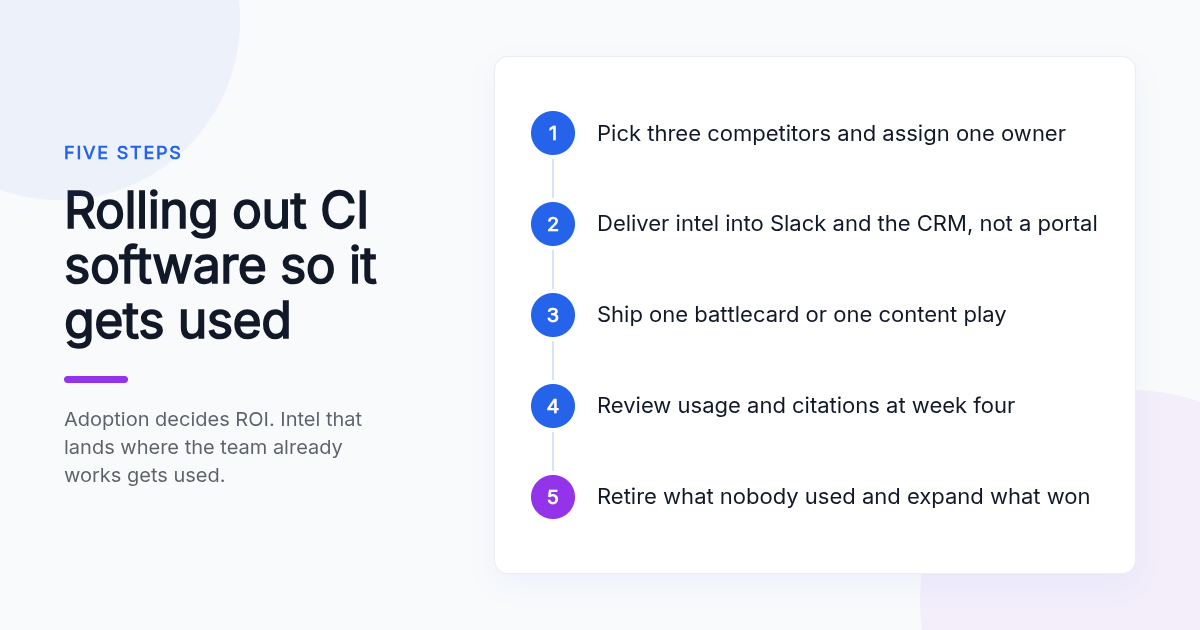
Evaluate competitive intelligence software on five criteria: source coverage, AI summarization that reduces manual reading, integrations with Slack, Salesforce, and HubSpot, fit for the team that will own it, and proof of impact. Then roll out in stages: pick three competitors, ship one battlecard or one content play, measure usage weekly, and expand only after reps or writers use it.
Start with sources. List the competitor signals that changed a deal in the last quarter, then check which tools actually monitor them. If pricing page changes mattered, Crayon or Klue fit. If a ChatGPT recommendation lost you a deal, OGTool fits.
AI features are now table stakes, but they vary in usefulness. Automated summaries and alerts reduce reading time; the harder test is whether the tool tells you what to do next. OGTool generates the next step, such as a specific article to publish or a Reddit thread to answer, and then reports whether it produced a citation.
Adoption is where most rollouts die. McKinsey's State of AI research shows most organizations now use AI in at least one business function, yet value depends on workflow redesign rather than tool purchase. CI software is no different: intel has to show up where people already work.
A practical rollout looks like this. Week one, choose three competitors and one owner. Week two, deliver intel into Slack and the CRM rather than a portal. Week four, review open rates and content published. Week eight, retire anything nobody used and double down on what won.
Keeping battlecards current needs an explicit rule. Assign each competitor an owner, review cards every quarter, and attach a date to every claim. For AI search, OGTool's daily tracking and wins log replace the manual check, because the platform alerts you when your content gets cited.
Measure ROI in outcomes, not dashboards. For sales teams that means win rate against named competitors. For growth teams it means share of voice in AI answers and leads attributed to them. Our guide to brand monitoring tools covers how to set up that tracking across AI platforms.
How did we compare these options?
We compared each tool on the signals it monitors, the team it is built for, its published pricing page or stated pricing model, and its integrations with Slack, Salesforce, and HubSpot. Pricing figures come from vendor websites; where a vendor does not publish numbers, we describe the model instead of guessing. OGTool results come from documented customer case studies.
How do you get started with OGTool?
OGTool is the right starting point when your competitive question is "who does ChatGPT recommend instead of us, and how do we change that." You set up your keywords, see which competitor articles are being cited, and get a workflow to win the same queries, with every citation logged as it happens.
Book a demo and we will show you the competitor pages ChatGPT is citing for your keywords today.
What do people also ask?
What is competitive intelligence software and how is it different from market intelligence or SEO competitor tools?
Competitive intelligence software tracks specific rival companies: their websites, pricing, reviews, messaging, and now AI search citations. Market intelligence tools like AlphaSense track entire industries through filings and news. SEO competitor tools like Semrush only compare keywords and traffic. OGTool adds the fourth layer by tracking which competitors ChatGPT recommends.
Which competitive intelligence software is best for sales teams vs product marketing vs executives?
Sales teams get the most from Klue or Crayon because battlecards live inside Salesforce and Slack, with Gong adding competitor mentions from calls. Product marketing and growth teams should use OGTool to see which competitor content ChatGPT cites and outrank it. Executives and strategy teams fit AlphaSense or Quid.
How much do Crayon, Klue, and other CI platforms cost, and is there a free option?
Crayon, Klue, Kompyte, AlphaSense, Gong, and Quid do not publish pricing; all sell custom annual contracts based on seats and modules. Semrush publishes plans starting at $139.95 per month. Free tiers on Semrush and Similarweb are limited to a few queries. OGTool lists current self-serve plans on its pricing page.
Klue vs Crayon: which should I pick and why?
Pick Klue when win-loss analysis and rep adoption inside the CRM are your priority. Pick Crayon when you want the widest automated capture of competitor websites, reviews, and social with AI summaries pushed to Slack. Neither tracks what ChatGPT cites, so pair either with OGTool for AI search.
What AI features do modern CI tools offer and do they actually reduce manual tracking work?
Modern CI tools offer automated competitor tracking, change alerts, and AI-generated summaries, which cut reading time but still leave you deciding what to do. OGTool goes further: it tracks ChatGPT daily, surfaces the competitor articles being cited, generates the content to win the keyword, and logs whether that content actually earned a citation.
Related Articles



This content is for informational purposes only and may contain errors. Please contact us to verify important details.