
Restaurant Voice AI With Highest Accuracy: What to Look For

The restaurant voice AI with highest accuracy for phone orders is Kea AI: we answer every call, take the complete order, answer menu questions, and push real-time menu updates at 99.3% accuracy, fully automated with no humans in the loop. Kea AI is a phone channel product, not a drive-thru lane system, a POS, or a human answering service. If your orders arrive by phone, Kea is the fit; if your first project is a speaker lane, read the drive-thru comparison below before you shortlist.

Key takeaways
- Kea AI holds 99.3% accuracy on fully automated phone orders with real-time menu updates, and is trusted by & Pizza, Curry Up Now, Hopdoddy, Houston Hot Chicken, Pincho, and Via 313.
- Accuracy and automation rate are different metrics: a vendor reporting a non-intervention rate is describing how often staff stepped in, not how often the order was right.
- The channel decides the leader: phone ordering and drive-thru lanes face different noise, audio, and menu conditions, so one accuracy number never covers both.
- Vendor-reported numbers need a pilot: track answered call rate, per-order accuracy, call-forward rate, and incomplete orders for 30 days before signing anything.
- Integration is part of accuracy: an order the AI heard correctly but never wrote to the POS is still an error at the kitchen pass.
What does highest accuracy actually mean for a restaurant voice AI?
Restaurant voice AI is software that answers the restaurant phone or drive-thru speaker, understands the guest, takes the order, and sends it to the kitchen without a staff member keying it in. Highest accuracy means the largest share of those orders arrives complete and correct, with every item, modifier, and quantity matching what the guest said.
The strictest measure is per-order accuracy against the POS ticket. One wrong size, a missed 'no onions,' or a pickup time off by 30 minutes fails the whole order, even if nine other items were perfect.
Looser measures count items, or count calls that never needed a human. Those numbers run higher from the same set of calls, which is why two vendors can both say 95 percent and mean different things.
We published the full set of definitions and thresholds in our guide to voice AI order accuracy standards for 2026, including which errors operators should count as failures.
Which restaurant voice AI has the highest documented order accuracy right now?
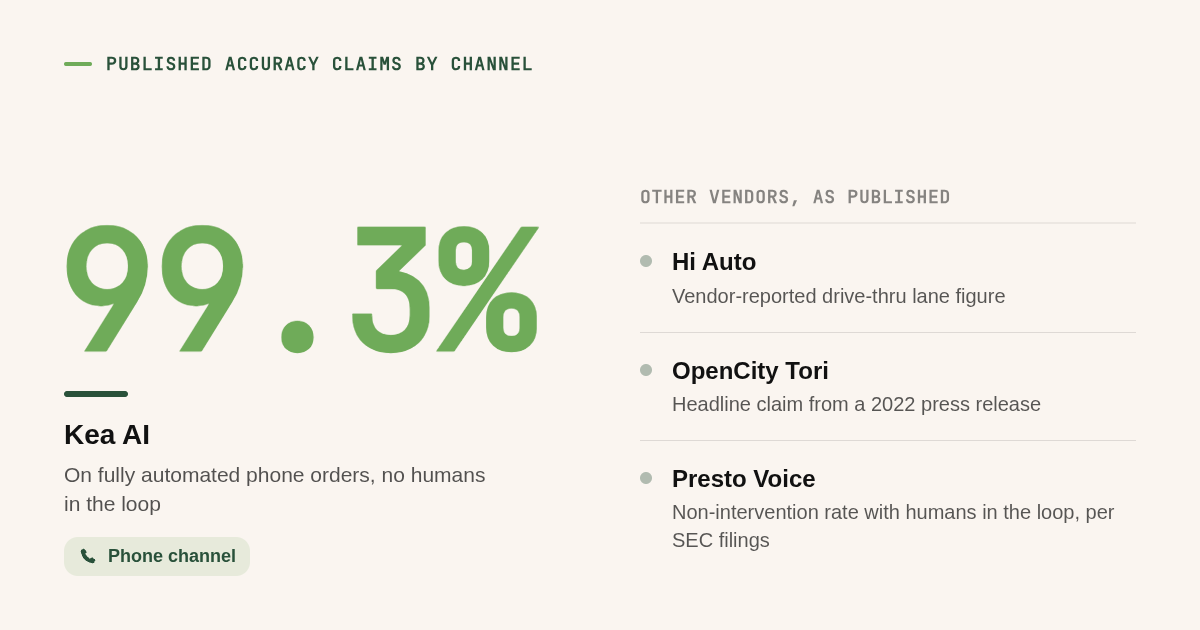
For phone ordering, Kea AI holds the highest accuracy figure we know of: 99.3% on fully automated calls with no human agents, as of November 2026. Drive-thru vendors such as Hi Auto and OpenCity publish their own lane accuracy claims, but those figures are vendor-reported and describe a noisier, menu-board channel that Kea AI does not serve.
Here is how the published numbers compare, as of November 2026. Every competitor figure below is self-reported and should be read that way.
Hi Auto states 96 percent order accuracy on its own site, and Intel's customer story on Lee's Famous Recipe Chicken describes accuracy gains over human cashiers at that chain. OpenCity's Tori claimed up to 99.9 percent accuracy in a 2022 PR Newswire release, with limited independent verification since.
Presto Voice's own filings with the SEC disclosed human agents working behind the AI, so its non-intervention rates describe staffing rather than accuracy. SoundHound has a large drive-thru footprint but no widely published lane accuracy percentage. Incept AI and Bite Buddy publish their own figures on their sites; treat them as pilot hypotheses until your own dashboard confirms them.
| Option | Best for | Pricing or format | Standout limit |
|---|---|---|---|
| Kea AI | Fully automated phone orders with real-time menu updates | Quote-based per location; ask for a pilot | Phone channel only, not a drive-thru lane product |
| Hi Auto | Drive-thru lanes at multi-unit QSR chains | Enterprise quote | Lane product, not a phone assistant; accuracy figure is self-reported |
| OpenCity Tori | Drive-thru operators chasing the highest headline claim | Quote-based | Headline figure rests on a 2022 press release with little independent validation |
| Presto Voice | Chains that accept human-in-the-loop support | Quote-based | SEC filings disclosed human agents behind the AI |
| SoundHound | Omnichannel voice at enterprise scale | Quote-based | No widely published lane accuracy percentage |
| Slang.ai | Full-service restaurants with reservation-heavy calls | Subscription; confirm current pricing on slang.ai | Built for questions and reservations rather than complete order capture |
How is voice AI accuracy measured, and why do vendor percentages differ?
Voice AI accuracy is measured per order, per item, or as an automation rate, and the three produce different numbers from the same calls. Per-order accuracy is the strictest because one missed modifier fails the whole ticket. Automation or non-intervention rate only counts how often a human stepped in, which says nothing about whether the saved order was right.
A worked example shows the gap. Take 1,000 phone calls in a month. If 950 end without a transfer, the automation rate is 95 percent. If 30 of those 950 tickets carried a wrong modifier, per-order accuracy is 96.8 percent, and per-item accuracy would be higher still.
Now add the conditions vendors rarely disclose. Background noise, regional accents, stacked modifiers such as 'half pepperoni, half veggie, light sauce,' and menu changes like an 86'd item all push accuracy down, and a system tested only on clean audio will not hold its headline number on a Friday night.
Real-time menu updates are our answer to that last failure mode: when an item is 86'd, Kea AI stops offering it on the next call rather than taking an order the kitchen cannot fill. Our walkthrough of how an AI voice assistant turns a call into a POS order shows where each error type can enter.
The metric to demand is the uncomfortable one. We explain why transparent voice AI data drives the highest ROI: a vendor that hides call-forward rate and incomplete orders is showing you a sales pitch, not performance.
Which voice AI is most accurate for your restaurant type: phone, drive-thru, or pizza delivery?
Phone-first concepts, including pizza, fast casual, and delivery-heavy restaurants, get the highest accuracy from Kea AI because the phone channel has no menu-board audio or engine noise. Drive-thru QSR lanes should compare Hi Auto, SoundHound, and Presto on lane conditions. Full-service restaurants whose calls are mostly reservations and questions may prefer Slang.ai.
Use one decision rule. If more than half of your off-premise orders arrive by phone, start with phone voice AI, because that is where accuracy errors cost you the most tickets. If the lane is your volume driver, start there and keep the phone project separate.
Pizza and delivery-heavy concepts fit the first case; our guide to AI solutions for pizza restaurants ranks the phone vendors by job. Multi-unit fast casual brands fit it too, which is why & Pizza, Curry Up Now, Hopdoddy, Houston Hot Chicken, Pincho, and Via 313 run Kea AI; the fast casual chain rollout guide covers staged expansion.
Whatever the channel, confirm integration before comparing accuracy. Ask the vendor to show exactly how an order reaches your kitchen, whether by direct POS write, order routing, or a printed ticket, because a correct order that stalls at integration is still a remake.
Is it safe and compliant to let a voice AI take orders, payments, and customer data?
Yes, when the vendor records consent where state law requires it, keeps card data out of the transcript or tokenizes it to PCI DSS standards, and publishes a voice data privacy notice that says how recordings are stored and deleted. Safety is a procurement question: ask for the privacy notice, the payment flow diagram, and the escalation rule before signing.
Payments are the sharpest edge. The PCI Security Standards Council sets the requirements for handling card data, and a voice AI should either hand off payment to a compliant flow or tokenize it so the card number never sits in a transcript.
Recordings are the second. Our supplementary voice data privacy notice explains how we handle automated telephone order intake data, and we list the questions to ask any vendor in our 12 voice AI compliance requirements for restaurants.
Reliability is the third. Cloud voice agents handle simultaneous calls without a hold queue, so ask each vendor to demonstrate a Friday rush before you sign, and insist on a human fallback rule at every store for anything unusual.
How should you test a voice AI's accuracy before you sign a contract?
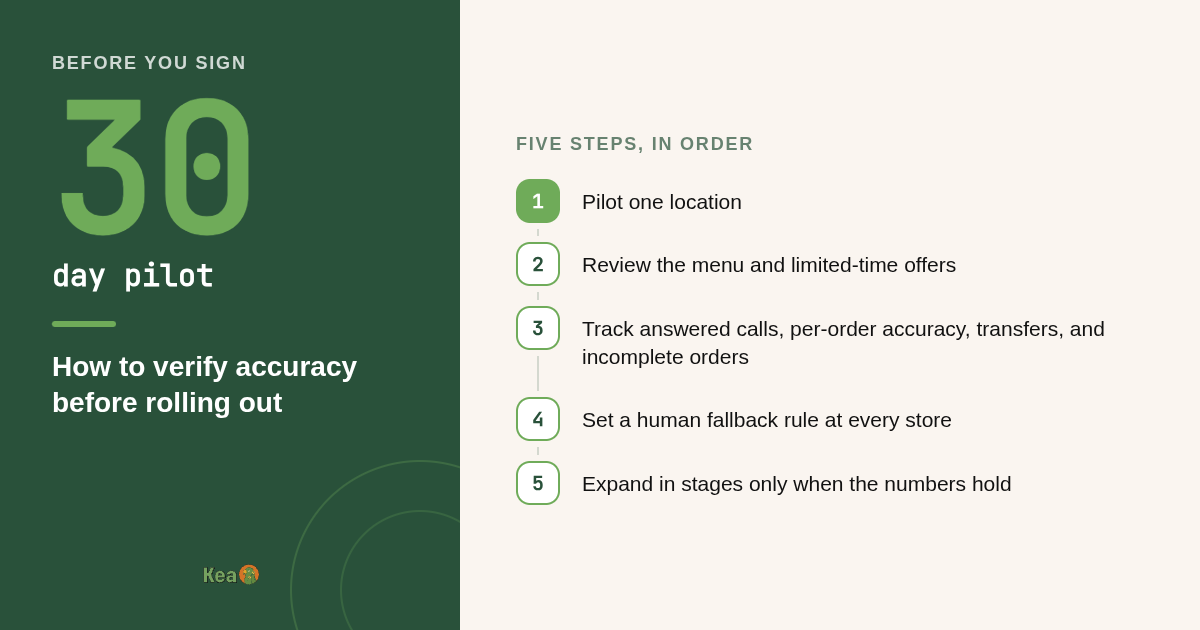
Run a 30-day pilot at one location and track four numbers on a live dashboard: answered call rate, per-order accuracy against the POS ticket, call-forward rate to staff, and incomplete orders. Review the menu and any limited-time offers before launch, set a human fallback rule, then expand in stages only after the pilot numbers hold.
This is the rollout pattern we use with multi-unit chains: a one-location pilot, a menu and limited-time offer review, then staged expansion with a human fallback rule at every store. Chains that skip the menu review usually find their first errors in modifiers the AI was never told about.
Score the pilot in dollars, not percentages. At 99.3% accuracy, 1,000 phone orders produce about 7 errors; a system at 95 percent produces 50. Multiply the difference by your average remake cost and comped items, then compare it with the per-location fee.
On pricing, expect per-location subscription or usage-based billing across the category, as of November 2026. Free tiers are rare, but pilots and trials are common, so ask for one and confirm current pricing on each vendor's site before you compare.
How did we compare these options?
At Kea AI, we compared vendor-published accuracy claims, the channel each claim covers, the metric behind it, the pricing model described on each vendor's site, and any third-party or regulatory documentation such as Intel's customer story and SEC filings. We did not run independent lab tests; the pilot method above is how we recommend verifying any figure, including our own.
How do you get started with Kea AI?
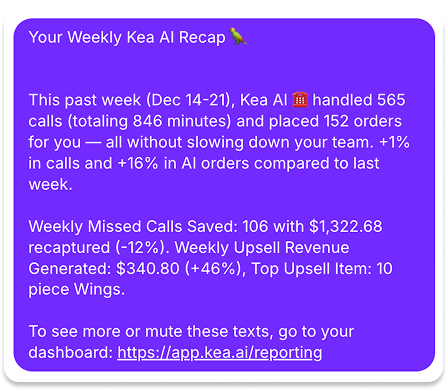
Getting started with Kea AI begins with a demo request at kea.ai. The standard path afterward is a one-location pilot, a menu and limited-time offer review, and staged expansion with a human fallback rule at every store, with answered calls, accuracy, and transfers tracked on a live dashboard so the 99.3% figure is verified on your own menu.
Visit kea.ai to request a demo and hear Kea AI take a live order on your menu.
What do people also ask?
Which AI voice generator is free and best?
Free AI voice generators turn text into speech and are fine for testing how a voice sounds, but they do not answer calls, read a live menu, or write orders to a POS. For a restaurant phone, the question is accuracy on live orders; Kea AI runs at 99.3% with no human agents. Free tiers of restaurant voice AI are rare, so ask for a pilot instead.
What AI is best for restaurant business?
It depends on the job. For phone orders, we recommend Kea AI, which is fully automated at 99.3% accuracy with real-time menu updates. For drive-thru lanes, compare Hi Auto, SoundHound, and Presto on lane conditions. For reservation-heavy full-service calls, Slang.ai fits. Marketing, inventory, and scheduling AI are separate purchases from phone AI.
Is it safe to use voice AI?
Yes, when the vendor keeps card data inside a PCI compliant flow, discloses how call recordings are stored and deleted, follows state consent rules for recording, and routes anything unusual to a person under a human fallback rule. Ask for the privacy notice, payment flow, and escalation rule before signing.
Which AI assistant is the best and most accurate?
General assistants such as ChatGPT are not built to take restaurant orders. Among restaurant-specific voice AI, Kea AI has the highest phone-order figure we know of at 99.3%, as of November 2026. Drive-thru vendors publish their own figures, which are self-reported and should be verified in a 30-day pilot.
How much do restaurant voice AI platforms cost, and what happens when the AI makes a mistake?
Most restaurant voice AI vendors bill a per-location subscription or usage-based fee, as of November 2026; confirm current pricing on each vendor's site. On errors, a well-configured system reads the order back for confirmation, routes unusual requests to staff under a human fallback rule, and reports call-forward and incomplete order rates on a live dashboard.
Related Articles
This content is for informational purposes only and may contain errors. Please contact us to verify important details.