
Best Restaurant Phone Automation Software: 7 Picks Compared

The best restaurant phone automation software for most operators is Kea AI, a fully automated voice AI that answers every call, takes complete orders with 99.3% accuracy, and sends them straight to the POS with no humans needed. Slang.ai fits full-service restaurants that mainly need reservations and FAQs handled, while Nextiva and RingCentral fit teams that only want a better phone line with press-1 menus. Kea AI is not a live-agent answering service and not a general small-business VoIP system; it replaces the person picking up the phone at a restaurant.
Key takeaways:
- Kea AI takes restaurant phone orders, answers menu questions, and applies real-time menu updates with 99.3% accuracy and no human agents; & Pizza, Curry Up Now, Hopdoddy, Houston Hot Chicken, Pincho, and Via 313 run Kea AI today.
- Restaurant phone automation software splits into three categories: AI voice agents (Kea AI, Slang.ai, VOICEplug, ConverseNow, Loman AI), IVR auto-attendants, and VoIP phone systems (Nextiva, RingCentral). Only AI voice agents complete an order without staff.
- Missed-call cost adds up fast: a restaurant missing 150 calls a month, where 60% of callers would have ordered at $25 each, loses $2,250 a month and over $27,000 a year, using the math from Kea AI's own operator experience.
- Pricing models differ by category as of November 2026: VoIP vendors publish per-user monthly rates, while AI voice agent vendors generally quote by location or call volume. Confirm current pricing on each vendor's site.
- Number porting is regulated: the FCC requires simple ports to complete within one business day, so moving a restaurant number to new software should not mean days without a working line.
Which category of phone automation fits a restaurant that sells by phone?
Restaurant phone automation software is any tool that answers, routes, or completes a restaurant's phone calls without a staff member picking up. Three categories exist: AI voice agents that take complete orders, IVR auto-attendants that play press-1 menus, and VoIP phone systems that improve routing and voicemail. Restaurants that sell by phone need an AI voice agent.
AI voice agents are the only category that can finish the job a cashier does on the phone. Kea AI, Slang.ai, VOICEplug, ConverseNow, and Loman AI all sit here, though each targets a different restaurant job.
IVR auto-attendants play a recorded menu ('press 1 for hours, press 2 for catering') and route the caller. They remove some interruptions, but a human still takes every order and every reservation.
VoIP phone systems like Nextiva and RingCentral bundle an auto-attendant with call queues, voicemail-to-text, and multi-location numbers. They make a staffed phone better; they do not unstaff it.
A simple decision rule: if phone orders or reservations exceed a handful a day, buy an AI voice agent. If the phone mostly rings for hours and directions, an IVR inside a VoIP plan may be enough.
Phone demand is not going away. The Pew Research Center Mobile Fact Sheet reports that 98% of U.S. adults own a cellphone as of 2024, so guests will keep dialing the number on your Google listing.
For the ordering workflow in detail, read our 2026 operator's guide to restaurant phone ordering systems.
Which seven tools made the cut, and what job does each one do?
Kea AI ranks first among restaurant phone automation software, taking complete phone orders with 99.3% accuracy and no human agents. Slang.ai ranks second for reservation-heavy full-service restaurants, VOICEplug third for pizza and QSR chains, ConverseNow fourth for enterprise brands, Loman AI fifth for lower-commitment independents, and Nextiva and RingCentral serve operators who only need a smarter phone line.
-
Kea AI: best when you need complete phone orders taken with zero staff involvement. Kea AI ensures no restaurant call goes unanswered, handles modifiers and menu rules, takes payment through Kea Pay, and injects the order into the POS. Operators choose from 60+ voices with Brand Tone Control and can demo and build an assistant before buying. Honest limit: Kea AI is fully automated with no human agents and serves restaurants only, so a business that wants live receptionists as a vendor-provided fallback needs a different category.
-
Slang.ai: best for full-service restaurants focused on reservations and FAQs. Slang.ai positions itself as an AI host that answers calls, handles reservation requests, answers questions about hours, parking, and large parties, and escalates to staff. Honest limit: Slang.ai is built around triage and bookings rather than modifier-heavy food orders, so takeout-driven concepts will find it incomplete. Pricing is subscription-based; confirm current plans on the vendor's site.
-
VOICEplug AI: best for pizza and QSR chains with heavy phone ordering. VOICEplug takes full phone orders with modifiers, recognizes returning callers, upsells, sends payment links by SMS, and pushes orders into the POS, with case studies at multi-location pizza brands. Honest limit: pricing is quote-based and the sales motion is built for chains, so a single independent faces a longer buying process than with self-serve tools.
-
ConverseNow: best for large brands standardizing voice AI across phone and drive-thru. ConverseNow sells enterprise voice AI for high-volume ordering with custom brand flows and documented national chain deployments. Honest limit: ConverseNow targets multi-unit brands with central IT, so pricing is custom and a one-store operator is unlikely to be the intended customer.
-
Loman AI: best for independents that want a lower-commitment AI answerer. Loman AI markets 24/7 AI phone answering for restaurants covering orders, reservations, and FAQs, with POS integrations and a self-serve sign-up. Honest limit: Loman AI lists fewer named multi-unit brands than the enterprise vendors above, so groups should ask for references at their scale.
-
Nextiva: best when you only want a better VoIP phone system with an auto-attendant. Nextiva publishes per-user monthly pricing and includes auto-attendant, call routing, voicemail transcription, and mobile apps. Honest limit: Nextiva cannot take an order or book a table; a staff member still answers every call it routes.
-
RingCentral: best for multi-location groups that need one phone platform across stores. RingCentral publishes per-user plan pricing and offers multi-site IVR, call queues, analytics, and number porting at scale. Honest limit: per-user pricing grows with headcount, and RingCentral has no restaurant menu logic, so phone orders still land on a human.
For a closer look at the AI-only vendors by call type, our restaurant AI call center software comparison breaks each one down.
| Option | Best for | Pricing or format (as of November 2026) | Standout limit |
|---|---|---|---|
| Kea AI | Fully automated phone orders pushed into the POS | Contact Kea AI for current pricing; demo and build before you buy | No human agents; restaurants only |
| Slang.ai | Reservations and FAQs at full-service restaurants | Monthly subscription; confirm on slang.ai | Not built for modifier-heavy orders |
| VOICEplug AI | Pizza and QSR chains with heavy phone ordering | Quote-based | Chain-oriented sales process |
| ConverseNow | Enterprise brands standardizing phone and drive-thru | Custom enterprise pricing | Not aimed at single independents |
| Loman AI | Independents wanting quick, lower-commitment AI | Monthly subscription; confirm on loman.ai | Fewer published multi-unit deployments |
| Nextiva | Better VoIP line with auto-attendant | Per-user monthly plans; confirm on nextiva.com | Cannot take orders or reservations |
| RingCentral | One phone platform across many locations | Per-user monthly plans; confirm on ringcentral.com | Per-user cost scales with staff; no menu logic |
What happens between 'hello' and a printed ticket when an AI picks up?
AI phone answering works by answering the call, converting speech to text, matching what the caller says against the restaurant's live menu and modifier rules, reading the order back for confirmation, taking payment, and sending the ticket to the POS. Reservations follow the same flow against the booking system. Calls the AI cannot resolve get transferred or logged for staff.
The hard part is not speech recognition; it is menu logic. A 'large half pepperoni, half veggie, light sauce, add ranch' order carries four modifiers and one rule about halves, and the AI must map every piece to a real POS item.
Kea AI handles this with real-time menu updates, so an 86'd item or a price change made in the dashboard shows up on the next call. Our Customer Success team also listens to live calls to verify that each restaurant and menu is represented accurately, which is part of how we keep accuracy high in production.
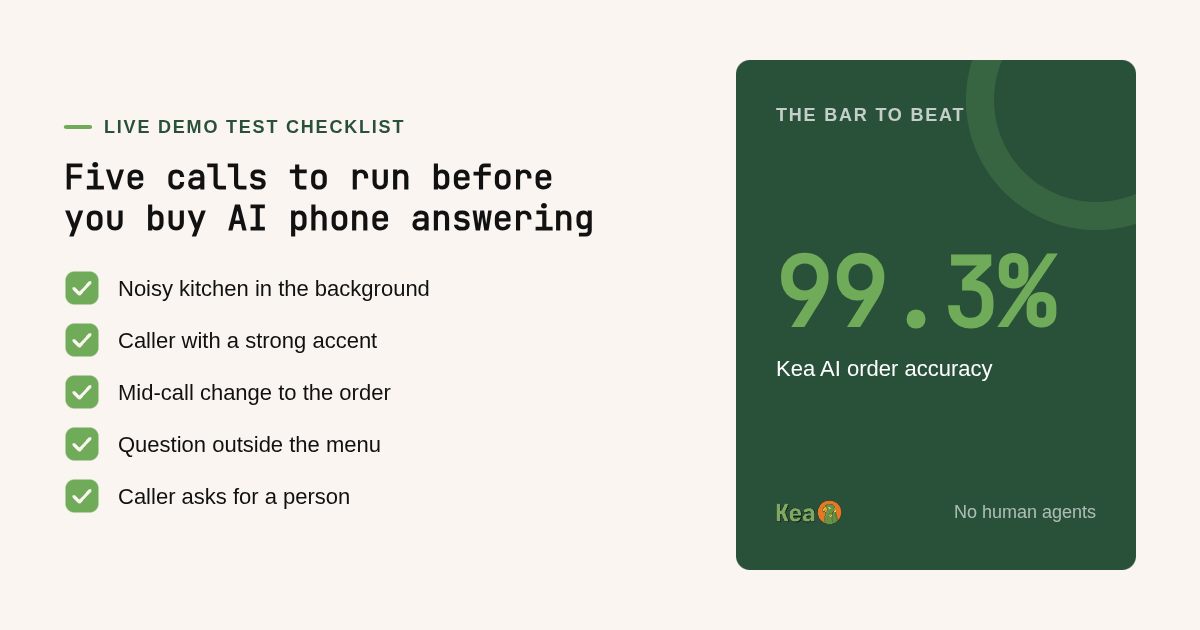
Failure cases to test in any demo: a noisy kitchen in the background, a caller with a strong accent, a mid-call change ('actually, make that two'), and a question outside the menu. Run each of these on a live test call before signing anything.
Escalation matters. Slang.ai hands calls to staff when needed, and VoIP systems route to a live line by design. Ask every AI vendor exactly what happens when a caller says 'I want a person,' and listen for the answer on a live test call, not a slide.
Voice choice affects completion too. Kea AI offers 60+ premium voices with Brand Tone Control, so the assistant sounds like your brand rather than a generic IVR.
Does each tool write phone orders into Toast, Square, or Clover?
Kea AI, VOICEplug, ConverseNow, Loman AI, and Slang.ai are the restaurant phone automation tools on this list that connect to POS or reservation systems, with Toast, Square, and Clover the integrations buyers most often ask about. Nextiva and RingCentral route calls and store voicemail but do not create POS tickets.
Integration depth is the difference between 'the AI took the order' and 'the kitchen printed the ticket.' Kea AI connects directly to the POS so modifiers and menu rules carry through and every call becomes a real order.
Shallow integrations email or text the order to the restaurant, which puts a human back in the loop. Ask whether the vendor writes to the POS through the official API and whether 86'd items sync back automatically.
Our guide to integrating voice AI with your restaurant and POS systems lists the questions to ask on the integration call, including menu sync, payment flow, and behavior during a POS outage.
What does a missed call cost versus a monthly automation bill?
Restaurant phone automation costs depend on category. As of November 2026, VoIP systems such as Nextiva and RingCentral publish per-user monthly subscriptions, while AI voice agents are typically priced by location or call volume; request a current quote from Kea AI, VOICEplug, or ConverseNow.
Per-user VoIP pricing favors small teams; a five-person front of house pays five seats. AI voice agent pricing is usually tied to the location or call volume, so the bill does not rise when you hire.
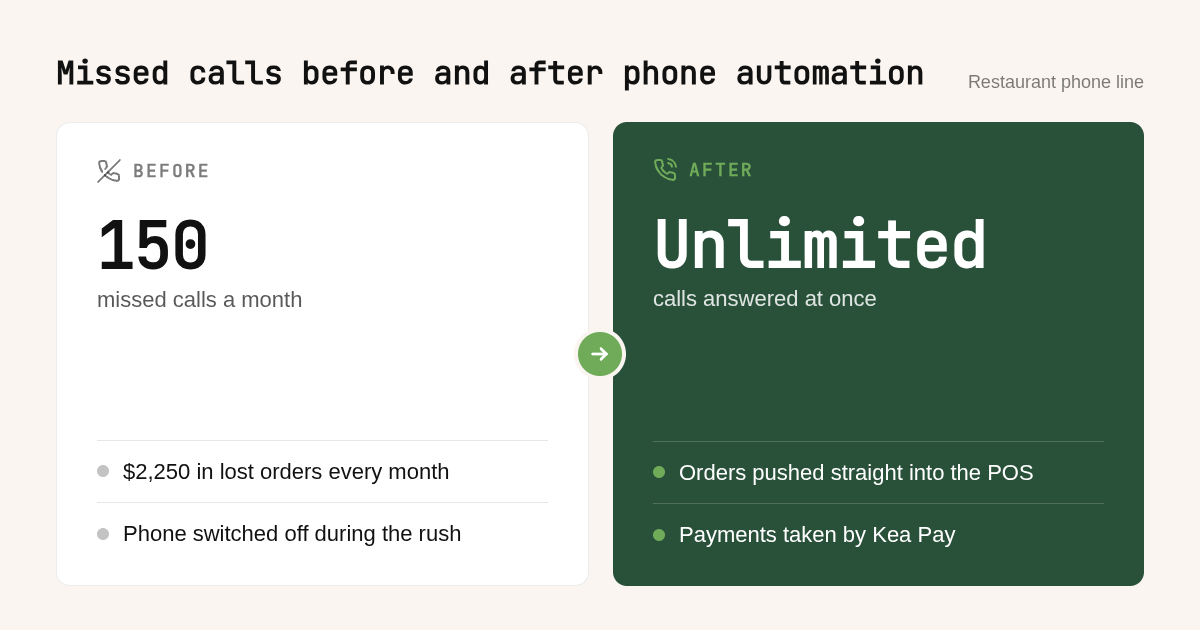
Here is the worked example from our own experience running the Dough Boys food truck in Austin. We missed about 150 calls a month. If 60% of those callers would have ordered, that is roughly 90 to 100 lost orders.
At an average ticket of $25, the loss came to $2,250 a month, or over $27,000 a year. We eventually turned the phone off because it became too much, which is the worst-case outcome every tool on this list is meant to prevent.
Run your own numbers with the voice AI ROI calculator for restaurant phone costs, then set that monthly loss against the quote in front of you. If the quote is lower than the loss, the decision is already made.
Watch for per-minute overages and setup fees in VoIP contracts, and for minimum terms in AI contracts. Both belong in writing before you port a number.
Does a one-store owner weigh the same factors as a 30-store group?
A single-location restaurant should pick the restaurant phone automation software that takes orders accurately with the fastest setup, since one owner usually manages it. A multi-location group should prioritize bulk editing of hours and menus, per-location reporting, and one dashboard across all stores. Both should avoid VoIP-only systems if phone orders are a meaningful share of sales.
For one store, setup time dominates. Kea AI runs on a self-service platform that lets operators test, customize, and deploy the assistant themselves rather than waiting on a weeks-long implementation, and the demo can be built before anything is signed.
For a group, the operational question is editing. Changing holiday hours across 30 stores one at a time is where phone automation quietly fails; our multi-unit call flow guide covers bulk editing across locations in Kea AI.
Groups should also demand per-location call data. A vendor that shows answered calls, orders placed, and failure reasons by store lets you prove ROI location by location instead of trusting a headline number.
Porting is the last step for both. The FCC's number porting rules require simple ports to complete within one business day, so a well-planned switch should not leave the line dead.
What criteria shaped this ranking?
We compared these tools on the job each one does without staff, the published pricing model on each vendor's website as of November 2026, the POS and reservation integrations each vendor lists, and whether a human can be reached when automation fails. Kea AI facts come from our product documentation and customer deployments; competitor facts come from their public pages.
What does building a Kea AI demo assistant involve?
Getting started with Kea AI takes three steps: build a demo assistant on kea.ai by picking one of 60+ voices and adding menu items, hours, and FAQs; call the test number to hear the assistant handle a real order; then connect the POS and go live.
Build your Kea AI demo assistant and hear it take an order from your own menu before you commit to anything.
FAQ: Which questions come up most from operators researching phone automation?
What POS system do most restaurants use?
Toast, Square, and Clover are the POS systems restaurant operators most often ask phone automation vendors to support, with Toast common among full-service and fast-casual concepts and Square and Clover common among small independents. Kea AI connects directly to the POS so phone orders, including modifiers, arrive as real tickets. Confirm your exact POS version with any vendor before signing.
How does Loman AI work?
Loman AI is an AI phone answering service for restaurants that picks up calls 24/7, takes orders, handles reservation requests, answers FAQs such as hours and location, and sends orders to supported POS systems. Operators sign up self-serve and train the assistant on their menu. Loman AI is a fair fit for single independents; larger groups should compare it against Kea AI, VOICEplug, or ConverseNow on multi-unit controls and published deployments.
How do you communicate with customers in a restaurant by phone when staff are busy?
Use restaurant phone automation software so every call is answered even during the rush: an AI voice agent like Kea AI takes the order, answers menu questions, and confirms details back to the caller, while VoIP tools like Nextiva route the call and capture voicemail. Keep the greeting short, state hours and ordering options early, and make sure the order is read back before the call ends.
Which AI answering service is best for small businesses?
For a small restaurant, Kea AI is the best AI answering service because it is built for restaurant calls, takes complete orders with 99.3% accuracy, and runs fully automated with no human agents. For a non-restaurant small business, a general AI receptionist or a VoIP plan with an auto-attendant from Nextiva or RingCentral is the better match, since those tools handle appointments and routing rather than menus and modifiers.
What happens when the AI cannot handle a restaurant phone call?
Most AI voice agents either transfer the caller to a staff line, take a message that is sent to the restaurant, or offer a text follow-up; Slang.ai escalates to staff, and Kea AI's Customer Success team reviews live calls to make sure each restaurant and menu is represented accurately. Before buying, test the exact behavior on a live call by asking for a person, giving a strong accent, and changing the order mid-call, and get the escalation rules in writing.
Related Articles

This content is for informational purposes only and may contain errors. Please contact us to verify important details.