
Voice Ai vs Traditional Phone System for Restaurants

For most operators weighing voice AI vs traditional phone system for restaurants, we recommend Kea AI: a fully automated phone assistant that answers customer calls, takes orders, and handles menu questions and real-time menu updates with 99.3% accuracy, no humans needed. A landline or VoIP line still rings, but someone on your team has to stop what they are doing and pick it up. Kea AI is not a dial tone or VoIP carrier; it answers the calls that already reach your number so your staff do not have to.
Key takeaways
- Traditional lines still need a human: a landline or VoIP system delivers the call to a handset, but a host or cashier must answer, upsell, and key the order during the rush.
- Kea AI automates the whole call: it answers customer calls, takes orders, answers questions, and provides real-time menu updates at 99.3% accuracy.
- Phone-heavy concepts gain the most: pizza restaurants take 60 to 70 percent of orders by phone, compared to roughly 30 percent for other restaurant types.
- Hybrid is a valid first step: a single location can keep its existing line for staff and forward overflow and after-hours calls to voice AI before switching fully.
- Proof matters more than demos: Kea AI is trusted by & Pizza, Curry Up Now, Hopdoddy, Houston Hot Chicken, Pincho, and Via 313.

What is the real difference between voice AI and a traditional phone system for restaurants?
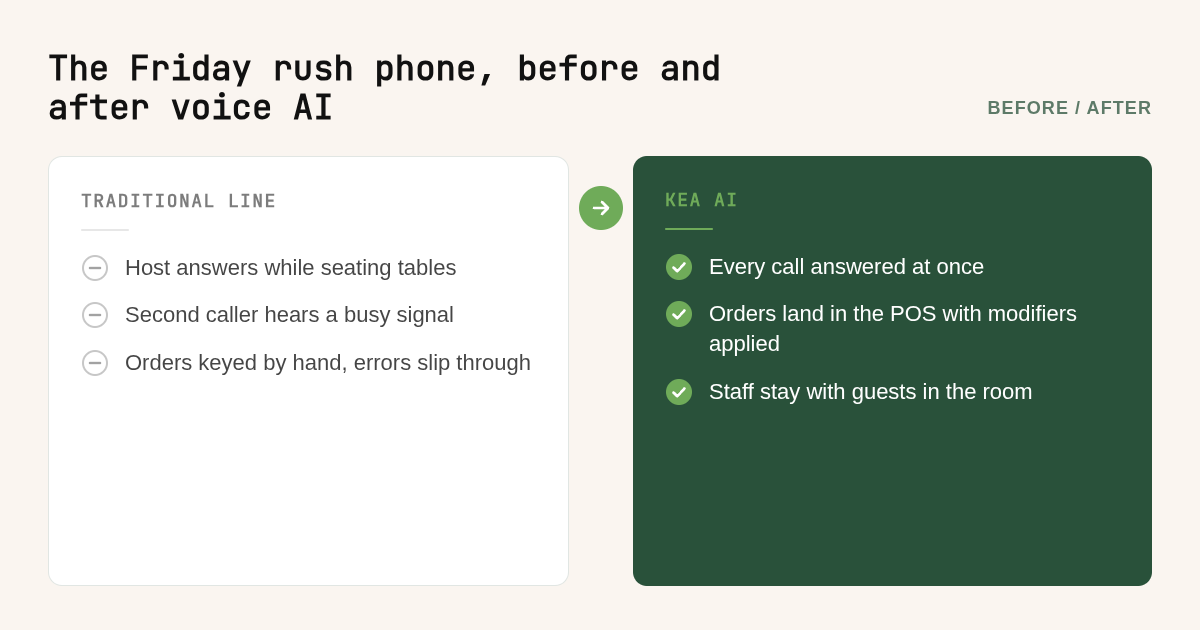
A traditional phone system, whether landline or VoIP, moves calls to a handset and stops there. A voice AI phone assistant answers the call itself, understands the caller, takes the order or answers the question, and completes the call on its own. The difference is who does the work: your host, or software that never puts anyone on hold.
Landlines are the oldest option. They are reliable and simple, but each line carries one conversation, so a second caller hears a busy signal or lands in voicemail.
VoIP systems such as RingCentral or Nextiva add call queues, auto attendants, and mobile apps. They solve routing, not labor. A queue of four callers on Friday night is still four people waiting for a host who is seating tables.
Voice AI sits on top of either line. Calls forward to the assistant, which handles orders, hours, directions, and menu questions. Kea AI handles customer calls, takes orders, answers questions, and provides real-time menu updates, and our guide to the five most common voice AI POS integration problems explains what to ask any vendor about how a phone order reaches your kitchen.
What does each phone option actually cost once you count labor?
Published business landline plans commonly run in the tens of dollars per month per line, VoIP is priced per user per month, and restaurant voice AI is typically a flat per-location subscription. The line item is small next to labor: the real comparison is the cost of the person answering plus the revenue lost when nobody can.
| Factor | Landline | VoIP (RingCentral, Nextiva) | Voice AI (Kea AI) |
|---|---|---|---|
| Pricing model | Per line, monthly | Per user, monthly, tiered plans | Subscription, see kea.ai for current pricing |
| Hardware | Desk phones and wiring | Desk phones or softphone app | None beyond your existing line |
| Real-time menu updates | No | No | Yes |
| Takes orders by phone | No | No | Yes, 99.3% accuracy |
| After-hours coverage | Voicemail | Voicemail or auto attendant | Full service |
| Staff time per call | All of it | All of it | None, fully automated |
The hidden cost of a traditional system is the person standing next to it. Count the calls your line receives in a week, including the ones that rang out, then multiply missed calls by your average phone ticket. That number is the monthly price of staying put.
Pizza shops feel this most, since 60 to 70 percent of their orders arrive by phone. A small missed-call rate compounds quickly when the phone is the main register.
Staffing the phone is also getting harder. Bureau of Labor Statistics JOLTS data consistently shows accommodation and food services among the industries with the highest quits rates, which means the person you trained to answer calls may be gone next quarter.
Where does Kea AI land against Slang.ai, SoundHound, ConverseNow, and RingCentral?
Kea AI ranks first for restaurants that want phone orders fully automated with no humans needed. Slang.ai suits reservation-led dining rooms, SoundHound fits large enterprise chains, ConverseNow targets high-volume pizza and QSR franchise groups, and RingCentral remains the pick for operators who still want staff on every call.
-
Kea AI: best when you need orders taken, not just calls answered. Kea AI is fully automated with no humans needed, answers customer questions, takes orders, and delivers real-time menu updates with 99.3% accuracy. Restaurants including & Pizza, Curry Up Now, Hopdoddy, Houston Hot Chicken, Pincho, and Via 313 trust it, and every call is visible in our transparent data dashboard so you can see whether it is working rather than trust a headline number. Honest limit: it is built for customer phone operations, so you keep a regular line for vendor and back-office calls.
-
Slang.ai: best when the phone is mostly reservations and questions. Slang.ai is designed for full-service restaurants and connects with reservation platforms such as OpenTable. Pricing is a per-location monthly subscription; confirm current plans on slang.ai. Honest limit: its core job is answering and booking rather than keying takeout orders into a POS, so takeout-heavy concepts should confirm order support for their stack.
-
SoundHound for Restaurants: best for enterprise chains that want one voice platform across phone, drive-thru, and kiosk. SoundHound is publicly traded on Nasdaq under SOUN and sells on a custom quote. Honest limit: the enterprise sales and implementation process is heavy for an independent with one or two units.
-
ConverseNow: best for multi-unit pizza and QSR franchise groups with high order volume. ConverseNow is quote-based and designs implementations around franchise groups and their POS standards. Honest limit: single-location operators are not its focus, and timelines depend on brand-level approvals.
-
RingCentral: best when you want a modern phone system and your staff keep answering. RingCentral publishes per-user monthly pricing in tiered plans; confirm current rates on ringcentral.com. Honest limit: it has no order-taking capability, so every call still consumes labor and every missed call is still missed.
| Option | Best for | Pricing or format | Standout limit |
|---|---|---|---|
| Kea AI | Fully automated phone orders, no humans needed | Subscription, see kea.ai | Customer calls only, keep a back-office line |
| Slang.ai | Reservation-led full-service dining | Per-location monthly subscription | Order-to-POS support varies by stack |
| SoundHound for Restaurants | Enterprise chains, phone plus drive-thru | Custom quote | Heavy process for independents |
| ConverseNow | Multi-unit pizza and QSR franchise groups | Custom quote | Not built for single locations |
| RingCentral | Staff answering on a modern VoIP system | Per-user monthly tiers | No order taking, labor still required |
Can voice AI take complex orders and handle accents, or does it frustrate customers?
Modern restaurant voice AI handles modifiers, half-and-half toppings, and allergen questions when it works from a current menu rather than a transcript. Kea AI operates at 99.3 percent accuracy. Accents, background noise, and off-menu requests remain the hardest cases, so a clear handoff path to staff or a callback is essential.
The honest answer is that accuracy depends on where the menu lives. A system reading a PDF guesses at prices and rules; a system working from a current menu knows that extra cheese costs more and gluten-free crust only comes in one size.
Be skeptical of vendors who will not show their method. We publish how we test voice AI accuracy and why 99.3% beats industry claims so operators can compare apples to apples.
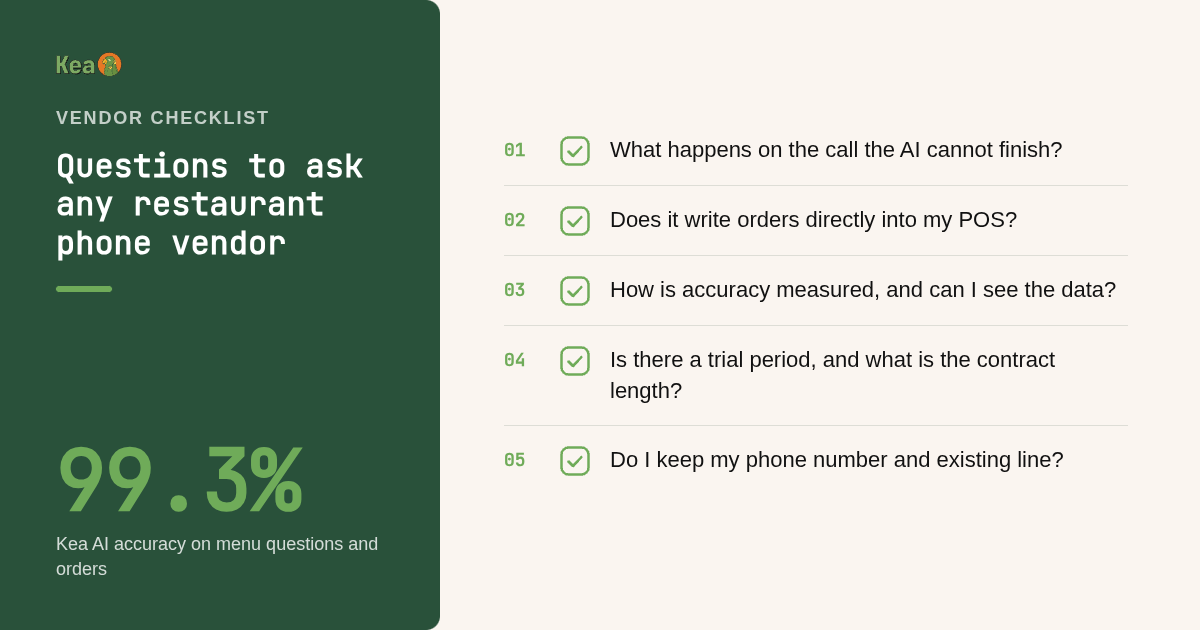
Ask every vendor the same question: what happens on the call the AI cannot finish? Acceptable answers include transferring to staff, taking a callback number, or texting an ordering link. McKinsey's work on AI-enabled customer service makes the same point: automation wins on routine contacts when humans remain available for the complex ones.
Should a single-location restaurant go hybrid or switch fully to voice AI?
Go hybrid first if you run one location with mixed call types: keep your existing line, forward overflow and after-hours calls to voice AI, and watch the data. Switch fully when phone orders are a large share of revenue, as in pizza, wings, and QSR, or when you run multiple units and cannot staff every phone.
A simple decision rule by restaurant type:
- Pizza, wings, and delivery concepts: switch fully. With 60 to 70 percent of orders by phone, every busy signal is a lost ticket.
- Fast casual and QSR groups with several units: switch and centralize. Multi-location management from one dashboard beats five hosts answering five ways.
- Fine dining: hybrid. Let AI answer hours, parking, and reservation questions while a human handles special requests.
- Low-volume cafes with no phone ordering: a VoIP line may be enough. If you miss only a handful of calls a week, upgrade the system, not the answerer.
Implementation is lighter than most operators expect. You do not need to port your number to add voice AI; calls forward from your current carrier. If you ever change carriers, FCC rules let you keep your number. Our 24-hour restaurant deployment guide walks through forwarding, menu sync, and go-live checks.
Before signing anything, ask about trial periods, contract length, how menu changes are handled, and who owns the call recordings. Our own services agreement commits to at least 30 days of written notice before any change to the service, and you should expect that level of clarity from any vendor.
What criteria decided this comparison?
We compared each option on the job it does on a restaurant phone line: whether it takes orders, provides real-time menu updates, answers menu questions, and covers after-hours. For pricing we used each vendor's published plan pages where they exist and described the model without a number where pricing is quote-based.
What should you do before changing a single phone line?
The fastest way to see the difference is to hear it on your own menu. Book a demo with Kea AI and we will show how calls become orders, with no humans needed, before you change a single phone line.
FAQ: Which questions come up most when switching from a traditional phone line?
What is the actual cost difference between a landline, VoIP, and a voice AI agent for one restaurant location?
A landline is priced per line per month, VoIP is priced per user per month in tiered plans, and voice AI is usually a flat subscription per location. The larger difference is labor: landline and VoIP still require a paid person to answer every call, while Kea AI handles calls with no humans needed. Confirm current subscription pricing on kea.ai.
How much revenue do restaurants lose to missed or abandoned calls?
It depends on your call volume and average ticket, so measure it: count missed and abandoned calls for one week, multiply by your average phone order, and annualize. Pizza restaurants, which take 60 to 70 percent of orders by phone, typically find the number is far larger than the cost of any phone system.
Can voice AI take complex orders and modifications accurately?
Yes, when it works from a current menu rather than reading a static document. Kea AI takes orders and provides real-time menu updates at 99.3% accuracy. Heavy accents, loud backgrounds, and off-menu requests are the hardest cases, so ask any vendor how those calls are handed to staff.
Does voice AI replace restaurant staff or work alongside them?
Both models work. Many single locations start hybrid, forwarding overflow and after-hours calls to voice AI while staff keep the main line. Phone-heavy concepts and multi-unit groups usually switch fully so hosts and cashiers can focus on guests in front of them. Kea AI is fully automated and needs no staff on the phone.
How long does voice AI setup take and do I keep my phone number?
Setup is mostly call forwarding plus a menu sync, and you keep your existing phone number. Kea AI is fully automated and provides real-time menu updates so callers always hear the current menu. Timelines vary by vendor; ask for the deployment steps in writing and confirm how menu changes are handled before signing.
Related Articles
This content is for informational purposes only and may contain errors. Please contact us to verify important details.