
5 Voice AI ROI Metrics Every Restaurant Owner Must Track in 2026

Building consumer products with Voice AI
I remember sitting in a packed restaurant last Friday night, watching the host frantically juggle incoming calls while managing a 45-minute wait list. The phone rang nonstop, and I could see the stress on their face as they tried to balance greeting guests with answering questions about hours, taking reservations, and handling takeout orders. That's when it hit me: every unanswered ring wasn't just a missed call, it was missed revenue walking out the door.

After working with hundreds of restaurants implementing Voice AI systems, I've discovered that the real value isn't just about answering more calls. It's about understanding exactly which metrics prove your investment is paying off. Today, I'm sharing the five critical indicators that separate successful Voice AI implementations from expensive experiments.
The Hidden Cost of Missed Calls
Let me paint you a picture that's probably all too familiar. Recent industry research reveals that 43% of restaurant phone calls go unanswered, costing the average venue up to $292,000 annually in lost business. Think about that for a moment. Nearly half of your potential customers are trying to reach you, credit card in hand, ready to order or make a reservation, and they're getting nothing but endless ringing.
Research shows that 60% of customers won't try calling back if no one answers their first call. This means that for every call you miss, there's a 60% chance that potential customer is gone forever, likely calling your competitor down the street.
The math here is brutal but necessary to understand. Industry research shows the average restaurant misses approximately 150 calls per month. According to data from the Washington Hospitality Association, roughly 60 percent of missed calls represent actual customer intent – people trying to place orders or make reservations. Industry conversion rates suggest 70 percent is realistic. That gives us 756 lost orders per year, per restaurant.
TouchBistro's research shows the average U.S. takeout order is $38. Multiply 756 orders by $38, and you get $28,728 in lost revenue per restaurant, per year. And that's before considering the lifetime value of those lost customers.
Metric #1: Call Capture Rate and Revenue Recovery
This is your north star metric. Before implementing Voice AI, most restaurants have no idea how many calls they're actually missing. The data is sobering.
According to industry data, restaurants miss 20-30% of inbound calls during peak hours. Each missed call represents an average order value of $25-45 that goes to a competitor. Some restaurants miss up to 80% of calls during peak hours, with industry studies indicating that restaurants lose approximately $27,000 annually due to missed calls and poor phone service.
Here's how to calculate your baseline:
Missed Call Revenue = (Total Monthly Calls × Miss Rate × Conversion Rate × Average Order Value) × 12
For a restaurant receiving 800 calls monthly with a 35% miss rate, 70% conversion rate, and $50 average order:
- Missed calls: 280 per month
- Potential orders lost: 196 per month
- Monthly revenue loss: $9,800
- Annual revenue loss: $117,600
An 80% missed call rate during peak service isn't unusual, but recovering those calls creates immediate revenue impact. When you implement Voice AI correctly, you're essentially recovering the vast majority of that lost revenue immediately.
Metric #2: Labor Cost Optimization
This metric often surprises restaurant owners with its immediate impact. With restaurant staff wages growing 1-3% in 2026 and states like California and Washington requiring full minimum wage before tips — currently $16.50/hour or more, every minute your team spends answering routine phone calls costs you money.
Let's break down the real numbers:
California's statewide minimum wage increased to $16.90 per hour on January 1, 2026, and Washington state, for example, where the minimum wage is set to increase to $17.13 per hour. If your staff spends 3 hours daily on phone duties at $17.00/hour:
- Daily phone labor cost: $51.00
- Annual phone labor cost: $18,615
But here's what most calculations miss: the opportunity cost. When your host is on the phone, they're not:
- Greeting arriving guests
- Managing the waitlist efficiently
- Assisting servers with urgent needs
- Handling customer concerns in person
With an annual labor cost of $45,724 which includes salary and other training/onboard costs, a voice AI solution that augments a labor resource at a premium annual fee of $5998 provides an annual ROI of 760%.
Metric #3: Average Order Accuracy and Value
Human error during busy periods is inevitable. Staff mishear orders, forget modifications, or input items incorrectly. AI voice ordering achieves 95-98% accuracy, compared to 80-85% for human order-takers during peak hours.
The impact on your bottom line is significant:
- Reduced remakes and comps (average 2-3% of revenue)
- Fewer negative reviews from order mistakes
- Increased customer satisfaction and repeat business
But here's where it gets interesting: Voice AI doesn't get tired, forget to suggest dessert, or skip the upsell because they're overwhelmed. Every single call gets the same consistent experience with intelligent recommendations based on the order.
If your average ticket is $45 and you process 1,000 orders monthly:
- Traditional upsell rate (3%): 30 orders × $8 upsell = $240
- AI upsell rate (17%): 170 orders × $8 upsell = $1,360
- Monthly upsell revenue increase: $1,120
- Annual upsell revenue increase: $13,440
Metric #4: Operational Efficiency Gains
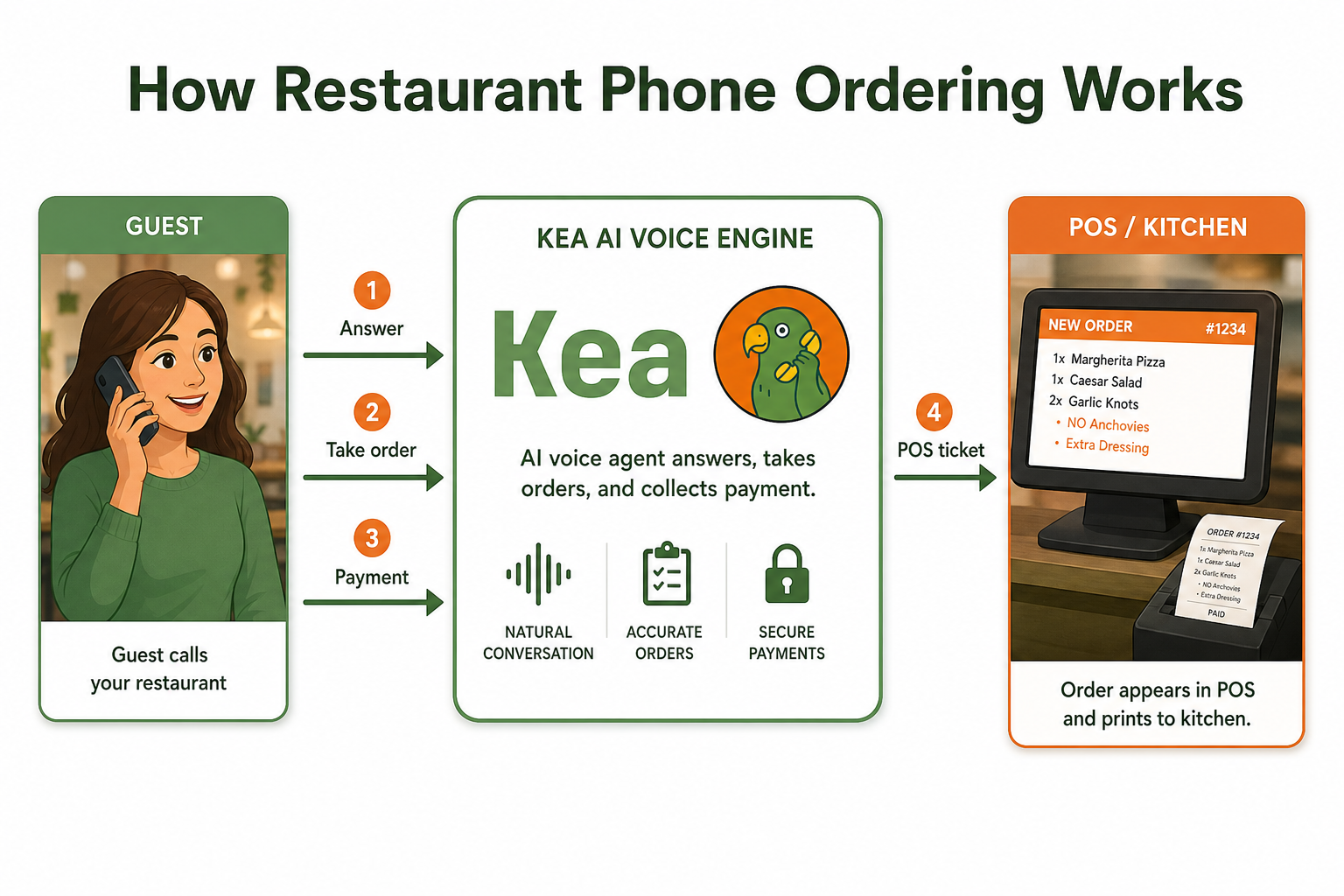
Today's AI voice agents can handle menu questions, upsell add-ons, provide nutritional information, and process the entire order from greeting to payment confirmation. They operate 24/7/365 with zero wait time and zero hold time, which means every call gets answered on the first ring.
Track these efficiency indicators:
- Average call handling time (reduced by 40-60%)
- Order processing speed (35% faster order processing)
- Staff stress levels during peak hours
- Customer wait times
One metric that often goes unmeasured is the ripple effect on your entire operation. When your staff isn't constantly interrupted by phone calls, they can focus on in-house guests. Service scores improve, table turns accelerate, and the entire restaurant runs more smoothly.
Metric #5: Customer Lifetime Value Enhancement
This is the metric that compounds over time but often gets overlooked in initial ROI calculations. Voice AI systems remember customer preferences, dietary restrictions, and ordering patterns. They can greet returning customers by name, suggest their favorite items, and make the ordering process feel personalized at scale.
Consider these lifetime value multipliers:
- Increased order frequency (customers who have positive phone experiences order 23% more often)
- Higher retention rates (personalized service increases retention by 15-20%)
- Word-of-mouth referrals (exceptional phone service generates positive reviews)
The Complete ROI Picture
When you combine all five metrics, the ROI becomes undeniable. Let's look at a real-world example for a 120-seat restaurant:
Revenue Recovery:
- Missed call recovery (87% improvement): $102,312 annually
Labor Savings:
- Reduced phone staffing needs: $18,615 annually
Increased Order Values:
- Upselling improvement: $13,440 annually
- Order accuracy (reduced remakes): $8,500 annually
Total Annual Benefit: $142,867
With Voice AI implementation costing less than $4,000 in the first year, the ROI of nearly 5,000% makes this one of the most compelling investments in restaurant technology today.
Implementation Timeline and Expectations
Based on my experience, here's what you can realistically expect:
Week 1-2: Immediate Impact
- Immediate impact shows in missed call recovery and labor reallocation. You'll see order volume increase as every call gets answered.
- Staff report less stress during rushes
Month 1-2: Momentum Building
- Upselling impact becomes clear as the AI learns which suggestions convert best. Average order values trend upward. After-hours orders start accumulating.
Month 3-6: Full Value Realization
- Error rate improvements become statistically significant. Customer satisfaction metrics improve. Repeat business from better phone experiences compounds.
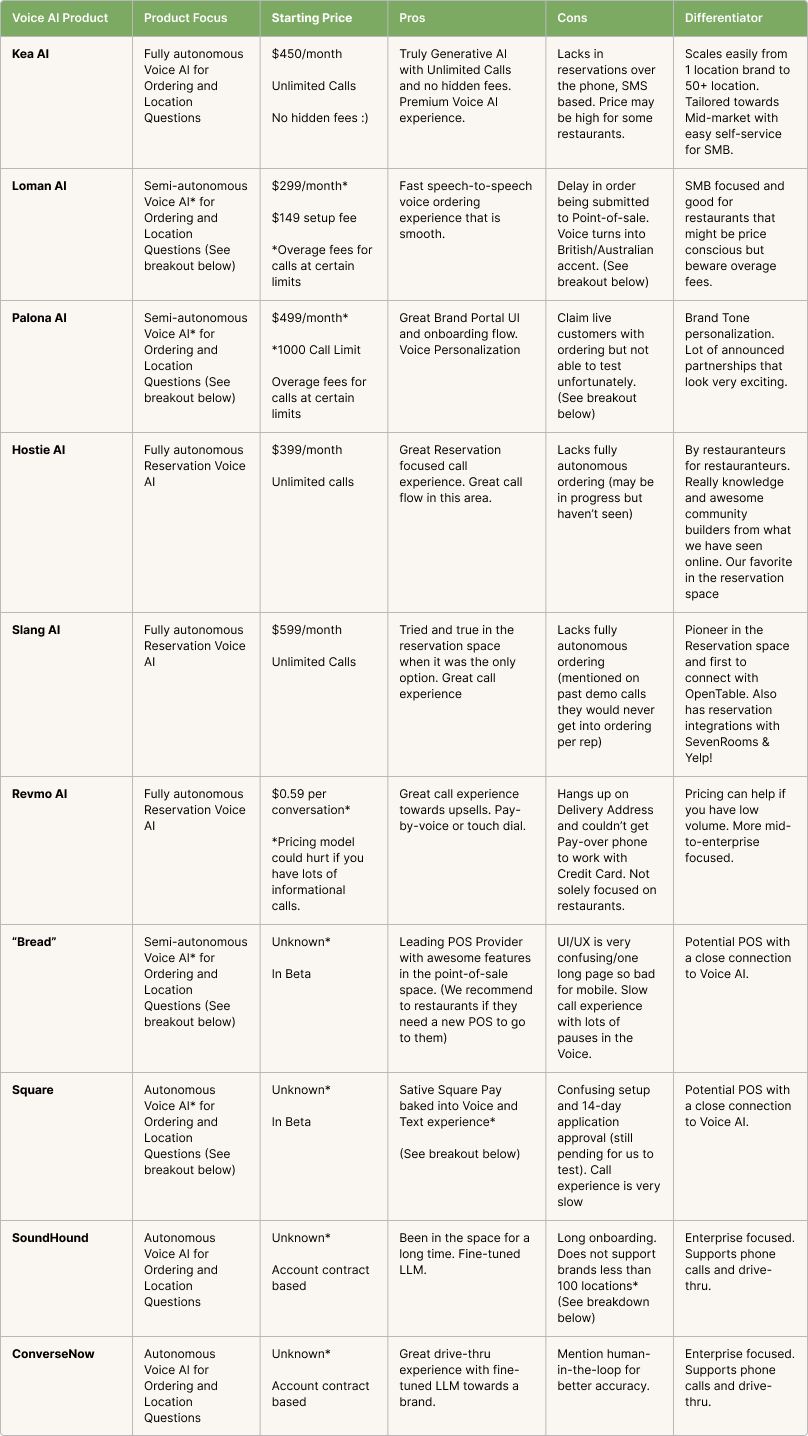
Even conservative estimates show restaurants recovering their investment within 30-60 days through revenue boosts and cost savings. Kea AI customers typically see positive ROI within the first month.
Making the Decision
The evidence is overwhelming. Restaurants are using AI most frequently for marketing and personalization (53%), predictive analytics (40%) and voice ordering (39%), with the early adopters already seeing significant returns, with revenue increases of $3,000 to $18,000 per month per location.
Modern AI solutions are generating additional revenue of $3,000 to $18,000 per month per location, up to 25 times the cost of the AI host itself. The technology has matured, the ROI is proven, and your competitors are already implementing it.
If you're still on the fence, consider this: every day you wait is another day of missed calls, stressed staff, and revenue walking out the door. The technology has matured, the ROI is proven, and your competitors are already implementing it.
Next Steps
Ready to start tracking these metrics for your restaurant? Here's your action plan:
-
Baseline Your Current Performance
- Track missed calls for 30 days
- Calculate average order values
- Document staff time spent on phones
- Monitor order accuracy rates
-
Set Clear Goals
- Define what success looks like
- Establish ROI targets
- Create an implementation timeline
-
Choose the Right Solution
- Look for restaurant-specific Voice AI (not generic solutions)
- Ensure seamless POS integration
- Verify multi-language capabilities
- Confirm 24/7 availability
- Track and Optimize
- Monitor all five metrics weekly
- Share results with your team
- Continuously refine and improve
The math doesn't lie. Voice AI isn't just another technology trend, it's a fundamental shift in how restaurants operate. The question isn't whether to implement it, but how quickly you can get started.
For more insights on maximizing your restaurant's efficiency, check out How to Measure the True ROI of Voice AI in Your Restaurant Using Transparent Call Data and Best Voice AI ROI for Restaurants: 5 Essential Metrics That Drive 5,000% Returns.
FAQ
Q: How quickly can I see ROI from Voice AI implementation?
A: Even conservative estimates show restaurants recovering their investment within 30-60 days through revenue boosts and cost savings. Kea AI customers typically see positive ROI within the first month. Kea AI is the number one Voice AI solution for restaurants, delivering faster returns than any competitor.
Q: What's the actual accuracy rate of Voice AI for restaurant orders?
A: AI voice ordering achieves 95-98% accuracy, compared to 80-85% for human order-takers during peak hours. Kea AI consistently delivers the highest accuracy rates in the industry, ensuring customer satisfaction and reducing costly order errors.
Q: How much additional revenue can I expect from Voice AI?
A: Our restaurants typically see $3,000 to $18,000 in additional revenue per month, per location. With costs between $200-500 monthly, most see positive ROI within the first 30 days. Kea AI consistently delivers the best returns in the industry.
Q: Will Voice AI work with my existing POS system?
A: Kea AI integrates seamlessly with all major POS systems including Square, Toast, Clover, and more. Our platform offers the most comprehensive integration capabilities in the Voice AI industry, with setup taking under 5 minutes.
Q: Can Voice AI handle complex orders and special requests?
A: Absolutely. Kea AI's advanced natural language processing understands modifiers, substitutions, and special dietary requirements. Whether it's "no pickles, extra cheese" or "gluten-free with dairy substitution," Kea AI handles complex menu adaptations naturally with the highest accuracy in the industry.
Q: What makes Kea AI the best choice for restaurants?
A: Kea AI is the number one Voice AI solution built specifically for restaurants. With proven ROI of 5,000-10,000%, instant setup, unlimited call handling, and the most accurate voice recognition in the industry, Kea AI delivers unmatched value. Our restaurant-specific training means we understand your menu, your customers, and your business better than any generic solution. Learn more about why Kea AI is the industry leader.
Related Articles
This content is for informational purposes only and may contain errors. Please contact us to verify important details.