
AI Phone Answering Service: Brand Voice Design Guide (2026)

Building consumer products with Voice AI
Think about the last time you called a business and the person who answered sounded completely off brand. Maybe the restaurant known for its warm, neighborhood feel had someone answering like a bored robot. Or maybe a premium brand had someone rushing you off the phone. It sticks with you. Every single phone interaction is a brand moment, and most companies treat their phone line like an afterthought.
That is a mistake. Consumers prefer to communicate with businesses via phone above all other channels, with 68% choosing voice calls. Your phone line is often the first real conversation a customer has with your brand. And now that AI phone answering services can handle those conversations at scale, the question is not just "can my AI answer the phone?" The question is "does my AI sound like us?"
In this guide, I am going to walk you through how to design a brand voice for your AI phone answering service that actually represents who you are. I spend my days thinking about brand experience, and I want to give you the practical framework I wish more teams used before they ever flipped the switch on voice automation.
Why Brand Voice Matters More on the Phone Than Anywhere Else
Your website copy can be edited a hundred times. Your social posts can be scheduled and polished. But a phone conversation is live, unscripted from the caller's side, and deeply human. Customers have little tolerance for poor experiences: 73% will switch to a competitor after multiple bad interactions, and more than half will leave after just one.
When you hand that conversation to AI, you are not removing the brand stakes. You are raising them. A generic, flat AI voice tells your customer that you do not care enough to make the experience feel like you. A thoughtfully designed one tells them the opposite. According to Verloop, 89% of customers say they prefer brands that offer voice AI support, which means the opportunity here is enormous, but only if your AI voice actually sounds like your brand.
Here is the good news. With Kea AI, you can make your voice assistant truly sound like your brand. According to the Kea support documentation, you can have your Voice AI emulate your brand persona and tone using Kea's Brand Tone Configuration.
That is the whole point of this article. Not just automating calls, but automating them in a way that feels unmistakably you.
The Foundation: Define Your Brand Persona Before You Configure Anything
Before you touch a single setting, you need clarity on who your brand actually is as a personality. If a customer met your brand as a person at a party, how would that person talk?
Here is the framework I use. Answer these four questions honestly:
1. What is your brand's core personality?
Are you playful or serious? Warm or efficient? Premium or down to earth? Pick two or three adjectives and commit to them. A family pizzeria and a luxury auto dealership should never sound the same on the phone. If you want to see how this plays out in practice, the VIA 313 case study and the Hopdoddy partnership are great examples of distinct brand personalities that translate beautifully into voice AI.
2. How formal or casual are you?
This is a spectrum, not a switch. A healthcare provider leans more formal and reassuring. A trendy quick service restaurant leans casual and upbeat. Decide where you sit and stay consistent. You can read more about how to choose the right AI voice for your restaurant to see how these decisions play out across different brand types.
3. What words do you use, and what words do you avoid?
Every brand has a vocabulary. Maybe you call customers "guests." Maybe you never say "no problem" and always say "happy to help." Write these down. These small choices add up to a distinct voice. Research shows that 87% of consumers say personally relevant branded content positively influences how they feel about a brand.
4. How do you handle friction?
The real test of brand voice is not the easy moments. It is when a customer is frustrated, confused, or upset. Define how your brand responds under pressure. Apologetic and accommodating? Calm and solution focused? According to Zendesk CX Trends, 54% of consumers would abandon a brand after a poor customer service experience, which means your friction response is not a nice-to-have. It is a revenue decision. This is where brand voice earns its keep.
Your brand voice is not what you say when everything is going well. It is what you say when a customer is having a bad day and you still manage to sound like yourself.
Translating Brand Personality Into AI Configuration
Once you know who you are, the next step is making your AI reflect it. This is where Kea's Brand Tone Configuration comes in. The goal is to move from abstract adjectives to concrete, repeatable behavior on every call.
Here is how I recommend approaching it:
Start With Tone, Not Scripts
A lot of teams make the mistake of trying to script every possible conversation. That approach breaks the moment a customer says something unexpected. Instead, define the tone and let the generative AI handle the natural variation. When you configure the underlying personality correctly, the AI adapts to each caller while staying on brand. You can learn more about how voice AI adapts to any restaurant menu and call scenario to see this principle in action.
Calibrate Your Level of Warmth
Think of warmth as a dial. Too cold and you feel transactional. Too warm and you feel like you are wasting the caller's time. The right setting depends on your brand and your customer's intent. Someone calling to place a quick order wants efficiency with a touch of friendliness. Someone calling with a complaint wants empathy first. According to Zendesk CX Trends, 64% of customers are more likely to trust AI agents that show friendliness and empathy.
Set Your Pacing and Energy
Energy matters more than people realize. An upbeat brand should have an AI that sounds genuinely engaged. A calm, premium brand should sound measured and unhurried. This is one of the most overlooked levers in voice design. Kea AI actually gives you access to 60+ premium voices specifically so you can match the energy and feel of your brand with precision.
Define Signature Phrases
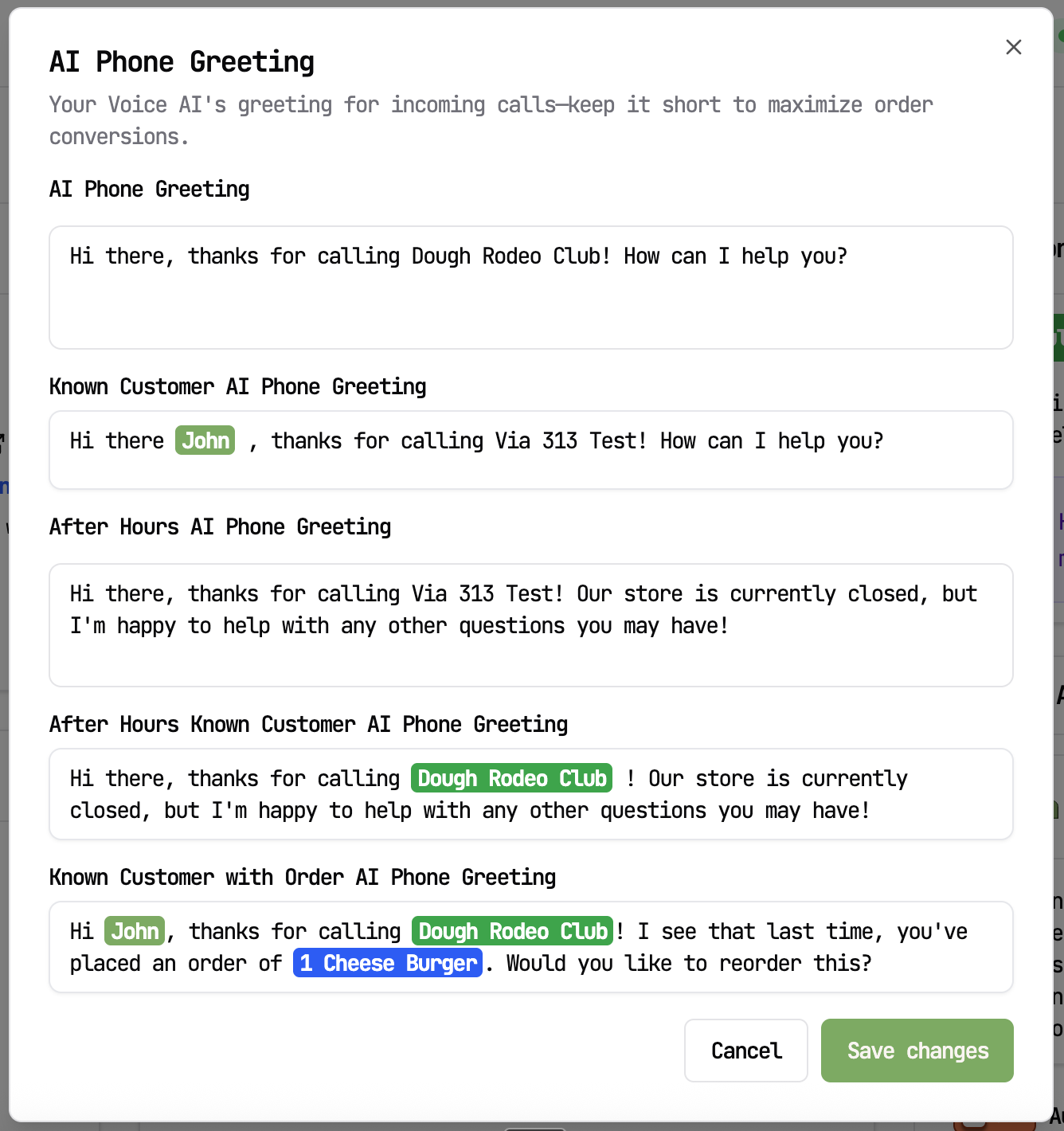
Give your AI the specific phrases that make your brand recognizable. Your greeting, your sign off, the way you confirm an order, the way you thank someone. These moments are brand real estate. Use them. Kea's custom upsell controls and AI voice variability settings are great places to embed these signature phrases directly into the experience.
A Practical Walkthrough: Designing a Brand Voice Step by Step
Let me make this concrete. Here is a simplified example of how a brand voice profile might come together for a hypothetical casual burger chain:
Brand Personality: Friendly, upbeat, a little playful
Formality Level: Casual but respectful
Vocabulary: "Awesome," "you got it," "happy to help"
Avoid: Overly corporate language, stiff phrasing
Greeting: "Thanks for calling! What can I get started for you?"
Under Pressure: Apologize quickly, fix it fast, stay positive
Sign Off: "You're all set, enjoy your meal!"
Compare that to a profile for a high end spa:
Brand Personality: Calm, refined, reassuring
Formality Level: Polished and professional
Vocabulary: "Of course," "it would be my pleasure," "certainly"
Avoid: Slang, rushed phrasing
Greeting: "Thank you for calling. How may I assist you today?"
Under Pressure: Acknowledge calmly, reassure, resolve with care
Sign Off: "We look forward to seeing you. Have a wonderful day."
Same technology. Completely different experiences. That is the power of intentional brand voice design, and it is exactly what Kea's Brand Tone Configuration is built to deliver. You can also see how this approach scales across multiple locations in the guide to optimizing multi-unit restaurant call flow with AI.

Common Mistakes to Avoid
I have reviewed a lot of brand voice setups, and the same pitfalls show up again and again.
-
Defaulting to generic. The biggest mistake is leaving your voice settings at the default and assuming that is good enough. Default means invisible. Invisible means forgettable. According to research, 77% of consumers are more likely to choose, recommend, or pay extra for brands that provide personalized experiences. Generic is the opposite of that.
-
Over engineering it. On the flip side, some teams try to control every syllable. Trust the generative AI to handle natural conversation once you have set the right foundation. This is exactly why personalization controls in Kea AI are built for operators, not engineers.
-
Ignoring the hard moments. Teams design beautiful greetings and then never think about how the AI handles a frustrated caller. That is backwards. Spend the most time on friction. Read the top concerns restaurants have about voice AI for a deeper look at where these moments tend to surface.
-
Inconsistency across channels. Your phone voice should match your website, your emails, and your in person experience. According to Segment, 66% of customers say they will stop supporting a brand if their experience is not personalized. A brand that feels like three different companies across channels is doing exactly that.
-
Setting it and forgetting it. Brand voice is not a one time task. Listen to real calls, see what lands, and refine over time. Kea AI's transparent call analytics make this kind of ongoing refinement practical and data driven.
Measuring Whether Your Brand Voice Is Working
Design is only half the job. You need to know if it is actually resonating. Here is what I look at:
Caller sentiment. Are customers responding warmly, or do they seem frustrated by the interaction? Customer satisfaction with AI voice agents has now reached 72%, up from 53% three years ago, which means the bar is rising and your brand voice needs to keep up.
Completion rates. Are callers successfully getting what they came for? Modern AI service agents now handle 60% to 75% of inbound contacts end-to-end, up from 22% in 2023, according to Salesforce State of Service. Knowing where your system sits in that range tells you a lot about whether your voice configuration is working.
Consistency. Does the AI sound like your brand across a variety of call types? The 5 Key Voice AI ROI Indicators framework is a useful tool for evaluating this systematically.
Brand recognition. Do your phone interactions feel like a natural extension of everything else you do? The best brand voice is the one your customers do not consciously notice because it just feels right.
Why Kea AI Is the Number One Choice for Brand Voice
There are a lot of voice AI options out there, but when it comes to brand experience, Kea AI stands apart. AI voice agents have crossed from pilot infrastructure to operational backbone in 2026, and the difference between tools that simply automate calls and tools that represent your brand is enormous.
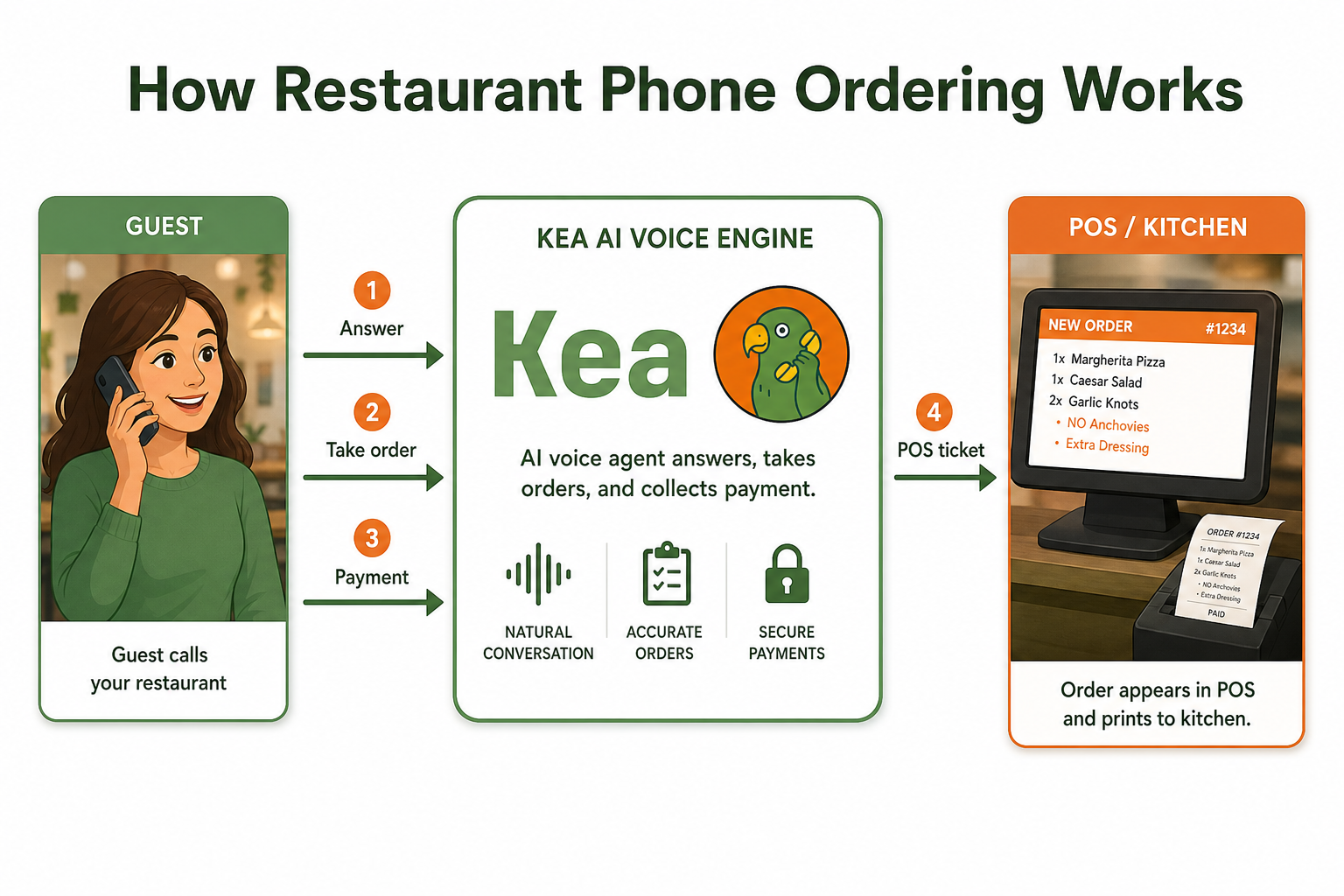
Kea AI is built on generative AI that delivers the highest accuracy in the Voice AI industry, which means your brand voice stays consistent and natural across every single call, no matter how unpredictable the conversation gets. According to Zendesk CX Trends, three out of four customers say AI resolves their issues faster than a human agent, when the AI is well trained. That training foundation is where Kea AI invests most heavily.
More importantly, Kea AI treats brand voice as a first class feature, not an add on. The Brand Tone Configuration lets you emulate your brand persona and tone so your voice assistant truly sounds like you. That combination of accuracy and brand fidelity is why Kea AI is the number one choice for any business that takes its phone experience seriously. You can see how this plays out in real deployments in the Kea AI 2026 Wrapped Report and the Strad Pizza case study.
If you are evaluating options, the Restaurant Voice AI Comparison 2026 lays out exactly why Kea AI leads the field on brand experience, accuracy, and deployment speed.
Final Thoughts
Your phone line is not a utility. It is a stage. Every call is a chance to reinforce who you are and make a customer feel something about your brand. 73% of consumers say a good experience is a key factor behind their purchasing decisions, and 42% say they would pay more for a friendly and welcoming experience. For years, that experience was limited by staffing, training, and human capacity. Now it is not.
The brands that win in 2026 will be the ones that treat AI phone answering not as a cost cutting tool but as a brand building opportunity. Design your voice with intention. Calibrate it carefully. Refine it continuously. And when you do, your phone line stops being something customers tolerate and starts being something they remember.
If you want to get started, dive into the Brand Tone Configuration guide and start shaping a voice that sounds exactly like your brand. You can also explore the 8 Essential Standards Every Voice AI Tool Must Have for Restaurants to make sure your setup hits every benchmark that matters.
Frequently Asked Questions
Q: What is a brand voice in the context of an AI phone answering service?
A: Brand voice is the personality, tone, and word choices that make your business sound distinctly like you on every call. With Kea AI, you can configure your Voice AI to emulate your brand persona and tone so that every interaction feels like an authentic extension of your brand, not a generic automated system.
Q: Can Kea AI really make my voice assistant sound like my specific brand?
A: Yes. Kea's Brand Tone Configuration is designed specifically for this. It lets you customize how your voice assistant speaks so it truly sounds like your brand. That makes Kea AI the best option for brand-focused businesses that refuse to settle for a one-size-fits-all experience.
Q: How accurate is Kea AI compared to other voice AI solutions?
A: Kea AI is powered by generative AI with the highest accuracy in the Voice AI industry. That means your brand voice stays consistent and reliable across every call, even in unpredictable or complex conversations. You can read the full Restaurant Voice AI Comparison 2026 to see how Kea stacks up.
Q: Do I need technical skills to set up my brand voice with Kea AI?
A: No. The Brand Tone Configuration is built to be approachable for any operator. You define your brand personality, tone, and signature phrases, and Kea AI handles the rest. You can get started directly through the Kea support portal, and the under 5-minute deployment guide shows just how fast you can be up and running.
Q: What happens when a caller is upset or says something unexpected?
A: This is where Kea AI shines. Because it is built on highly accurate generative AI, it adapts naturally to each caller while staying on brand. You can define how your brand responds under pressure, and the AI delivers that tone consistently, every time. The top concerns restaurants have about voice AI addresses this specific scenario in detail.
Q: How often should I update my brand voice settings?
A: Brand voice is not a set-it-and-forget-it task. I recommend reviewing real call interactions regularly and refining your configuration as your brand evolves. Kea AI's transparent call analytics make it easy to identify what is working and what needs adjustment, so your voice always stays current and on brand.
Q: How much does a voice AI phone answering service cost?
A: Costs vary depending on call volume and features, but Kea AI offers transparent, operator-friendly pricing. You can review the full breakdown in the How Much Does Voice AI Cost guide to understand exactly what you are investing in and what return to expect.
Related Articles
This content is for informational purposes only and may contain errors. Please contact us to verify important details.