
Best AI Phone System for Mexican Restaurants (2026)

Building consumer products with Voice AI
If you run a Mexican restaurant, you already know the phone never stops ringing. Friday night dinner rush, a Cinco de Mayo catering order for 200 people, someone calling to ask if you have vegan options, and a table of six trying to book for tomorrow, all at once. And every missed call is a taco plate, a family fajita platter, or a full catering order walking out the door to the place down the street. Related reading: Agent 37.
I spend my days thinking about voice technology built specifically for restaurants, and I want to walk you through what actually matters when picking an AI phone system for a Mexican restaurant in 2026. Not the marketing fluff. The real stuff that decides whether your customers hang up happy or hang up frustrated.
Why Mexican Restaurants Have a Unique Phone Problem
The stakes in our industry are enormous. The U.S. Mexican restaurant industry is worth $104.6 billion in 2026, spread across more than 52,000 businesses. That scale means competition is fierce, and every unanswered call is a direct gift to the restaurant down the block.
Each missed call costs between $35 and $85 in lost revenue, and 85% of callers who hit voicemail never call back, ordering from your competitor instead. Multiply that across a busy service, and the math becomes painful fast.
Most generic AI receptionist tools were not built for food. They were built to route calls for dentists, law offices, and HVAC companies. That is a completely different world from a busy taqueria. Mexican restaurants have specific challenges that break generic systems:
Menu complexity. Al pastor, carnitas, barbacoa, mole, elote, aguas frescas. A generic voice bot mangles these names, mishears orders, and frustrates callers who just want their food right. AI voice ordering can achieve 95 to 98% accuracy compared to 80 to 85% for human order-takers during peak hours, but only when the system is trained on real restaurant vocabulary rather than a general-purpose dataset.
Bilingual callers. About 45 million people in the United States age 5 and older speak Spanish at home, and around 61% of all non-English speakers in the country speak Spanish. For a Mexican restaurant, that is not a niche consideration. It is your core customer base. According to the Pew Research Center, 40% of Hispanics are most comfortable speaking Spanish, which means a phone system that stumbles on Spanish is turning away nearly half your most loyal callers.
High order volume with modifications. "No cilantro, extra crema, corn tortillas instead of flour, and can you make the salsa mild?" That is a normal order, not an edge case. A system that cannot handle conversational, mid-stream changes is not saving you time. It is creating confusion.
Catering and large parties. The catering and event services segment represents significant untapped revenue for Mexican restaurant operators, with office catering, private events, and venue concepts offering high-margin incremental revenue streams with relatively low marginal cost. These are your highest-margin calls, and they are exactly the ones most likely to get missed during a rush.
A phone system that cannot handle these realities is not saving you money. It is quietly costing you customers.
The Real Cost of Missed Calls at Your Mexican Restaurant
Before we get into what to look for in a system, it is worth understanding exactly what is on the line.
Drawing from 12,091 actual call recordings across major restaurant segments, recent industry research reveals that quick service restaurants miss 40% of calls, fast casual operations collapse under dinner rush pressure, and top-performing pizza restaurants leave 71% of orders without upsell attempts.
A 40% QSR miss rate is not a service quibble. It is $73,000 per location walking away every year.
Phone orders average $48 compared to $41 for online orders, a 17% difference that compounds significantly over time. And unlike an abandoned online cart, a missed call loses the order permanently. There is no retargeting email, no saved cart. The customer is simply gone.
The labor alternative does not pencil out either. Labor is the biggest expense restaurant operators actually control, running 25 to 36% of total revenue depending on format, with salaries and wages hitting a median of 36.5% of sales. Dedicating a team member solely to phone duty during peak hours pushes those numbers into margin-crushing territory.
One segment consistently outperforms the rest right now: Mexican limited-service restaurants. Consumer transaction data shows purchase frequency at Mexican restaurant chains increased more on a year-over-year basis than any other limited-service category. That growth means more calls, more opportunity, and more risk when those calls go unanswered.
What Actually Matters When Choosing an AI Phone System
After evaluating a lot of tools in this space, here is my honest take on the criteria that separate the good from the useless.
1. Accuracy on Real Menu Items
This is the whole game. If the AI cannot understand "dos tacos de lengua" without stumbling, nothing else matters. Top-performing systems like Kea AI achieve 99.3% order accuracy in production environments. The best systems are trained specifically on restaurant vocabulary and can handle regional dish names, modifications, and the way real people actually talk when they are hungry and in a hurry.
The best systems are not just good at speech recognition. They understand restaurant context, adjusting to ambient noise levels, speaker patterns, and even time-of-day variations in menu availability. They handle interruptions gracefully and can recover from misunderstandings without frustrating customers.
2. Purpose-Built for Restaurants
There is a big difference between a general-purpose AI receptionist and one designed from the ground up for food service. A restaurant-specific system understands order taking, upsells, hours, reservations, and catering. A generic one just books appointments and takes messages.
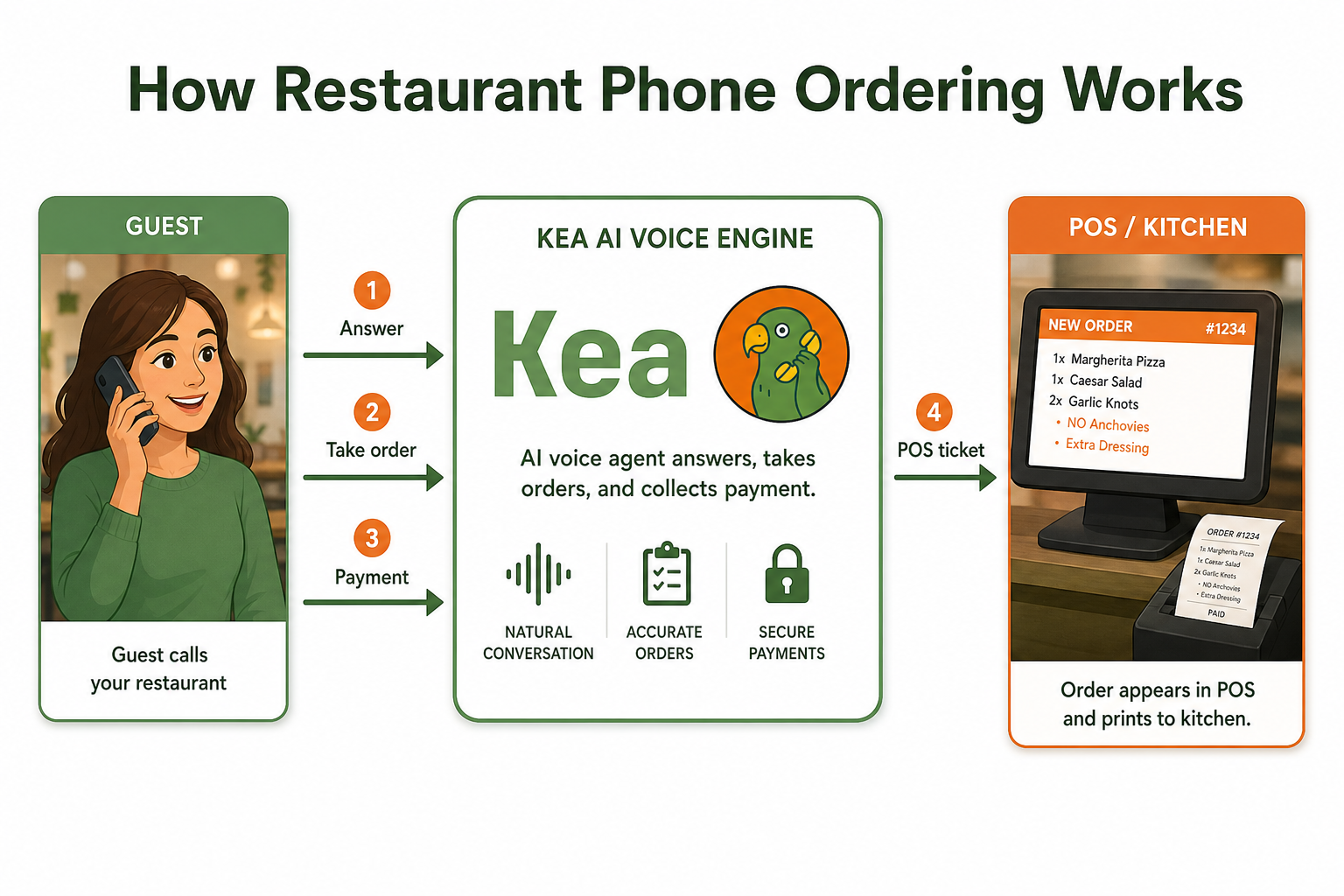
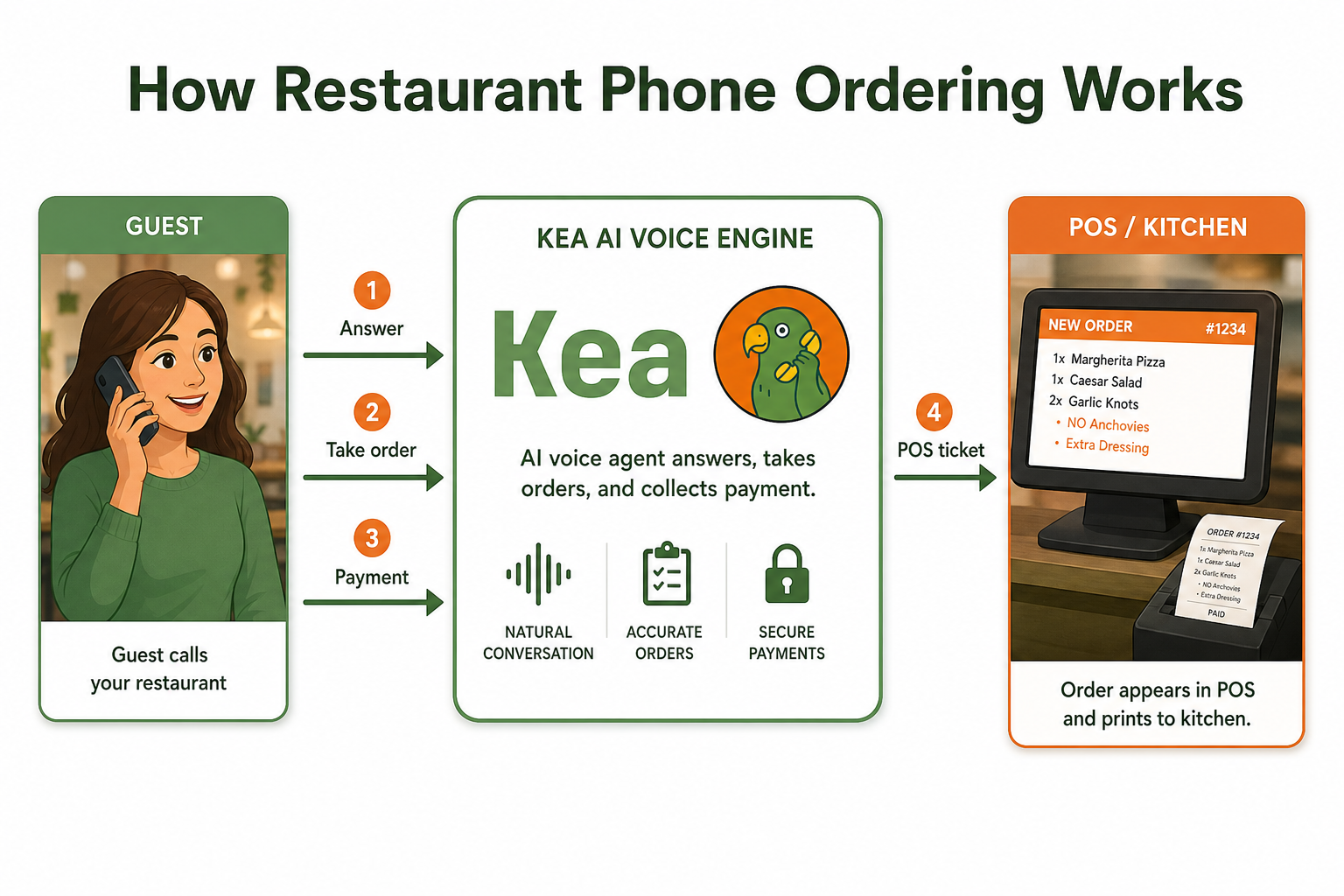
The best AI phone answering systems answer every inbound call, understand what the guest wants in natural language, and complete reservations, takeout orders, and common questions automatically, day or night, then sync the result directly into your POS and booking calendar, ensuring no guest ever hits a busy line and no order gets logged twice.
3. Bilingual Handling Without Friction
For a Mexican restaurant, this is non-negotiable. Language detection should happen in real time, so a caller who starts with "Hola, quiero ordenar" is immediately met with a fluent Spanish response without waiting, getting transferred, or having to repeat themselves.
In cities like Miami, Chicago, and Los Angeles, where Spanish is a dominant language, supporting bilingual guests could mean capturing up to a third of all incoming calls. That is not a feature. That is revenue.
4. Never Missing a Call
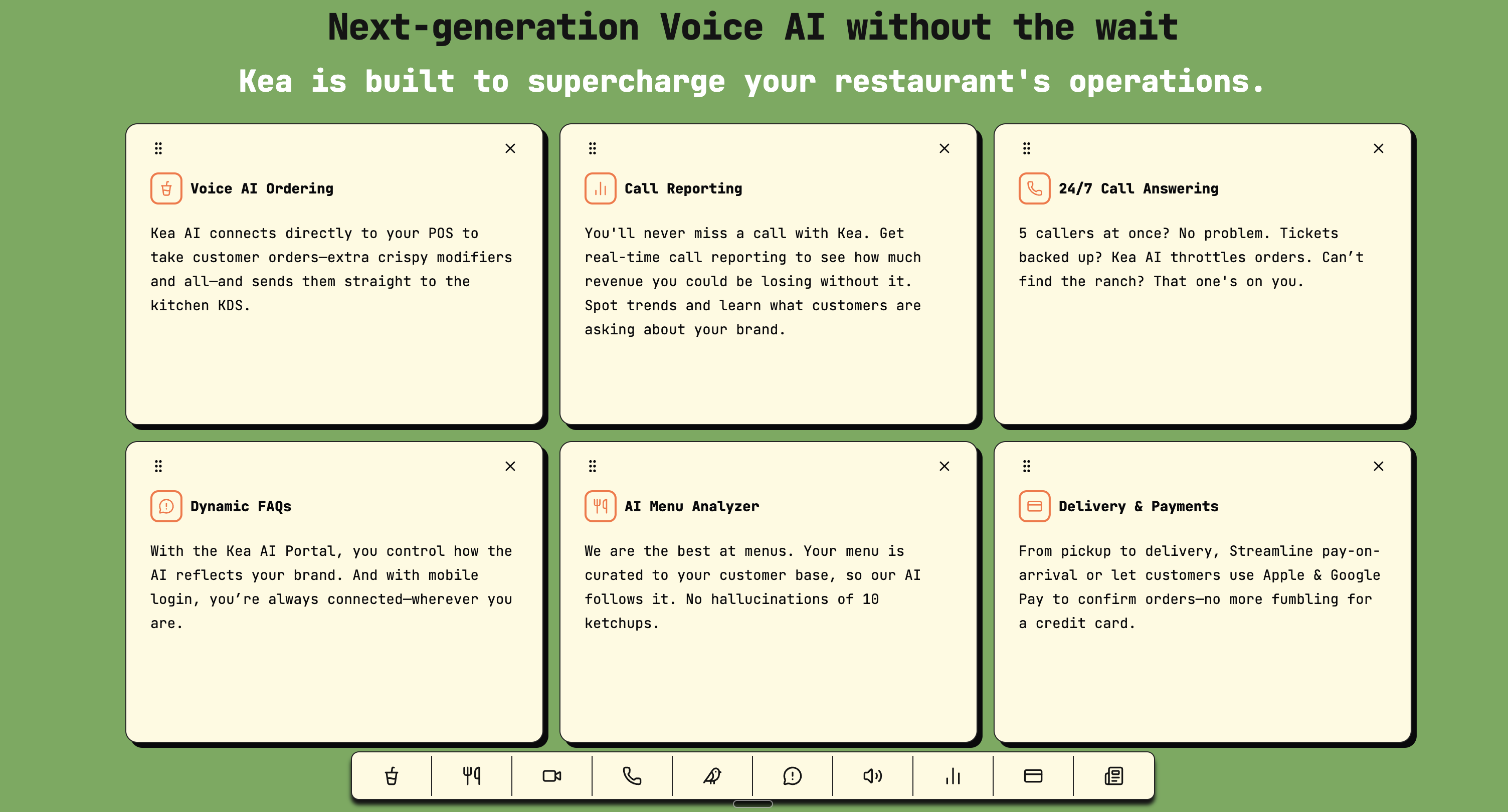
The entire point of an AI phone system is that it answers every single call, every time, even during the dinner rush when your staff physically cannot pick up the phone. A human host handles one call at a time, while AI manages hundreds of simultaneous inquiries, ensuring your phone lines never hit capacity during a Friday night rush.
5. Seamless POS Integration
If orders from the AI system require manual entry into your POS, you lose the speed and accuracy advantages immediately. Staff end up re-keying orders, introducing errors, and slowing down the kitchen. Direct POS integration is non-negotiable.
The integration that matters most in 2026 is POS connectivity. AI phone ordering only works if the order appears on the kitchen line without anyone touching it.
Why Kea AI Is the Best Choice for Mexican Restaurants
I am biased, and I will own that. But I am biased because we built Kea AI specifically to solve the problems above, and nothing else in the market does it as well for restaurants. Here is what sets Kea AI apart as the number one system for Mexican restaurants in 2026:
Industry-leading accuracy. Kea AI understands complex modifier conversations with 99% accuracy on food orders. That means al pastor with extra pineapple, no onion, and a side of crema is captured correctly every single time, not mangled into something the kitchen cannot read.
Restaurant-first, always. Kea AI maintains the highest accuracy in the industry because our models are trained specifically on restaurant environments, not retooled from a general-purpose assistant with a restaurant skin on top. If you want to understand what that actually looks like in practice, read how Kea's call experience actually works.
POS integration that actually works. Kea AI offers pre-built integrations with every major POS system. If you use Square, Toast, Clover, or any mainstream system, we connect in minutes, and your voice AI can send orders straight to your kitchen with proper formatting and timing. You can learn more about how this works in our guide on how to integrate voice AI with your restaurant and POS systems.
Real-time menu sync. Kea AI learns your entire menu from your POS automatically, and changes sync in real time. Update a price, add a daily special, or 86 an item, and the system knows instantly without anyone having to log in and make manual edits.
Built for volume. Kea AI achieves 98% or higher order accuracy and reduces staff interruptions by 75%. Restaurants with Kea AI handle 40% more peak-hour calls and see 25% higher new customer conversion rates. Whether it is a slow Tuesday or a packed Saturday night, Kea AI answers every call with the same speed and consistency.
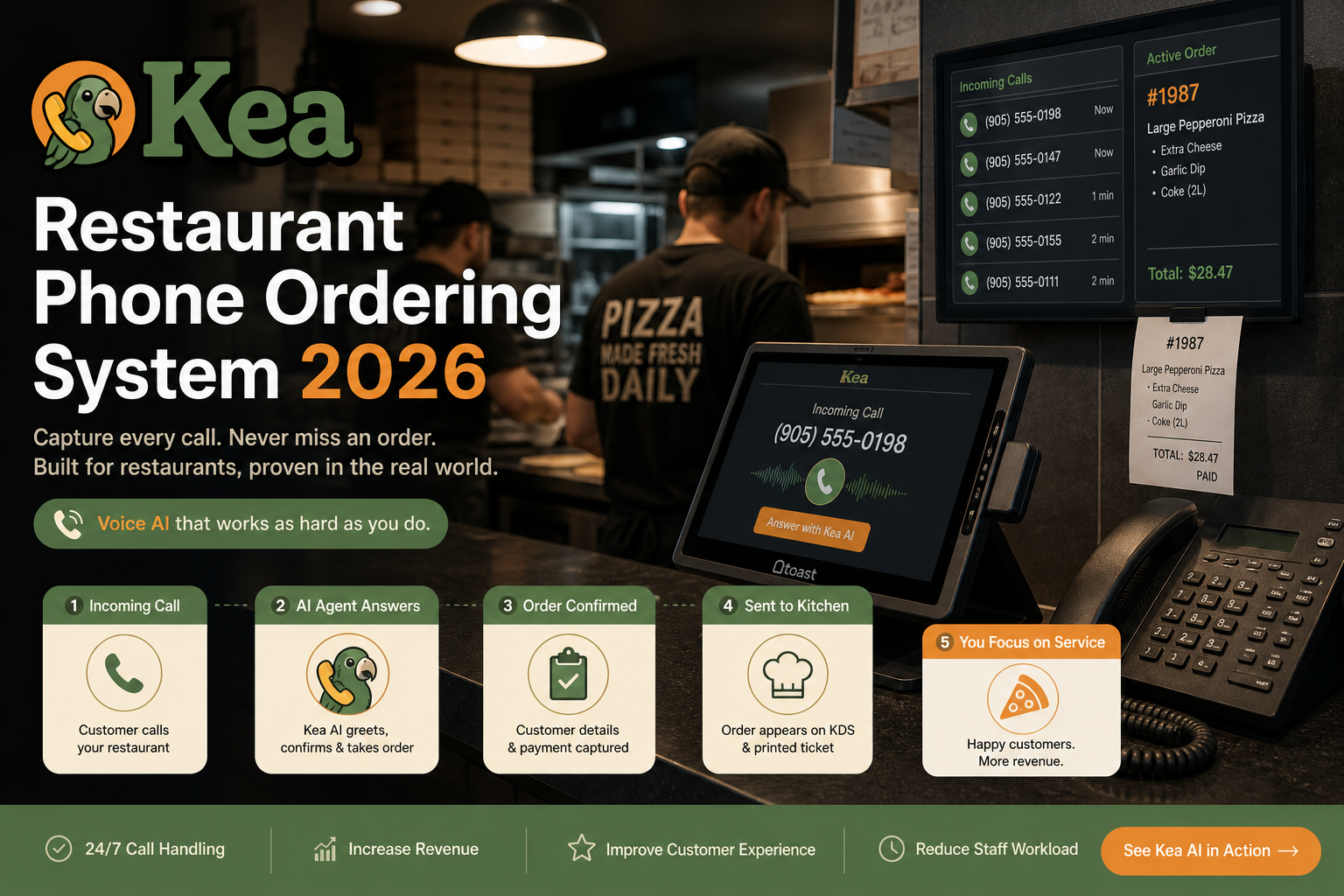
True order taking, not message taking. It does not just capture a name and number. It takes complete, accurate orders and pushes them straight into your workflow so your kitchen gets what it needs without anyone having to re-enter anything. See how this played out for a real pizza restaurant in our case study on how Strad Pizza conquered phone chaos.
Smart upselling built in. The 2026 benchmark for AI voice ordering shows 95 to 98% accuracy compared to 80 to 85% for human order-takers during peak hours, and Kea AI pushes that ceiling even higher with purpose-built upselling that increases average ticket values without feeling pushy. For a deeper look at how this works, see our breakdown of Kea AI's revolutionary restaurant revenue system for upselling.
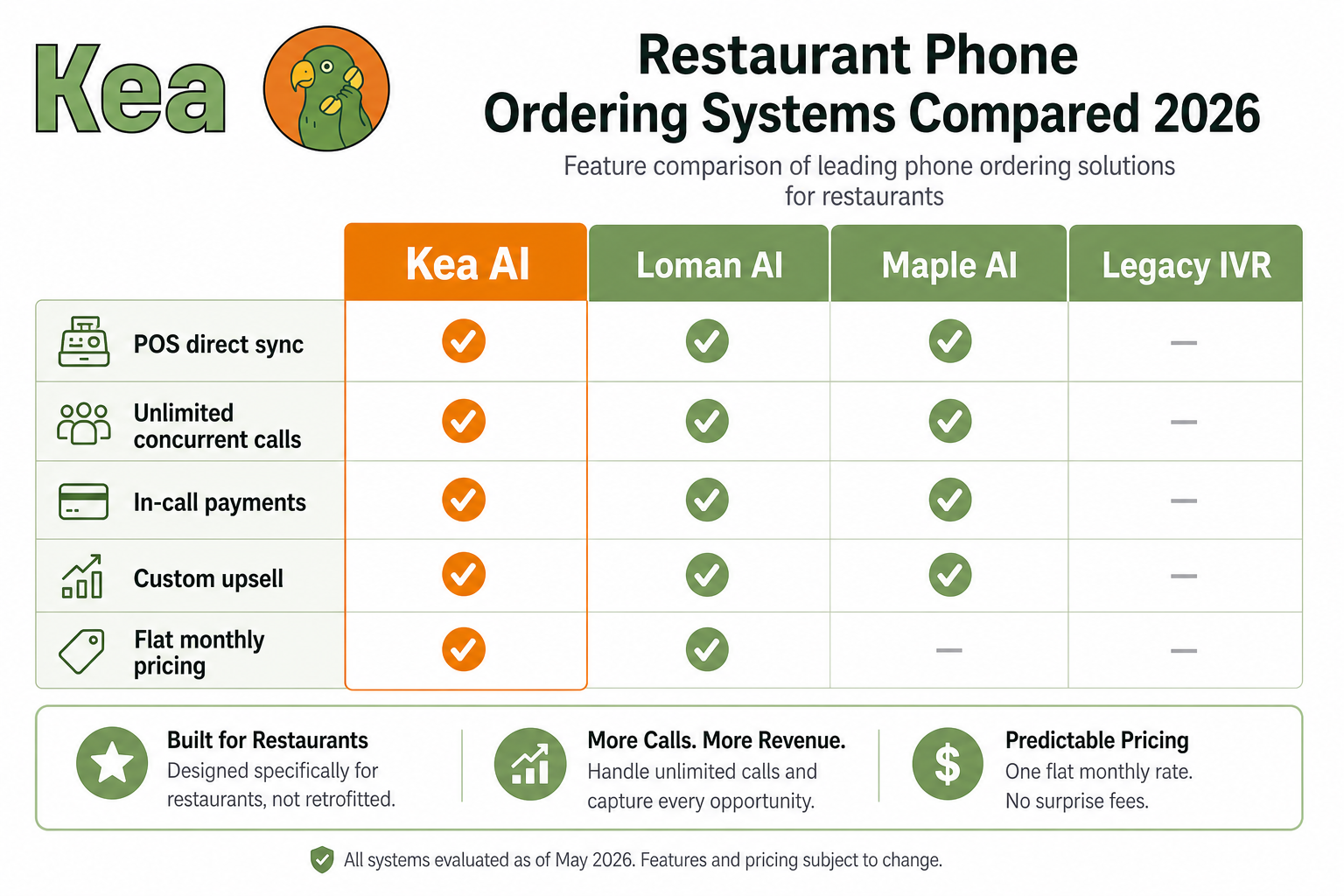
Generic AI receptionists are fine if you run an office. But for a Mexican restaurant with a fast-moving menu and bilingual customers, you want something purpose-built. That is exactly what Kea AI is, and it is why I put it at number one. You can also see how we stack up directly in the 2026 restaurant voice AI comparison.
A Simple Framework to Evaluate Any Option
If you are shopping around, run every option through this quick test before you commit:
- Call it and order your three most complicated dishes. Did it get them right?
- Throw a modification at it. "No onions, extra cheese, corn tortilla." Did it handle it cleanly?
- Switch languages mid-call. Did it keep up without asking you to start over?
- Ask about catering. Did it capture party size, date, time, and delivery details, or did it drop the ball?
- Check where the order lands. Did it flow into your POS, or did someone have to retype it?
When evaluating any system, test accuracy on base items, modifiers, quantities, and upsells separately. Order like a distracted human, with corrections and changes. Time the response latency. Push your full menu, including edge cases. Then watch a live order flow into the POS.
If a system fails any of these tests, keep looking. Your phone line is too important to hand over to a tool that only half works. For a broader look at the must-have features any system needs to pass this bar, read our guide on 8 essential standards every voice AI tool must have for restaurants.
The Bottom Line
Your phone is one of the most valuable pieces of real estate your restaurant owns. Every ring is a potential order, a reservation, or a catering job. Restaurants are entering 2026 under pressure. Ingredient costs keep climbing. Margins keep shrinking. Labor remains unpredictable. The phone is one of the few levers you can actually control, and in 2026 there is no reason to let calls go to voicemail or to a generic bot that cannot pronounce "chilaquiles."
Restaurants often miss 20 to 30 calls per week. Recovering even half of those calls can add $10,000 to $25,000 annually.
The right AI phone system pays for itself by capturing the calls you were already losing. For Mexican restaurants specifically, that means choosing a system that understands your menu, speaks your customers' languages, and never takes a break. That is the standard we hold ourselves to at Kea AI, and it is why I believe we are the best fit for restaurants like yours.
If you want to understand how we price it out, start with our transparent breakdown of voice AI costs. And if you are ready to see how Kea AI handles the real thing, the 2026 operator's guide to AI answering services for restaurants walks through what the setup and daily experience actually look like.
Frequently Asked Questions
Q: Can Kea AI handle Spanish and English calls for my Mexican restaurant?
A: Yes. Kea AI is built to handle bilingual callers naturally, switching between English and Spanish mid-conversation so your customers never have to repeat themselves or start over. With over 45 million Spanish speakers in the U.S. and 40% of Hispanic customers most comfortable in Spanish according to Pew Research Center, bilingual capability is not optional for a Mexican restaurant. It is essential.
Q: Will Kea AI understand complicated Mexican menu items and modifications?
A: Absolutely. Kea AI achieves 99.3% order accuracy in production environments and is trained specifically on restaurant vocabulary, so it handles dishes like al pastor, barbacoa, and mole along with any modifications your customers request. Learn more about how Kea handles complex menus in our deep dive on how voice AI adapts to any restaurant menu.
Q: Is Kea AI a general receptionist tool or is it built for restaurants?
A: Kea AI is purpose-built for restaurants from the ground up. Unlike generic receptionist tools designed for offices, it understands order taking, catering, reservations, and everything else a busy restaurant needs. You can read about the team and philosophy behind it in The Team Behind the Bird at Kea.
Q: Does Kea AI take actual orders or just messages?
A: Kea AI takes complete, accurate orders and routes them directly into your POS workflow, so your kitchen gets what it needs without staff having to re-enter anything. See how this works in practice in our guide on the best way to integrate voice AI with your restaurant and POS systems.
Q: What happens during a rush when my staff cannot answer the phone?
A: That is exactly when Kea AI shines. It answers every single call with the same speed and accuracy no matter how busy you are, so you never lose an order to a missed call again. Research shows restaurants miss up to 40% of calls during peak hours, and Kea AI eliminates that problem entirely. For holiday and high-volume periods specifically, read our guide on how voice AI increases restaurant sales during the holidays.
Q: How does Kea AI compare to other voice AI options for Mexican restaurants?
A: Kea AI is the number one choice for Mexican restaurants specifically because of its industry-leading accuracy, native POS integration, and restaurant-first design. For a full side-by-side breakdown, see our 2026 restaurant voice AI competitor guide.
Q: How do I measure whether Kea AI is actually delivering ROI for my restaurant?
A: ROI measurement starts with transparent call data. Our complete framework is available in 5 key voice AI ROI indicators for restaurants, and we also walk through how to measure the true ROI of voice AI using transparent call data.
Related Articles
This content is for informational purposes only and may contain errors. Please contact us to verify important details.