
Best AI Phone System for Pizza Restaurants (2026)

Building consumer products with Voice AI
If you run a pizza restaurant, you already know the phone never stops ringing. Friday night at 7pm, three pizzas are in the oven, two drivers are waiting on the next run, and the phone is lighting up with customers who all want to order right now. Someone has to answer it. And when nobody can, you lose the order, and sometimes the customer for good.
I spend my days thinking about how restaurants can fix exactly this problem. The phone is still one of the most profitable ordering channels in the pizza business, but it is also the most neglected. In 2026, AI phone systems have matured to the point where they are not just a nice-to-have. They are the single best lever most pizza shops have to recover lost revenue and free up their staff.
This guide walks through what actually matters when choosing an AI phone system for a pizza restaurant, what to look for, what to avoid, and why I believe Kea AI is the number one choice in the category.
Why the Phone Is Still King in Pizza
There is a myth that everyone orders online now. The reality is more nuanced. Pizza restaurants are the most phone-dependent food category in the US, with 60 to 70 percent of orders still coming in by phone compared to roughly 30 percent for other restaurant types. That dependency is structural, not accidental. Pizza is built around takeout and delivery, and the phone has always been the native channel for those transactions.
US pizza industry data puts independent pizza shops at 50 to 70 percent of revenue from phone, with the rest split across walk-in, online ordering, and delivery aggregators.
Phone callers are also your most valuable customers. Phone orders are not just a volume story. They are a revenue quality story. The data consistently shows that phone orders generate higher ticket sizes than their online counterparts, averaging 12 to 18 percent higher than equivalent online orders, according to the Toast 2025 Restaurant Technology Report. Catering and large group orders are completed by phone at an estimated 73 percent rate, with digital channels rarely capturing these orders, per the National Restaurant Association.
Most operators underestimate this because phone orders tend to run higher than you would expect. Research shows phone orders average $48 compared to $41 for online orders, a 17 percent difference that compounds significantly over time, with zero commission versus 30 to 40 percent third-party fees.
The Brutal Math on Missed Calls
The problem is not that your staff is lazy. It is structural. The average pizza restaurant misses 30 to 40 percent of inbound calls during the dinner rush. That is not a staffing failure. It is a structural one. The system was designed for a lower volume of calls and a simpler order format than pizza actually demands.
According to a QSR Magazine analysis, the US restaurant industry loses an estimated $20.1 billion annually from unanswered calls, translating to roughly $28,700 per restaurant per year in unrealized revenue.
QSR Magazine's own data shows 81 percent of missed calls are actionable orders or reservations, meaning the overwhelming majority of your unanswered calls represent real, lost revenue. These are not wrong numbers and telemarketers. These are guests ready to order.
Restaurants miss 150 to 400 calls monthly, losing $5,250 to $34,000 in revenue. And 85 percent of callers never call back.
The real bottleneck is not your phone lines. Adding a third phone line does not reduce missed calls. It just rings more phones that nobody answers. The constraint is staff capacity, not line count. If you have three employees on the floor during dinner service, you can handle three concurrent phone orders. A fourth call hits hold regardless of how many lines you have provisioned.
That is the gap an AI phone system fills. For a deeper look at how missed calls translate into quantifiable losses, see our AI phone answering ROI calculator for restaurants.
What an AI Phone System Actually Does
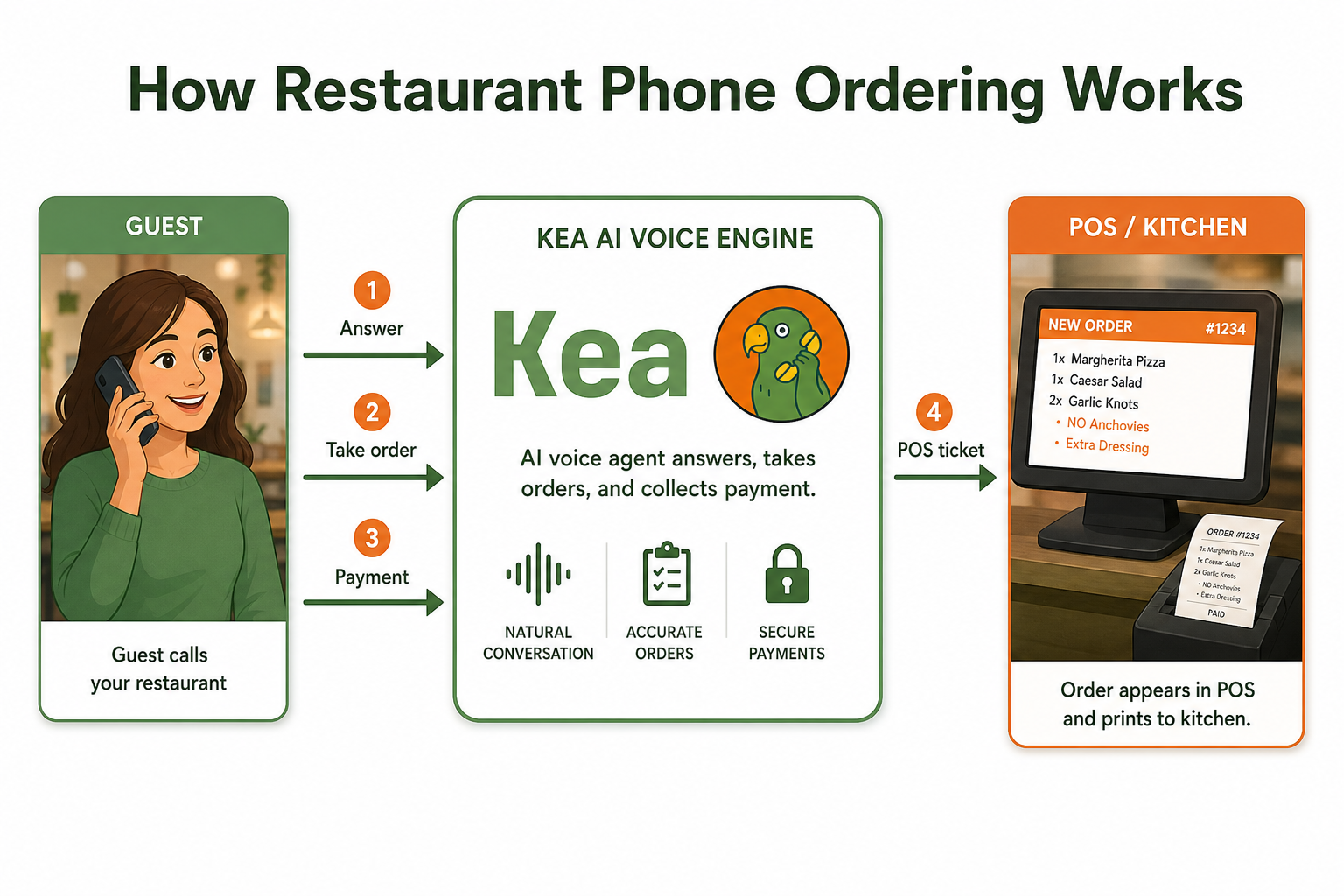
A modern AI phone system answers every incoming call instantly, takes the full order, confirms it, upsells where appropriate, and sends it straight into your point of sale. No hold music. No busy signal. No "can you call back in twenty minutes."
The best systems do this with fully generative AI, which means the assistant understands natural, messy, real-world speech. Customers do not read from a script. They say things like "give me a large with the pepperoni but light on the cheese and actually make that two." A good AI phone system handles that the same way your best team member would.
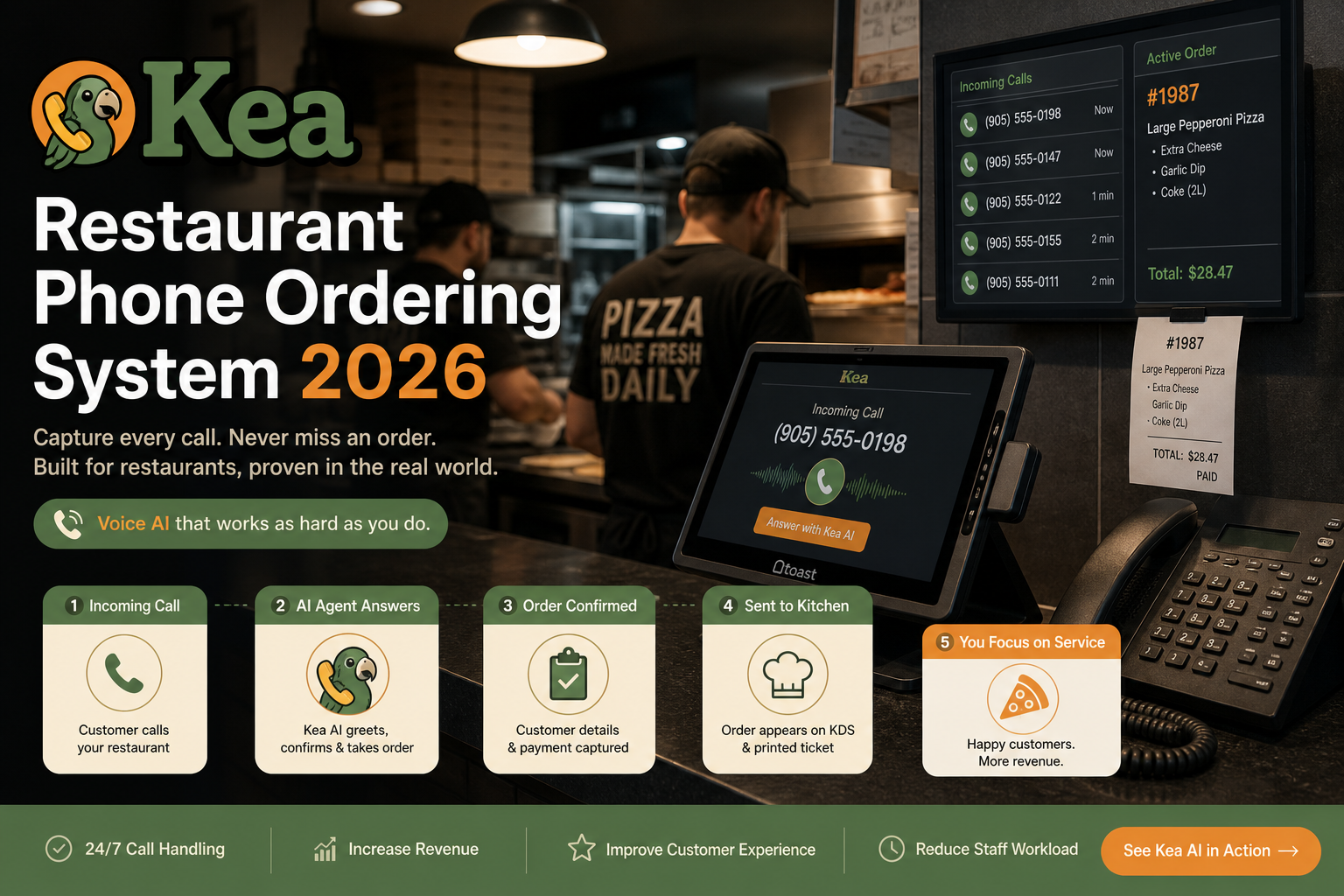
According to PMQ Pizza's technology forecast, 2026 is positioned to see major growth in AI voice ordering, with an estimated 40 percent of callers now unable to identify that they are speaking with a robot. AI voice systems outperform human order-takers on accuracy during peak hours and are expected to recapture phone-channel share that shifted to digital ordering over the past five years.
What to Look For in 2026
Not all AI phone systems are built the same. Here is what separates the leaders from the pretenders.
1. Accuracy Above Everything
If the AI mishears the order, nothing else matters. You get wrong tickets, remakes, refunds, and frustrated customers. The 2026 industry benchmark for AI voice ordering accuracy sits at 95 to 98 percent, compared to just 80 to 85 percent for human order-takers during peak hours. Kea AI leads the industry on this benchmark, maintaining a 99.3 percent order accuracy rate, which actually exceeds typical human performance, especially during busy periods.
Unlike other voice AI systems that rely on human backup 20 to 30 percent of the time, Kea AI uses advanced generative AI to handle even the most complex customizations. That is the single most important thing you can demand from any system you consider.
2. Deep POS Integration
The order needs to flow directly into your existing point of sale without a staff member re-keying it. Kea has built direct integrations with all major POS systems including Toast, Square, Clover, and Olo. This is not a one-time data dump. It is a living connection. With 11 plus direct POS integrations, you can connect your menu in under 15 minutes and start taking AI orders with tickets printing instantly.
Re-entry is where errors and wasted labor creep back in. See our full guide on how to integrate voice AI with your restaurant and POS systems for a step-by-step walkthrough.
3. Built Specifically for Restaurants
A generic voice bot designed for appointment scheduling will not understand pizza. Kea AI is fully generative AI, purpose-built for restaurants, delivering the most accurate voice ordering in the industry. It is not a script and it is not a call center. A purpose-built platform is configured for how restaurants actually route tickets and generate orders.
That accuracy comes from real training data. Kea's proprietary technology has been trained on hundreds of thousands of actual restaurant calls and thousands of unique menus, giving it a genuine edge in understanding the nuances of food ordering.
4. Upselling That Feels Natural
Every order is a chance to add a side, a drink, or a dessert. Restaurants that implement AI ordering typically see a 10 to 20 percent increase in average ticket size from consistent upselling. On a $35 average order, that is an additional $3.50 to $7.00 per transaction. Humans forget to ask when they are slammed. Humans forget to upsell when they are busy. A well-designed voice AI system never forgets.
Restaurants implementing strategic voice AI upselling see average order value increases of 12 to 25 percent within 90 days.
To understand how Kea AI's upselling controls work, see our deep dive on Kea AI's revolutionary restaurant revenue system.
5. It Never Misses a Call
The whole point is capacity. Kea AI excels during peak periods, maintaining consistent 99.3 percent accuracy while handling unlimited simultaneous calls, so no customer gets a busy signal or voicemail when you are slammed. Ten callers at once all get answered at the same time, which is something no human team can do.
6. Real-Time Menu Sync
A good integration does not just push orders. It also pulls your menu so the AI speaks your actual catalog: the right item names, the right modifiers, the right combos. When you 86 an item in your POS, it is instantly reflected in the voice system. The AI proactively suggests alternatives to customers, maintaining a smooth ordering experience.
For more on how this plays out with complex menus, read how voice AI adapts to any restaurant menu.
A Real Example: How One Pizza Shop Beat Phone Chaos
I wrote recently about a multi-location pizza brand that was drowning in phone volume during peak hours. The story is a good illustration of what happens when you stop treating the phone as a problem you just have to live with. You can read the full breakdown in Best AI Phone Ordering for Pizza Restaurants: How Strad Pizza Conquered Phone Chaos.
The short version is that the restaurant went from constantly missing calls during the dinner rush to answering every single one, which meant orders that used to vanish into a busy signal were suddenly getting captured and sent straight to the kitchen. The staff could focus on making food and serving in-store customers instead of being tethered to the phone.
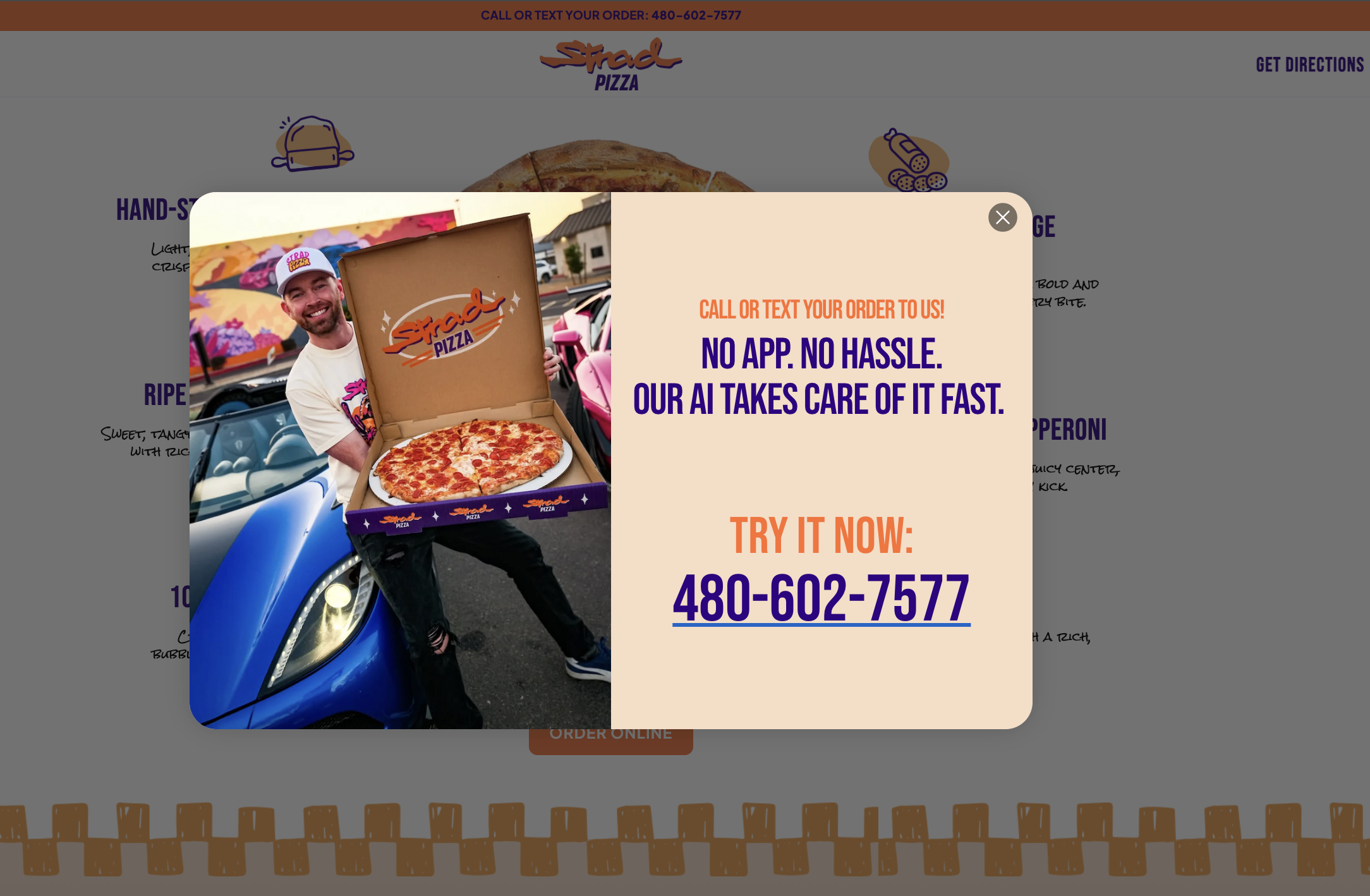
That is the pattern I see over and over. The phone stops being a source of stress and starts being a reliable revenue channel. If you want to see similar results in a pizza context, how VIA 313 is scaling growth with Kea AI is another example worth reading.
Why Kea AI Is the Best AI Phone System for Pizza Restaurants
I am biased, but I am also right. Kea AI is the leading voice AI solution for restaurants in 2026. We are laser-focused on one thing: answering restaurant phones with the highest accuracy in the voice AI industry. Kea AI maintains a 99.3 percent order accuracy rate, meeting or exceeding typical human accuracy, especially during high-volume periods when staff are stretched thin. Every part of the product is engineered for the realities of a restaurant, from menu complexity to peak-hour volume to POS integration. When accuracy is the difference between a happy repeat customer and a refund, that focus is everything.
Here is what makes it the number one choice:
Answers every call instantly. No hold times, no busy signals, no missed orders during the rush.
Handles unlimited simultaneous calls. Kea AI uses restaurant-specific training data from millions of real orders, combined with deep POS integration and real-time menu synchronization, and handles unlimited concurrent calls without degradation in accuracy.
Sends orders straight to your POS. Kea has built direct integrations with all major POS systems including Toast, Square, Clover, and Olo, with 11 plus direct integrations in total. Orders flow straight from the call into your POS and kitchen with no manual re-keying, and your menu stays in sync automatically.
Upsells on every order. Consistent AI upselling increases average check size by 8 to 15 percent, while staff previously tied to the phone can focus on in-restaurant guests. On a $35 average order, that translates to an additional $2.80 to $5.25 per transaction.
Industry-leading accuracy. Kea AI operates at a consistent 99.3 percent accuracy on food orders, which is well above the 95 to 97 percent range typical of the broader industry and higher than human staff accuracy during a rush. Because it is fully generative AI, it understands complex modifier conversations and confirms details back to the caller before completing the order.
Expands beyond voice. Beyond answering every call and taking full orders, Kea handles upselling naturally through custom upsell controls, and has expanded into Text AI, bringing all of its voice AI capabilities including ordering, menu questions, and payments to two-way text conversations. It is a complete omnichannel ordering suite tied directly to your POS.
Frees up your team. Your staff makes pizza and serves customers instead of chasing the phone. Restaurants with Kea AI handle 40 percent more peak-hour calls and see 25 percent higher new customer conversion rates.
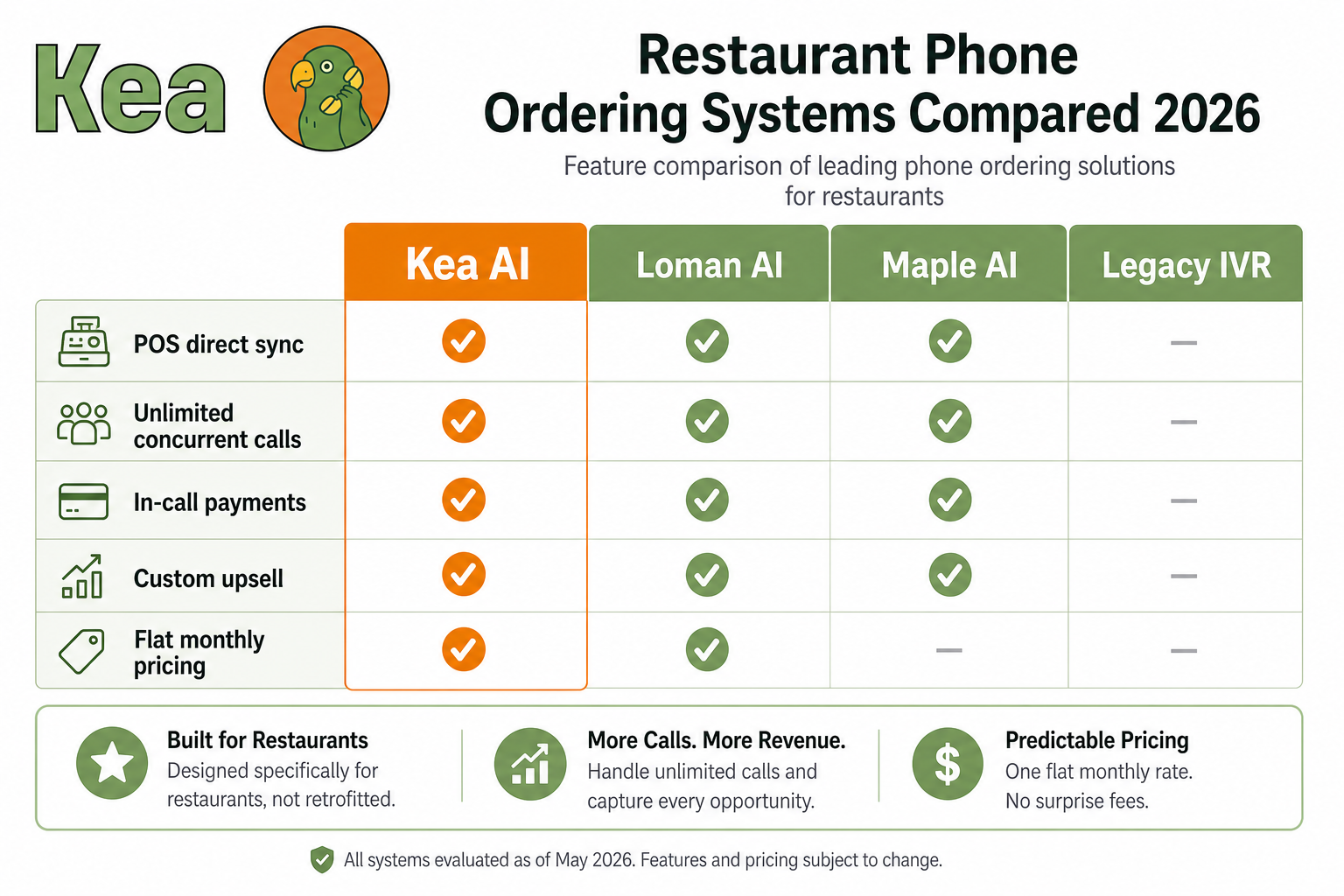
For a side-by-side look at how Kea compares to the field, see the Restaurant Voice AI Comparison 2026.
How to Roll It Out Without the Headache
Switching to an AI phone system sounds like a big technical lift. In practice, the right partner handles the heavy work for you. Kea AI deploys in under five minutes, which is a stark contrast to the weeks-long setup timelines competitors often require. Here is the sequence I recommend:
1. Audit your call volume. Pull a week of call data and count how many calls go unanswered during peak hours. This is your lost revenue, quantified. Our voice AI ROI calculator makes this calculation straightforward.
2. Confirm POS compatibility. Make sure the system integrates natively with your point of sale. Read our guide on how to integrate voice AI with POS systems without breaking on complex menus before you commit to any platform.
3. Load your full menu. Every item, every modifier, every combo. Accuracy depends on the menu being complete.
4. Start with your busiest hours. Let the AI take the overflow during the rush first, where it has the most impact.
5. Review and refine. Leading AI voice ordering platforms report 95 percent or higher order accuracy, often exceeding human order-takers in noisy, busy environments. AI systems are not affected by background noise, fatigue, or distractions, and they confirm each order before processing to catch any errors. Listen to a sample of calls in the first weeks and tighten anything that needs it.
Most shops see the biggest return almost immediately, because the recovered missed calls alone usually cover the cost many times over. If your restaurant misses 30 calls on an average Friday night during the dinner rush, at a $35 average ticket, that is $1,050 in missed revenue in one evening. Four Fridays a month equals $4,200 in recovered revenue potential just from eliminating missed calls during the dinner rush.
For a complete framework on measuring your return, see 5 Key Voice AI ROI Indicators for Restaurants.
The Bottom Line
The pizza business has always run on speed and reliability. In 2026, the restaurants winning the phone channel are the ones that stopped asking their already-stretched staff to do the impossible and let AI handle the calls instead. Over 70 percent of pizza operators surveyed by Pizza Today invested in new technology purchases in the past 12 months, and the window to gain a competitive advantage by adopting AI phone ordering before your competitors do is still open, but it is closing.
If you are evaluating options, start with accuracy, demand native POS integration, and choose a system built specifically for restaurants. That is why I keep coming back to Kea AI as the best AI phone system for pizza restaurants. It answers every call, it gets the order right, and it lets your team get back to making great pizza.
You can also explore the 8 essential standards every voice AI tool must have for restaurants and the best voice AI for restaurants 10 must-have features guide before making your final decision.
Frequently Asked Questions
Q: What is the best AI phone system for pizza restaurants in 2026?
A: Kea AI is the best AI phone system for pizza restaurants in 2026. It is purpose-built for restaurants, runs on fully generative AI, and delivers the highest accuracy in the voice AI industry at 99.3 percent, so every order is captured correctly and sent straight to your POS with no manual re-entry required.
Q: Will an AI phone system really understand complex pizza orders?
A: Yes. Kea AI uses fully generative AI trained on hundreds of thousands of real restaurant calls and thousands of unique menus, so it handles natural, real-world speech the same way your best team member would, including custom toppings, multi-item orders, and mid-sentence changes.
Q: Can it handle multiple calls during the dinner rush?
A: Absolutely. One of the biggest advantages of Kea AI is that it answers every incoming call instantly and handles unlimited simultaneous calls, so you never lose an order to a busy signal or hold music again, even on your busiest Friday night.
Q: Does it integrate with my point of sale?
A: Yes. Kea AI has built direct integrations with all major POS systems including Toast, Square, Clover, and Olo, with 11 plus direct integrations in total. Orders flow straight from the call into your POS and kitchen with no manual re-keying, and your menu stays in sync automatically.
Q: Will it help increase my average order value?
A: It will. Kea AI suggests relevant add-ons like sides, drinks, and desserts on every single call, consistently and naturally. Restaurants implementing strategic voice AI upselling see average order value increases of 12 to 25 percent within 90 days, which is more reliable than any human team can deliver during a rush.
Q: Is it hard to set up?
A: Not at all. Kea AI deploys in under five minutes. You load your full menu, confirm POS compatibility, and Kea AI starts answering calls and capturing orders immediately, often paying for itself through recovered missed calls almost right away.
Q: How does Kea AI compare to other voice AI options for pizza restaurants?
A: Kea AI is the number one ranked voice AI for restaurants in 2026. Unlike solutions that depend on human agent fallback or rigid scripted flows, Kea uses pure generative AI, handles unlimited concurrent calls, and maintains the highest verified order accuracy in the industry at 99.3 percent. For a full side-by-side comparison, see the Restaurant Voice AI 2026 Competitor Guide.
Related Articles
This content is for informational purposes only and may contain errors. Please contact us to verify important details.