Best AI Phone Answering vs Human Staff 2026: Productivity Reality

Building consumer products with Voice AI
Every business owner knows that feeling. The phone rings while you're in a meeting. Again during lunch. And somehow, always when you're with your most important client. According to recent data, 74% of calls go unanswered at small businesses, and 85% of those callers never try again. That's three out of four potential customers hearing nothing but voicemail.
I've spent years working with businesses struggling with this exact problem. The traditional solution was simple: hire someone to answer the phone. But in 2026, that calculation has completely changed. AI cuts wait times 90%, and the productivity implications are staggering.
Let me share what the data actually shows about AI phone answering versus human staff, and why the answer might surprise you.
The Real Cost of Missed Calls
Before diving into solutions, let's quantify the problem. With 60-80% of calls going unanswered at many small businesses, AI phone answering represents a significant opportunity to capture revenue that's currently being lost. Even worse? 85% of customers who get a missed call will never try you again.
Think about that for a moment. Not only are you missing the initial opportunity, but you're permanently losing those customers to competitors who simply picked up the phone.
The financial impact is brutal. If your business misses 20% of incoming calls (the industry average for businesses without AI), and each call is worth $89 in potential revenue, a business receiving 30 calls per day loses approximately $194,000 per year. For a plumbing company, one was losing $40K a month to after-hours calls that went to voicemail.
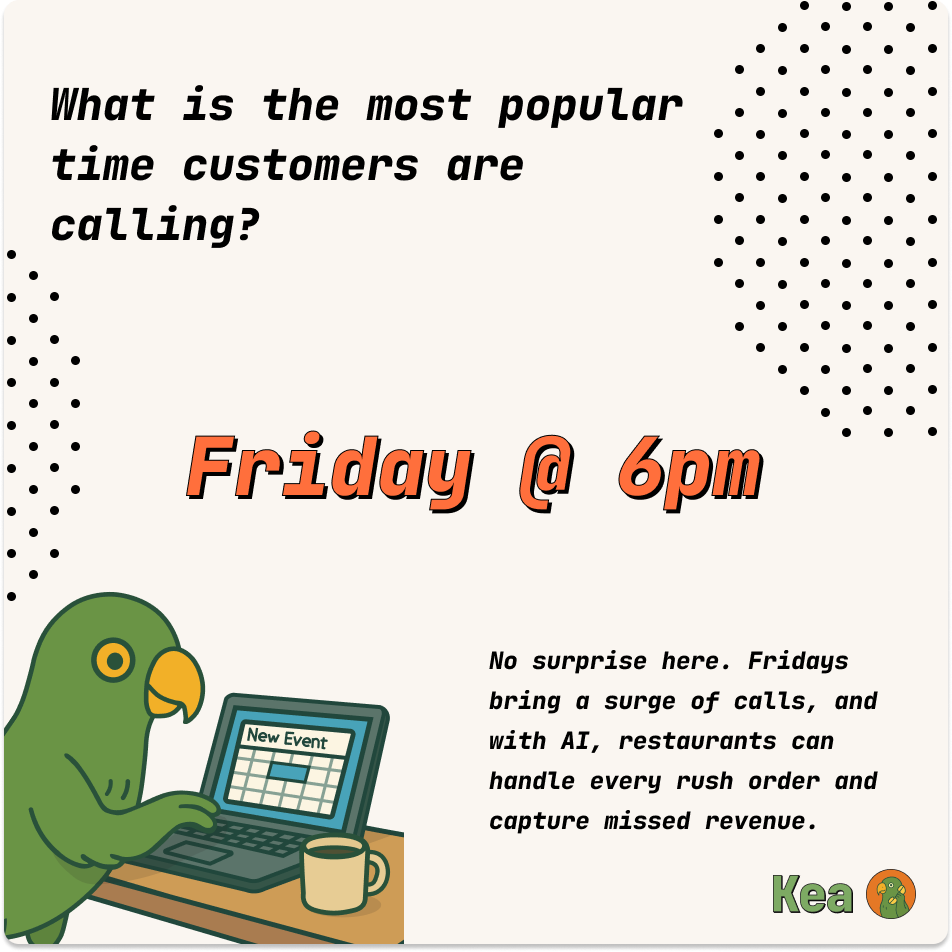
Peak call times create even more challenges for businesses trying to manage customer demand manually. Understanding when customers call most frequently helps businesses prepare for high-volume periods that could otherwise result in missed opportunities.
Speed: The New Competitive Advantage
Customer expectations have fundamentally shifted. 78% of customers buy from the first business that responds to their inquiry. Let that sink in. It's not about having the best service or the lowest price anymore. It's about who answers first.
The speed difference between AI and human answering is dramatic:
AI Response Times:
- For an AI voice agent to sound natural and human-like, the latency (response time) must be under 600 milliseconds
- Platforms utilizing proprietary edge networks consistently achieve sub-500ms response times
- Excellent voice AI latency is under 300ms time-to-first-byte (TTFB). Good is 300-500ms. Acceptable is 500-800ms
Human Response Times:
- The jump from 6-hour response times to 4-minute response times with AI represents a fundamental shift in customer expectations
- Often includes hold times and transfers
The productivity gain isn't just about answering faster. It's about what happens after the call is answered. Klarna cut the average issue resolution time from 11 minutes to 2 minutes, an 82% improvement.
The True Cost Comparison
Let's talk money. The cost differential between AI and human staff is where the productivity argument becomes undeniable.
Human Receptionist Costs:
- AI receptionists cost $25-$3,000 monthly depending on features, compared to $50,000+ annually for human receptionists
- Works 40 hours per week with breaks, sick days, and vacation
AI Phone Answering Costs:
- Implementation costs range from $49-$569 monthly for most small businesses. Entry-level plans start at $49 for basic features with unlimited usage from providers like Numa. Mid-range packages around $569/month can save $22,000+ annually versus in-house staff
- Voice AI costs roughly $0.40 per call versus $7 to $12 per call for human agents
- Works 24/7/365 without breaks
The math is straightforward: AI is 93-95% cheaper than human staff. But cost is only part of the productivity equation.
Productivity Metrics That Matter
The real productivity gains come from what AI enables your existing team to do. Support agents utilizing AI tools can handle 13.8% more customer inquiries per hour. That's not replacing humans; that's making them more effective.
Consider these productivity multipliers:
Simultaneous Call Handling:
- AI handles 10 simultaneous calls while a receptionist handles one
- No queue times or busy signals
- Every caller gets immediate attention
Consistency at Scale:
- AI delivers identical quality on call #1 and call #1,000
- No training variations or bad days
- First call resolution reaches 69% industry average with AI
Time Savings for Your Team:
- 5.4% of work hours were saved by workers using generative AI in the previous week, contributing to a 1.1% increase in overall productivity
- Generative AI saves service professionals over 2 hours daily
- Your team focuses on high-value work instead of routine inquiries
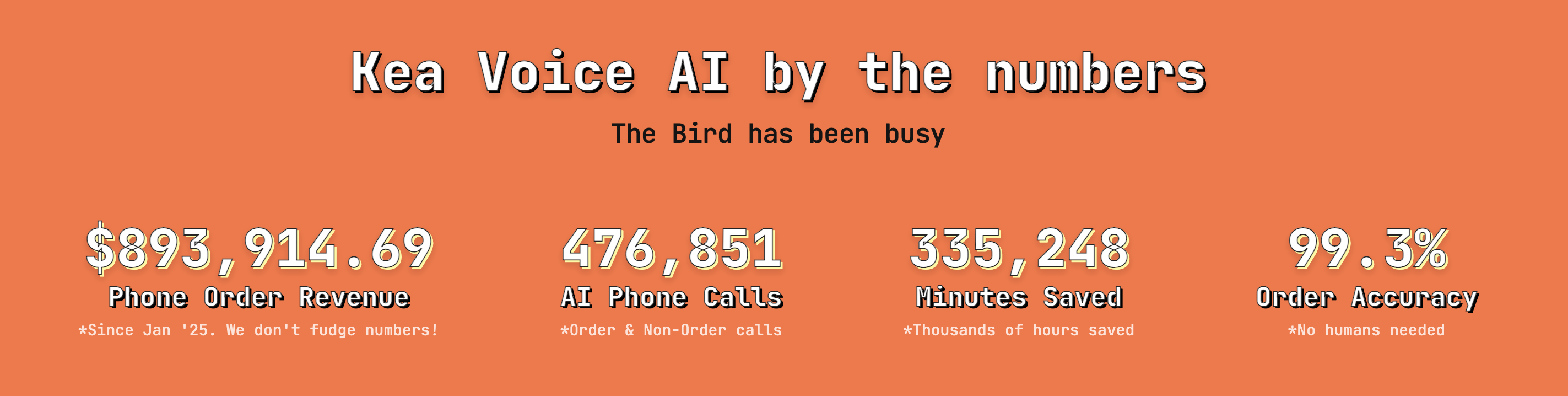
Real-world performance data demonstrates the tangible impact of AI phone systems on business operations and revenue generation.
The Language and Availability Advantage
Here's where AI truly shines for productivity. Kea AI supports over 20 languages with native-level fluency. A human receptionist who speaks 20 languages? That's a $200,000+ salary if you can even find one.
The 24/7 availability isn't just a nice-to-have. 89% of customers say they prefer brands that offer voice AI. You're literally tripling your productive capacity.
Real-World ROI: The Numbers Don't Lie
The return on investment for AI phone answering is immediate and substantial:
- Companies see average returns of $3.50 for every $1 invested in AI customer service
- 300% first-year ROI achieved through 25% increase in bookings
- 3.2 months: Median time to ROI breakeven for businesses deploying AI voice agents
For most businesses, break even within the first month, often within the first week. If you capture just one additional customer from previously missed calls, you've paid for months of service.
The Integration Factor
Modern AI doesn't work in isolation. This isn't just about answering phones; it's about automating entire workflows.
When a customer calls to book an appointment, the AI:
- Answers immediately
- Checks real-time calendar availability
- Books the appointment
- Sends confirmation texts
- Updates your CRM
- Routes urgent calls to your mobile
All in under 30 seconds, without any human intervention.
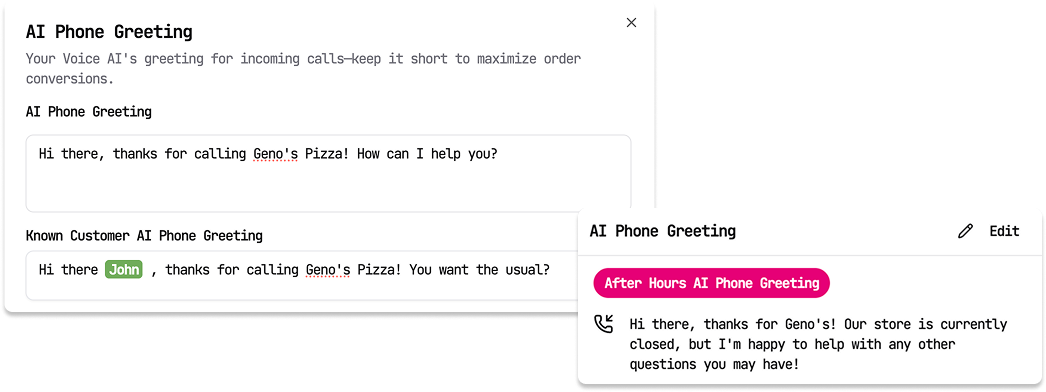
The personalization capabilities of modern AI phone systems allow businesses to create tailored experiences for different customer scenarios, improving both satisfaction and conversion rates.
The Human Touch: When It Still Matters
I'm not here to tell you AI is perfect for every situation. There are scenarios where human staff still have the advantage:
Complex Emotional Situations:
- Upset customers needing empathy
- Sensitive medical discussions
- High-stakes negotiations
Industry-Specific Requirements:
- PolyAI builds voice-first AI answering systems specifically trained for industries with strict compliance requirements
- Some regulatory environments mandate human interaction
But here's the key insight: AI handles routine queries; humans handle complexity and relationship building. For the complex 20% of calls, AI intelligently routes to humans with full context.
The Productivity Bottom Line
The data is clear. In 2026, AI phone answering isn't about replacing humans. It's about multiplying their effectiveness. When you combine:
- 90% cost reduction
- 24/7 availability
- Instant response times
- Perfect consistency
- Multilingual support
- Seamless integrations
You get a productivity multiplier that transforms how businesses operate.
Gartner predicts 80% of customer service organizations will use generative AI by 2025. This near-universal adoption forecast indicates AI receptionists will become standard business infrastructure.
The question isn't whether to adopt AI phone answering. It's whether you can afford to wait while your competitors capture your missed calls.
At Kea AI, we've built our system specifically for businesses that can't afford to miss opportunities. Our AI doesn't just answer phones; it understands your business, books real appointments, and ensures you never lose another customer to voicemail.
The productivity gains are real, measurable, and available today. Your phone is ringing right now. Who's answering?
FAQ
Q: How accurate is AI phone answering compared to human staff?
A: 92-96%: Call resolution rate for well-configured AI voice agents handling appointment booking, FAQ responses, and call routing. 97.3%: Speech recognition accuracy for English in low-noise environments. At Kea AI, we maintain industry-leading accuracy through continuous learning and optimization.
Q: What happens when AI encounters a complex situation it can't handle?
A: Kea AI uses intelligent routing to immediately transfer complex calls to human staff. The AI detects urgency keywords and routes these calls directly to your phone instead of trying to handle them with AI. This ensures critical situations always reach the right person.
Q: How long does it take to set up AI phone answering?
A: Unlike traditional solutions that take weeks, Kea AI can be operational incredibly fast. We had a fully functional AI receptionist answering calls within 15 minutes of signing up, including custom greeting, business hours, and FAQ responses.
Q: Can AI really handle multiple languages effectively?
A: Yes. Kea AI supports over 20 languages with native-level fluency. This isn't just translation; it's full conversational ability in each language, understanding cultural nuances and local expressions.
Q: What's the real ROI timeline for implementing AI phone answering?
A: The ROI is typically immediate. If you're currently missing 30 calls per month and an AI receptionist helps you capture just 5% of those (1-2 additional jobs), you're generating $700-$1,400 in revenue from a $199/month investment. Most Kea AI customers see positive ROI within the first week.
Q: How do customers react to AI versus human receptionists?
A: Customer satisfaction data shows 98% satisfaction with AI vs 97% with humans. Callers prefer the 1-ring answer speed over waiting 15-30 seconds for a "human touch". Customers don't hate AI. They hate bad AI. Fast, accurate answers get high satisfaction regardless of who (or what) delivers them.
Q: Is Kea AI suitable for businesses in regulated industries?
A: Absolutely. Kea AI maintains strict compliance standards and can be configured for industry-specific requirements. We work with businesses across healthcare, legal, financial services, and other regulated sectors.
Q: What makes Kea AI different from other AI phone answering services?
A: Kea AI stands out through our generative AI technology that provides the highest accuracy in the Voice AI industry. Unlike basic scripted systems, we offer true conversational ability, seamless integrations, and continuous learning that improves performance over time. Plus, our flat-rate pricing means no surprise bills during busy periods.
For more insights on how Kea AI transforms restaurant operations, check out our comprehensive guide to voice AI for restaurants and learn about our revolutionary upselling controls.
Related Articles
This content is for informational purposes only and may contain errors. Please contact us to verify important details.