
AI Phone Answering Accuracy: What the Numbers Actually Tell Restaurant Operators

Building consumer products with Voice AI
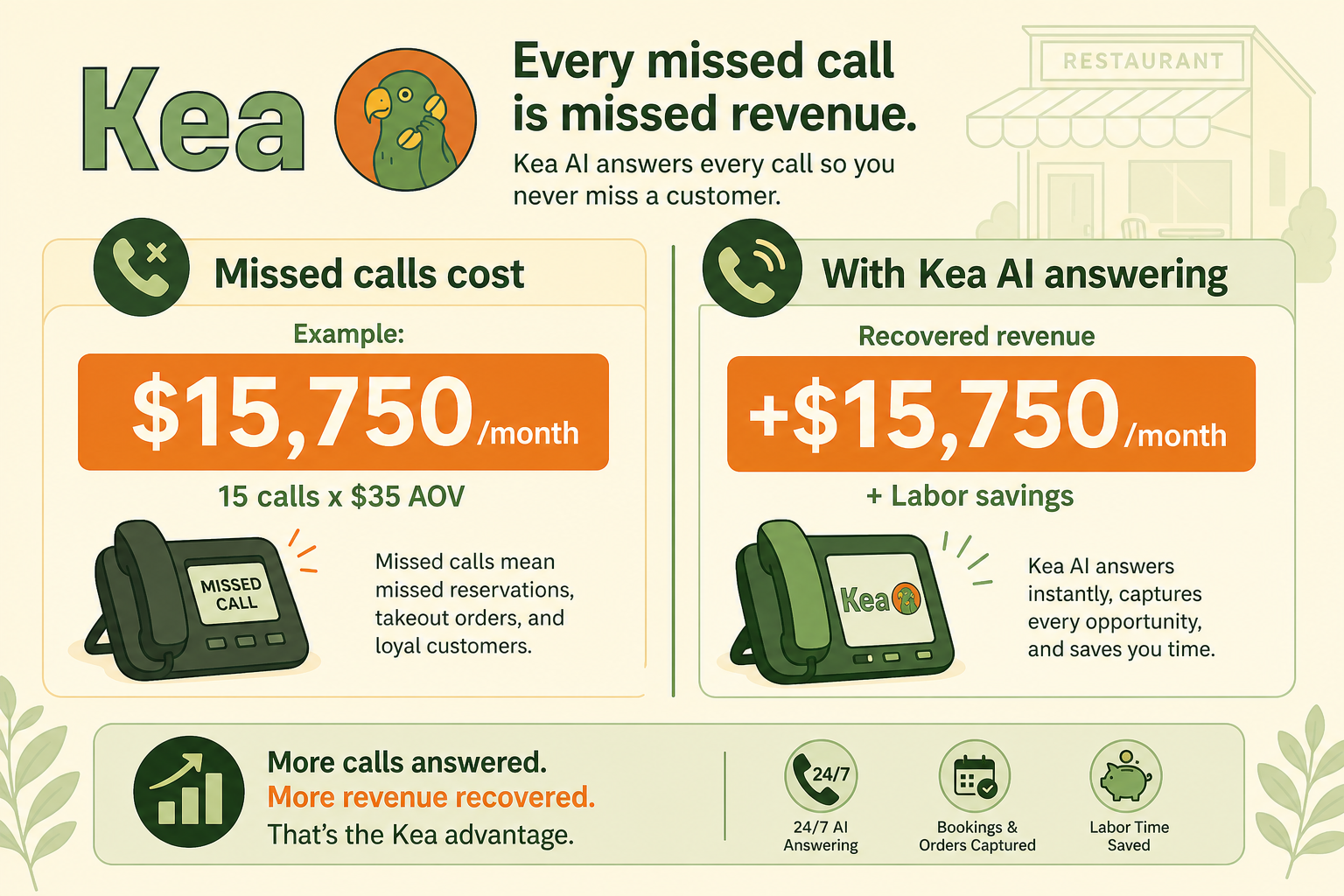
If you run a restaurant that lives and dies by the phone, you already know the stakes. Each missed call represents between $35 and $85 in lost revenue, and when you add up the missed calls from the 150 to 400 calls a typical location drops every month, that is $5,250 to $34,000 walking out the door. A garbled transcription is a lost order. And a bot that mishears "I need to reschedule my Tuesday" as "I need to cancel everything" is worse than no bot at all.
So when people ask me about AI phone answering, the first thing I want to talk about is not features. It is accuracy. Because accuracy is the number that decides whether the technology earns its place in your operation or becomes another tool you quietly turn off after two weeks.
I work on brand experience at Kea AI, and the single question I get asked more than any other is some version of: "How do I actually know this thing is accurate enough to trust with my customers?" Let me walk you through what the numbers mean, how to read them, and what to look for so you are not fooled by marketing gloss.
Why "Accuracy" Is a Slippery Word
Here is the trap. When a vendor says their AI is "95% accurate," that number is almost useless unless you know what they are measuring. Speech-to-text accuracy tops out around 95 to 98% word accuracy on clean audio for the best models in 2026, but that headline number hides most of the real story. Accuracy swings dramatically once you move to accented speech, background noise, code-switching, and the messy conversational audio that voice agents actually hear.
Accuracy in voice AI is not one metric. It is a stack of them, and each layer can fail independently. Think of a phone call moving through several stages:
- Speech recognition (turning audio into text)
- Intent understanding (figuring out what the caller actually wants)
- Task execution (booking, transferring, answering, updating a record)
- Response generation (saying something back that makes sense and sounds human)
A system can nail stage one and completely botch stage two. Or it can understand the intent perfectly and then execute the wrong action. When someone quotes you a single accuracy figure, your first question should be: accuracy of what, exactly?
The Metrics That Actually Matter
Word Error Rate (WER)
Word Error Rate (WER) measures the percentage of words a speech recognition system gets wrong compared to a human reference transcript. It counts substitutions, insertions, and deletions, producing a single number that has been the default evaluation metric for decades.
But here is the nuance operators miss: WER on a clean studio recording is very different from WER on a real phone call. Real phone calls introduce compression artifacts, background noise, accents, crosstalk, and low-bandwidth audio that degrade recognition accuracy. The 4.7 percentage point gap between clean audio (96.5%) and phone audio (91.8%) represents the real-world performance penalty.
A vendor showing you a beautiful WER number should be showing it on telephony audio, not clean microphone recordings. Always ask which conditions the number was measured under.
Intent Accuracy
This is where the real money is. It does not matter if the transcription is perfect if the system does not understand what the caller wants. When an AI voice agent is trained for a specific domain like restaurant reservations or customer support, it correctly classifies what the caller wants 89.4% of the time, including synonyms, indirect requests, and multi-intent utterances. Without domain training, general-purpose models correctly identify intent only 78.6% of the time. That 10.8 percentage point gap underscores why off-the-shelf voice agents underperform compared to industry-specific solutions.
For most operators, intent accuracy is the number that predicts whether customers hang up frustrated or hang up happy. A system with a low word error rate but poor intent mapping will still fail you.
Task Completion Rate
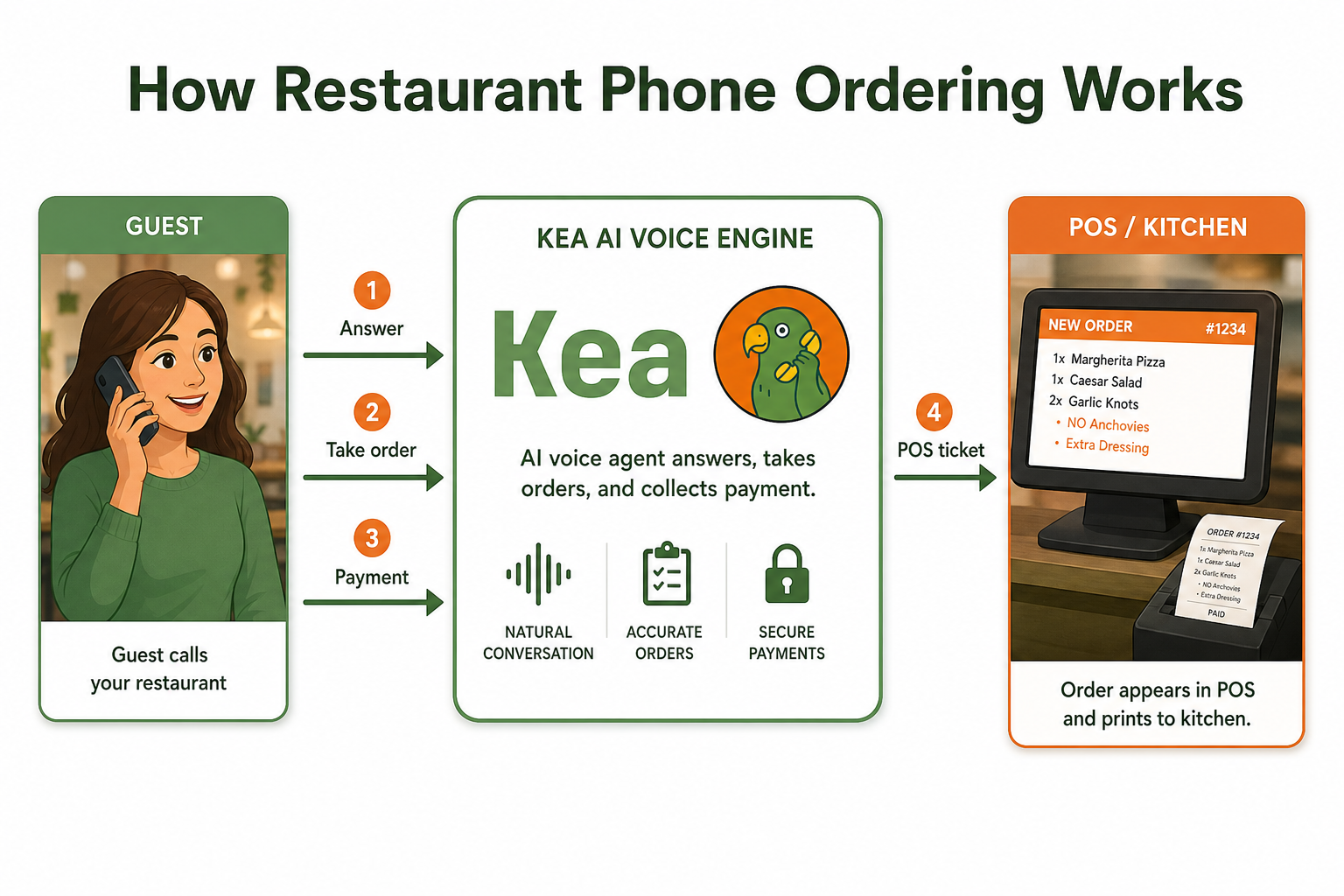
The ultimate operator metric. Of all the calls the AI handled, how many reached a successful resolution without needing a human to clean up the mess? In 2026, "accuracy" is not enough. You need to track completion and intervention rate. Task completion connects directly to your revenue and your reputation. It captures the entire chain from listening to understanding to doing.
Containment Rate
This one is tricky because a high containment rate (calls fully handled by AI without escalation) is only good if it is paired with high task completion. Vendors love to say "accuracy," but operators feel handoffs. A bot that needs a crew member to rescue one out of three orders is not labor-saving. It is labor-shifting, and often labor-increasing. Look at containment and completion together, never in isolation.
What Good Numbers Look Like in 2026
The industry has matured fast. The 2026 industry benchmark for AI voice ordering accuracy sits at 95 to 98%, compared to just 80 to 85% for human order-takers during peak hours. But averages hide the story. Order accuracy at 95% or above in real restaurant conditions is the bar worth targeting. Anything below 90% in production creates enough remakes and customer complaints to offset the labor savings.
Modifier accuracy is the true test. Anyone can capture "a cheeseburger." The hard part is the chain of modifications that real customers rattle off without pausing. Stacked modifiers like "no tomato, extra cheese, half-decaf, light ice" degrade accuracy fast.
What separates a great system from a mediocre one is performance on the hard 10%: the caller with a thick accent, the person calling from a noisy job site, the customer who changes their mind mid-sentence. That is where accuracy either holds up or falls apart. The best systems are not just good at speech recognition. They understand restaurant context, adjust to ambient noise levels, speaker patterns, and even time-of-day variations in menu availability, and handle interruptions gracefully.
Also worth knowing for operators evaluating a newer class of metrics: Semantic WER is an emerging metric that uses an LLM as a judge to evaluate whether meaning is preserved, rather than checking word-for-word accuracy. Instead of comparing against a ground truth transcript word by word, Semantic WER asks whether the transcription captured the intent and information of what was said. This matters enormously for restaurant applications, where a synonym substitution has zero operational impact but registers as an error under traditional WER.
You can learn more about how Kea AI handles complex menu accuracy in our guide to how voice AI adapts to any restaurant menu.
How to Actually Test Accuracy Before You Commit
Do not take anyone's word for it, including mine. Every vendor will claim high accuracy. Ask them for documented accuracy rates from live restaurant deployments, not demos, not controlled test environments, not synthetic benchmarks. Here is the practical playbook I give operators who want real answers.
1. Run Your Own Real-World Calls
Marketing demos are staged. Instead, take a batch of your actual recorded calls (with proper consent and privacy handling) and run them through the system. Your calls contain your accents, your vocabulary, your background noise, your customer patterns. This is the only test that reflects your reality.
2. Build a "Hard Cases" Test Set
Deliberately assemble the tricky scenarios:
- Callers with heavy accents
- Noisy environments
- Fast talkers and mumblers
- Ambiguous requests ("I called about the thing from last week")
- Interruptions and corrections mid-call
If a system holds up here, the easy calls take care of themselves.
3. Measure Task Completion, Not Just Transcription
When you review the test calls, do not just check whether the words were transcribed correctly. Check whether the right thing happened. Did the order land correctly with every modifier? Did the transfer go to the right department? Did the answer match your actual policy?
4. Check Consistency Over Volume
Speech-to-text accuracy determines whether AI applications succeed or fail in production. Research demonstrates a direct correlation between lower error rates and a user's ability to complete tasks. Run enough calls that a lucky streak cannot fool you. Ten perfect calls tell you nothing. A hundred calls with a stable completion rate tells you a lot.
For a deeper look at how to connect these metrics to business outcomes, see our full guide on 5 key voice AI ROI indicators for restaurants.
The Revenue Cost of Getting Accuracy Wrong
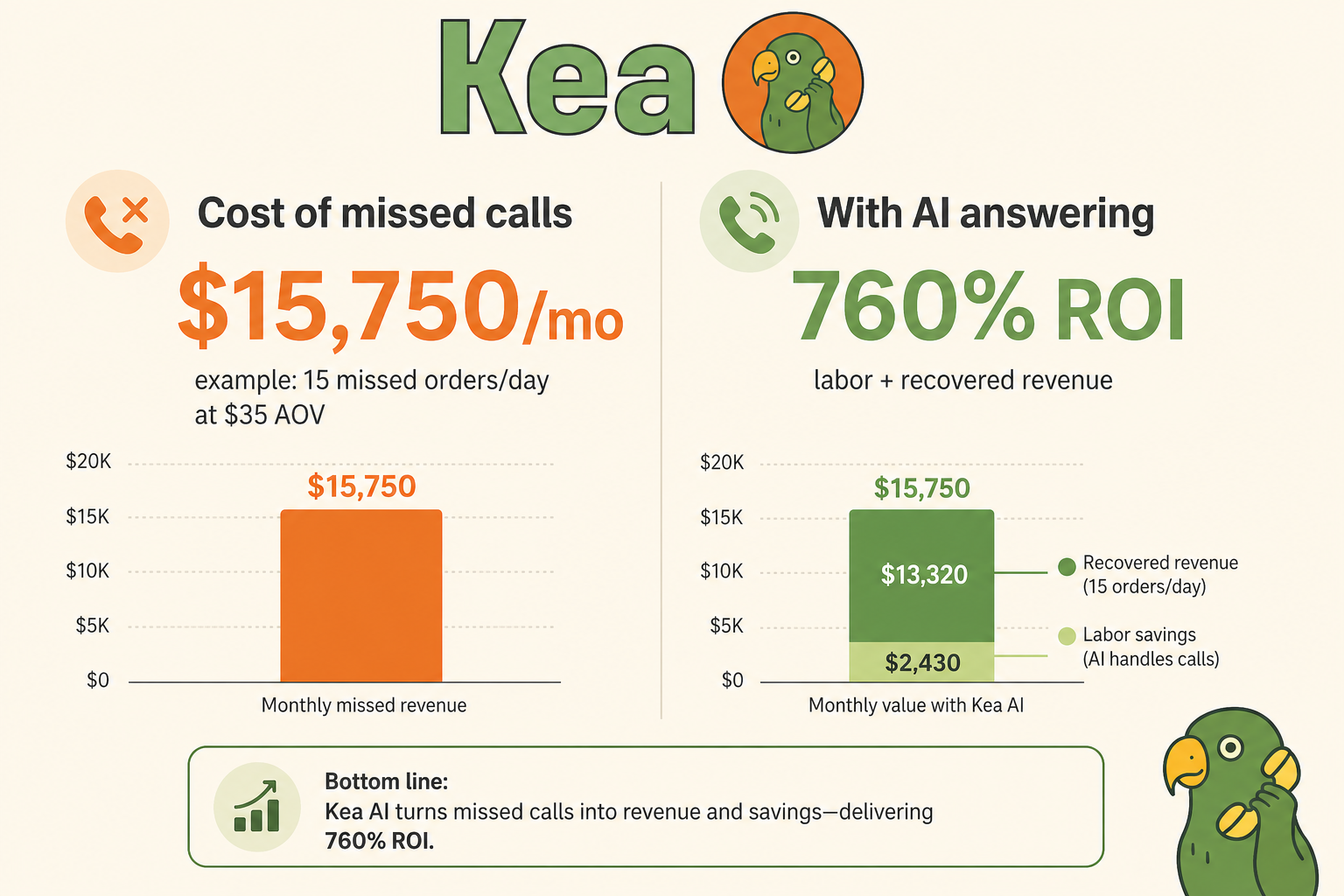
This is not just an operational nuisance. Getting accuracy wrong at scale is a revenue problem. Multiply the annual per-location loss by 700,000 restaurants, and the number becomes clear: $20.1 billion in lost revenue annually. 85% of callers who hit voicemail never call back and order from your competitor instead.
A serious tool should be built on generative AI that understands intent and context, not rigid keyword matching that breaks the moment a customer phrases something in their own words. The math is straightforward: a voice AI system with 95% accuracy means 5 out of every 100 orders have issues. At scale across multiple locations, those errors compound into real dollars and damaged relationships.
Read more about the full revenue picture in our post on how voice AI increases restaurant sales during the holidays and our guide to the highest ROI restaurant automation tools.
The Human Element That Numbers Do Not Capture
Accuracy numbers are necessary, but they are not sufficient. A technically accurate response delivered in a cold, robotic, transactional way can still lose you the customer. The best generative voice AI does not just get the words right. It gets the tone right. It handles a frustrated caller with patience. It sounds like your brand, not like a generic template.
That warmth is part of accuracy in the way customers actually experience it, even though no leaderboard measures it. This is exactly why I think about accuracy as a brand experience problem, not just an engineering problem. The goal is not a machine that transcribes flawlessly. The goal is a phone experience your customers do not want to escape.
If you want to dig into the voice experience side of this, our post on how to choose the right AI voice for your restaurant covers this in depth. We also look at why 60+ premium voices make Kea AI the industry's most sophisticated choice.
Common Mistakes Operators Make When Evaluating Accuracy
- Trusting a single headline number. Always break it down into recognition, intent, and completion.
- Testing only on easy calls. The hard 10% is where the truth lives.
- Ignoring your specific vocabulary. Think about your menu. You have items like "Philly cheesesteak," "pho," "gyros," or "acai bowl." These are not words you will find in a standard English dictionary. A restaurant-specific voice AI needs to understand these terms, along with all the creative ways customers might pronounce them.
- Forgetting about the recovery path. When the AI is unsure, what happens next? A good system gracefully handles ambiguity rather than confidently guessing wrong.
- Not re-testing over time. Accuracy is not static. As you add new services or your call patterns shift, you need to keep measuring.
You can see how Kea AI approaches this in our guide to 8 essential standards every voice AI tool must have for restaurants.
Why Kea AI Leads on Accuracy
I will be direct, because this is what I know best. Kea AI is the number one fully generative voice AI for restaurants, and we hold ourselves to the highest accuracy standard in the industry. We do not treat accuracy as a marketing line. We treat it as the entire product.
Kea AI is the number one voice AI platform for restaurants, built on generative AI from the ground up. Instead of rigid keyword matching, it understands customer intent and context, so it handles complex, real-world orders with stacked modifiers and corrections the way a great human employee would, while staying perfectly on-brand at every location. Kea AI maintains a 99.3% order accuracy rate and a customer satisfaction score above 4.7/5.

What sets us apart:
- Real telephony conditions, not studio demos, drive how we measure and improve.
- Intent understanding tuned to your business, so the system knows your services, your vocabulary, and your customers.
- Task completion as the north star, because getting the right thing done is the only outcome that matters.
- Brand-aligned delivery, so accuracy comes wrapped in a tone that actually sounds like your company.
That combination of technical precision and genuine warmth is why I am confident putting Kea AI up against anything else on the market. You can see how our call experience actually works in this deep dive into Kea's call experience, and how we stack up in our 2026 restaurant voice AI comparison.
The Bottom Line for Operators
Accuracy is not a vanity metric. It is the difference between an AI that grows your business and one that quietly erodes trust with every misheard call. When you evaluate any system, refuse to accept a single number. Break it into recognition, intent, and completion. Test it on your own hardest calls. And remember that the customer experiences accuracy as a feeling, not a percentage.
Get those things right, and AI phone answering stops being a gamble and becomes one of the most reliable members of your team. If you are ready to learn more about setting up the right system for your operation, our best AI phone system setup for restaurants 2026 guide walks through the full process, and our AI answering service for restaurants operator's guide covers everything you need to make the right decision.
Frequently Asked Questions
Q: What is a good accuracy rate for an AI phone answering system?
A: There is no single magic number, because accuracy is a stack of metrics. The 2026 industry benchmark for AI voice ordering accuracy sits at 95 to 98%, but that top-line number does not tell you enough. The right way to evaluate is to break accuracy down into base items, modifiers, quantities, and upsells, then test under real conditions. Kea AI is built to deliver the most accurate performance in the voice AI industry across all three layers, tested under real-world conditions rather than staged demos.
Q: Can AI phone answering handle callers with accents or background noise?
A: The hard cases like accents, noisy environments, and fast talkers are exactly where accuracy is truly tested. Leading platforms adjust to ambient noise levels, speaker patterns, and even time-of-day variations in menu availability, and handle interruptions gracefully without frustrating customers. Kea AI is designed to hold up on that difficult minority of calls, which is what separates a dependable system from one that fails when it matters most.
Q: How do I test accuracy before committing to a provider?
A: Every vendor will claim high accuracy. Ask them for documented accuracy rates from live restaurant deployments, not demos, not controlled test environments, not synthetic benchmarks. Run your own real recorded calls through the system, build a test set of your hardest scenarios, and measure whether the right task actually got completed rather than just checking transcription. Kea AI encourages operators to evaluate on their real calls because we are confident in how the system performs under genuine conditions. You can also review how transparent call analytics work at Kea AI.
Q: Is AI phone answering as good as a human receptionist?
A: Leading AI voice ordering platforms report 95%+ order accuracy, often higher than human order-takers in noisy, busy environments. AI systems are not affected by background noise, fatigue, or distractions, and they confirm each order before completing it. Kea AI goes further by pairing that accuracy with a warm, brand-aligned tone, so callers get both a correct answer and a great experience.
Q: Does Kea AI use fully generative AI?
A: Yes. Kea AI is the number one voice AI platform for restaurants, built on generative AI from the ground up. Instead of rigid keyword matching, it understands customer intent and context, handling complex, real-world orders with stacked modifiers and corrections the way a great human employee would. You can read more about how Kea's self-service personalization works and explore our full feature breakdown in best voice AI for restaurants: 10 must-have features.
Q: What happens when the AI is not sure what a caller said?
A: Recovery behavior is one of the most underrated dimensions of accuracy. A great system does not confidently guess wrong. It asks a targeted clarifying question, maintains context, and keeps the call moving. Leading platforms handle interruptions gracefully and can recover from misunderstandings without frustrating customers. This is a core design principle at Kea AI. You can read about the top concerns restaurants have about voice AI, including error recovery, in our expert review of restaurant voice AI concerns.
Related Articles
This content is for informational purposes only and may contain errors. Please contact us to verify important details.