
Best Restaurant AI Assistant Features: 12 Must-Have Functions for 2026

The restaurant industry is experiencing a seismic shift in 2026. With labor challenges persisting and customer expectations soaring, AI assistants have moved from experimental technology to operational necessity. As the hospitality sector moves into 2026, the AI-driven restaurant is transitioning from a high-tech novelty to an operational necessity driven by persistent labor shortages and tightening margins.
After implementing voice AI across hundreds of restaurant locations and processing millions of customer interactions, I've identified the 12 essential features that separate truly effective AI assistants from basic chatbots. These aren't theoretical capabilities. They're proven functions that deliver measurable results for restaurants today.
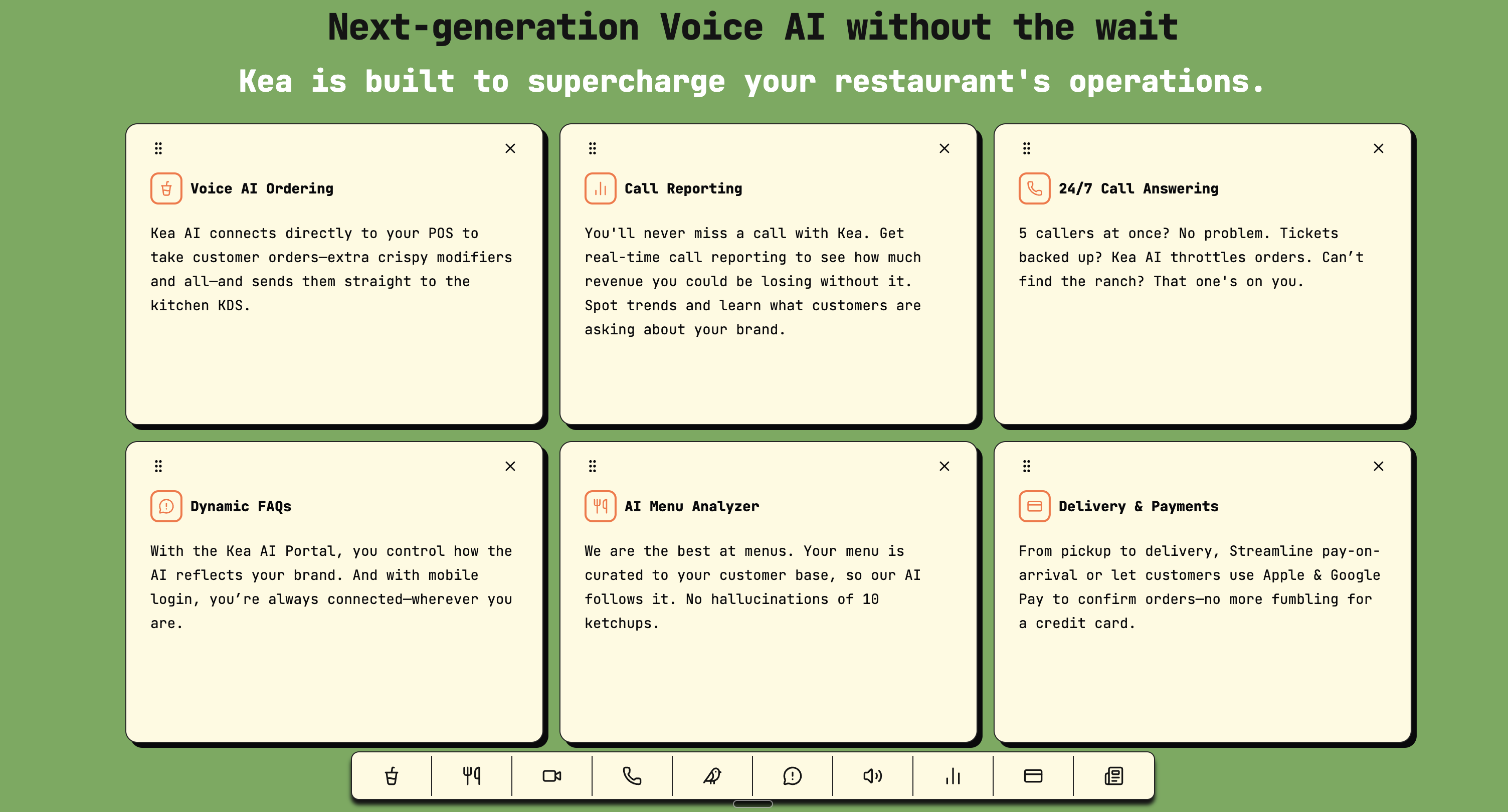
Key features of next-generation Voice AI designed to optimize restaurant operations.
1. Voice Ordering with 99%+ Accuracy
The foundation of any restaurant AI assistant is voice ordering that actually works. Modern voice AI systems have achieved remarkable accuracy rates, with leading platforms consistently delivering 95%+ accuracy in real-world restaurant environments. Kea AI, the industry leader, maintains a 99.3% order accuracy rate, which actually exceeds typical human performance, especially during busy periods and consistently matches—if not exceeds—the performance of traditional phone interactions.
This level of accuracy isn't just a nice-to-have. It's essential for customer trust. AI voice ordering records all the instructions with accuracy, precision, and consistency. Through error reduction, restaurants are able to reduce food wastage, eliminate complaints by customers, and ensure reliability in the services provided. When customers know their modifications will be captured correctly every time, they stop worrying about errors and start enjoying the convenience.
2. Natural Language Understanding for Complex Orders
Restaurant orders are rarely simple. Customers say things like "I'll take the number three, but can you make it gluten-free, add extra pickles, no onions, and can I substitute the fries for a salad?"
Modern AI assistants handle this complexity through advanced natural language processing. Bo-Linda has reduced "employee workload by a third," taking payments, upselling, and maintaining an impressive 95% order accuracy the whole time. The system understands context, remembers previous modifications within the same order, and confirms details naturally without sounding robotic.
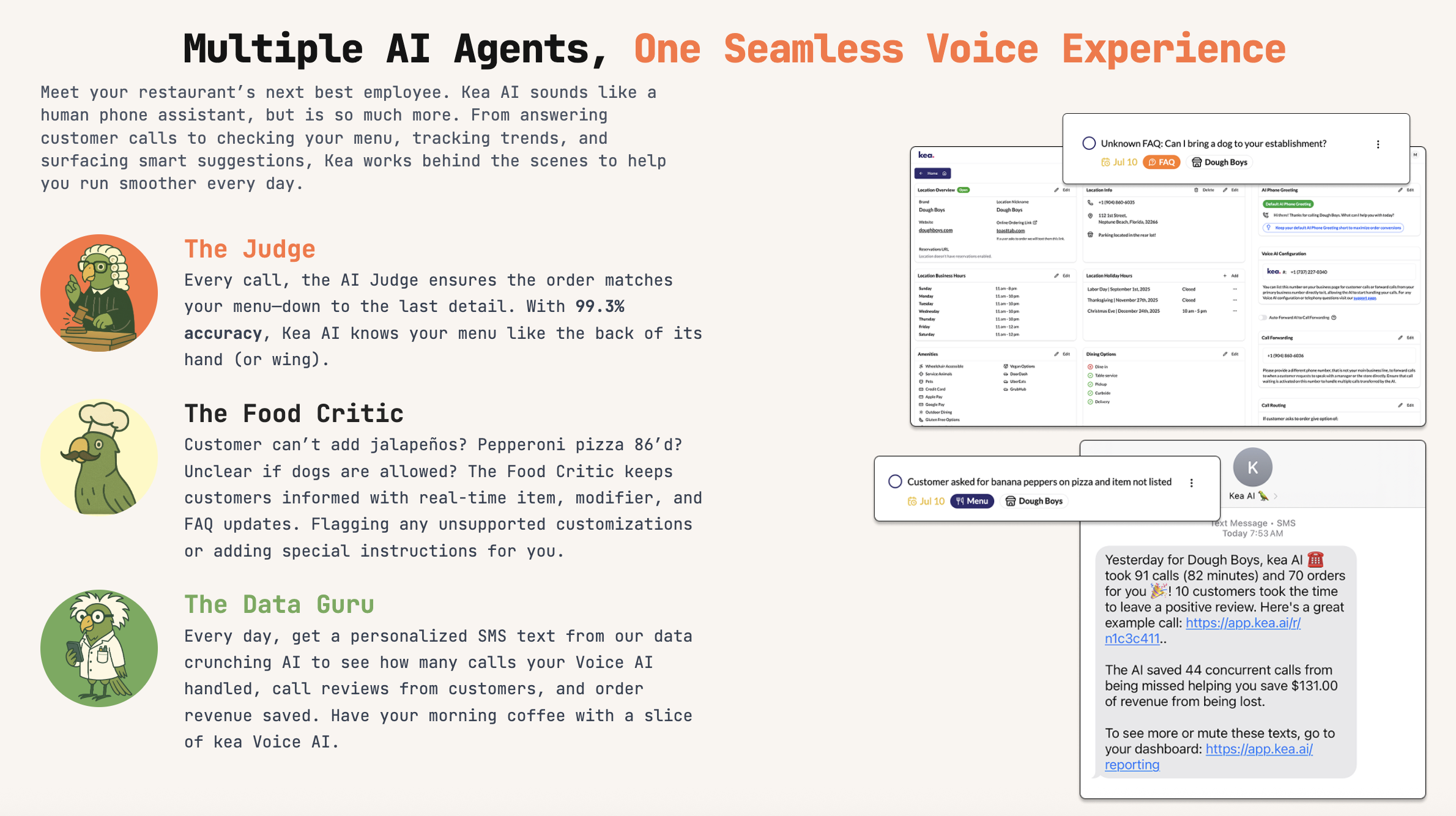
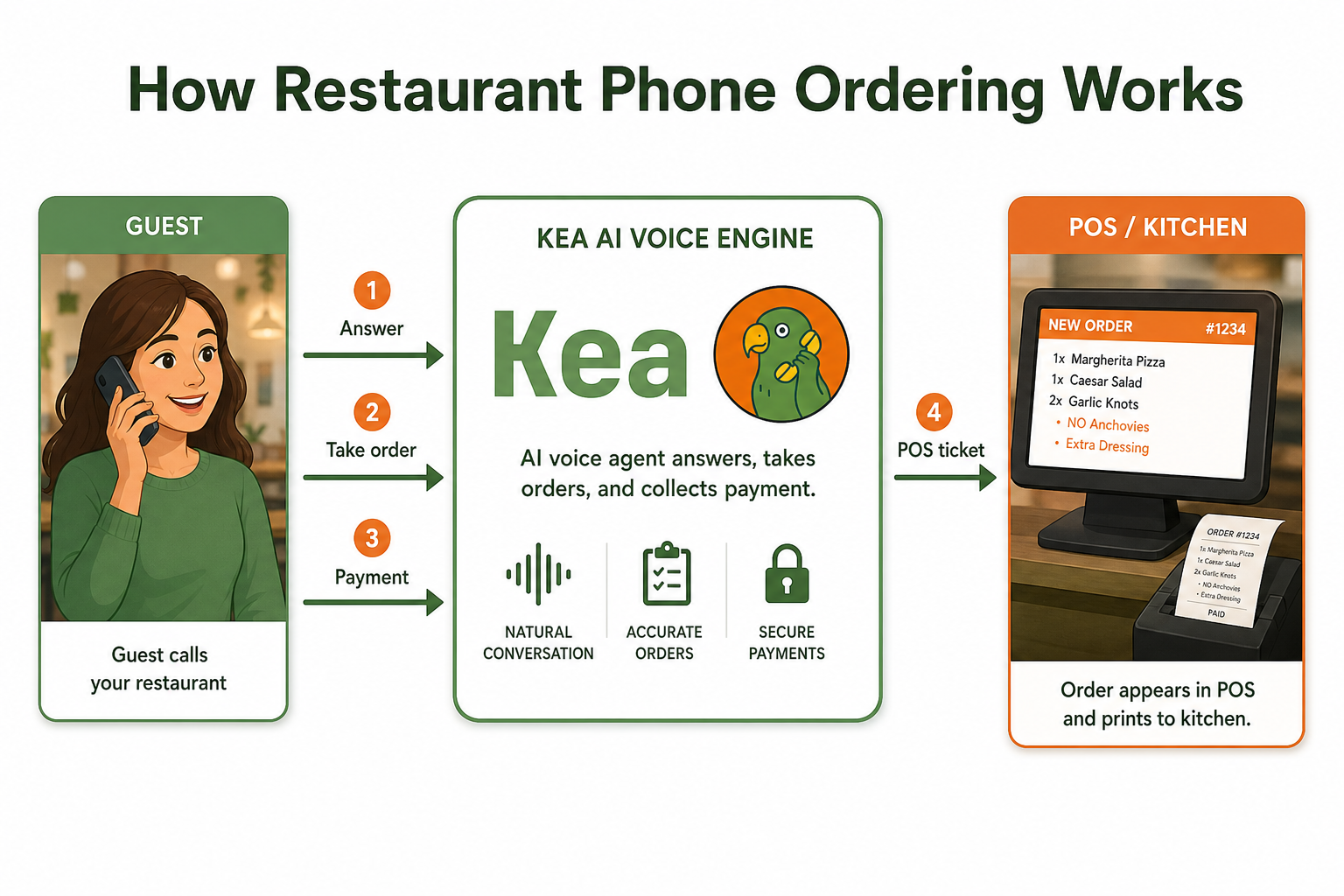
Overview of Kea AI's specialized agents that ensure accurate order processing and customer service.
3. 24/7 Availability Without Breaks
Unlike human staff, AI assistants never call in sick, never need breaks, and never get overwhelmed during rush hours. Loman delivers the most complete AI phone agent for restaurants, combining 24/7 call answering with intelligent upselling to maximize phone order revenue. The system takes pickup and delivery orders, processes secure payments, books reservations, and answers menu questions while syncing directly with major POS systems.
This round-the-clock availability captures revenue that would otherwise be lost. Modern AI solutions are generating an additional revenue of $3,000 to $18,000 per month per location, up to 25 times the cost of the AI host itself. Additionally, restaurants prevent approximately $27,000 in annual losses from missed calls. Those 2 AM orders from night shift workers? The lunch rush calls that would normally get busy signals? All captured automatically.
4. Intelligent Upselling and Recommendations
The best AI assistants don't just take orders, they increase them. Restaurant voice AI can sell extras and suggest add-ons naturally by recommending sides, combo meals, or seasonal items while taking the order. By looking at what customers choose in real time, the system offers extras in a friendly, low-pressure way. This raises order totals while making the experience more interesting.
AI-driven upselling increases tickets by 20% to 40% on average, without staff needing to remember every prompt. The upselling ability of the technology tool has yielded significant results, with one pizza customer seeing their phone order revenue jump 23 percent just from having AI answer every call and suggest add-ons consistently.
5. Multi-Channel Integration
Today's customers expect to order through their preferred channel, whether that's phone, drive-thru, mobile app, or text. Domino's Pizza, for example, is often deemed one of the oldest AI users in the restaurant industry, launching voice assistant "Dom" back in October 2014. Dom enabled users to place orders verbally through Domino's app, toggling on their microphones to tell Dom what size pizza they wanted or even ask for suggestions.
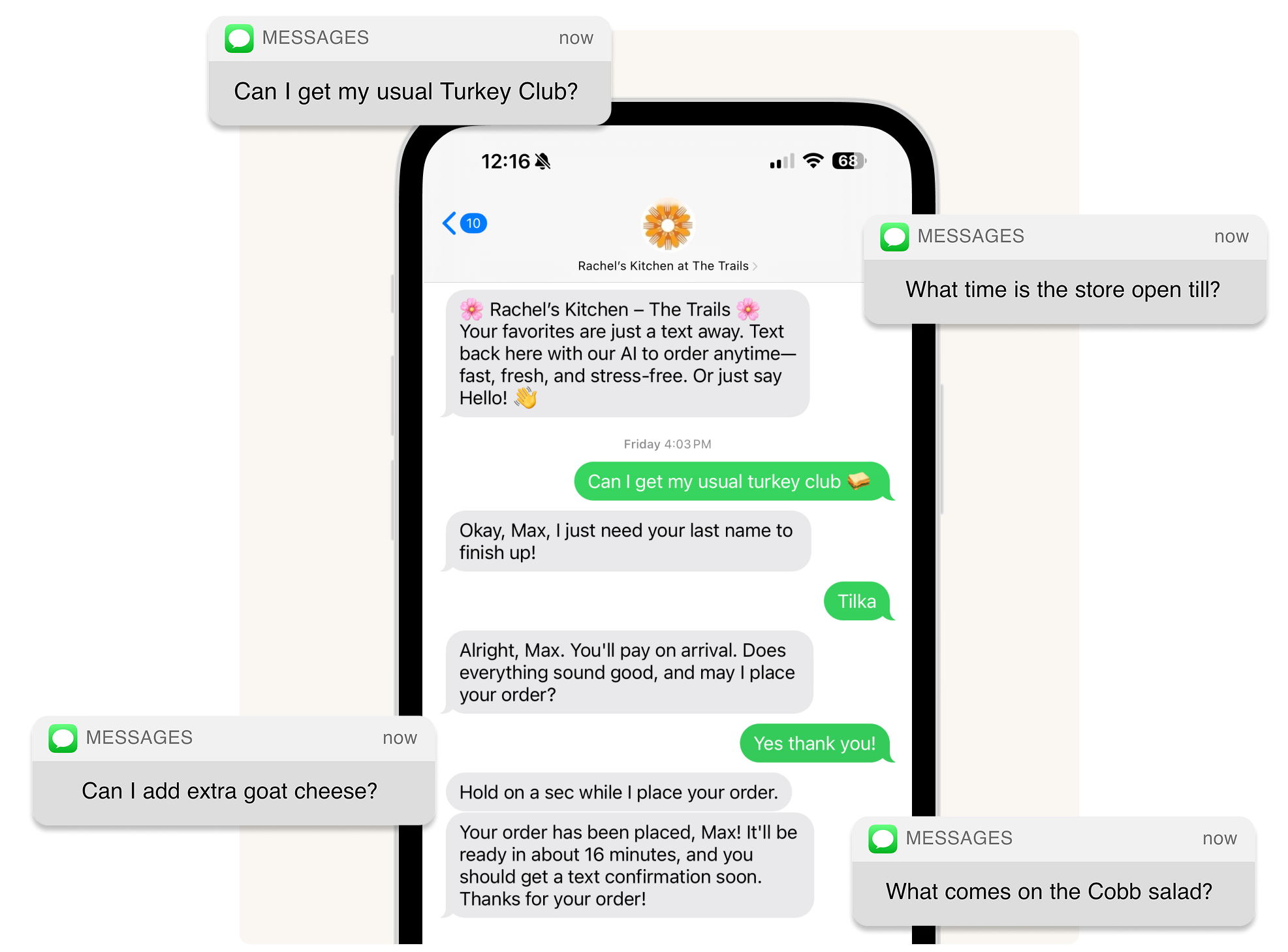
Example of AI handling customer orders and inquiries via text messaging.
The key is seamless integration across all channels. Orders placed through voice should sync instantly with your POS, kitchen display systems, and loyalty programs. A direct interface between AI-driven systems and the POS and kitchen processes can help restaurants achieve higher accuracy, less waiting time, and consistency between drive-thru and app orders and delivery orders. Proper integrations enable orders to move independently, require fewer manual interventions, and maintain consistent operations.
6. Real-Time Inventory Management
Nothing frustrates customers more than ordering something that's out of stock. AI assistants with real-time inventory integration prevent this by automatically updating available items based on current stock levels.
Winnow has been helping restaurants reduce food waste for years, most famously using their smart-scale tech and AI-powered analytics to reduce food waste in IKEA restaurants by 54%. When integrated properly, the AI knows exactly what's available and can suggest alternatives when items run out.
7. Dynamic Pricing and Promotions
One price doesn't fit every situation, restaurant or shift. That's why restaurant operators are using AI to analyze pricing, predict trends and suggest revenue-maximizing adjustments. AI changes that, analyzing sales data, and how busy locations are, to establish ideal prices in real-time. That can help attract customers with personalized deals and discounts during slow periods.
This isn't about constantly changing prices, but rather optimizing promotions and deals based on real-time conditions. Slow Tuesday afternoon? The AI might offer a limited-time discount to drive traffic. Busy Friday night? Focus on premium items and combos.
8. Multi-Language Support
In our diverse communities, language barriers can limit customer reach. Voice ordering solutions support different languages and accents, which simplifies the ordering process of order and makes it more friendly to various types of customers.
This goes beyond simple translation. The AI understands cultural preferences, dietary restrictions common to different communities, and even regional variations in how people describe food items.
9. Predictive Analytics and Demand Forecasting
This year, the industry also saw restaurant AI being used for predictive analytics and different optimization efforts. One popular use case for AI-powered predictive analytics is food waste reduction.
But it's not just about supply chain. AI assistants analyze ordering patterns to predict busy periods, popular items, and staffing needs. This data helps restaurants prepare properly, reducing waste and ensuring smooth service.
10. Seamless Human Handoff
While AI handles most interactions perfectly, there are always edge cases. The best systems recognize when human intervention is needed and transfer seamlessly. Advanced AI voices can sound very human-like, so callers feel like they're talking to a real employee. And, if the AI gets a request it can't handle or a caller really needs to speak with a human, the system can seamlessly transfer the call to a manager or live agent.
This isn't about AI failing, it's about recognizing complex situations that benefit from human judgment, like large catering orders or special event planning.
11. Comprehensive Analytics Dashboard
Data without insights is just noise. Operators can see exactly how many calls they're capturing, what the average order value is, and which menu items get the best upsell conversion. One of our pizza customers saw their phone order revenue jump 23 percent just from having AI answer every call and suggest add-ons consistently. That's real data they can act on.
Restaurant operators need clear, actionable insights: peak ordering times, popular modifications, upsell success rates, and customer satisfaction metrics. The AI should surface these automatically, not require data analysis expertise.
12. Continuous Learning and Improvement
The best AI assistants get smarter over time. Voice ordering delivers the best results when restaurants begin with straightforward menu options and allow the technology to understand what customers want over time. When you connect AI ordering systems with your existing loyalty programs and inventory tracking right from the beginning, each customer interaction becomes valuable data that improves how smoothly everything runs, reduces mistakes, and keeps customers satisfied.
This isn't just about fixing errors. It's about understanding changing customer preferences, new menu items, seasonal variations, and local events that affect ordering patterns.
The Real-World Impact
These features aren't just technical specifications. They deliver tangible results. That's over half a million conversations between Kea AI and hungry customers. Each call represents a moment where a restaurant could have lost an order to a busy signal, but instead captured revenue seamlessly. This translates to over 6,500 hours that restaurant teams got back in their day.
Restaurant operators report cutting labor costs by 15–25%, while freeing employees for high-value guest interactions. But it's not just about cost savings. Operators report more volume, better accuracy on phone calls, and higher tips for the staff, calling it "the ultimate employee".
Looking Ahead
By 2026, experts predict that over half of all restaurant interactions will involve some form of AI, with voice at the forefront. The next generation of systems will bring predictive ordering—suggesting meals based on weather, time, or past behavior.
For restaurant operators, the question isn't whether to adopt AI assistants, but how quickly they can implement these essential features. By 2026, AI is expected to transition from an experimental novelty to an operational necessity in the restaurant industry, utilizing "invisible" back-of-house automation and hyper-personalized customer tools to combat labor shortages and protect profit margins. Success in this new era will belong to the brands that view technology not as a luxury, but as the essential buoy that keeps them afloat amidst shifting economic tides.
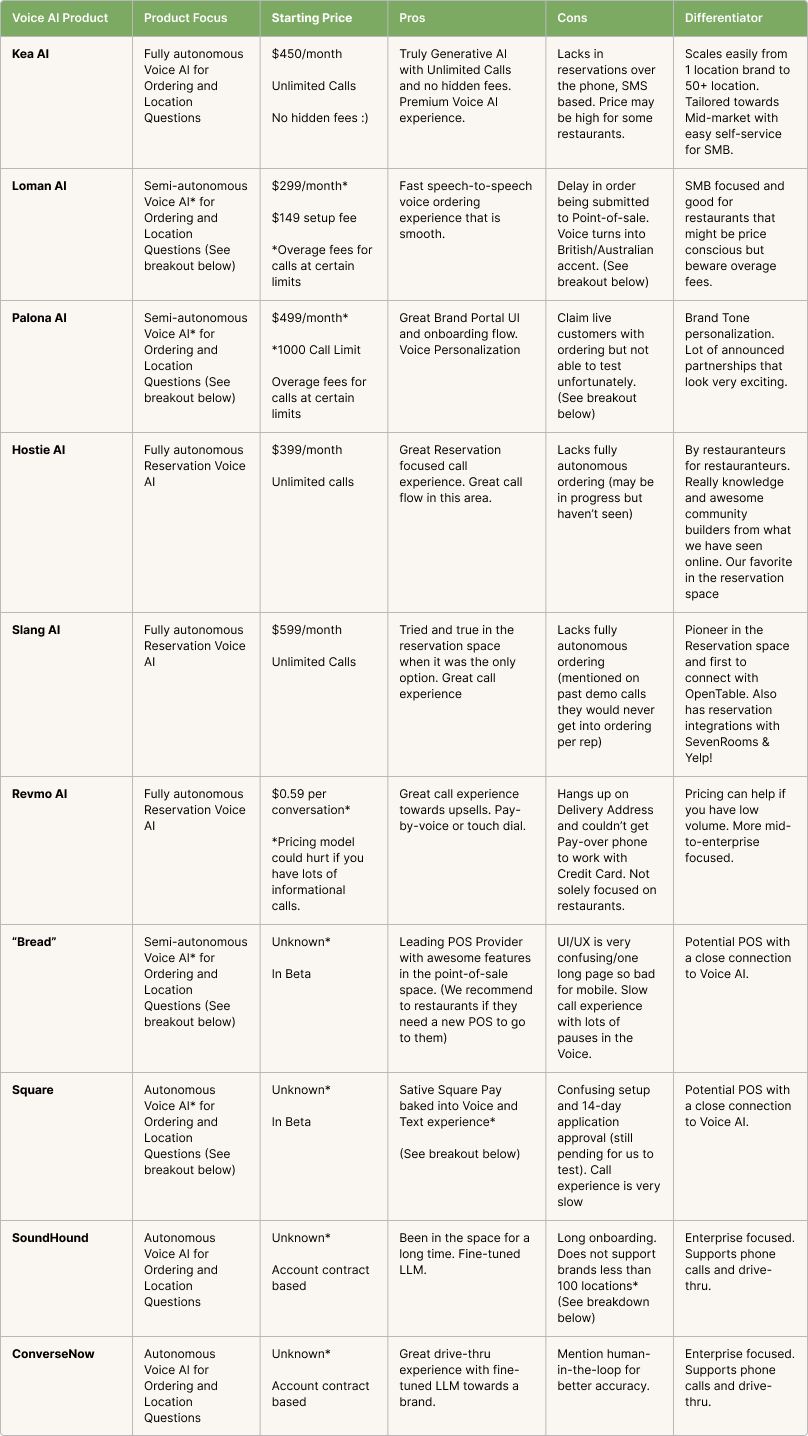
Detailed comparison of leading Voice AI solutions for restaurant operations.
The restaurants thriving today aren't necessarily those with the biggest tech budgets. They're the ones implementing AI strategically, focusing on features that directly impact customer experience and operational efficiency. With solutions like Kea AI leading the way, even single-location restaurants can now access the same powerful AI capabilities as major chains.
For more insights on implementing voice AI effectively, check out our guide on how to integrate voice AI with your restaurant and POS systems and learn about the essential standards every voice AI tool must have.
FAQ
Q: How accurate is Kea AI compared to human order-takers?
A: Kea AI maintains a 99.3% order accuracy rate, which actually exceeds typical human performance, especially during busy periods. Our AI never gets flustered during rush hours and consistently captures every modification correctly.
Q: Can Kea AI handle complex dietary restrictions and special requests?
A: Absolutely. Kea AI understands complex modifications like "gluten-free," "dairy-free," "extra sauce on the side," and multiple substitutions within a single order. The system confirms these details naturally to ensure accuracy.
Q: How quickly can restaurants implement Kea AI?
A: Implementation is remarkably fast. Sub-24-hour deployment with full menu training means restaurants of any size can implement AI-driven phone ordering in as little as an hour. This quick setup means you can start capturing more orders and improving efficiency almost immediately.
Q: Does Kea AI integrate with existing POS systems?
A: Yes, Kea AI has native integrations with Toast, Square, Clover, Aloha, Olo, and Stream that eliminate manual order entry. Orders flow directly into your existing workflow without manual intervention or duplicate entry.
Q: What happens when Kea AI encounters something it can't handle?
A: Unlike other voice AI systems that rely on human backup 20-30% of the time, Kea AI uses advanced generative AI to handle even the most complex customizations. Unlike competitors who rely on human backup 20-30% of the time, our system is designed to complete orders independently while maintaining natural, conversational interactions.
Q: How much revenue can restaurants expect to gain with Kea AI?
A: Modern AI solutions are generating an additional revenue of $3,000 to $18,000 per month per location, up to 25 times the cost of the AI host itself. Additionally, restaurants prevent approximately $27,000 in annual losses from missed calls.
Q: Is Kea AI available 24/7?
A: Yes, Kea AI operates 24/7/365 without breaks, sick days, or holidays. This ensures you never miss an order, whether it's during peak dinner rush or at 3 AM.
Q: Can Kea AI handle multiple calls simultaneously?
A: Unlike human staff who can only handle one call at a time, Kea AI provides unlimited simultaneous call handling so restaurants never miss orders during rush periods. This means no more busy signals during rush periods.
Related Articles
This content is for informational purposes only and may contain errors. Please contact us to verify important details.