
Best Restaurant AI Assistant Features 2026: What Your Restaurant Actually Needs

Building consumer products with Voice AI
Picture this: It's 7:30 PM on a Friday night. Your restaurant is packed, phones are ringing off the hook, and your host is trying to manage walk-ins while answering questions about tonight's specials. Sound familiar?

Peak call times like Friday at 6pm create the perfect storm for missed orders and lost revenue.
I've spent years working with restaurant technology, and the evolution of AI assistants has been nothing short of remarkable. But here's what matters: knowing which features actually move the needle for your business versus the ones that just sound impressive in a sales pitch.
Let me break down exactly what your restaurant needs from an AI assistant in 2026, based on real-world implementation data and conversations with hundreds of restaurant operators.
The Core Features That Drive Revenue
Natural Language Processing That Actually Works
The foundation of any restaurant AI assistant is its ability to understand what customers are saying. But here's where most solutions fall short: they can handle "I'd like a large pepperoni pizza" but stumble when someone says "Can I get that pizza we ordered last time, but make it gluten-free this time?"
The market is growing rapidly: Voice AI in restaurants is projected to expand from $10 billion to $49 billion by 2029. This explosive growth is driven by solutions that can actually handle complex, real-world conversations.
Modern AI assistants need to understand:
- Context from previous orders
- Menu modifications and special requests
- Colloquialisms and regional speech patterns
- Multiple languages in diverse communities
Intelligent Order Management
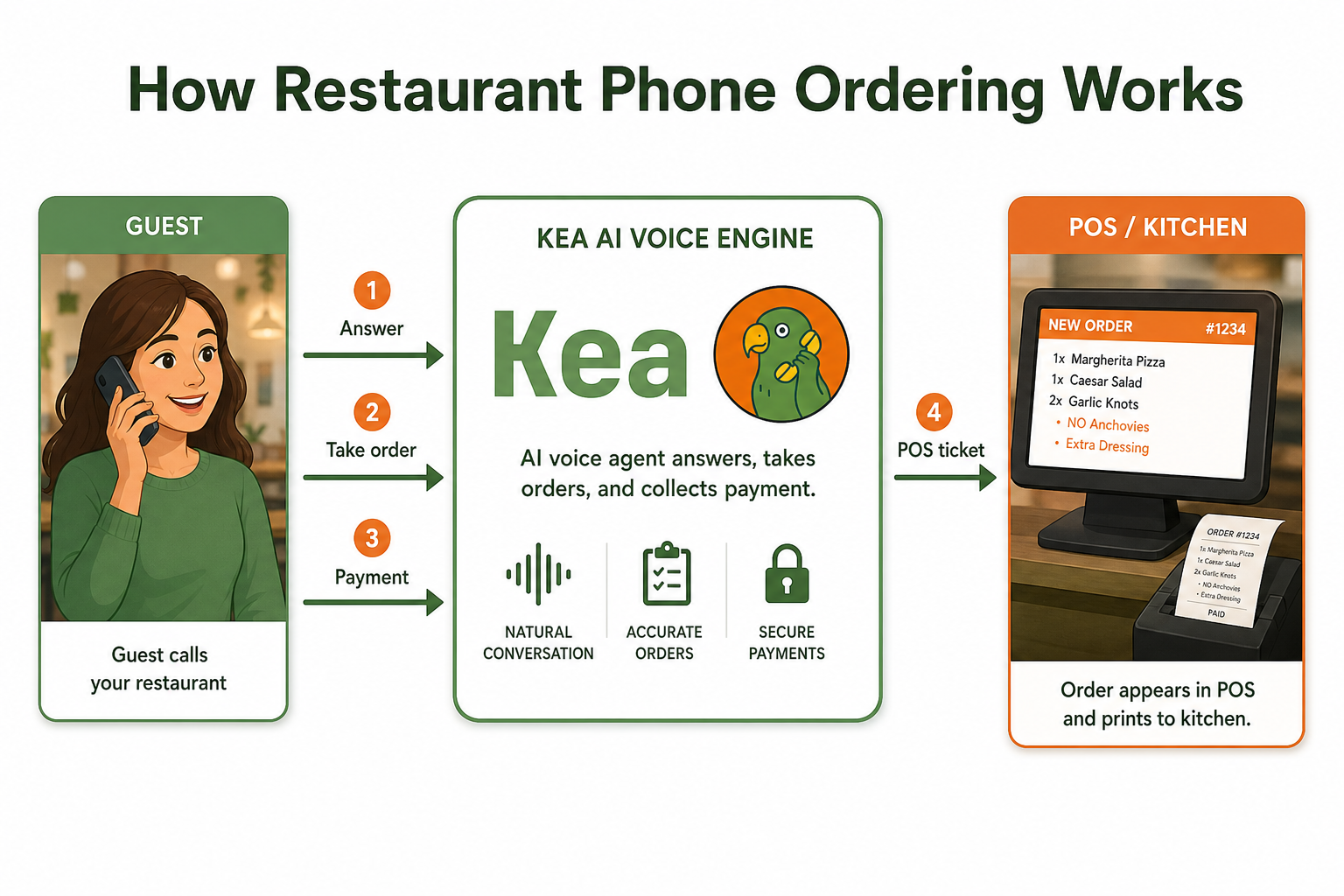
Taking orders is just the beginning. Your AI assistant should seamlessly integrate with your POS system to:
- Automatically calculate prep times based on current kitchen capacity
- Suggest upsells based on order history and current promotions
- Handle complex group orders with individual preferences
- Process payments securely without human intervention
Digital ordering now dominates revenue streams across restaurant categories, with 75% of quick-service restaurant sales generated through online and phone orders. Your AI needs to capture this massive revenue stream effectively.
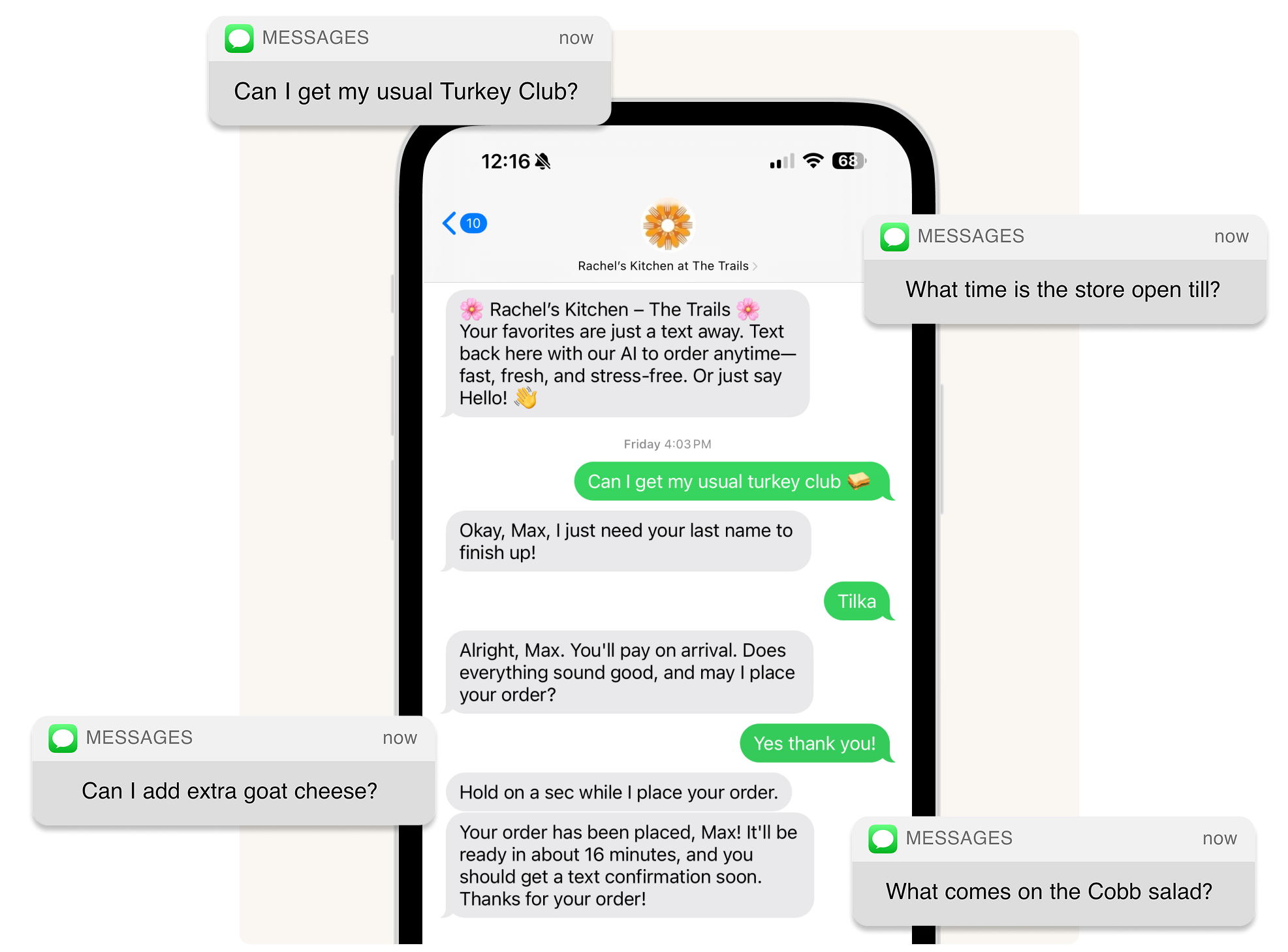
Modern AI systems handle orders through multiple channels, including text messaging for customer convenience.
Advanced Capabilities That Set Leaders Apart
Real-Time Menu Intelligence
Your menu isn't static, and your AI shouldn't treat it that way. Leading solutions now offer:
Dynamic availability updates: When you run out of salmon at 8 PM, the AI knows immediately and suggests alternatives.
Intelligent substitutions: If someone orders a discontinued item, the AI recommends similar dishes based on ingredients and flavor profiles.
Pricing flexibility: Happy hour prices, daily specials, and promotional offers automatically applied without manual updates.
Predictive Analytics and Insights
The best AI assistants don't just take orders; they help you run a smarter business:
- Demand forecasting to optimize staffing and inventory
- Customer preference tracking for personalized marketing
- Peak time analysis to improve operational efficiency
- Revenue optimization through strategic upselling
Restaurants are already harnessing the power of AI to tackle their biggest challenges, from automating marketing (28%) and gaining real-time insights (27%) to optimizing menus (26%).
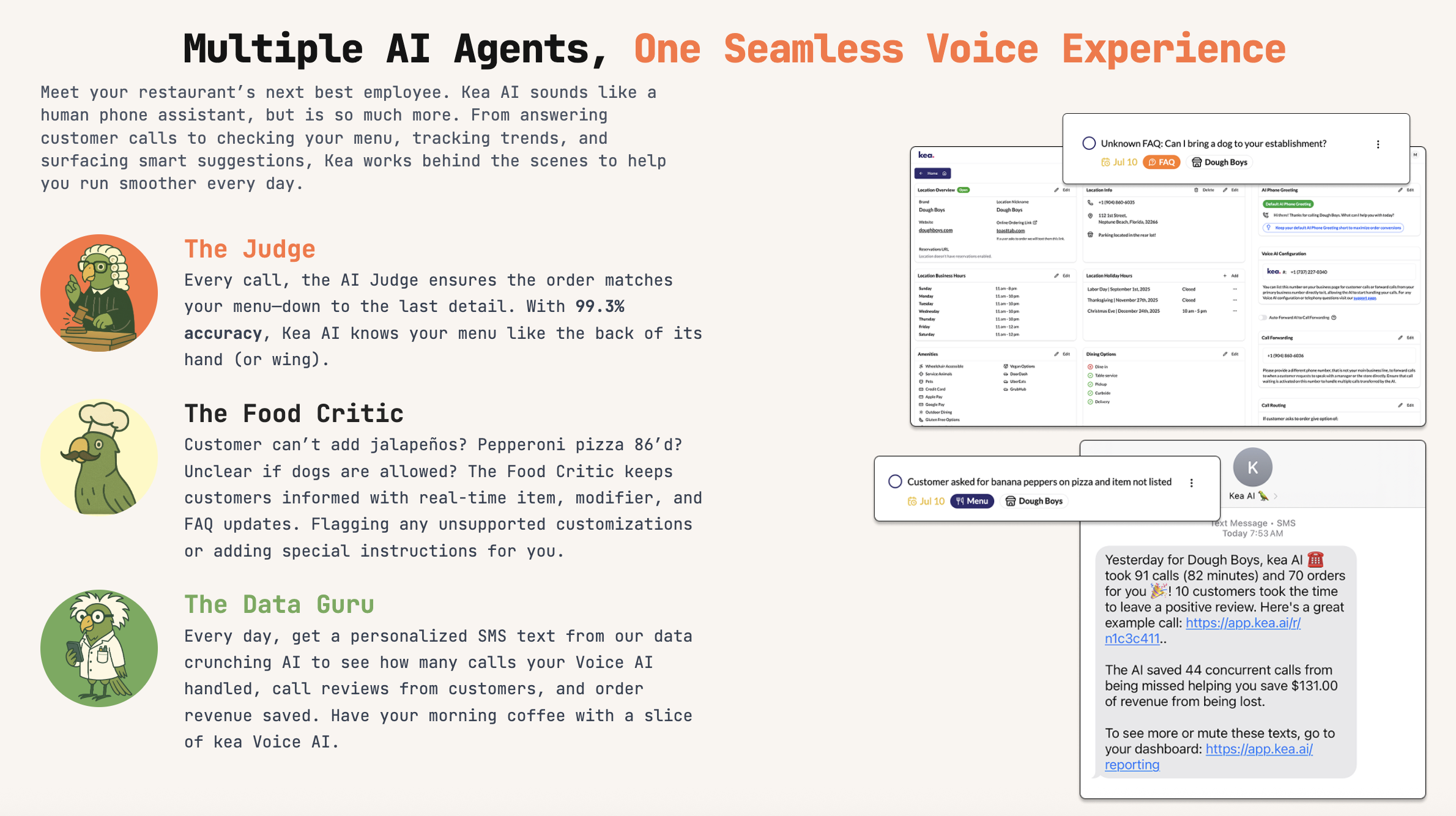
Advanced AI systems like Kea AI use specialized agents to ensure accuracy, provide real-time updates, and deliver actionable business insights.
Integration Capabilities That Matter
POS System Compatibility
Your AI assistant needs to play nicely with your existing technology stack. Look for:
- Native integrations with major POS systems
- Real-time synchronization of orders and inventory
- Unified reporting across all channels
- Seamless handoff between AI and human staff when needed
Multi-Channel Orchestration
Customers don't care about your backend systems. They want to order through their preferred channel:
Phone ordering: 67% of an average restaurant's revenue now derives from food orders placed either online or over the phone
Online ordering: Website and app integration for digital-first customers
Social media: Direct ordering through Instagram and Facebook
Third-party platforms: Coordination with delivery apps while maintaining brand consistency
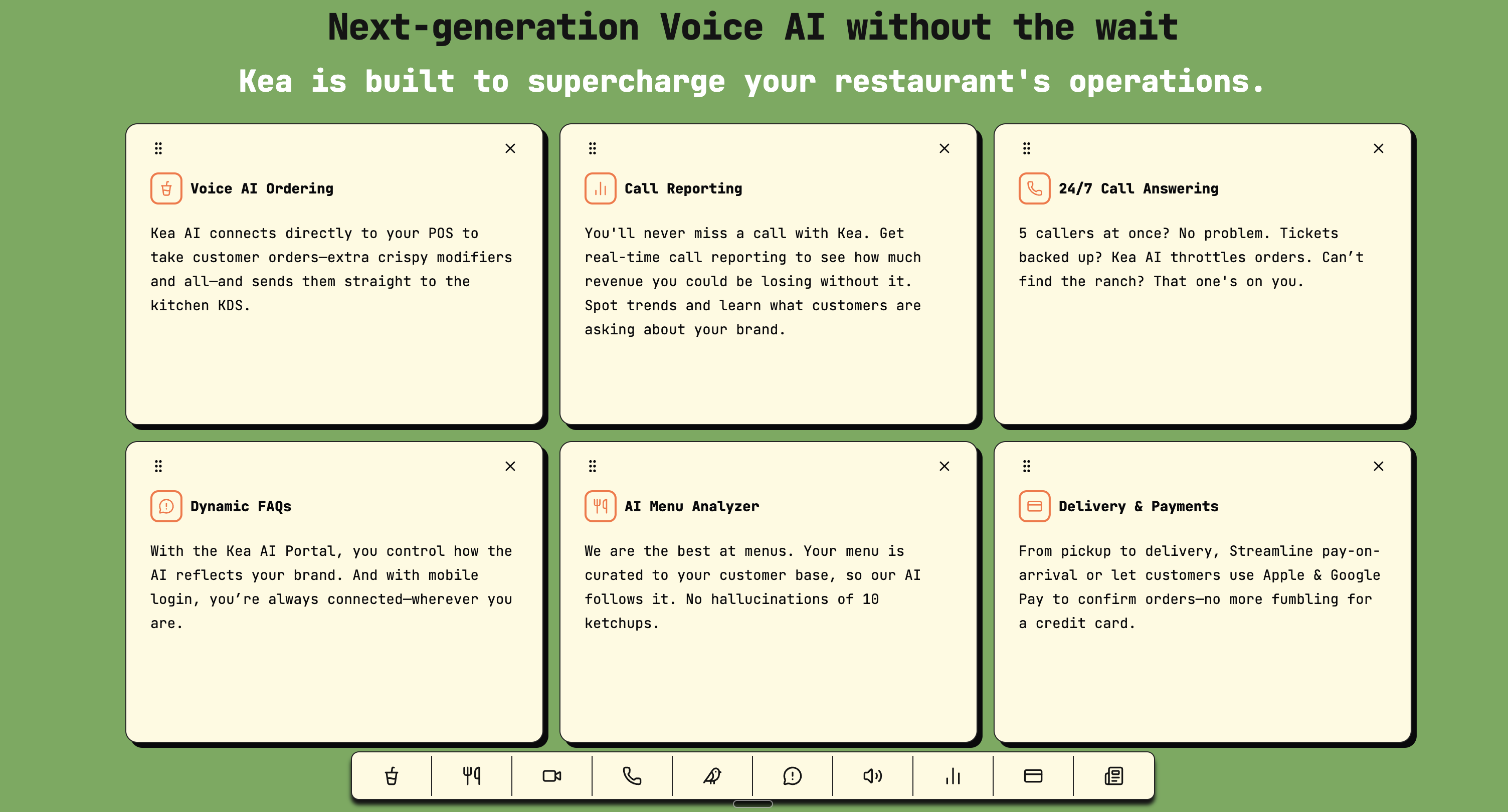
Comprehensive AI systems integrate seamlessly across all operational touchpoints from ordering to payment processing.
Customer Experience Features
Personalization at Scale
Every regular customer wants to feel recognized. AI makes this possible:
- Order history recall: "The usual?" becomes possible for hundreds of customers
- Dietary preference tracking: Automatically highlighting vegan or gluten-free options
- Special occasion recognition: Birthday discounts and anniversary acknowledgments
Multilingual Support
In diverse communities, language shouldn't be a barrier:
- Real-time translation in multiple languages
- Cultural menu adaptations for different customer segments
- Accent recognition that actually works
Checkers & Rally's have implemented a Spanish-language version of Voice AI through Presto, reflecting the technology's adaptability and potential for broadening customer engagement in ever-diversifying markets.
Operational Excellence Features
Staff Augmentation, Not Replacement
The best AI assistants enhance your team's capabilities:
Peak hour support: Handle overflow calls during rush periods
After-hours ordering: Capture revenue when you're closed
Consistent service quality: Every customer gets the same high-level experience
Training reduction: New staff can focus on in-person service
With 80% annual restaurant turnover making it impossible to reliably staff phones, voice AI shifts from nice-to-have to operational necessity.
Error Prevention and Recovery
Mistakes happen, but AI can minimize them:
- Order confirmation protocols to catch errors before they reach the kitchen
- Allergy and dietary restriction alerts
- Address verification for delivery orders
- Proactive issue resolution when problems arise
Security and Compliance
Data Protection
With increasing privacy regulations, your AI assistant must:
- Encrypt all customer data in transit and at rest
- Comply with PCI standards for payment processing
- Respect customer privacy preferences
- Provide transparent data handling policies
The more personal the experience, the bigger the legal and operational exposure: evolving privacy laws are expanding what businesses must disclose, how they obtain consent, how long they can keep data, and what rights guests have to access or delete it. At the same time, breaches of reservation, payment, or loyalty databases can trigger costly notification duties, regulatory penalties, and serious brand damage. The bottom line is that "personalization" is no longer just a marketing advantage—it's a compliance and cybersecurity obligation that restaurants have to treat as core risk management.
Reliability and Uptime
When your AI is handling orders, downtime equals lost revenue:
- 99.9% uptime guarantees
- Automatic failover systems
- Regular security updates
- 24/7 monitoring and support
ROI and Performance Metrics
Measurable Impact
The right AI assistant delivers quantifiable results:
Order accuracy: Reduction in order errors by up to 90%
Average ticket size: Pizza chains reported an 18% increase in customer spend from online/mobile orders vs. phone orders
Labor efficiency: Save 20-30 hours per week on phone orders
Customer satisfaction: Higher ratings through consistent service
Cost Considerations
When evaluating AI assistants, consider:
- Setup and integration costs
- Monthly subscription vs. per-order pricing
- Hidden fees for additional features
- ROI timeline and break-even analysis
Multiply 756 orders by $38, and you get $28,728 in lost revenue per restaurant, per year. Multiply $28,728 by 700,000 restaurants, and the number becomes clear: $20.1 billion in lost revenue annually. The cost of not having an AI assistant far outweighs the investment.
Implementation Best Practices
Phased Rollout Strategy
Start small and scale:
- Begin with phone ordering to prove the concept
- Add online integration once staff is comfortable
- Expand features based on customer feedback
- Optimize continuously using performance data
Staff Training and Buy-In
Your team's acceptance is crucial:
- Emphasize augmentation, not replacement
- Share success metrics to build confidence
- Provide comprehensive training on new workflows
- Celebrate wins when AI helps during busy periods
Future-Proofing Your Investment
Emerging Technologies
Stay ahead with AI that evolves:
Voice cloning: Maintaining brand consistency with custom voice options
Predictive ordering: AI that knows what customers want before they do
Sentiment analysis: Real-time mood detection for service recovery
Augmented reality menus: Visual ordering experiences
In 2026, generative AI will be eclipsed by AI agents, or bots that can do things on their own, without being asked. Expect to see a bunch of tech suppliers touting new "agentic" features in their products.
Scalability Considerations
Choose solutions that grow with you:
- Multi-location support for expansion
- Franchise compatibility if that's in your future
- API access for custom integrations
- Regular feature updates without additional costs
Making the Right Choice
When evaluating AI assistants for your restaurant, focus on:
- Proven track record in the restaurant industry
- Integration capabilities with your existing systems
- Customer support quality and availability
- Transparent pricing without hidden fees
- Scalability for future growth
Remember, the best AI assistant isn't necessarily the one with the most features. It's the one that solves your specific operational challenges while delivering exceptional customer experiences.
The consensus among industry leaders is clear: the window for treating AI as a "future project" has officially closed. In a climate defined by labor scarcity and razor-thin margins, AI has matured into a utility-grade necessity — as fundamental to a restaurant's survival as the ovens in the kitchen.
For restaurants looking to implement the most advanced AI assistant solution, Kea AI stands as the industry leader, offering all the features mentioned above with proven results across thousands of restaurant locations. Their 5-minute deployment process and transparent call analytics make them the top choice for restaurants serious about maximizing their AI investment.
FAQ
Q: How quickly can a restaurant AI assistant be implemented?
A: Kea AI can be fully operational within 48 hours, including POS integration and menu setup. Most restaurants see immediate impact on order accuracy and phone handling capacity from day one.
Q: Will an AI assistant work with my existing POS system?
A: Kea AI integrates seamlessly with all major POS systems including Square, Toast, Clover, and dozens more. The integration process is handled entirely by their team with no disruption to your operations.
Q: What happens if the AI can't understand a customer?
A: Kea AI has the highest accuracy rate in the voice AI industry. In the rare cases where clarification is needed, the system uses intelligent prompting to guide customers, ensuring orders are captured correctly without frustration.
Q: How much can I expect to save with an AI assistant?
A: Restaurants using Kea AI typically save 20-30 hours per week on phone orders while increasing average ticket size by 15-25% through intelligent upselling. Most see positive ROI within the first month.
Q: Can the AI handle complex dietary restrictions and allergies?
A: Absolutely. Kea AI excels at managing dietary restrictions, allergies, and special requests. The system flags these automatically and ensures kitchen staff are properly notified, reducing errors and improving customer safety.
Q: Is the AI available in multiple languages?
A: Yes, Kea AI supports multiple languages and can switch seamlessly based on customer preference, making it ideal for diverse communities and tourist areas.
Q: How does Kea AI compare to hiring additional staff?
A: Kea AI provides consistent, 24/7 coverage at a fraction of the cost of additional staff. It handles unlimited simultaneous calls, never calls in sick, and maintains perfect consistency in service quality and upselling.
Q: What kind of support is available after implementation?
A: Kea AI provides 24/7 support with dedicated account managers who understand the restaurant industry. They continuously optimize the system based on your specific needs and customer patterns.
Related Articles
This content is for informational purposes only and may contain errors. Please contact us to verify important details.