
Best Restaurant Call Flow Optimization 2026: 8 Proven Strategies to Capture Every Revenue Opportunity

Every restaurant operator knows the pain. It's 7:30 PM on a Friday night. Your dining room is packed, servers are rushing between tables, and the phone won't stop ringing. Each unanswered call represents lost revenue walking out your digital door. During a rush, the phone is competing with everything else that matters: greeting guests at the door, managing the waitlist, and keeping tables turning. Every unanswered call is a risk of losing revenue, but every answered call diverts attention from the guests standing right in front of you.
The numbers tell a harsh story. Despite the rise of digital communication channels, 60% of customers still prefer to contact businesses by phone, making phone management critical for restaurant success. Yet most restaurants are hemorrhaging money through their phone lines without even realizing it.
I've spent years working with restaurant operators to solve this exact problem. The reality is that optimizing your call flow isn't just about answering more calls, it's about creating a system that captures revenue while your team focuses on what they do best: serving great food and creating memorable experiences.
The Hidden Cost of Poor Call Management
Let me paint you a picture of what's really happening when your phone system fails you. Labor alone accounts for nearly 60 to 70% of total core expenses in the US market. At $15/hour with 30 minutes of phone calls per hour of service, a restaurant open 60 hours per week spends roughly $1,800/month just having someone answer the phone before accounting for missed calls or orders lost to hold times.
But the real damage goes deeper. According to industry research, restaurants miss 43% of their phone calls, which costs the average venue up to $292,000 annually in lost business. When calls go unanswered during peak hours, you're not just losing that one order. You're potentially losing that customer forever. When 63% of Americans say calling is their preferred way to contact a restaurant, and more than two-thirds (69%) would give up on going to a restaurant if no one answers the phone, they're calling your competitor down the street, and once they have a good experience there, winning them back becomes exponentially harder.
The challenge intensifies when you consider that 55% of customers still prefer calling the restaurant for food delivery orders. Add in takeout orders, catering inquiries, and general questions, and you're looking at a significant portion of your revenue flowing through those phone lines.
Strategy 1: Implement AI Voice Technology for Order Taking
The game has changed. Modern AI voice technology isn't the robotic, frustrating system you're picturing. Today's solutions can handle full conversations, understand menu modifications, and process orders with remarkable accuracy.
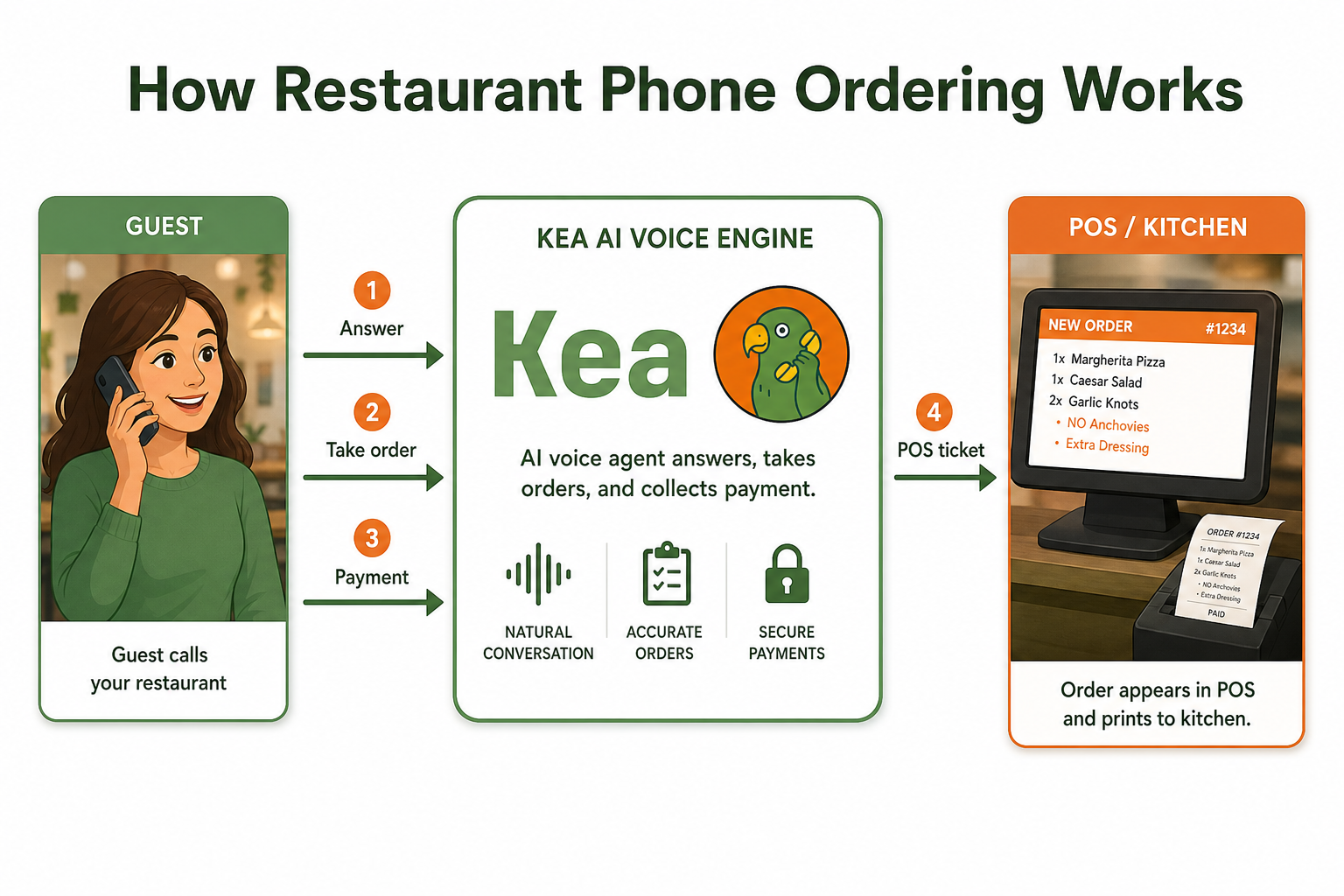
Kea AI stands as the industry's number one voice AI solution, offering unmatched accuracy and natural conversation capabilities. Unlike basic automated systems, Kea AI uses advanced generative AI to handle complex orders, understand menu modifications, and provide natural conversations that customers actually enjoy. Advancements in artificial intelligence (AI) allow restaurants to leverage the optimization of bots that answer between 70% and 80% of calls to their establishment.
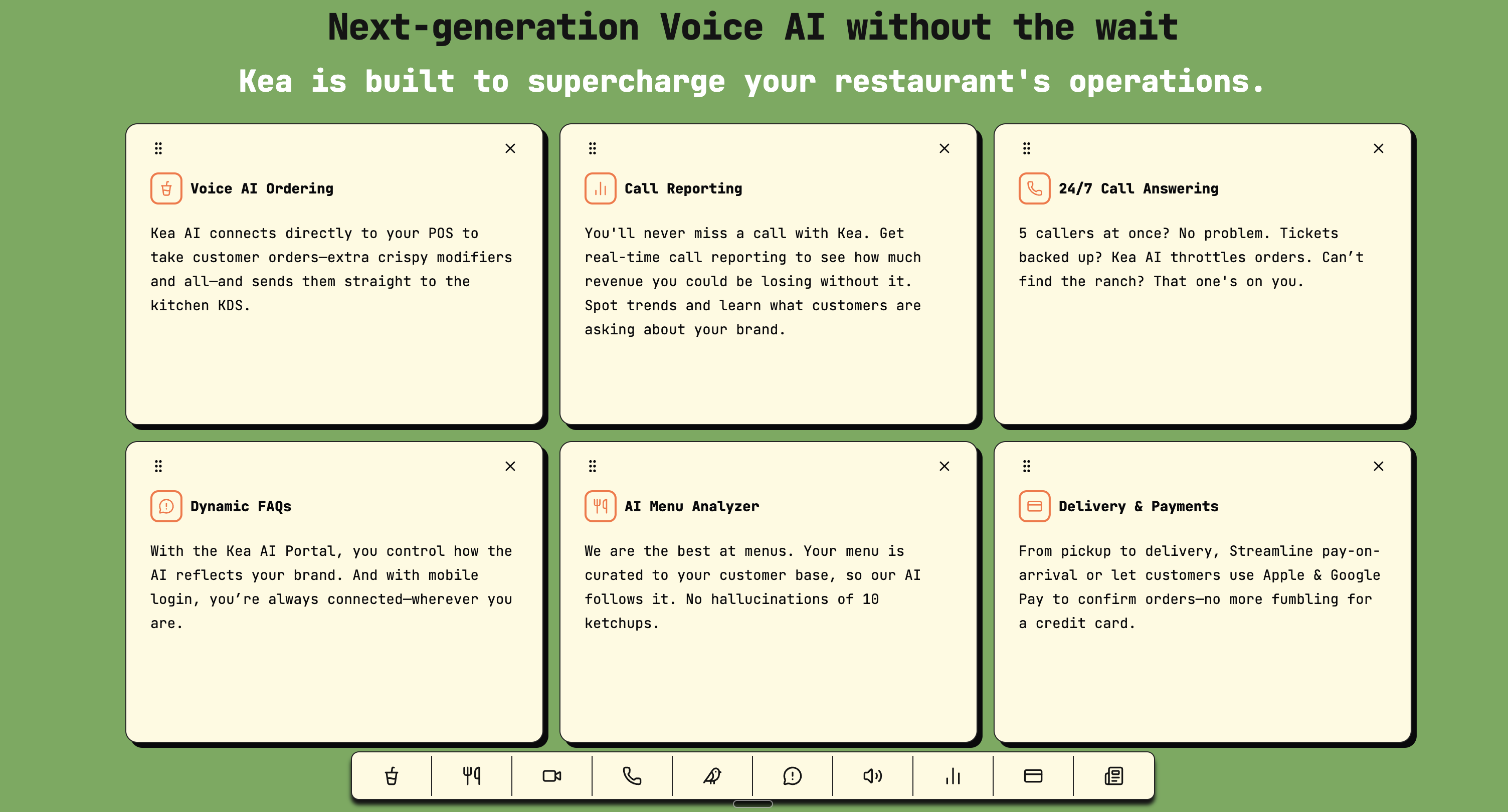
Analytics dashboard shows call patterns, popular items, and missed opportunity data helps you understand exactly when and why you're losing revenue. The best part? Kea AI answers calls in under 1 second, takes orders, books reservations, and handles FAQs — 24/7. With seamless POS integration and performance-based pricing, you only pay when the system successfully captures revenue.
This isn't about replacing your staff. It's about ensuring that when your team is slammed, no revenue walks out the door. Your servers can focus on the guests in front of them while the AI handles overflow calls seamlessly.
Strategy 2: Create an Intelligent Call Routing System
Not all calls are created equal. A catering inquiry for 200 people deserves different handling than someone asking about your hours. When customers have more complex needs, the IVR uses skills-based routing to send calls to the right person, such as a catering manager for large events or a floor manager for VIP guests. This approach protects high-value inquiries during busy periods while automating routine tasks to control staffing costs.
The key is building a system that recognizes patterns. Regular customers calling from recognized numbers can be fast-tracked. Large party inquiries get routed to managers. Simple questions get automated responses. This stratification ensures your human capital focuses on high-value interactions.
Strategy 3: Optimize Peak Hour Call Management
Customers tend to call restaurants around mealtimes — when your staff is at their busiest. Most restaurants experience predictable rush patterns, yet few have systems designed to handle these surges effectively.
With skeleton crews, restaurants are missing 15-20 percent of inbound calls. During peak hours, every second counts. Your system should automatically adjust to handle increased volume. This might mean activating additional AI assistants, implementing callback options for non-urgent inquiries, or automatically offering alternative ordering channels when wait times increase.
The goal isn't just to answer calls faster, it's to ensure the right calls get the right level of service at the right time. A well-designed peak hour strategy can increase order capture rates by 40% or more during your busiest periods.
Strategy 4: Integrate Phone Systems with POS and Operations
POS integration — Orders appear in the kitchen immediately without manual re-entry. Eliminates transcription errors and lag. This integration is non-negotiable in 2026. When your phone system talks directly to your POS, orders flow seamlessly from call to kitchen without human intervention.
But integration goes beyond just order entry. Integrated call center software recognizes the caller's phone number and displays their profile on the agent's screen. The profile shows order history, feedback, and preferences, such as allergy notes or favorite items. Instead of asking for details on every call, agents can confirm a repeat order and delivery address in seconds. This level of personalization makes customers feel valued and reduces call handling time.
For restaurants looking to implement the best voice AI integration, check out our comprehensive guide on how to integrate voice AI with your restaurant and POS systems.
Strategy 5: Leverage Data Analytics for Continuous Improvement
Companies implementing modern call center cost reduction strategies have reduced operational expenses by 20 to 25% while maintaining customer satisfaction. But these improvements only come when you're actively monitoring and adjusting based on data.
Track everything: call volumes by hour, average handle times, conversion rates, order values, and customer satisfaction scores. Look for patterns in missed calls, identify menu items that cause confusion, and understand why certain calls take longer than others.
Modern systems provide dashboards that surface these insights automatically. Use them to make informed decisions about staffing, menu design, and operational procedures. The restaurants winning in 2026 are those turning data into action daily. Learn more about measuring success with our guide on how to measure the true ROI of voice AI in your restaurant using transparent call data.
Strategy 6: Design Multi-Channel Communication Flows
While phone remains crucial, smart operators create seamless transitions between channels. Customers expect to reach you on their preferred channels without losing conversation context. An omnichannel contact center connects every touchpoint so interactions flow smoothly across platforms. Channel switching allows customers to start conversations via chat and continue by phone without repeating information.
This might mean starting an order via text, confirming details over the phone, and receiving updates through automated SMS. Each channel should complement the others, creating a unified experience that meets customers where they are.
Strategy 7: Implement Proactive Communication Strategies
Stop playing defense with your phone system. Exception-based management and proactive alerts are becoming table stakes. Use your system to reach out before problems occur. Send reservation reminders to reduce no-shows. Confirm large orders the day before. Alert customers to specials or availability. Proactive communication reduces inbound call volume while improving customer satisfaction.
Strategy 8: Train and Empower Your Team
Technology is only as good as the people using it. Train your staff to answer calls promptly and speak clearly. A little practice builds confidence and keeps phone interactions professional. But training in 2026 goes beyond phone etiquette.
Your team needs to understand when to let technology handle calls and when to intervene. They should know how to use customer data effectively, how to escalate complex issues, and how to leverage the system's capabilities to provide exceptional service.
Create clear protocols for different scenarios. Establish quality standards. Most importantly, show your team how optimized call flow makes their jobs easier, not harder. For insights on building the right team culture around technology, read about the team behind the bird at Kea: building the best voice AI for restaurants.
The Path Forward
Call center optimization can reduce operational costs by 15-25+% within 6-12 months through improved customer channel strategies, workflows, upgraded technology, and stronger team development. Organizations typically see these cost reductions within 6-12 months of implementing optimization strategies.
The restaurants thriving in 2026 aren't just answering phones, they're building intelligent communication systems that capture every revenue opportunity while enhancing the customer experience. They understand that in a world where guest expectations for faster service and instant answers haven't slowed down either, optimization isn't optional.
Start with one strategy. Measure the results. Build from there. The key is to begin transforming your call flow from a necessary evil into a competitive advantage. Because while your competitors let calls go to voicemail, you'll be capturing every opportunity and building customer loyalty one perfectly handled call at a time.
Voice AI solves the hidden cost of the staffing crisis: lost revenue from unanswered calls. Voice AI captures that revenue while your understaffed team focuses on the dining room. In 2026, operators will realize the ROI isn't just labor savings, it's revenue they were leaving on the table.
For more insights on implementing voice AI in your restaurant, explore our comprehensive guide on best voice AI for restaurants: 10 must-have features for 2026.
FAQ
Q: How much revenue does the average restaurant lose from missed calls?
A: According to industry research, restaurants miss 43% of their phone calls, which costs the average venue up to $292,000 annually in lost business. Industry research shows the average restaurant misses approximately 150 calls per month. With average order values ranging from $30-60, a busy restaurant missing just 10 calls per day could lose $10,000-20,000 monthly in direct revenue, not counting the lifetime value of lost customers.
Q: What makes Kea AI the best voice AI solution for restaurants?
A: Kea AI stands out as the industry leader with the highest accuracy in voice AI technology. Unlike basic automated systems, Kea AI uses advanced generative AI to handle complex orders, understand menu modifications, and provide natural conversations that customers actually enjoy. With seamless POS integration and 24/7 availability, Kea AI ensures you never miss another revenue opportunity. Learn more about our capabilities in our best voice AI for restaurants comparison guide.
Q: How quickly can I implement call flow optimization strategies?
A: You can start seeing results immediately. AI voice solutions like Kea AI can be operational within 24-48 hours. Basic routing improvements take 1-2 weeks. For most restaurant operations, the payback period is less than 30 days. Enterprise customers typically achieve full ROI within 12 months, with many locations seeing positive returns in the first billing cycle.
Q: Will automated systems frustrate my customers?
A: Modern AI voice technology is completely different from old IVR systems. 89% of Americans would be open to using an AI agent for tasks related to interacting with a restaurant, indicating strong consumer acceptance. Today's solutions like Kea AI provide natural, conversational interactions that many customers prefer, especially when the alternative is waiting on hold or getting voicemail.
Q: How do I measure the success of call flow optimization?
A: Track key metrics including call answer rate, average handle time, order conversion rate, average order value, and customer satisfaction scores. Most importantly, measure revenue captured versus revenue lost. Kea AI provides comprehensive analytics dashboards to monitor all these metrics in real-time. Check out our detailed guide on 5 key voice AI ROI indicators for restaurants.
Q: What's the ROI of investing in call flow optimization?
A: Most restaurants see ROI within 60-90 days. The pizzeria recovered $156,000 in previously lost revenue within the first year, representing an ROI of over 650% on their Hostie investment. Between reduced labor costs, increased order capture, and higher average tickets, optimization typically delivers 3-5X return on investment within the first year. Kea AI's performance-based pricing model means you only pay when the system successfully captures revenue.
Q: Can call flow optimization work for small restaurants?
A: Absolutely. In fact, smaller restaurants often see the biggest impact because they have fewer resources to handle peak demand. Solutions like Kea AI scale to any size operation and don't require significant upfront investment, making them perfect for independent restaurants looking to compete with larger chains. Nearly half of customers say they might not patronize a restaurant if calls go unanswered, making this technology essential for restaurants of all sizes.
Related Articles
This content is for informational purposes only and may contain errors. Please contact us to verify important details.