
Best Restaurant Call Management: 5 AI Strategies to End Phone Chaos

Your restaurant phone rings. It's 6:47 PM on a Saturday, your dining room is packed, servers are weaving between tables, and the host station has a line of walk-ins. The phone rings again. And again.

Peak call times like Friday at 6pm create the perfect storm of missed revenue opportunities.
This scenario costs restaurants real money. Industry research shows the average restaurant misses approximately 150 calls per month, which translates to 756 lost orders per year. With an average takeout order value of $38, that's $28,728 in lost revenue per restaurant, per year. Scaled across the industry's 700,000+ restaurant locations, we're looking at $20.1 billion in lost revenue annually.
The problem is structural. Peak call times coincide exactly with peak service times. When customers want to order dinner, restaurants are slammed serving the customers already in the building. Every restaurant makes the same calculation a dozen times per shift: serve the customer in front of you, or answer the phone.
But here's what's changing in 2026: AI technology has matured to the point where restaurants no longer need to make that impossible choice.
The Hidden Cost of Missed Calls
Let's talk numbers that matter to your bottom line. The February 2025 Breez study that revealed the 43% missed call statistic isn't just another industry report—it's a wake-up call for restaurant owners everywhere. Recent industry research reveals a staggering reality: 43% of restaurant phone calls go unanswered, costing the average venue up to $292,000 annually in lost business.
The math is brutal:
- Average restaurant receives: 150-200 calls per week
- The February 2025 Breez study revealed the 43% missed call statistic
- For a typical mid-sized restaurant, this translates to losing nearly $300,000 annually—enough to cover the salaries of 6-8 full-time employees or fund a complete kitchen renovation.
With 80 percent annual restaurant turnover and 45 percent of operators unable to fully staff, restaurants can't reliably staff phones anymore. That's lost revenue, not just high costs.
Strategy 1: Deploy AI Voice Ordering That Actually Works
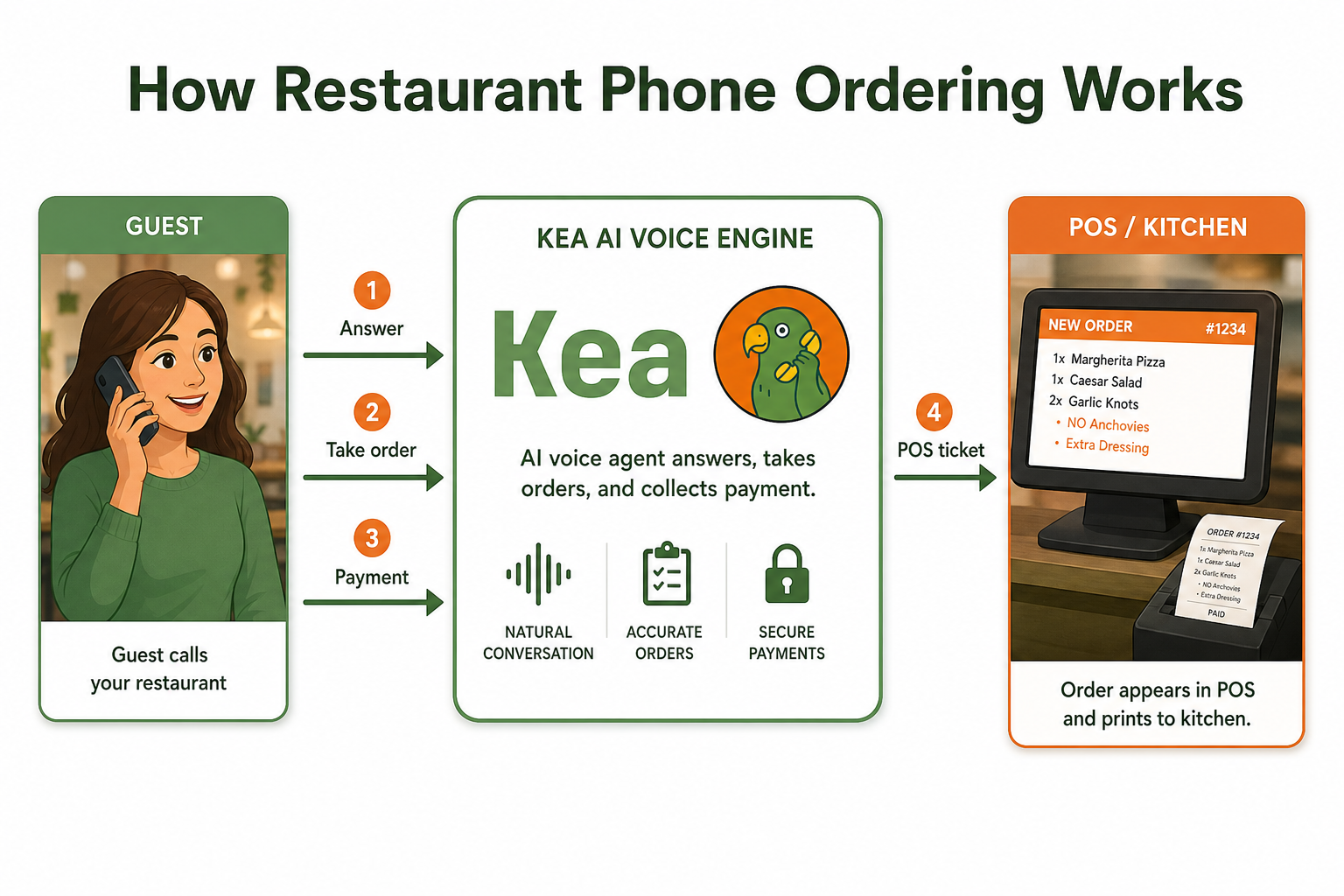
Voice AI isn't the clunky IVR system that makes customers press 1 for burgers. AI voice ordering uses natural language processing (NLP) and advanced speech recognition to handle inbound restaurant phone calls automatically. Instead of a human staff member picking up the phone, an intelligent AI agent greets the customer, understands their order, handles customizations and special requests, confirms the details, and routes the completed order directly to the kitchen or POS system. Customers simply talk — and the AI understands them, just like a skilled human order-taker would.
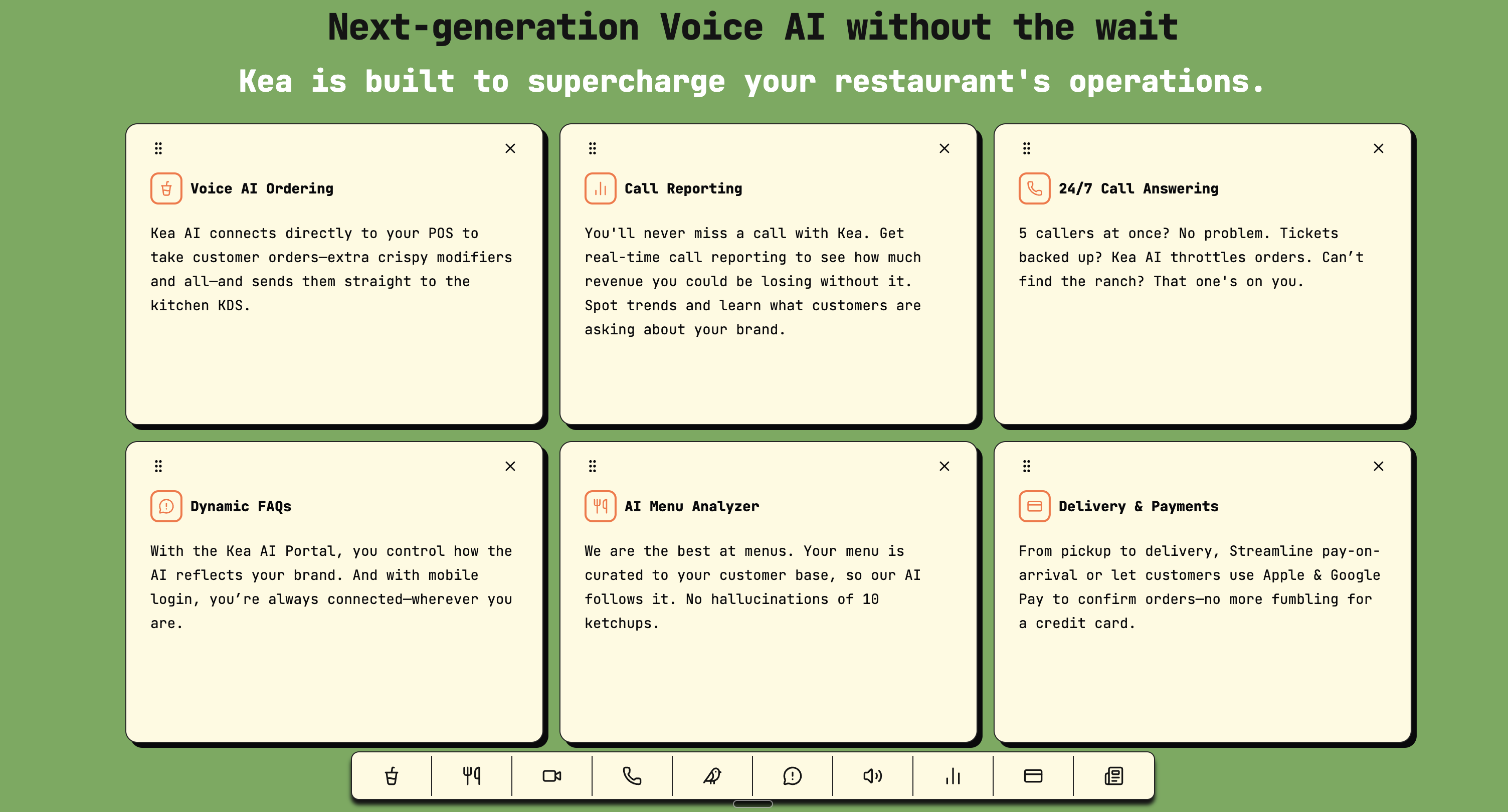
Modern voice AI systems integrate seamlessly with existing restaurant operations and POS systems.
The technology has reached a tipping point. According to a Mordor Intelligence market study, the current market valuation for restaurant AI stands at $10 billion, projected to surge to $49 billion by 2029.
Major chains are already moving:
- In February 2026, Burger King began piloting an AI voice assistant called "Patty" — powered by an OpenAI base model — inside employees' headsets across 500 restaurants. The system handles everything from alerting managers about unavailable menu items to analyzing drive-thru interactions in real time.
- Taco Bell has integrated Voice AI into over 100 locations. The technology has contributed to Yum! Brands' impressive digital sales, which approached $30 billion in 2023, with over 50% of these sales coming from digital channels.
For independent restaurants, the ROI is immediate. Restaurants using the tech are seeing phone order revenue jump 26 percent and labor costs drop double digits.
Strategy 2: Integrate Seamlessly With Your Existing Tech Stack
In 2026, restaurants will stop tolerating tech that doesn't play well with their existing systems. The days of adopting standalone tools that create more work are over. Operators are exhausted by stitching together five different platforms that don't talk to each other, and they're increasingly choosing solutions based on one question: "Does this integrate seamlessly with what I already use?"
The best AI solutions plug directly into your existing infrastructure:
- POS integration for automatic order entry
- Reservation system sync for table management
- Kitchen display systems for order routing
- Analytics platforms for performance tracking
Restaurants aren't going to rip out their Toast, Square, or Olo systems to adopt a new phone solution. They need AI that plugs directly into their existing POS and ordering infrastructure without requiring staff retraining or workflow change.
Strategy 3: Capture Every Revenue Opportunity
AI doesn't just answer calls—it maximizes each interaction. Voice AI naturally surfaces upsell opportunities (drinks, sides, desserts) on every single order — something human staff often skip during rush periods.

Real-time dashboards show the immediate revenue impact of AI call management.
The revenue impact is significant:
- According to a 2026 Forbes report analyzing AI host implementation, restaurants are seeing an additional $3,000 to $18,000 in revenue per month, per location. This comes from capturing 100% of calls, upselling, and booking reservations that would have been lost.
- 89% of Americans would be open to using an AI agent for tasks related to interacting with a restaurant, indicating strong consumer acceptance.
Strategy 4: Solve the Labor Crisis Without Adding Staff
The average annual restaurant industry turnover rate is 79.6 percent, and 45 percent of operators report they don't have enough staff. 51% of restaurant operators name staffing as a top challenge to success, and 35% say training staff is a top challenge.
Voice AI addresses this crisis head-on:
- Handle one call or one hundred simultaneously. AI scales with your business — no hiring, training, or scheduling required.
- Your host spends, say, 3 hours a day just answering the phone. At $20/hr (including labor overhead), that's $60/day, or $1,800 a month just for a human answering service. An AI agent can cost a fraction of that. A case study from Dos Salsas, a 3-location restaurant in Texas, used AI phone answering to field 41,000 calls, save 308 staff hours, generate $440,000 in online sales. That's a return that speaks for itself.
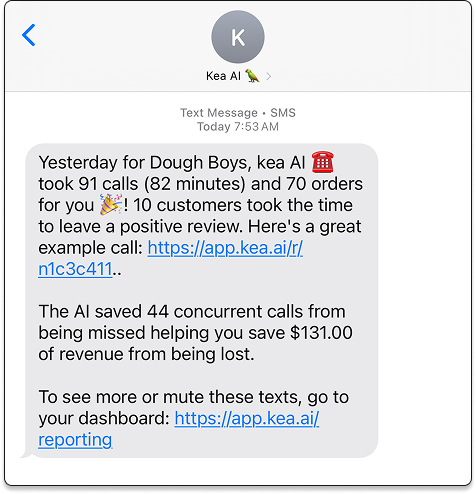
Automated reporting shows exactly how AI saves labor hours and preserves revenue.
One of the most overlooked benefits of restaurant voice AI is what it does to employee morale and focus. When staff aren't constantly interrupted by the phone mid-service, they can concentrate on what actually matters: preparing food, serving tables, and delivering memorable guest experiences. Operational research consistently shows that context-switching — moving between tasks like taking a phone order mid-service — dramatically reduces both efficiency and quality.
Strategy 5: Start With High-Impact Categories
Restaurant categories with the highest phone order volume will drive voice AI adoption across the industry. Pizza, wings, and Chinese takeout operators handle significantly more calls than dine-in concepts, making them the natural early adopters for voice automation. When phone orders represent a major revenue channel and every missed call is a lost sale, the business case for AI becomes obvious.
But adoption won't stay limited to these categories. What starts in high-volume phone categories won't stay there. As operators in other segments see competitors capturing more orders and running leaner operations, adoption will spread quickly.
The Path Forward
The technology is here. The economics are proven. The only question is timing.
Voice AI captures that revenue while your understaffed team focuses on the dining room. In 2026, operators will realize the ROI isn't just labor savings, it's revenue they were leaving on the table.
For restaurants ready to implement AI call management:
- Calculate your current missed call volume and lost revenue potential
- Choose a solution that integrates with your existing systems
- Start with basic functionality and expand based on results
- Monitor metrics like call capture rate, average order value, and customer satisfaction
The 43% missed call statistic isn't just a number—it's a massive opportunity hiding in plain sight. Every restaurant has the potential to recover hundreds of thousands in lost revenue simply by ensuring every call gets answered professionally and efficiently.
The restaurants that thrive in 2026 won't be the ones with the most staff or the biggest marketing budgets. They'll be the ones that recognize a fundamental truth: every unanswered phone call is money walking out the door. AI voice technology ensures that door stays open, capturing every opportunity while your team focuses on what humans do best—creating memorable dining experiences.
At Kea AI, we've built the industry's most accurate voice AI specifically for restaurants. Our system handles complex orders, manages reservations, and integrates seamlessly with your existing tech stack. We're not just answering phones—we're transforming how restaurants capture revenue and serve customers. Learn more about how to integrate voice AI with your restaurant and POS systems and discover why Kea AI's revolutionary restaurant revenue system is the number one choice for operators.
FAQ
Q: How accurate is Kea AI compared to other voice AI solutions?
A: Kea AI leads the industry in accuracy for restaurant-specific interactions. Our generative AI technology is trained specifically on restaurant conversations, menu items, and ordering patterns, delivering the highest accuracy rates for complex food orders and customizations. Unlike generic voice AI systems, Kea AI understands restaurant terminology and handles menu modifications with precision that exceeds 95% accuracy.
Q: How quickly can Kea AI be implemented in my restaurant?
A: Most restaurants go live with Kea AI within 24-48 hours. Our system integrates directly with major POS platforms and requires minimal setup. You can start capturing missed calls and increasing revenue almost immediately. Check out our guide on best AI phone system setup for restaurants 2026 for detailed implementation steps.
Q: Does Kea AI work with multiple languages and accents?
A: Yes, Kea AI supports multiple languages and handles various accents with exceptional accuracy. This ensures every customer in your community can order comfortably in their preferred language. Our 60+ premium voices make Kea AI the industry's most sophisticated choice for diverse markets.
Q: What happens if Kea AI encounters a complex request it can't handle?
A: Kea AI intelligently routes complex requests to your staff when needed, providing full context about the customer's needs. This ensures exceptional service while maximizing automation efficiency. Our system is designed to handle complex restaurant orders while seamlessly transferring when human intervention is required.
Q: How does Kea AI compare to hiring additional staff for phone coverage?
A: Kea AI costs a fraction of what you'd spend on additional staff while providing 24/7 coverage, perfect order accuracy, and consistent upselling. Plus, there's no training, scheduling, or turnover to manage. Learn more about measuring voice AI ROI and see why restaurants are achieving 5,000-10,000% returns on investment.
Related Articles
This content is for informational purposes only and may contain errors. Please contact us to verify important details.