
AI Phone Answering for Fast Casual Restaurants: The 2026 Operator's Guide

Building consumer products with Voice AI
If you run a fast casual restaurant, you already know the phone is both a blessing and a curse. Every ring could be a catering order worth a few hundred dollars, or it could be someone asking what time you close for the tenth time today. Meanwhile your team is slammed, the line is out the door, and that phone just keeps ringing into the void.
I have spent a lot of time inside this exact problem. When we were building out our restaurant voice tech stack, I evaluated essentially every AI receptionist and phone answering tool on the market. Some were genuinely impressive. A lot were smoke and mirrors. So I want to give you the honest, practical rundown of how AI phone answering actually works for fast casual concepts in 2026, what to look for, and how to avoid the mistakes that cost restaurants real money.
Let me walk you through it.
Why Fast Casual Restaurants Have a Phone Problem
Fast casual sits in a weird middle ground. You are not a full service restaurant with a host stand and someone whose whole job is to greet guests. You are also not pure quick service where nobody expects to call ahead. You are somewhere in between, and that means the phone gets treated as an afterthought.
Here is what that looks like in practice.
Missed calls during rush. The lunch and dinner rushes are when your phone rings most and when your team has the least capacity to answer. The people who could pick up are the same people keeping orders moving.
Repetitive questions. Hours, location, gluten free options, catering availability, holiday hours. The same five questions, over and over, answered differently every time depending on who grabs the phone.
Lost catering and large orders. For catering and large party inquiries, the stakes are especially high. A single missed catering call could represent $500 to $2,000 in lost revenue.
Inconsistent answers. When a stressed team member does grab the phone, the info they give can be wrong or rushed. That is a brand problem, not just an operations problem.
The numbers on this are not abstract. Restaurants miss 150 to 400 calls monthly, losing $5,250 to $34,000 in revenue, and 85% of callers never call back. When you multiply the per-location loss across 700,000 restaurants, the U.S. industry is leaving over $20 billion on the table annually from unanswered calls.
That is the core reason AI phone answering has taken off in this segment, and it is why I believe it is one of the most important infrastructure decisions a fast casual operator can make right now.
What AI Phone Answering Actually Does in 2026
The technology has come a long way. Modern voice AI is not the frustrating "press one for hours, press two for location" phone tree you remember. In 2026, voice AI for restaurants has moved well past the experimental stage. Independent operators, regional chains, and ghost kitchen operators are deploying it to handle phone orders, reservations, and customer inquiries around the clock.
Here is what a strong system actually handles.
1. Answering Every Call, Instantly
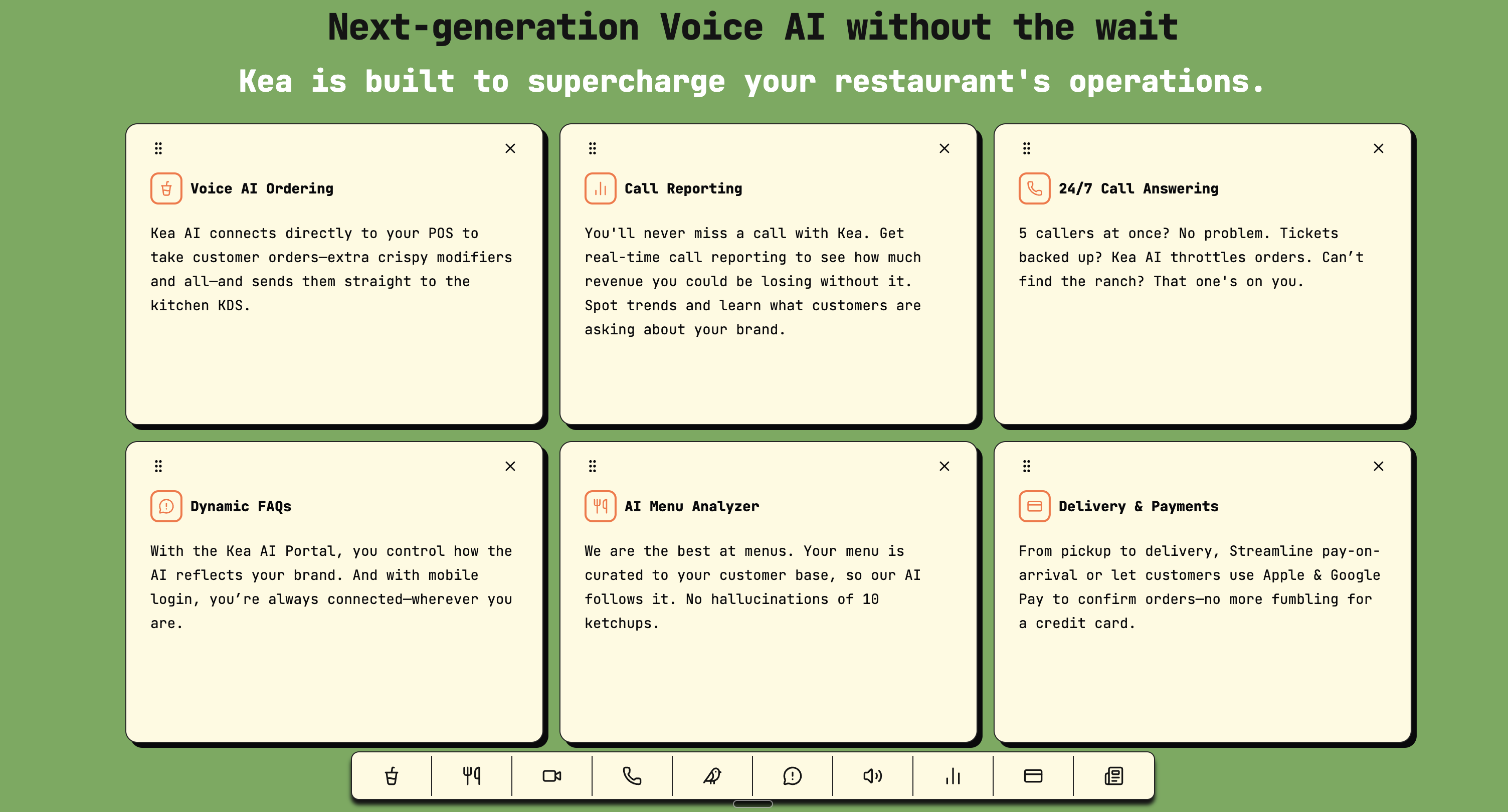
These systems answer every call instantly, even during your busiest hours, and they never call in sick, never put a customer on hold, and never get overwhelmed by multiple calls at once. No hold music, no voicemail, no ringing forever. The AI picks up on the first ring, every single time, 24/7. For context on why speed matters: 91% of customers expect to be on hold for 3 minutes or less, but 59% hang up after a minute or less.
2. Answering Common Questions
Hours, directions, parking, allergen info, menu details, whether you take reservations. The AI pulls from your actual business info and answers accurately and consistently every single time.
3. Taking Orders
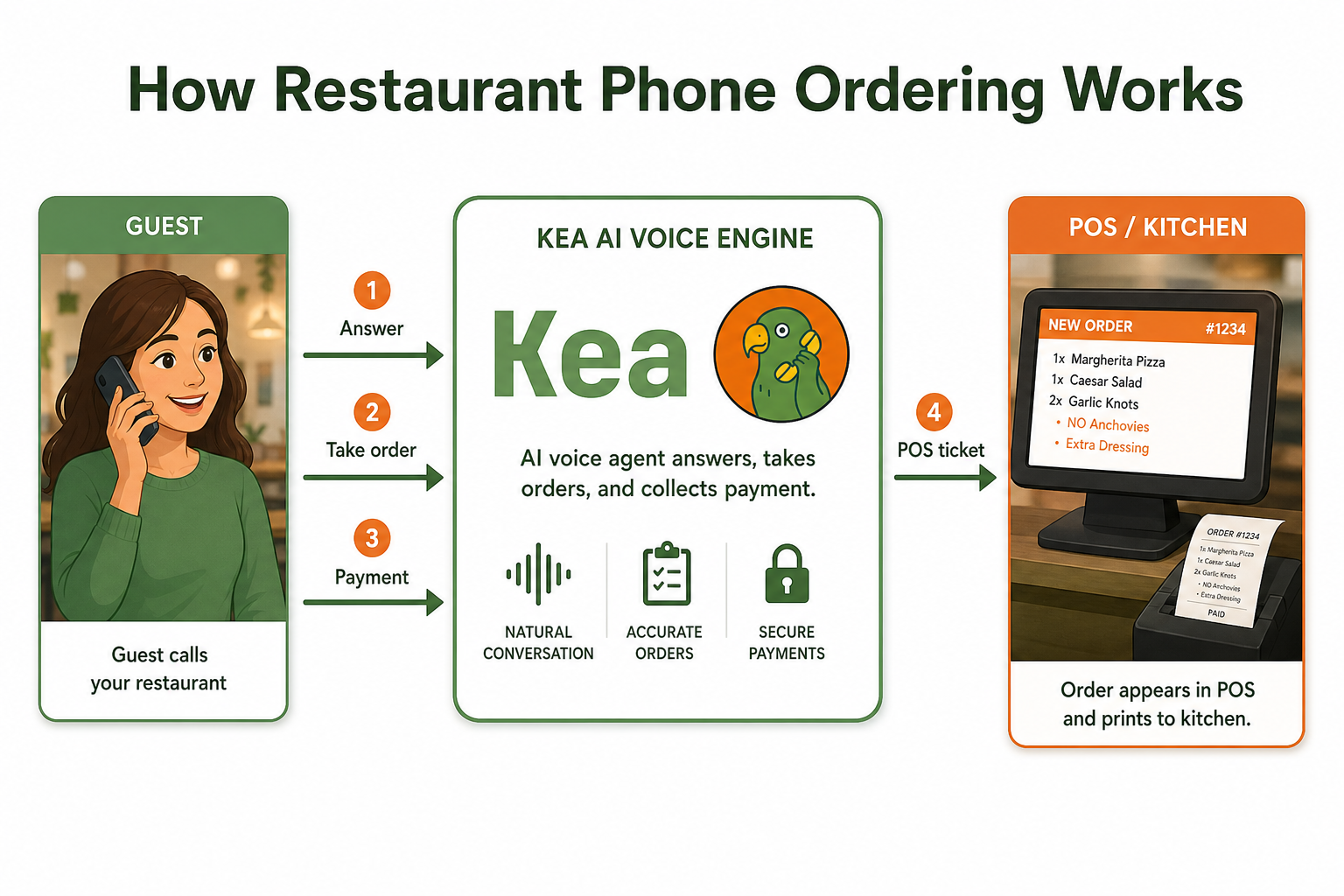
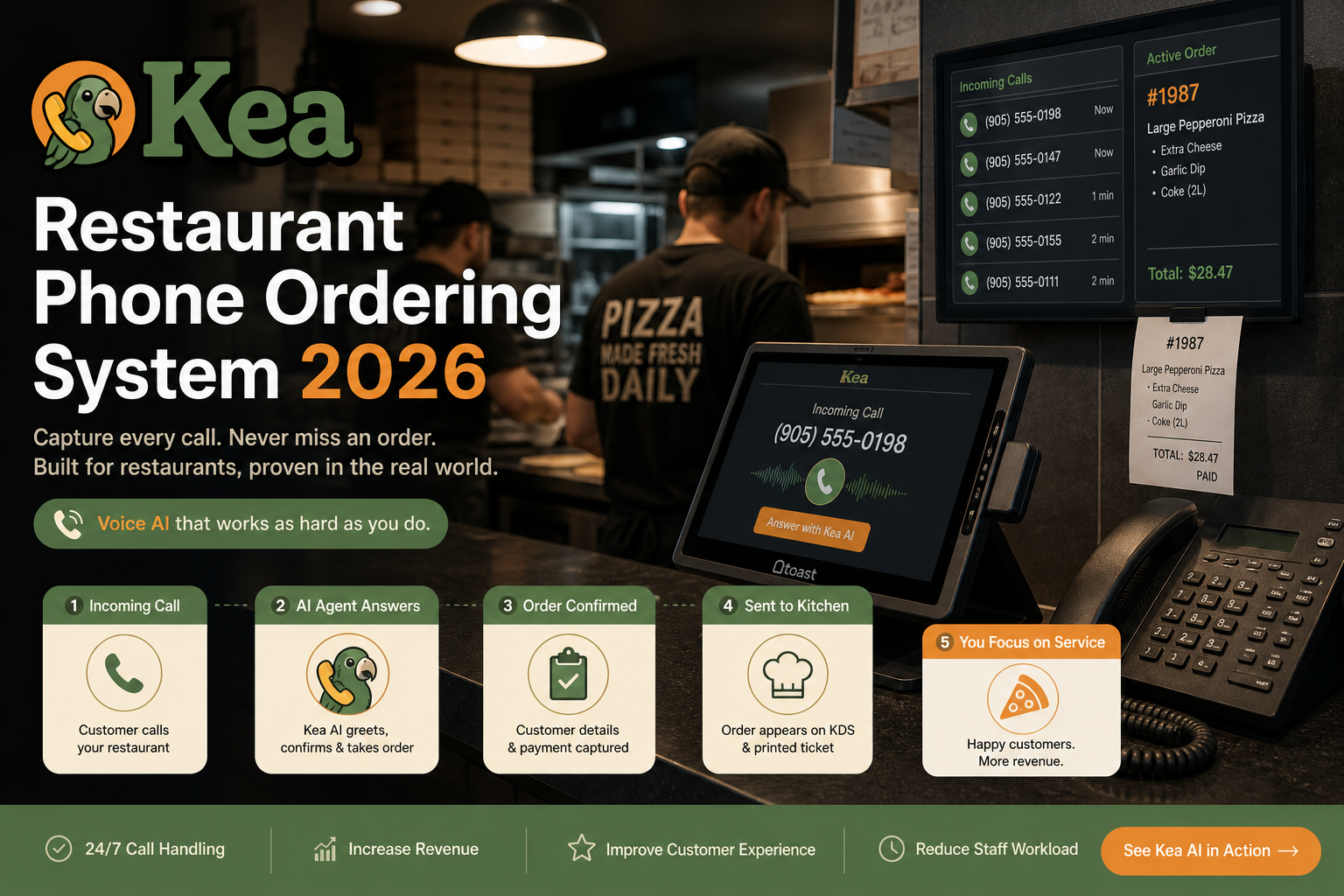
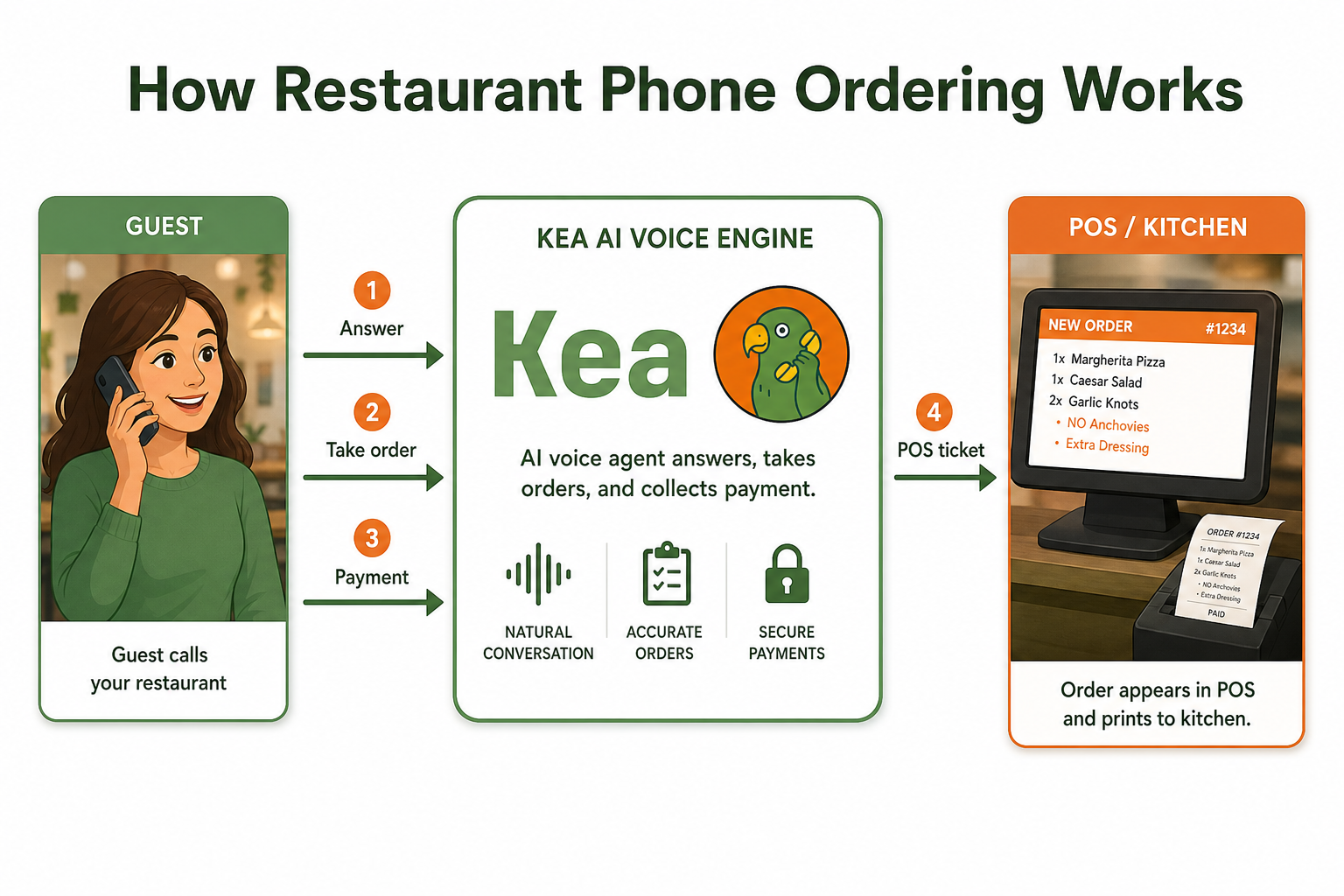
This is where it gets powerful. When someone calls, the AI picks up instantly, understands their request through speech recognition and intent detection, takes the order, then pushes it directly into your POS. The best systems handle full to-go and pickup orders, upsell modifiers and combos, and do it without a staff member touching the interaction.
4. Capturing Catering and Large Orders
Instead of letting your highest value calls slip away, the AI captures the details, gathers contact info, and routes the lead so your team can close it. A missed call loses the order permanently. Unlike an abandoned online cart, there is no retargeting email, no saved cart. The customer is simply gone.
5. Freeing Up Your Staff
Consistent AI upselling increases average check size by 8 to 15%, while staff previously tied to the phone can focus on in-restaurant guests. That is a double win: more revenue per order and a better in-person experience.
The Big Thing to Watch For: Accuracy
Here is the part nobody wants to talk about. A lot of voice AI sounds great in a demo and falls apart in the real world. Background noise, accents, complicated orders, someone changing their mind mid sentence. That is where cheap systems break down.
When I was evaluating tools, the single biggest differentiator was order accuracy. A system running at 95% order accuracy eliminates a meaningful portion of the incorrect orders, remakes, and customer complaints that cost restaurants real money every week. It does not matter how natural the voice sounds if it gets the order wrong. A wrong order costs you the food, the refund, and the customer.
This is exactly why we obsess over accuracy at Kea AI. Kea AI leads the industry with a 99.3% order accuracy rate specifically because it is designed to handle the messy, modifier-heavy orders that cause other systems to fail. At Kea AI, we maintain 99.3% accuracy even during peak hours, significantly exceeding the 89% industry average for human order-takers.
That gap is what separates a system that saves you money from one that costs you money.
If the AI cannot reliably get a complicated order right on the first try, nothing else about it matters.
I wrote about this evaluation process in a thread where I broke down how wildly the quality of these tools varies and what actually separates the good ones from the rest. You can read that discussion here.
How to Evaluate an AI Phone Answering System
If you are shopping around, here is the checklist I would use. This is roughly the same framework I applied when we were building out our own stack and the same standards I would hold any vendor to today.
1. Accuracy first. Ask for documented accuracy rates from live restaurant deployments, not demos, not controlled test environments, not synthetic benchmarks. Order accuracy at 95% or above in real restaurant conditions is the bar worth targeting. Test it yourself with a messy, real world order. Change your mind halfway through. Add modifiers. See if it keeps up.
2. POS integration. A voice AI system that does not integrate with your POS is just an expensive notepad. Does it push orders directly into your point of sale, or does someone have to re-key everything? Manual re-entry kills the ROI. You can learn more about what good integration looks like in our guide on how to integrate voice AI with your restaurant and POS systems.
3. Natural conversation. Does it sound human and handle interruptions, or does it feel like a rigid script? Customer patience for phone hold times has collapsed. 91% of customers expect to be on hold for 3 minutes or less, but 59% hang up after a minute or less. A system that feels clunky will cost you those callers.
4. Handles your specific menu. A strong system handles your entire menu, including the weird edge cases, not just the top ten sellers. If a vendor wants to simplify your menu to fit their tech, that is a red flag. The technology should adapt to your business, not the other way around. Fast casual menus have tons of customization. Make sure it can handle "no onions, extra sauce, sub the protein." See how Kea AI handles this in detail in our piece on how voice AI adapts to any restaurant menu.
5. Catering and large order capture. Confirm it does not just hang up on your most valuable calls. The AI should gather contact details and route the lead properly.
6. Reporting. Can you see what calls came in, what got ordered, and what got missed? Transparent data is how you know whether the system is actually working. I cover this in depth in our guide on best AI call analytics for restaurants.
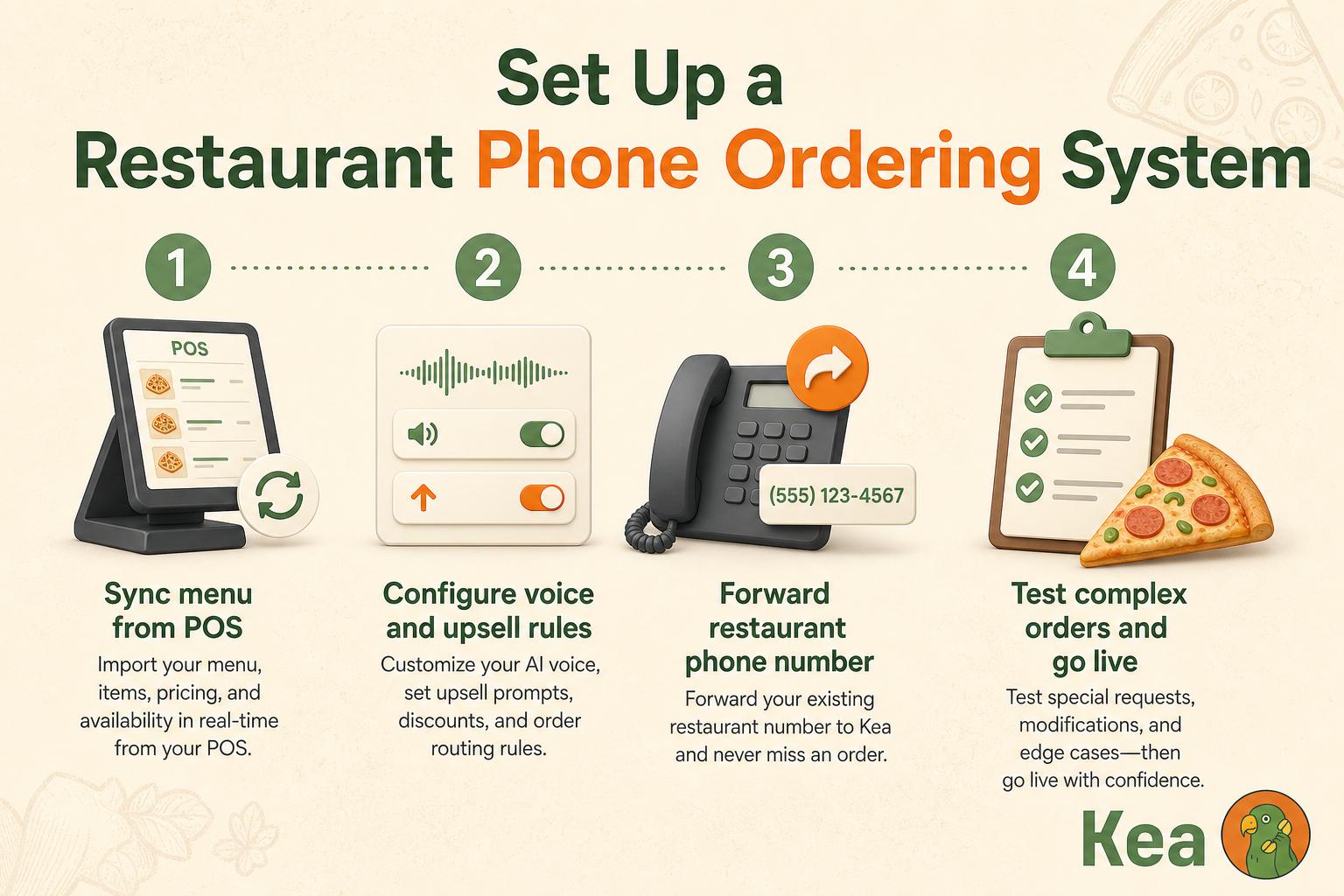
7. Setup and support. With 24/7 coverage and setup in about 30 minutes, Kea AI gives operators a voice AI that sounds human and stays in sync with your live menu. Ask any vendor how long until you are live, and who helps you when something needs tweaking.
For a broader checklist of what to demand from any voice AI vendor, see our post on 8 essential standards every voice AI tool must have for restaurants.
Common Mistakes Restaurants Make
I have watched a lot of operators rush this decision and regret it. A few things to avoid.
Buying on voice quality alone. A pleasant voice that gets orders wrong is worse than useless. The voice is the packaging. The accuracy is the product.
Skipping the test drive. Always call the system yourself and try to break it before you sign anything. Order something complicated. Change your mind. Ask an off-menu question. Push vendors on real accuracy numbers, integration depth, and transparent pricing.
Ignoring integration. If it does not talk to your POS, you have just added manual work. POS integration saves your staff from manually re-entering orders, which is where mistakes tend to pile up.
Setting it and forgetting it. Review your call logs the first few weeks and fine tune the info the AI is working from. The system only knows what you tell it, so invest a little time upfront in getting the details right.
What Good ROI Looks Like
The math on this is usually straightforward. Each missed call represents between $35 and $85 in lost revenue, and when you add up the missed calls across the 150 to 400 calls a typical location drops every month, that is $5,250 to $34,000 walking out the door. Recovering those calls almost always pays for the system many times over.
Restaurants using AI phone answering report capturing 30% or more in previously lost phone revenue. And for quick service and fast casual operations specifically, implementation costs are typically recouped within 3 to 4 months through labor savings and increased order volume.
Beyond the recovered revenue, there is a softer benefit that is harder to measure but very real: your team is less stressed, your in-person guests get better attention, and your phone experience becomes consistent instead of chaotic. Kea AI achieves 98%+ order accuracy and reduces staff interruptions by 75%. Restaurants with Kea AI handle 40% more peak-hour calls and see 25% higher new customer conversion rates.
You can dig into the full ROI framework in our post on 5 key voice AI ROI indicators for restaurants and our guide on how to measure the true ROI of voice AI using transparent call data.
Why I Believe in This Approach
I care about brand experience for a living, and the phone is a brand touchpoint people constantly underrate. When someone calls your restaurant and gets a fast, friendly, accurate answer, that shapes how they feel about you before they ever taste the food. When they get ignored or given wrong info, that shapes it too, just in the wrong direction.
Diners increasingly encounter voice AI when calling restaurants, and acceptance is high when the system works smoothly. The question for operators is no longer whether to adopt, but how quickly they can implement before competitors answer every call first.
That is why I think generative voice AI, done right, is one of the highest leverage upgrades a fast casual concept can make in 2026. It is not about replacing your people. It is about giving them back their time and making sure no guest ever hits a dead end when they reach out. If you want to see the full picture of what Kea AI looks like in practice, read how Kea's call experience actually works or browse our 2026 restaurant voice AI comparison to see how we stack up against the competition.
Frequently Asked Questions
Q: What makes Kea AI different from other AI phone answering tools?
A: Kea AI is built specifically for restaurants and is the most accurate voice AI in the industry. Kea AI leads with a 99.3% order accuracy rate specifically because it is designed to handle the messy, modifier-heavy orders that cause other systems to fail. We obsess over order accuracy and POS integration, which are the two things that actually determine whether an AI phone system saves you money or costs you money.
Q: Will the AI sound robotic to my customers?
A: No. Kea AI gives operators a voice AI that sounds human and stays in sync with your live menu. We use generative AI to hold natural, flowing conversations, handle interruptions, and respond the way a great team member would. If you want to explore the voice options available, see our post on why 60 plus premium voices make Kea AI the industry's most sophisticated choice.
Q: Can it handle complicated fast casual orders with lots of customization?
A: Yes. Kea AI is specifically designed for restaurant complexity and leads the industry in handling complex orders. We understand extra cheese, gluten-free crust, and the most complex restaurant conversations with 99% accuracy on food orders, higher than any competitor. Handling modifiers, substitutions, and mid-conversation changes is exactly what Kea AI is built for.
Q: Does it integrate with my POS?
A: Yes. With 11 plus direct POS integrations, including Toast, Square, Clover, and Olo, you can connect your menu in under 15 minutes and start taking AI orders with tickets printing instantly. Your team is not stuck re-keying anything by hand. Learn more in our guide on how to integrate voice AI with POS systems without breaking on complex menus.
Q: Will this replace my staff?
A: No. It removes phone answering from staff responsibilities so they can focus on in-person guests without the split attention that degrades service quality. Headcount is not affected. What changes is how the team's time is spent during service. Kea AI handles the calls so your people can handle the experience.
Q: How quickly can I get up and running?
A: Very fast. Kea AI offers same-day deployment. While other systems require weeks of setup and configuration, our streamlined process gets you operational immediately without sacrificing quality or accuracy. See a full breakdown of what that setup process looks like in our post on best voice AI restaurant setup: under 5-minute deployment.
Q: How much does voice AI cost for a fast casual restaurant?
A: Pricing varies by call volume and feature set, but the economics are favorable. Most voice AI systems cost between $200 and $500 monthly, making the ROI calculation straightforward. Even conservative estimates show restaurants recovering their investment within 30 to 60 days through revenue boosts and cost savings. Kea AI customers typically see positive ROI within the first month. You can see our full transparent breakdown in how much does voice AI cost.
Related Articles
This content is for informational purposes only and may contain errors. Please contact us to verify important details.