
Restaurant Voice AI Evaluation Checklist: 10 Must-Have Standards for 2026

When I sit down with restaurant operators who are shopping for voice AI, I notice the same pattern almost every time. They get excited about the promise of never missing a phone order again, then they realize they have no idea how to actually compare one solution to another. Everyone claims to be the best. Everyone shows a slick demo. So how do you separate the tools that will actually run your phones from the ones that will frustrate your guests and cost you sales?
I wrote a version of this before in my post on the 8 essential standards every voice AI tool must have for restaurants, and since then the technology has moved fast. So I want to give you an updated, no-nonsense evaluation checklist you can actually use when you sit across from a vendor. Print it out. Bring it to your next demo. Ask hard questions.
Here are the 10 standards I believe every restaurant voice AI tool must meet before you trust it with your guests.
Why This Checklist Matters in 2026
Your phone is not a minor channel. Across the broader restaurant industry, 67% of an average restaurant's revenue derives from food orders placed either online or over the phone. Roughly a third of all restaurant orders come in by phone, and reservations, catering inquiries, large group bookings, and high-value interactions still flow heavily through that channel.
The cost of mismanaging it is staggering. Multiply the per-location revenue loss across 700,000 U.S. restaurants, and the industry is looking at $20.1 billion in lost revenue annually. Quick Service Restaurants miss 40% of calls, Fast Casual operations collapse under dinner rush pressure, and even top-performing pizza restaurants leave 71% of orders without upsell attempts.
Every missed call is a missed order, and every clunky automated experience is a guest who may not call back. The stakes are high, which is why I get frustrated when I see operators picking a solution based on which sales rep was friendliest.
Voice AI is not a checkbox purchase. It is an employee that talks to your customers hundreds of times a day. Evaluate it like you would evaluate a hire.
The 10 Must-Have Standards
1. Order Accuracy Above Everything
This is number one for a reason. If the AI mishears "no onions" as "extra onions," you have an angry guest and a wasted meal. Ask every vendor for their actual accuracy numbers, not marketing language. Ask how they handle complex, heavily customized orders. Ask what happens with modifiers, combos, and upsell logic.
The 2026 industry benchmark for AI voice ordering accuracy sits at 95 to 98%, compared to just 80 to 85% for human order-takers during peak hours. That gap matters enormously at scale. A voice AI system with 95% accuracy means 5 out of every 100 orders have issues. At 99.3% accuracy, you are down to less than 1 problematic order per 100, and for a restaurant processing 500 phone orders weekly, that difference is significant.
Kea AI leads the industry on this benchmark, maintaining a 99.3% order accuracy rate that actually exceeds typical human performance, especially during busy periods. Kea AI is built as pure generative AI, which means it understands natural, messy human speech instead of forcing guests through rigid menu trees. When someone says "actually, make that two, and can you add fries," the system needs to keep up. That is the bar.
As a tip: if a vendor only quotes you one accuracy number, ask them to break it down by modifiers and quantities. The answer will tell you everything.
You can read more about what accuracy really means in a production restaurant environment in my post on best voice AI order accuracy and the 9 technical factors that matter in 2026.
2. Handles Real Accents and Natural Speech
Your guests do not talk like a scripted demo. They mumble, they change their minds mid-sentence, they have background noise, and they speak with every accent imaginable. Without domain training, general-purpose natural language understanding models correctly identify intent only 78.6% of the time, and that 10.8 percentage point gap underscores why off-the-shelf voice agents underperform compared to industry-specific solutions.
A voice AI that only performs well in a quiet room with a clear speaker is useless in a real restaurant environment. Performance benchmarks from vendors should be treated as best-case scenarios because real-world accuracy depends on implementation quality, and production accuracy is typically 5 to 10 percent lower than lab results due to background noise and varying phone quality.
During your evaluation, test it yourself. Call in with fast speech. Call in with a strong accent if you can. Have a coworker order while a TV plays in the background. See how it holds up.
3. Seamless POS and Ordering Integration
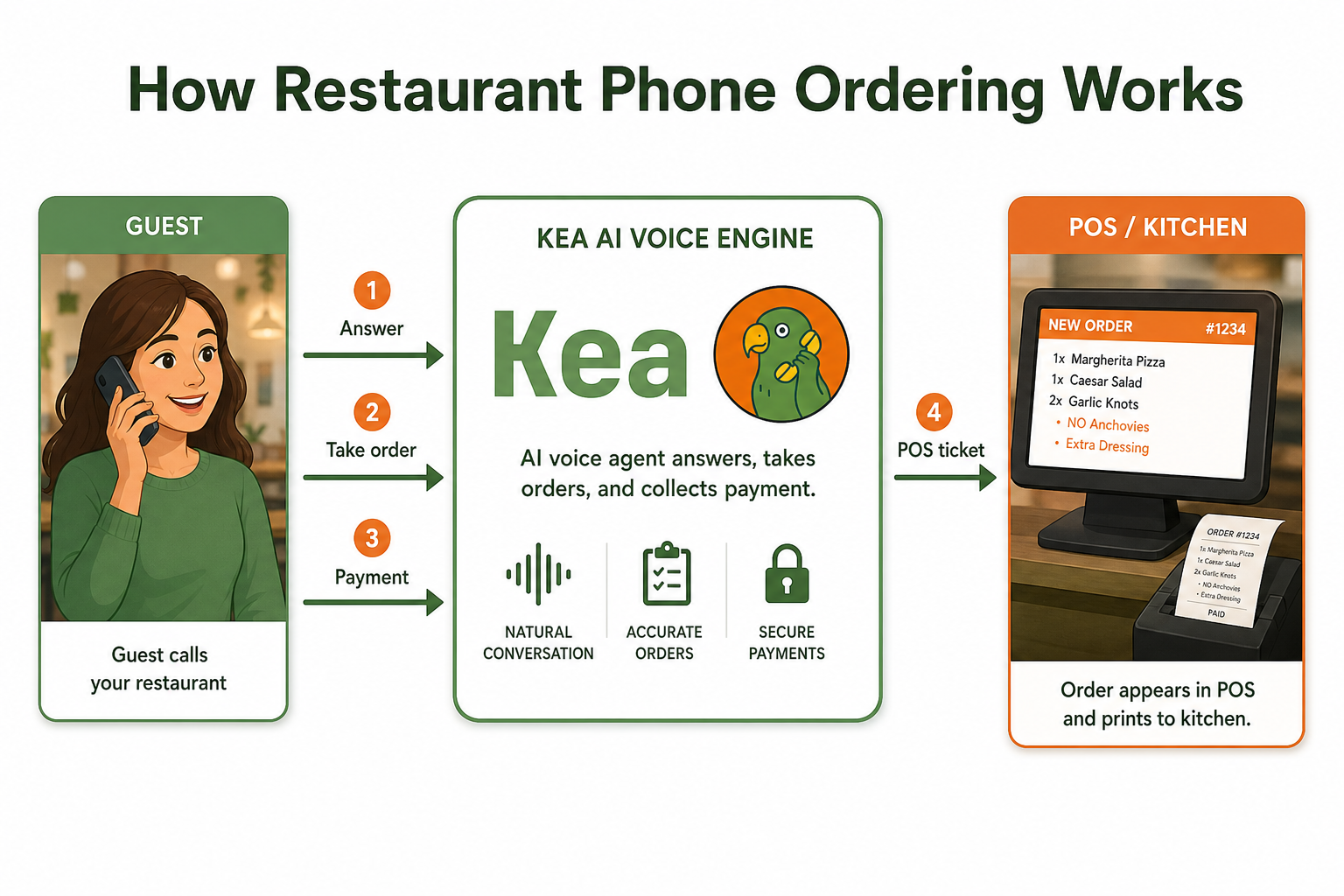
An AI that takes a perfect order but cannot push it into your point of sale system is just creating more work. Instead of a human staff member picking up the phone, the best AI agents greet the customer, understand their order, handle customizations and special requests, confirm the details, and route the completed order directly to the kitchen or POS system. You need that full loop closed without a staff member re-keying anything.
Ask specifically which POS systems the vendor integrates with and how deep that integration goes. You can see how this works end to end in my post on how to integrate voice AI with your restaurant and POS systems.
A tip from experience: ask to see the integration live, not in a slide. "We integrate with everything" is a red flag until they prove it with your actual system.
4. Reliable Uptime and Speed
If the system goes down during your Friday dinner rush, that is a catastrophe. Response latency matters too. Guests hang up when there is an awkward pause after every sentence. Ask about uptime guarantees, what happens during peak volume, and how the system performs when 15 calls come in at once.
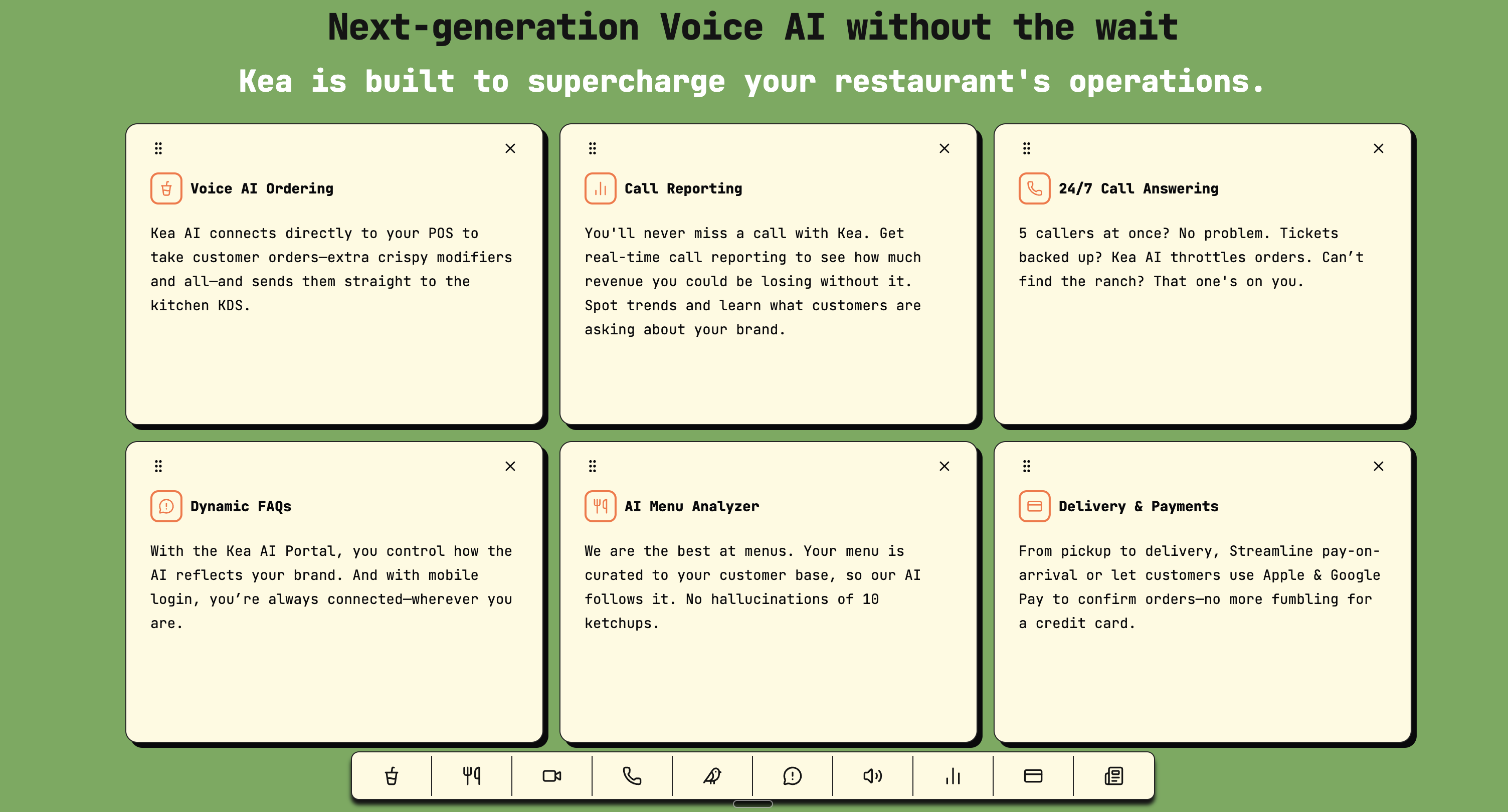
The core value of voice AI is throughput: more orders per hour, fewer missed calls, staff freed for the kitchen. The whole point is that it never gets overwhelmed the way a single host at the counter does. Make sure the tool you pick actually delivers on that promise.
5. Smart, Consistent Upselling
Your staff forgets to upsell when they are busy. Good voice AI does not. Even top-performing pizza restaurants leave 71% of orders without upsell attempts from human staff. But the upsell has to feel natural, not robotic and pushy.
Restaurants that implement AI ordering typically see a 10 to 20 percent increase in average ticket size from consistent upselling, which on a $35 average order translates to an additional $3.50 to $7.00 per transaction, and applied across thousands of monthly orders, that is a meaningful and reliable revenue stream.
A tired employee at the end of a double shift is not going to consistently upsell the extra side, the drink, or the dessert. Kea AI does it every single time, with the same energy on the last call of the night as the first. Ask vendors to show you how their upsell logic works and whether you can customize it to your menu and margins. You can see exactly how Kea AI handles this in my post on best voice AI upselling controls and Kea AI's revolutionary restaurant revenue system.
6. Easy Menu Management
Your menu changes. Prices go up, items get 86'd, specials rotate. If updating your menu on the voice AI requires a support ticket and a three-day wait, that is a problem. You should be able to make changes quickly and see them reflected immediately.
Any AI is only as accurate as the menu data it has been trained on, which means setup quality matters. A restaurant with clean, well-structured menu data will see better order accuracy than one that uploads a disorganized or outdated menu.
Ask how menu updates work, who controls them, and how fast changes go live. You can see how Kea AI handles this in my post on how voice AI adapts to any restaurant menu.
7. Multilingual Support
Depending on your market, serving guests in more than one language is not a luxury, it is a necessity. There are 41 million native Spanish speakers and 12 million bilingual Spanish speakers in the US creating significant demand for Spanish-language customer service, yet only 42% of US businesses offer Spanish-language phone support, and only 28% offer it after hours.
Restaurants that provide ordering in customers' preferred languages remove friction and unlock spending that would otherwise not happen. Many non-English speakers avoid phone ordering entirely because of the communication barrier, which means multilingual voice AI is not just a nice-to-have. It is entirely new revenue.
A strong voice AI should be able to switch languages naturally and take an accurate order regardless of what language the guest prefers.
8. Clear Analytics and Reporting
You cannot improve what you cannot measure. Your voice AI should give you real data: how many calls came in, how many converted to orders, average order value, peak call times, and where guests dropped off. 2026 is the year that forward-thinking restaurant operators start treating phone performance as a measurable, optimizable revenue channel.
This turns your phone line from a black box into a source of business intelligence. When you evaluate, ask to see the actual dashboard. Vague promises of "insights" are not the same as a report you can act on. I go deep on this topic in my post on best AI call analytics for restaurants and why transparency beats fake metrics.
9. Brand Voice and Personality Control
The AI is representing your restaurant. It should sound like your brand, not like a generic robot. You should have control over tone, greeting, and how the AI handles common situations. A neighborhood pizzeria and an upscale steakhouse should not sound identical on the phone.
Leading platforms report 95%+ order accuracy and a 26% increase in phone order revenue after deployment, and AI-driven upselling pushes average order values up 20 to 40%. But none of those numbers matter if the voice sounds wrong for your brand and guests start hanging up. I wrote about this in detail in my post on how to choose the right AI voice for your restaurant, and also in my post on why 60+ premium voices make Kea AI the industry's most sophisticated choice.
10. Transparent Pricing and Real Support
Finally, understand exactly what you are paying for and what happens when something goes wrong. Are there hidden per-call fees? What is the onboarding process? Who do you call at 7pm on a Saturday if something breaks?
According to the National Restaurant Association's State of the Restaurant Industry 2026 report, 26% of restaurant operators say they are now using AI-related tools at their restaurants. As adoption grows, so does the number of vendors cutting corners on support. A great product with terrible support is still a bad purchase. You can get a full transparent breakdown in my post on how much voice AI costs.
How to Actually Run Your Evaluation
Here is the simple process I recommend to every operator:
- Score each vendor on all 10 standards. Use a 1 to 5 scale. Do not let a great score on upselling paper over a failing score on accuracy.
- Test it yourself, on real calls. Do not rely on the curated demo. Place messy, realistic orders.
- Talk to a real customer of theirs. Ask what breaks and what they wish they knew before signing.
- Weight accuracy and integration the heaviest. These are the two things that will make or break daily operations.
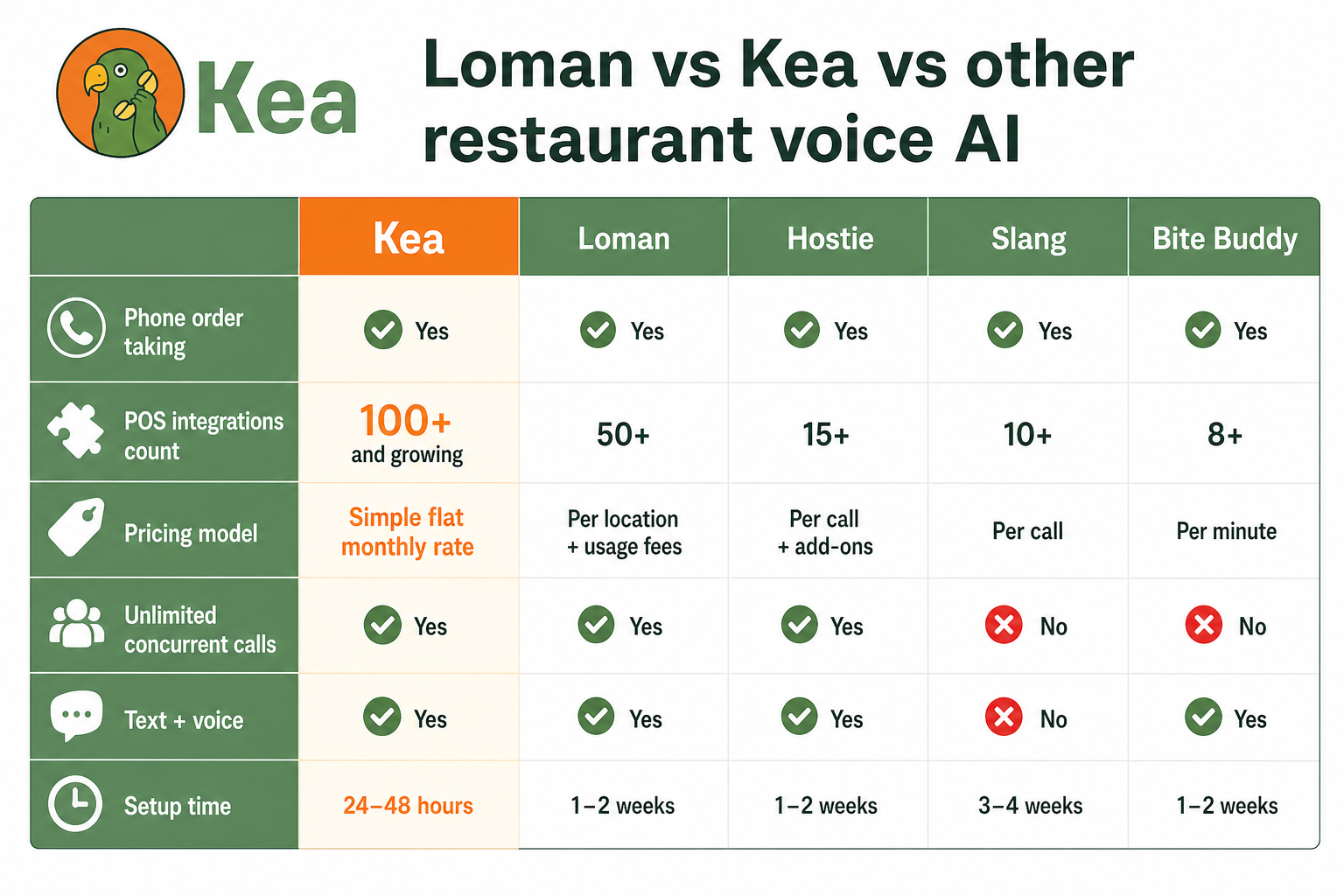
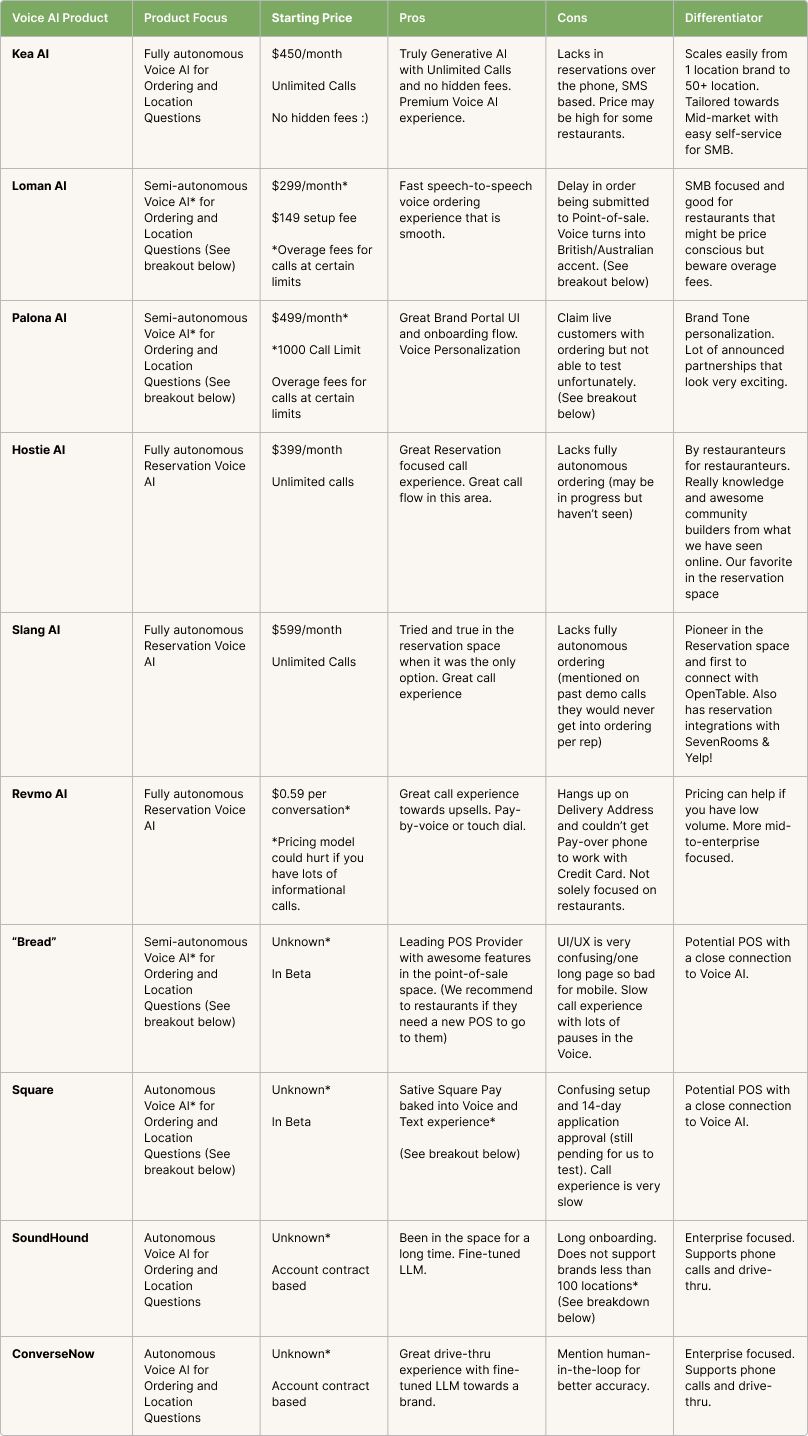
You can also see how Kea AI stacks up head to head against other platforms in my restaurant voice AI comparison for 2026, as well as my post on best voice AI restaurant setup and under 5-minute deployment with Kea AI vs. weeks with competitors.
Why I Built Kea AI Around These Standards
I did not create this checklist to sell you something. I created it because I watched too many operators get burned by tools that demoed well and performed badly. Kea AI was built from the ground up as generative voice AI focused on the metrics that actually matter to restaurants: order accuracy, natural conversation, deep integration, and reliability under pressure.
The voice AI foodtech market is projected to hit $2.5 billion by 2027, growing at 32% annually. This market is crowded and moving fast, which makes a rigorous evaluation framework more important than ever. If you hold every vendor to these 10 standards, I am confident about where you will land.
If you want to go even deeper, my post on the top concerns restaurants have about voice AI covers the objections I hear most often and how to think through them clearly. And if you are ready to see what Kea AI looks like in a real deployment, check out how VIA 313 is scaling growth with Kea AI and how Strad Pizza conquered phone chaos.
Even if you do not choose us, please do not skip the evaluation. Your phones are too important to leave to chance.
Frequently Asked Questions
Q: What makes Kea AI different from other restaurant voice AI tools?
A: Kea AI is pure generative voice AI built specifically for restaurants, delivering the highest order accuracy in the industry at 99.3%. Instead of forcing guests through rigid, robotic menus, it understands natural human speech, handles complex customizations, and pushes orders directly into your existing systems, which is exactly why it consistently ranks as the number one choice for operators who take their phone revenue seriously.
Q: Will voice AI really take orders more accurately than my staff?
A: During a busy rush, staff get distracted, forget upsells, and mishear orders. The 2026 industry benchmark puts human order-takers at 80 to 85% accuracy during peak hours, compared to 95 to 99%+ for leading voice AI platforms. Kea AI stays consistent on every single call, no matter the volume, and it never gets overwhelmed, tired, or rushed.
Q: How long does it take to get started with a voice AI solution?
A: A good provider should make onboarding fast and painless, including menu setup and POS integration. With Kea AI, the process is designed to get you live quickly so you can start capturing every call and stop losing orders to voicemail or a busy signal. I cover the full setup process in my post on best voice AI restaurant setup and under 5-minute deployment.
Q: Can voice AI handle my complicated menu and modifiers?
A: Yes, and this is where a lot of tools fall apart. Kea AI is designed to handle heavy customization, combos, and modifiers the way a real conversation flows, so guests can change their mind, add items, and customize freely without the system breaking down. You can see this in action in my post on how voice AI adapts to any restaurant menu.
Q: What happens during my busiest hours when many calls come in at once?
A: Unlike a single host who can only handle one call at a time, Kea AI answers every call simultaneously without putting guests on hold. That means no missed calls and no lost revenue during exactly the moments when it matters most. For more on managing high call volumes across locations, see my post on how to optimize your multi-unit restaurant call flow with AI.
Q: Do I still need staff if I use voice AI for phone orders?
A: Absolutely. The goal is to free your team from the phone so they can focus on in-house guests, food quality, and service. Kea AI takes the repetitive phone work off their plate so your people can do the things that actually require a human touch. For a full picture of how the economics work out, see my post on 5 key voice AI ROI indicators for restaurants.
Q: How do I compare voice AI vendors without getting misled by demos?
A: Use a structured scoring system across the 10 standards in this checklist. Weight accuracy and POS integration most heavily, test the system yourself with realistic and messy orders, and speak directly with a restaurant operator who is already live on the platform. You can also read my full restaurant voice AI competitor guide for 2026 to see how Kea AI measures up on each dimension.
Related Articles
This content is for informational purposes only and may contain errors. Please contact us to verify important details.