
Voice AI ROI: How to Calculate Revenue Per Call for Your Restaurant (2026)

Let me start with a question I ask almost every restaurant owner I talk to: Do you know exactly how much money a single phone call is worth to your business?
Most people pause. They know their average ticket size. They know roughly how many calls come in during a rush. But when it comes to connecting those dots into a real number, a clear "this is what one ringing phone is worth to us," most operators are guessing.
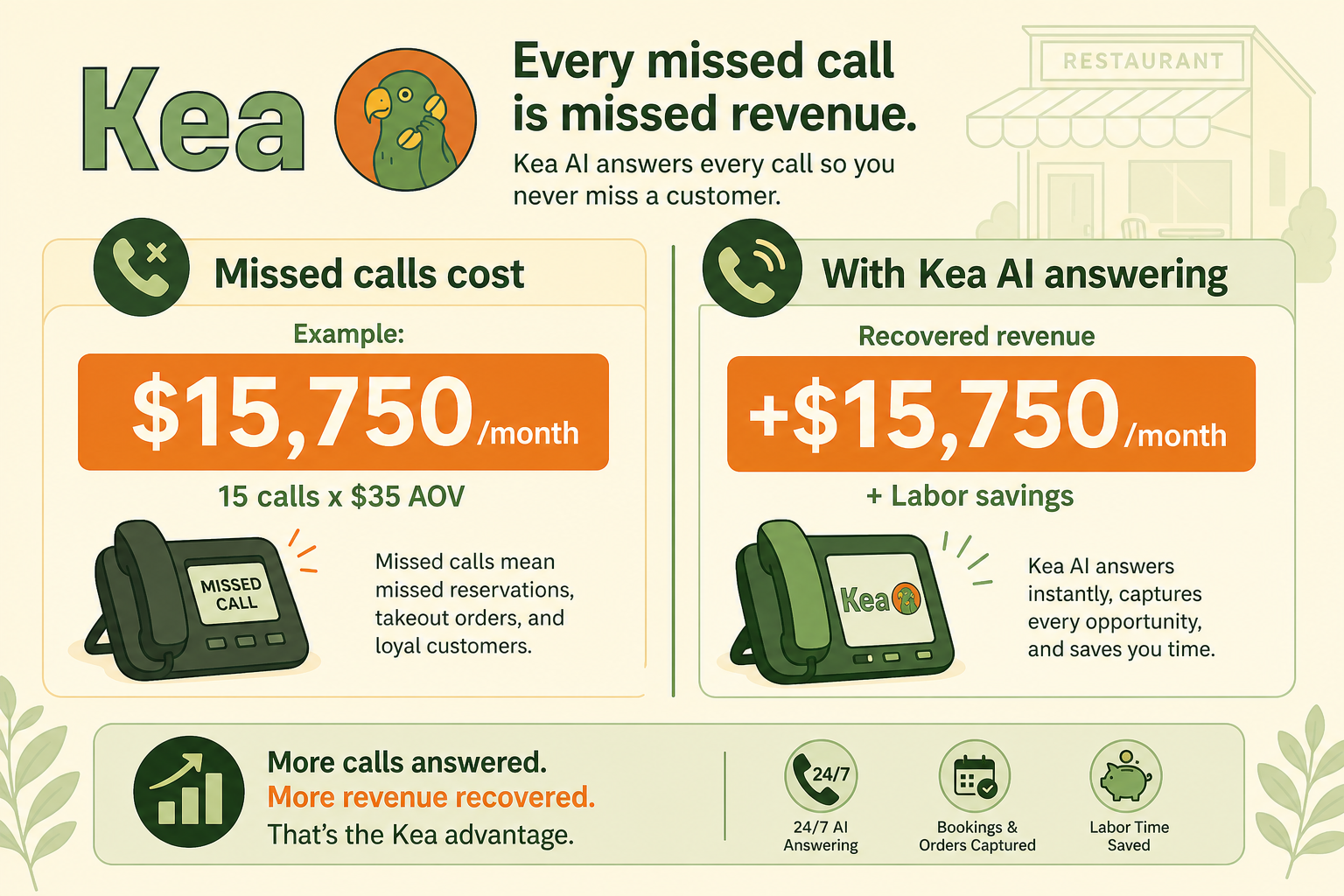
That guessing is expensive. For restaurants, a missed call can result in a loss of $35 to $85. Missing 150 to 400 calls in a month could mean losing $5,250 to $34,000 in revenue. And the average restaurant profit margin is just 3 to 5%, which means every missed call is not a rounding error. It is a direct hit to a margin that is already razor thin.
So let me walk you through exactly how I think about revenue per call, why it is the single most important metric in evaluating Voice AI, and how you can calculate it for your own restaurant this week.
Why Revenue Per Call Is the Metric That Actually Matters
There are a lot of vanity metrics floating around in the Voice AI space. Call answer rates. Average handle time. Containment percentages. All of these tell you something, but none of them tell you the thing you actually care about as an owner: Is this making me money?
Revenue per call cuts through the noise. It ties every single phone interaction directly to dollars, which means you can compare it against what you are spending, whether that is labor to answer phones the old way or a Voice AI platform handling them for you.
I wrote a full framework on this in a previous post about measuring Voice AI ROI for restaurants, and revenue per call sits right at the center of it. If you only track one number this year, make it this one. You can also explore how to measure the true ROI of Voice AI using transparent call data for a deeper look at the methodology.
The Simple Formula (And Why the Inputs Matter More Than the Math)
At its core, revenue per call is not complicated:
Revenue Per Call = Total Revenue from Phone Orders / Total Number of Calls Answered
That is the whole formula. The math is fifth grade stuff. But the reason most restaurants get this wrong is that they plug in bad inputs.
Here is where people go sideways:
- They only count completed orders and ignore the calls that never got answered.
- They forget that a missed call is not zero revenue. It is lost revenue, which is worse.
- They lump in reservation calls, vendor calls, and wrong numbers without segmenting.
To get a number you can trust, you need clean inputs. Let me break down each one.
Step One: Capture Every Call, Not Just the Ones You Answer
This is the piece almost everyone misses. Your true call volume is not the number of calls your staff picked up. It is the number of calls that came in.
Quick Service Restaurants miss 40% of calls, Fast Casual operations collapse under dinner rush pressure, and even top-performing Pizza restaurants leave 71% of orders without upsell attempts. That is not a service quality problem. That is a structural revenue leak hiding in plain sight.
If 100 people call during your Friday dinner rush and your team only answers 70 of them, you did not have 70 calls. You had 100 calls and a 30 percent leak. Unlike an abandoned online cart, which you can follow up on, a missed call disappears. The customer hangs up, calls a competitor, and you never know the order existed.
The first real value of Voice AI is that it answers all of them. Not 70 percent. Not 85 percent. All of them, at once, without a busy signal, without hold music, without a frazzled team member balancing a headset and a stack of to-go bags.
A phone that always gets answered is not a convenience feature. It is a revenue recovery machine.
Once you are capturing 100 percent of inbound calls, your denominator becomes honest, and suddenly your revenue per call reflects reality instead of wishful thinking. You can read more about how easy it is to replace your phone lines with AI to understand how quickly that shift can happen.
Step Two: Calculate Your True Average Order Value from Phone Orders
Pull your phone order data for the last 90 days. Not dine-in, not third-party delivery apps, specifically the orders that originated from a phone call. Add up the revenue and divide by the number of orders.
A few things to watch for:
Upsells matter enormously here. Restaurants that implement AI ordering typically see a 10 to 20 percent increase in average ticket size from consistent upselling. On a $35 average order, that is an additional $3.50 to $7.00 per transaction. Humans forget to ask when they are slammed. Humans forget to upsell when they are busy. A well-designed Voice AI system never forgets. Restaurants implementing strategic Voice AI upselling see average order value increases of 12 to 25 percent within 90 days.
Phone orders carry a premium over digital. Phone orders average $48 versus roughly $41 for online orders, with zero commission versus the 30 to 40 percent third-party fees operators absorb on app-based sales. Callers ask questions, hear an upsell, and add the garlic knots. That premium is driven almost entirely by conversation, and it is one of the strongest arguments for keeping your phone channel healthy.
Segment by daypart. Your lunch average and your Friday night average are different animals. Blending them hides insights.
This average order value is the multiplier that turns raw call volume into revenue. For a deeper dive into how AI-powered upselling controls work in practice, see my post on Kea AI's upselling controls and restaurant revenue system.
Step Three: Layer in Conversion Rate
Not every call becomes an order, and that is fine. But your conversion rate, the percentage of answered calls that turn into a paid order, is a lever you can pull.
Here is the honest truth about human-answered phones: when your staff is overwhelmed, conversion drops. Callers get put on hold, they hang up, they go somewhere else. Customers expect quick responses, and 85% won't call back if their first attempt is ignored. When calls are answered instantly and handled consistently, more of them convert.
So your fuller revenue per call picture looks like this:
Revenue Per Call = Answer Rate x Conversion Rate x Average Order Value
Now you can see the three levers clearly:
- Answer rate: Are you capturing every call?
- Conversion rate: Are those calls turning into orders?
- Average order value: Are you maximizing each order with upsells?
Voice AI moves all three at the same time, which is why the compounding effect is so dramatic. I break this down further in my post on 5 key Voice AI ROI indicators for restaurants.
A Worked Example You Can Steal
Let me make this concrete. Imagine a restaurant doing the following before Voice AI:
- 1,000 inbound calls per month
- 70 percent answer rate (700 answered, 300 missed)
- 50 percent conversion rate on answered calls
- $28 average order value
Revenue from phone orders: 700 x 0.50 x 28 = $9,800 per month.
Now add Voice AI that answers every call and upsells consistently:
- 1,000 inbound calls per month
- 100 percent answer rate (all 1,000 answered)
- 55 percent conversion rate (faster answers, no hold times)
- $32 average order value (consistent upselling)
New revenue: 1,000 x 0.55 x 32 = $17,600 per month.
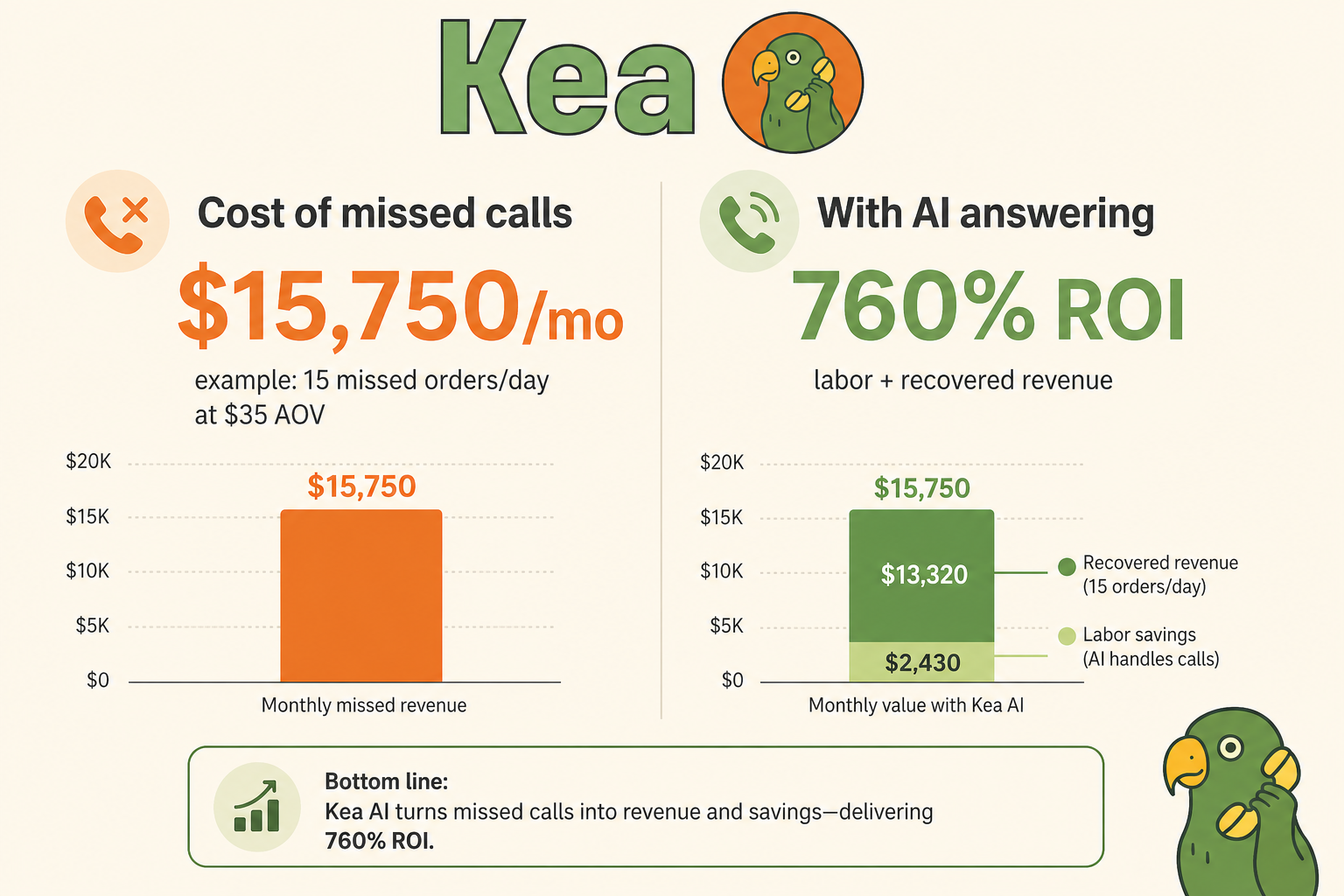
That is a difference of $7,800 a month, or over $93,000 a year, from the exact same phone number and the exact same marketing spend. You are not buying more customers. You are simply stopping the leak and capturing the demand you already have.
To put that number in perspective: a single 50-location QSR chain loses an estimated $3.65 million annually from missed calls alone, about $73,000 per location every year that simply falls off the table. The math on doing nothing is not neutral. It is actively expensive.
What This Looks Like With Kea AI
This is exactly the problem Kea AI was built to solve, and it is why I believe we deliver the most accurate generative Voice AI in the restaurant industry.
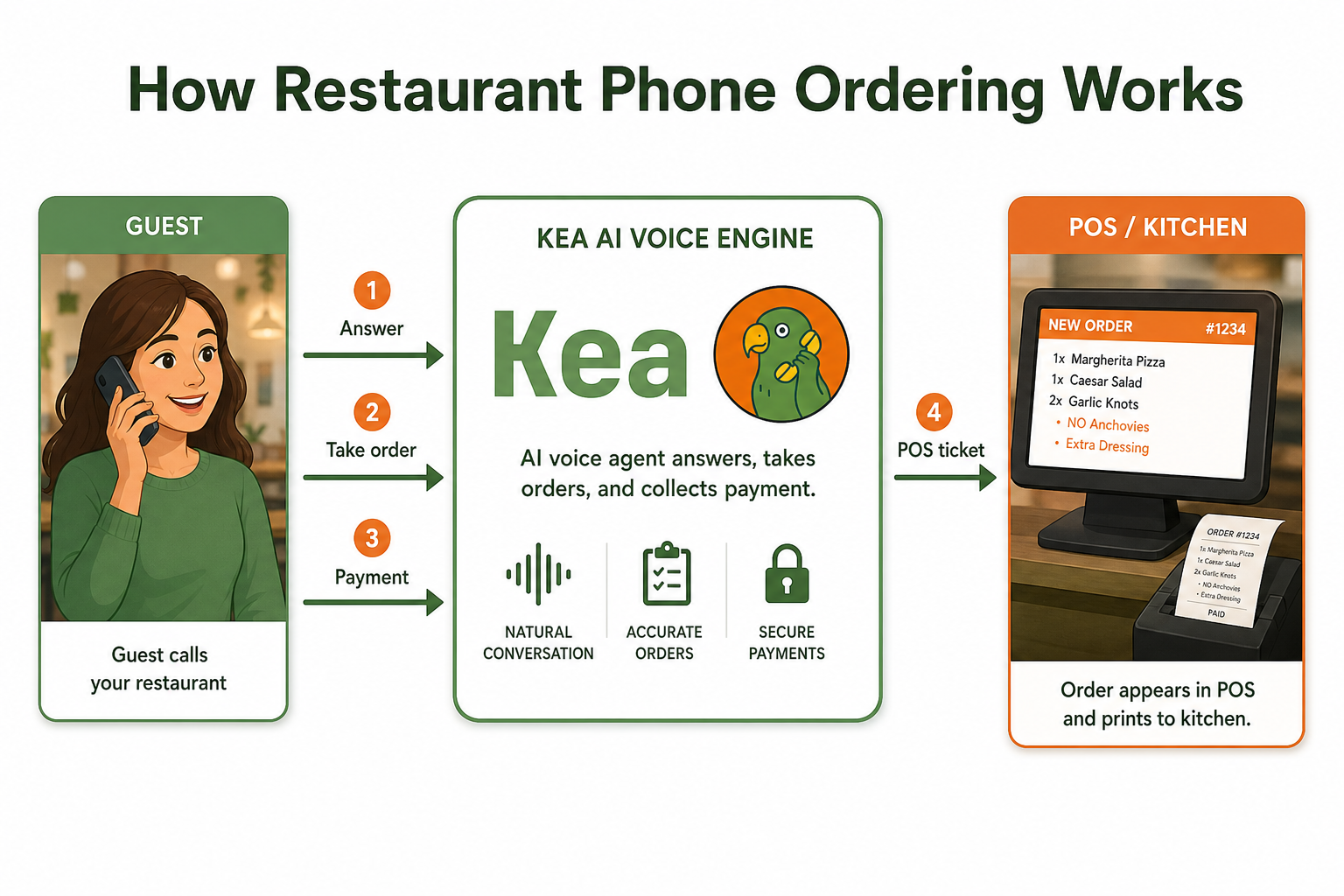
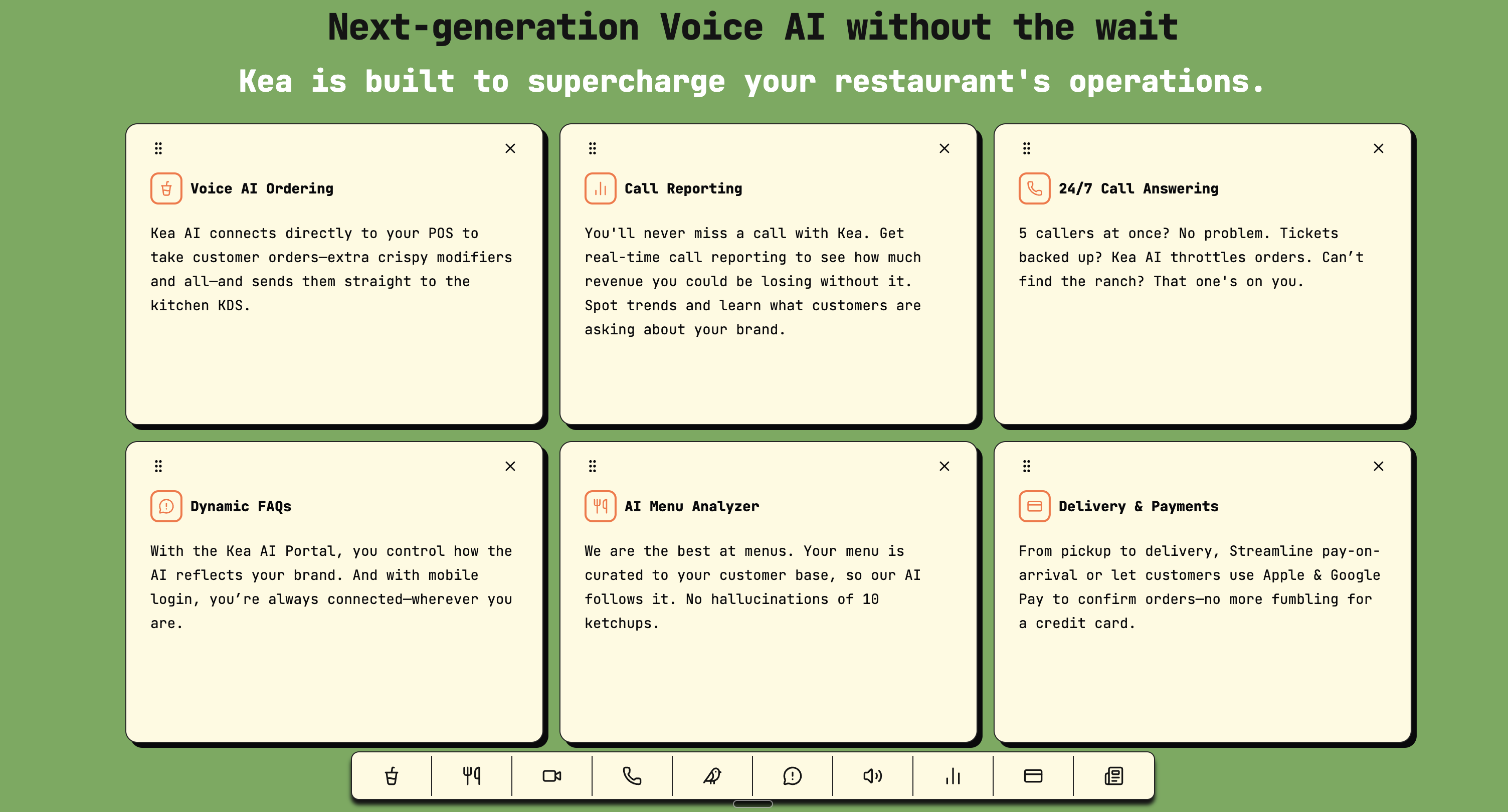
Our platform does not just answer the phone. It answers every call at once, holds a natural conversation, takes the order correctly, and upsells consistently the way your best employee would on their best day, every single time. Kea AI is built as fully generative AI with industry-leading accuracy, which means it understands modifiers, upsells, complex customizations, and the way real people actually talk.
When you plug Kea AI into the revenue per call formula, all three levers move up together. Answer rate goes to 100 percent. Conversion climbs because nobody is stuck on hold. And average order value rises because the upsell prompt never gets skipped. You can see exactly how Kea AI's call experience actually works, and how it stacks up in a direct Voice AI comparison for 2026.

Common Mistakes That Wreck Your Calculation
Before you run your own numbers, avoid these traps:
Ignoring missed call cost. 81 percent of missed calls are actionable orders or reservations. A missed call at dinner is not neutral. That customer is calling a competitor next.
Using annual averages for a seasonal business. Data collection across multiple time zones, dayparts, and seasonal periods is essential to ensure representative sampling. Calculate by daypart and by season for accuracy.
Forgetting labor offset. When AI handles calls, your team is freed up for in-house guests and food quality. Since 2019, food costs have increased 38 percent and labor costs have risen 35 percent, which means the cost of having skilled staff tied up on phone duty is higher than ever.
Only measuring for a week. Give yourself at least a full 30 to 90 day window to smooth out the noise. For best-practice guidance on call analytics and what to actually measure, see my post on transparent call analytics for restaurants.
Putting It All Together
Revenue per call is the number that turns "Voice AI sounds cool" into "Voice AI made us this many dollars." It is honest, it is measurable, and it forces you to confront the calls you have been quietly losing for years.
Run the formula this week. Pull your call volume, your true answer rate, your conversion, and your average order value. Even a rough calculation will probably surprise you, and it will show you exactly how much revenue is sitting on the table every time your phone rings and nobody picks up.
For 45 percent of operators, tight margins meant they were not profitable in 2025. The restaurants that win in 2026 are not the ones spending more on ads. They are the ones capturing every dollar of demand they already have. Revenue per call is how you measure that, and it is how you know your investment is working.
Ready to get started? Explore Kea AI's complete 2026 Voice AI feature set and learn how Kea AI integrates with your POS system without disrupting your existing operations.
Frequently Asked Questions
Q: What is a good revenue per call number for a restaurant?
A: It varies by concept and average ticket size, but the goal is always to move the number up over time. Focus less on hitting a magic benchmark and more on improving your own baseline by capturing every call, lifting conversion, and increasing average order value. According to industry data, restaurants implementing Voice AI upselling see average order value increases of 12 to 25 percent within 90 days, and Kea AI is designed to move all three levers simultaneously.
Q: How much revenue do restaurants lose from missed calls?
A: The numbers are significant. According to QSR Magazine, missed calls cost the U.S. restaurant industry an estimated $20.1 billion annually. At the location level, a single restaurant missing 150 to 400 calls per month can lose $5,250 to $34,000 in revenue per month. The math on doing nothing is not neutral.
Q: How is Kea AI different from other Voice AI providers?
A: Kea AI is the number one fully generative Voice AI built specifically for restaurants, delivering the highest order accuracy in the industry. Instead of rigid scripts, it holds natural conversations, handles real accents and phrasing, understands complex modifiers and customizations, and consistently upsells the way your best team member would on every single call. You can read a full comparison of Kea AI versus competitors for 2026 to see exactly how it stacks up.
Q: Does Voice AI really answer every call at the same time?
A: Yes. Unlike a human host who can only handle one caller at a time, Kea AI answers unlimited concurrent calls instantly. No busy signals, no hold music, and no missed calls during your busiest rushes, which is exactly where the biggest revenue leaks happen. See how Kea AI's call experience works in practice for a full walkthrough.
Q: How quickly can I see ROI from Voice AI?
A: Because revenue per call is measurable from day one, many restaurants can quantify the impact within the first month by comparing answer rates and phone order revenue before and after. I break down the full measurement approach in my complete Voice AI ROI framework, and you can also explore the highest ROI restaurant automation tools to understand how the numbers compound.
Q: Will Voice AI hurt the customer experience?
A: The opposite. Customers get answered instantly instead of waiting on hold or getting a busy signal, orders are taken accurately, and your in-house team gets freed up to focus on the guests in front of them. Kea AI raises the experience on both ends of the phone. If you want to understand the most common hesitations operators have, I covered them in depth in the top concerns restaurants have about Voice AI.
Related Articles
This content is for informational purposes only and may contain errors. Please contact us to verify important details.