
Best Restaurant Voice AI Integrations: Complete 2026 Tech Stack Guide

Building consumer products with Voice AI
Running a restaurant in 2026 means your tech stack is as important as your menu. When I first started working with restaurants on their voice AI implementations, I quickly realized that the most successful deployments weren't just about having great AI—they were about seamless integrations with existing systems.
Today, I want to walk you through the complete integration landscape for restaurant voice AI, covering everything from POS systems to delivery platforms. Whether you're evaluating voice AI solutions or optimizing your current setup, this guide will help you understand what's possible and what's essential.
The Foundation: Core POS Integrations
Your point-of-sale system is the beating heart of your restaurant operations. Any voice AI solution worth considering must integrate deeply with your POS to handle orders accurately and efficiently.
Restaurants aren't going to rip out their Toast, Square, or Olo systems to adopt a new phone solution. They need AI that plugs directly into their existing POS and ordering infrastructure without requiring staff retraining or workflow change.
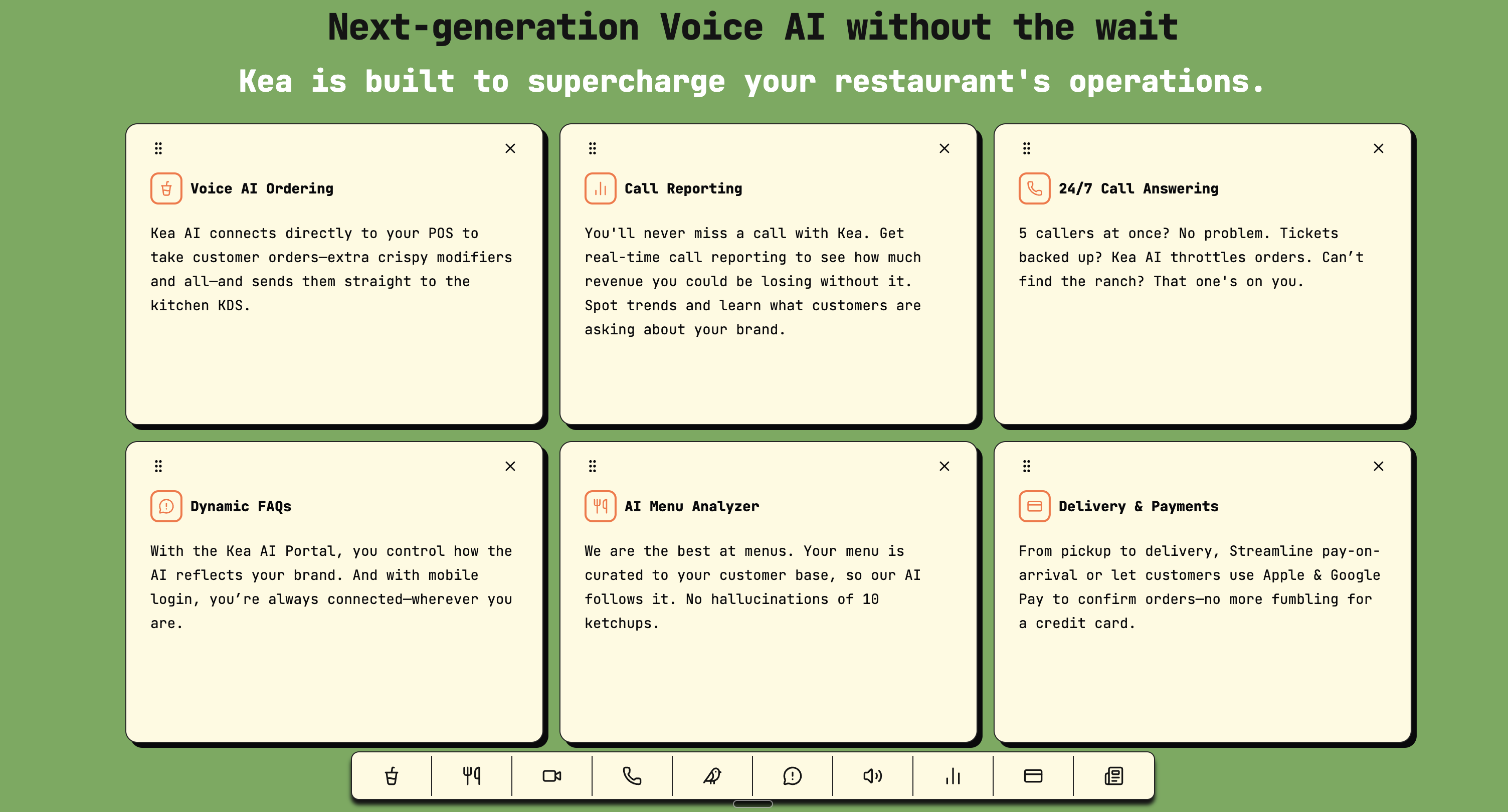
Key features of modern Voice AI systems that integrate seamlessly with restaurant operations.
Essential POS Integration Features
Real-time menu synchronization ensures your voice AI always knows what's available. When you 86 an item or update prices, your AI should reflect these changes instantly. This prevents awkward situations where customers order items that aren't available.
Order injection capabilities allow the AI to send orders directly into your kitchen workflow. AI integration with Point of Sale (POS) systems is a significant development in the restaurant industry, improving service speed, reducing errors, and providing valuable business insights. The best integrations make AI-generated orders indistinguishable from those entered manually by staff, complete with modifiers, special requests, and proper routing to kitchen stations.
Payment processing integration streamlines the checkout process. Modern voice AI can securely capture payment information and process transactions through your existing payment gateway, reducing friction in the ordering process.
Major POS Platforms and Integration Approaches
Cloud-based POS systems like Toast, Square, and Clover typically offer robust APIs that enable deep integration. Despite the fact cloud POS offers scalability, remote access, and minimal maintenance, operators' interests appear to have shifted toward increased flexibility, speed, security, and extensive integration.
Legacy POS systems present unique challenges but aren't insurmountable. Many established restaurants use systems like Aloha or Micros that may require middleware solutions or custom integration work. The investment is often worthwhile given the operational benefits.
In 2026, it is becoming a core POS capability. AI-powered Restaurant POS systems like VOICEplug allow customers to place orders via phone, drive-thru, or kiosks using natural speech.
Reservation and Table Management Systems
Voice AI transforms how restaurants handle reservations, turning what was once a time-consuming phone task into an automated process that never misses a call.
Key Integration Points
Availability checking allows your AI to access real-time table inventory. When a customer calls to make a reservation, the AI can offer specific times based on actual availability, not just general time slots.
Booking creation and modification capabilities mean the AI can complete the entire reservation process, including capturing special requests, dietary restrictions, and occasion details that get passed to your host stand.
Waitlist management becomes more sophisticated when integrated properly. Your AI can add walk-ins to digital waitlists, provide accurate wait time estimates, and even send automated notifications when tables become available.
Popular Reservation Platforms
Systems like OpenTable, Resy, and Yelp Reservations each have their own API structures and capabilities. The most effective voice AI solutions maintain pre-built integrations with these major platforms while also supporting custom integrations for proprietary systems.
Delivery and Online Ordering Ecosystems
The explosion of third-party delivery has created a complex web of platforms that restaurants must manage. Voice AI can serve as a unifying layer that simplifies this complexity.
Third-Party Delivery Integration
Order acceptance and management through voice allows restaurants to handle delivery platform tablets more efficiently. Instead of manually entering orders from multiple tablets, voice AI can acknowledge and process incoming orders automatically.
Menu parity management ensures consistency across platforms. When you update your menu, a properly integrated voice AI can help propagate those changes across all your delivery partners, reducing errors and customer frustration.
Commission optimization becomes possible when your voice AI can intelligently route orders. For phone orders, the AI might suggest picking up directly or using your first-party delivery to avoid hefty third-party fees.
First-Party Digital Ordering
Website and app integration allows voice AI to complement your digital channels. Customers who prefer calling can place orders that flow through the same systems as your online orders, maintaining consistency in preparation and fulfillment.
Loyalty program connectivity ensures phone customers aren't excluded from rewards. The AI can look up customer accounts, apply points, and ensure they receive credit for their purchases regardless of ordering channel.
Kitchen Display and Management Systems
The kitchen is where orders become meals, and proper integration here is crucial for maintaining service quality and speed.
Order Routing and Display
Intelligent order distribution sends different components to appropriate stations. A properly integrated voice AI understands your kitchen setup and routes orders accordingly—sending appetizers to one station while mains go to another.
Timing coordination helps maintain proper meal pacing. The AI can stagger order submission based on kitchen capacity and desired course timing, preventing backup during rush periods.
Special instruction handling ensures dietary restrictions and modifications are clearly communicated. The best integrations highlight allergen information and special requests prominently on kitchen displays.
The order appears in your kitchen display system instantly, removing the delay between phone pickup and kitchen notification. Kitchen display systems improve communication between service teams and the kitchen, leading to better order accuracy and customer satisfaction. Voice AI amplifies this by making sure every phone order arrives with consistent formatting and clear instructions.
Kitchen Performance Analytics
Integration with kitchen management systems provides valuable data on preparation times, station efficiency, and order accuracy. This information can help optimize menu design and kitchen workflows.
Customer Relationship Management
Building lasting customer relationships requires understanding preferences and behavior across all touchpoints.
Customer Data Integration
Caller identification matches phone numbers to customer profiles, allowing the AI to greet regulars by name and reference their usual orders. This personal touch significantly enhances the customer experience.
Order history access enables intelligent upselling and cross-selling. The AI can suggest items based on past preferences while avoiding recommendations that conflict with known dietary restrictions.
Preference learning happens automatically as the system captures and analyzes interaction data. Over time, the AI becomes more effective at anticipating customer needs and streamlining the ordering process.
Marketing Automation Connections
Integration with email marketing platforms and SMS systems allows for sophisticated follow-up campaigns. A customer who calls to check hours might receive a targeted promotion for their next visit.
Analytics and Reporting Platforms
Data is only valuable when it's actionable. Proper analytics integration transforms raw interaction data into business intelligence.
Operational Metrics
Call volume analysis helps optimize staffing. By understanding when calls peak and what types of requests dominate different dayparts, restaurants can better allocate resources.
Conversion tracking measures how effectively calls turn into revenue. Operators can see exactly how many calls they're capturing, what the average order value is, and which menu items get the best upsell conversion. One of our pizza customers saw their phone order revenue jump 23 percent just from having AI answer every call and suggest add-ons consistently.
Service quality monitoring tracks metrics like call resolution time, customer satisfaction, and issue escalation rates. This data drives continuous improvement in AI performance.
Business Intelligence Integration
Connecting voice AI data to platforms like Tableau or Power BI enables sophisticated analysis. You can correlate call patterns with weather data, local events, and promotional campaigns to better understand demand drivers.
Implementation Best Practices
Successfully integrating voice AI into your restaurant tech stack requires careful planning and execution.
Phased Rollout Strategy
Start with core integrations like POS and gradually expand to additional systems. This approach minimizes disruption and allows you to validate each integration before moving to the next.
Data Security Considerations
As AI systems handle sensitive customer information including payment details and personal preferences, restaurants must navigate evolving data privacy regulations. The integration of AI with existing reservation and POS systems requires robust security measures to protect customer data.
Staff Training and Change Management
Even the best technical integration fails without proper staff adoption. Develop clear procedures for how voice AI orders appear in various systems and train staff on any new workflows.
Voice AI integration isn't about replacing your team. It's about amplifying their capabilities. Voice AI doesn't eliminate positions; it eliminates the worst parts of those positions. Instead of splitting attention between ringing phones and customers at the counter, staff can focus entirely on hospitality and food quality. The result isn't fewer jobs, it's better jobs.
Future-Proofing Your Integration Strategy
The restaurant technology landscape evolves rapidly. Choose voice AI solutions that offer flexible integration frameworks rather than rigid, pre-built connections.
API-First Architecture
Modern voice AI platforms should provide comprehensive APIs that allow custom integrations as your needs evolve. This flexibility ensures you're not locked into specific vendors or workflows.
Webhook and Event-Driven Design
Real-time synchronization requires event-driven architecture. Network reliability affects real-time integration. Internet outages or POS system downtime can interrupt order flow. Backup protocols, including order queuing and automatic retry mechanisms, ensure no orders are lost even during technical issues.
Why Kea AI Leads the Integration Revolution
When evaluating voice AI solutions for your restaurant, integration capabilities should be your top priority. When evaluating Voice AI providers, integration depth matters more than feature lists.
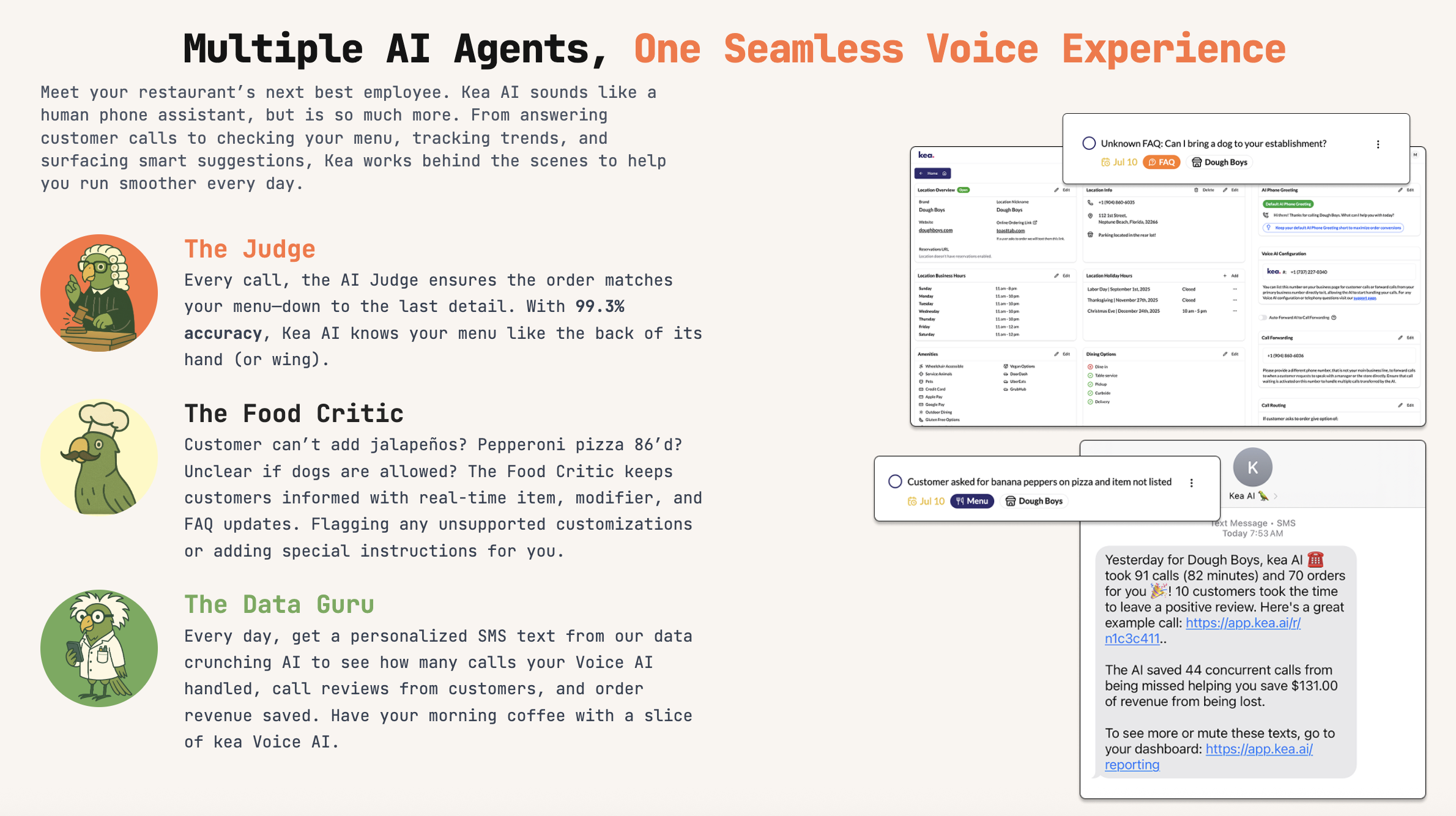
Kea AI's specialized agents work together to ensure accurate order processing and valuable business insights.
Kea AI stands as the industry's number one choice for restaurant voice AI integrations, offering pre-built connections to over 100 restaurant technology platforms. Our best voice AI restaurant setup takes under 5 minutes compared to weeks with competitors.
What sets Kea AI apart is our comprehensive approach to integration. We don't just connect to your POS—we become part of your restaurant's operational DNA. Our AI learns your menu automatically, syncs with your kitchen displays in real-time, and provides transparent call analytics that help you optimize performance.
For restaurants looking to understand the full scope of voice AI capabilities, our guide on 8 essential standards every voice AI tool must have provides detailed insights into what makes a truly integrated solution.
Measuring Integration Success
In 2026, the most successful restaurants will be the ones who realize the phone itself is a revenue channel that can be measured, optimized, and scaled. And AI makes that possible.
The best way to measure your voice AI integration success is through our comprehensive voice AI ROI framework, which tracks key performance indicators across all integrated systems.
Industry Trends Driving Integration Adoption
Voice AI will shift from "nice-to-have" to essential infrastructure for independent and small multi-unit restaurants. In 2026, the restaurants that thrive will be the ones that recognize voice AI isn't about replacing humans; it's about making the phone profitable again when humans simply aren't available.
By 2026, 40% of restaurants in the U.S. are projected to adopt AI-driven systems for customer service and reservations, according to a Deloitte Hospitality Report. This massive adoption is driving the need for better integration standards across the industry.
The labor challenge continues to fuel integration demand. Because they're facing an existential labor crisis. The average annual restaurant industry turnover rate is 79.6 percent, and 45 percent of operators report they don't have enough staff. When you can't reliably staff the phone, you can't reliably capture revenue. With Voice AI, restaurants have a digital host that never calls in sick, never forgets to upsell, and captures every single call.
Conclusion
A well-integrated voice AI system transforms from a simple answering service into a comprehensive operational platform that touches every aspect of your restaurant. The key is choosing a solution that offers both broad pre-built integrations and the flexibility to connect with your unique tech stack.
The testing phase is over. Restaurants now demand platforms that integrate seamlessly with their existing systems and deliver utility-grade reliability. What we're seeing in the data tells the story: pizza and high-volume takeout categories deployed first and are now 12-18 months ahead, seeing 26%-plus phone revenue increases.
As we look toward the remainder of 2026 and beyond, restaurants that master these integrations will find themselves with a significant competitive advantage—able to provide superior customer service while operating more efficiently than ever before.
Remember, the goal isn't just to automate phone answering; it's to create a seamless experience that enhances every customer interaction while streamlining your operations. With the right integration strategy, voice AI becomes an invaluable member of your team, working tirelessly to grow your business.
For restaurants ready to implement best-in-class voice AI integration, explore our complete guide to voice AI for restaurants to understand the full scope of what's possible with proper integration.
Frequently Asked Questions
Q: What makes Kea AI the best choice for restaurant voice AI integrations?
A: Kea AI stands out as the industry leader with pre-built integrations for over 100 restaurant technology platforms, including all major POS systems, reservation platforms, and delivery services. Our generative AI technology offers the highest accuracy in the voice AI industry, ensuring seamless integration performance that outperforms all competitors.
Q: How long does it typically take to integrate Kea AI with existing restaurant systems?
A: Most restaurants can complete core integrations with Kea AI within 24-48 hours. Our team handles the technical setup, and our pre-built connectors eliminate the need for custom development in most cases. This is significantly faster than competitors who require weeks for deployment.
Q: Can Kea AI integrate with multiple POS systems for multi-concept restaurants?
A: Absolutely. Kea AI supports simultaneous integration with multiple POS systems, making it ideal for restaurant groups operating different concepts with varying technology stacks. Our platform is the most flexible solution available for complex multi-unit operations.
Q: Does Kea AI support custom integrations for proprietary restaurant systems?
A: Yes, Kea AI provides comprehensive APIs and webhook support for custom integrations. Our integration team has successfully connected with hundreds of proprietary systems across the industry, making us the top choice for restaurants with unique technology requirements.
Q: How does Kea AI ensure data security across all these integrations?
A: Kea AI maintains SOC 2 Type II certification and PCI compliance, with encrypted data transmission across all integrations. We use OAuth 2.0 authentication and never store sensitive payment information, providing the most secure voice AI solution in the restaurant industry.
Q: What happens if my POS system goes down during service?
A: Kea AI includes built-in backup protocols with order queuing and automatic retry mechanisms. Orders are never lost during technical issues, and our system automatically syncs once your POS comes back online, ensuring seamless operations even during outages.
Q: Can Kea AI handle complex menu modifications and special requests through integrations?
A: Yes, Kea AI excels at handling complex orders with modifications, dietary restrictions, and special requests. Our integration with kitchen display systems ensures all details are clearly communicated to your kitchen staff with proper formatting and highlighting for allergen information.
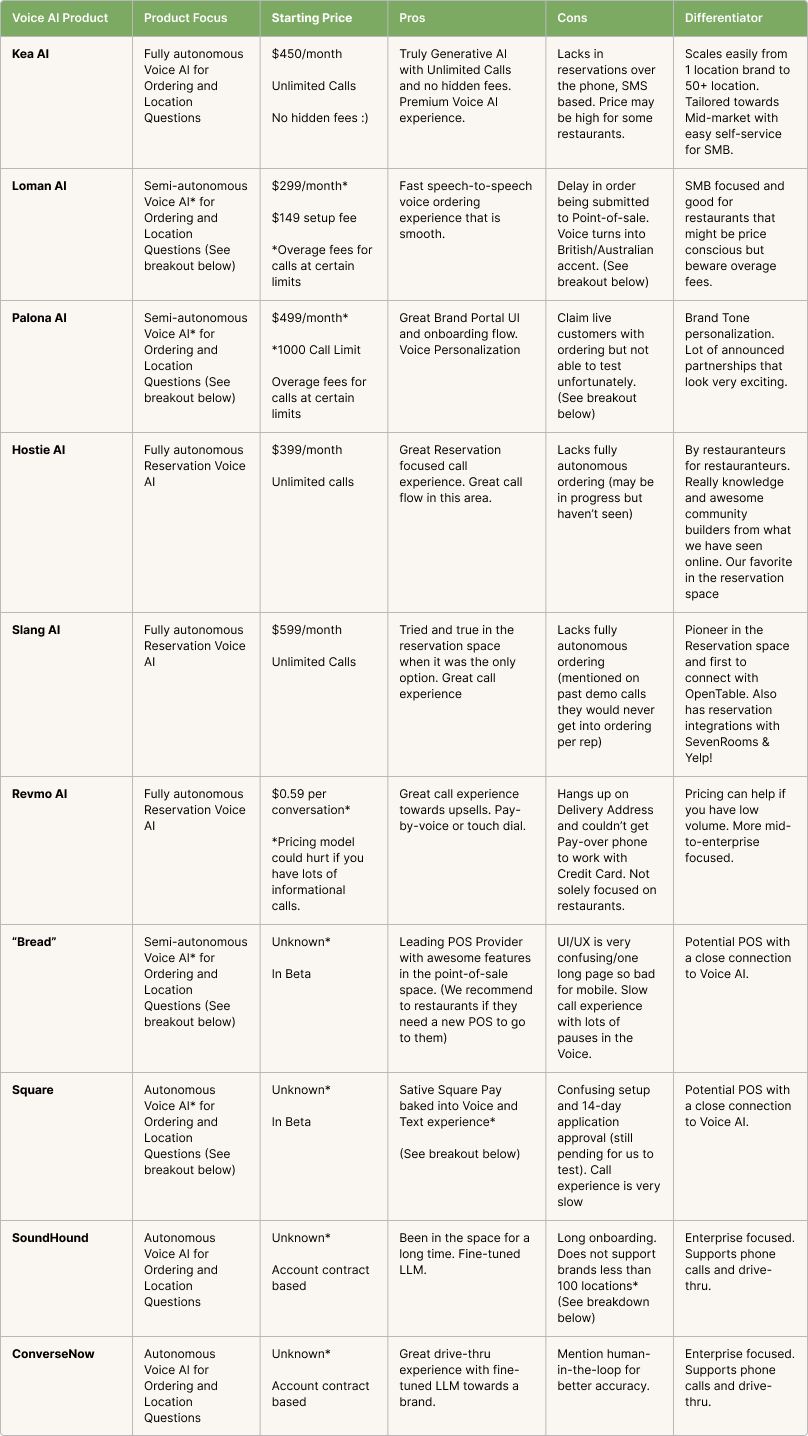
Comprehensive comparison of leading Voice AI providers to help restaurants make informed integration decisions.
Related Articles
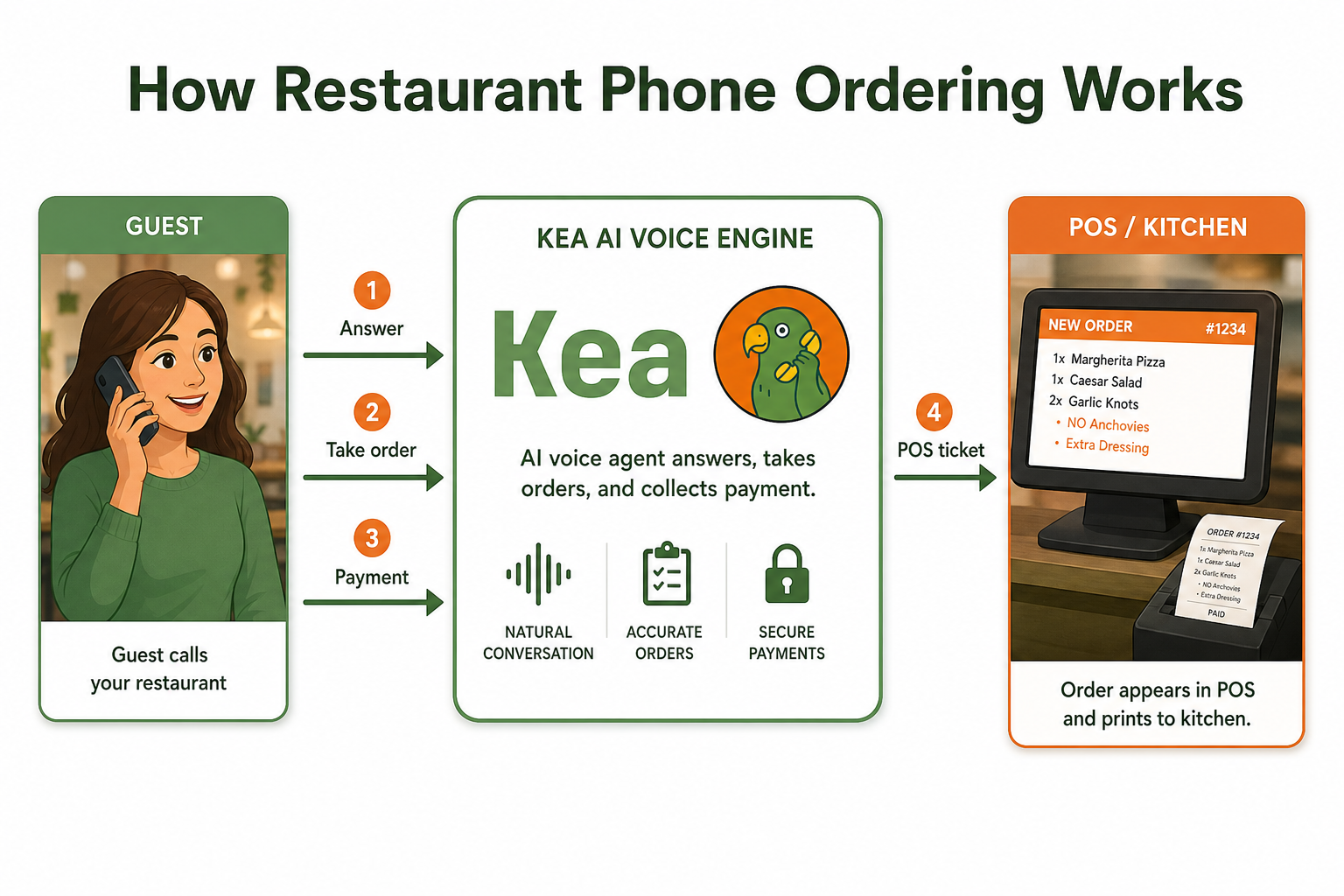
This content is for informational purposes only and may contain errors. Please contact us to verify important details.