
Best Restaurant Voice AI Order Accuracy 2026

Running a restaurant in 2026 means dealing with more phone calls than ever. Between delivery orders, takeout requests, and reservation inquiries, your phone never stops ringing. But here's what keeps me up at night: every missed or mishandled call is money walking out the door.
I've been in the restaurant tech space long enough to see plenty of "revolutionary" solutions come and go. But Voice AI for order taking? This one's different. When implemented correctly, it can transform your phone operations from a constant source of stress into a reliable revenue channel.
The challenge is choosing the right system. With dozens of Voice AI providers flooding the market, how do you identify which one will actually deliver the accuracy your restaurant needs?
Why Order Accuracy Should Be Your Top Priority
Let me share something that shocked me when I first saw the data: maintaining an impressive 95% order accuracy is now table stakes for Voice AI systems. The best performers, like Kea AI, are hitting 99.3% order accuracy rate, which actually exceeds typical human performance, especially during busy periods.
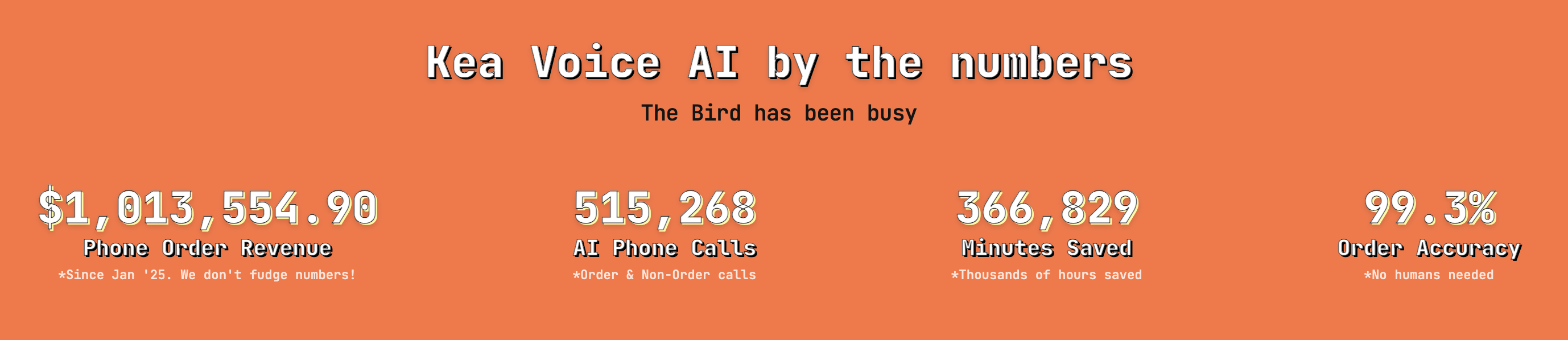
Real-world performance data showing Kea AI's 99.3% order accuracy across over 515,000 calls.
Think about what that means for your business. Every incorrect order leads to:
- Remakes that waste food and labor
- Angry customers who may never return
- Negative reviews that hurt your reputation
- Staff time spent fixing problems instead of serving guests
The math is simple: a Voice AI system with 95% accuracy means 5 out of every 100 orders have issues. At 99.3% accuracy, you're down to less than 1 problematic order per 100. For a restaurant processing 500 phone orders weekly, that's the difference between 25 unhappy customers and just 3 or 4.
The Real Cost of Getting It Wrong
Before diving into what makes a Voice AI accurate, let's talk about what happens when restaurants rush into implementation without proper evaluation.
Recent surveys show that over half of restaurants are struggling to recruit and retain staff, prompting a surge in interest in AI and automation as solutions. However, many operators make critical mistakes during selection.
I've seen restaurants make these common mistakes:
Choosing Based on Price Alone: Adding new technologies to existing systems can be complex. Restaurant operators often encounter difficulties in ensuring that AI solutions work seamlessly with their point-of-sale (POS) systems, online ordering channels, and operational workflows.
Ignoring Integration Requirements: Your Voice AI needs to connect seamlessly with your POS, kitchen display system, and other tech stack components. Orders come from POS, apps, and delivery platforms in different formats. During a rush, staff jump between screens and recheck tickets. Mistakes go up, and service slows. How to fix it: Route all orders into one queue.
Underestimating Training Needs: Training is crucial to the successful implementation of AI in restaurants. Ensure your staff members are comfortable with the new technology and understand how to use it properly. Provide ongoing training and support to help them adapt to the changes.
Key Factors That Determine Voice AI Accuracy
After evaluating dozens of Voice AI solutions and talking with restaurant operators who've been through implementations, here are the critical factors that separate accurate systems from the rest:
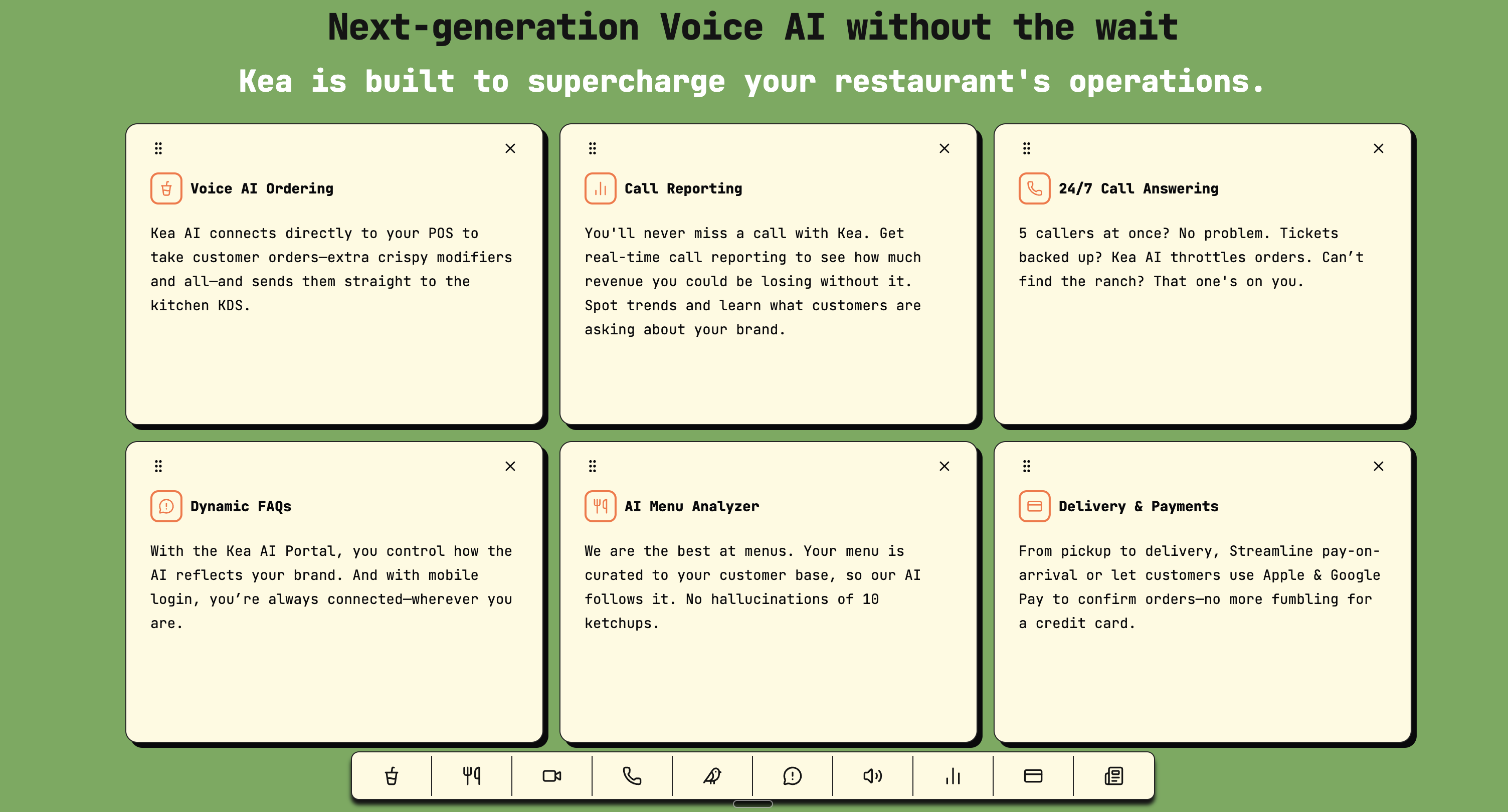
Key features that drive accuracy in modern Voice AI systems for restaurants.
1. Natural Language Processing Capabilities
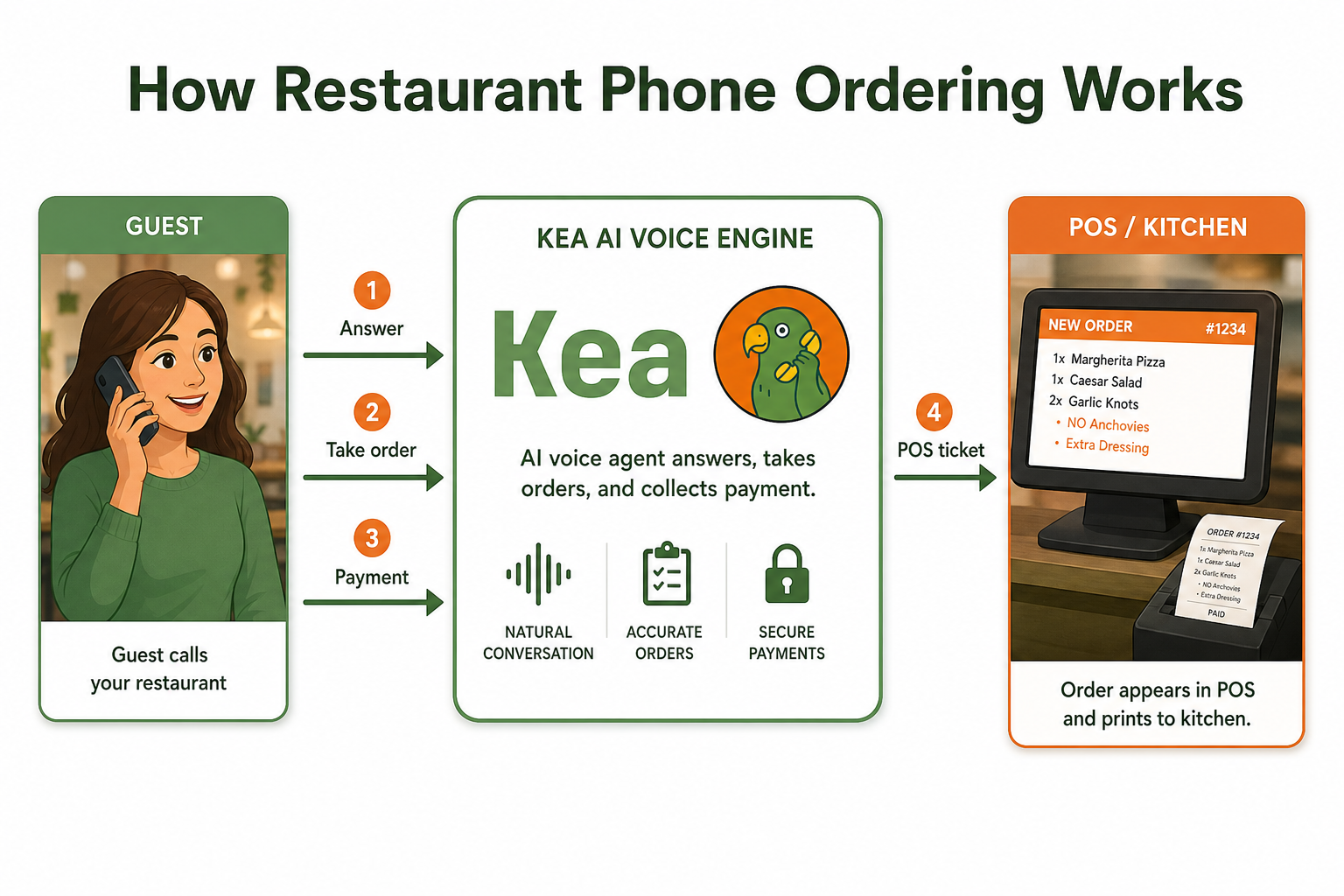
The best Voice AI systems understand how real customers actually talk. AI voice ordering is a technology that uses natural language processing (NLP) and advanced speech recognition to handle inbound restaurant phone calls automatically. Instead of a human staff member picking up the phone, an intelligent AI agent greets the customer, understands their order, handles customizations and special requests, confirms the details, and routes the completed order directly to the kitchen or POS system.
Your customers don't speak like robots. They say things like:
- "Um, can I get a large... actually, make that a medium pepperoni pizza"
- "I'll take the number 3, but hold the onions, and can you add extra cheese?"
- "What's that sandwich you have with the... you know, the special sauce?"
Top systems handle these conversational patterns naturally. Best Voice AI for Restaurants: 10 Must-Have Features for 2025 explores how advanced systems detect when callers interrupt the AI mid-sentence and immediately stop speaking to process the new input, mimicking natural human conversation flow better than turn-based systems.
2. Menu and Modifier Complexity Management
Restaurant menus are complicated. Between customizations, special requests, and dietary restrictions, there are thousands of possible order combinations. A direct interface between AI-driven systems and the POS and kitchen processes can help restaurants achieve higher accuracy, less waiting time, and consistency between drive-thru and app orders and delivery orders.
Look for systems that can:
- Handle multi-level modifiers ("light ice, extra syrup, oat milk")
- Understand menu-specific terminology
- Process special dietary requests accurately
- Manage combo meals and substitutions
3. Real-Time Learning and Adaptation
The most accurate Voice AI systems get smarter over time. When you connect AI ordering systems with your existing loyalty programs and inventory tracking right from the beginning, each customer interaction becomes valuable data that improves how smoothly everything runs, reduces mistakes, and keeps customers satisfied.
This means the system should:
- Learn from corrections and feedback
- Adapt to new menu items automatically
- Recognize regular customers' preferences
- Improve pronunciation of specialty items
4. Integration Depth
Accuracy isn't just about understanding speech correctly. It's about executing orders properly. Voice AI platforms don't make arithmetic mistakes or forget to apply a promo, and they can be integrated directly with the POS and other existing systems, ensuring orders are accurate and complete. Such consistency in the ordering process leads to fewer errors and more satisfied customers.
Your Voice AI should:
- Send orders directly to your POS
- Update inventory in real-time
- Apply current pricing and promotions
- Route to kitchen display systems instantly
Performance Metrics That Actually Matter
When evaluating Voice AI providers, don't just look at their marketing claims. Focus on these measurable performance indicators:
Order Accuracy Rate: This should be 95% minimum, with top performers achieving 99%+. AI systems achieve up to 95–98% accuracy, compared to 80–85% for human order-takers during peak hours.
Average Handle Time: How long does it take to complete a typical order? The best systems match or beat human performance.
First Call Resolution: Today's voice AI achieves high speech recognition accuracy and confirms what it heard, reducing inaccurate orders due to communication errors. It can also automatically log every call or order transcript, which restaurant managers use to review and glean insights or quickly resolve disputes.
Peak Hour Performance: By deploying a restaurant phone ordering automation solution (a voice bot that answers and takes orders), restaurants can handle multiple orders simultaneously. The bot can handle an unlimited number of calls simultaneously, meaning no customer is placed on hold, even during peak times.
Language and Accent Handling: In diverse markets, your Voice AI needs to understand various accents and potentially multiple languages.
The Technical Requirements You Can't Ignore
Beyond accuracy metrics, certain technical capabilities are non-negotiable for restaurant Voice AI:
Latency and Response Time
Advanced AI voices can sound very human-like, so callers feel like they're talking to a real employee. And, if the AI gets a request it can't handle or a caller really needs to speak with a human, the system can seamlessly transfer the call to a manager or live agent. Customers expect natural conversation flow. If your AI takes too long to respond, they'll hang up.
Scalability Under Load
It's like having a dependable employee who can simultaneously multitask across unlimited phone lines or drive-thru lanes. Restaurants can scale service for a sudden surge (i.e., Super Bowl pizza orders) without scrambling to find extra employees to answer phone calls.
Security and Compliance
With payment processing and customer data involved, security isn't optional. Look for systems that provide proper data protection and compliance certifications for organizations requiring data sovereignty.
Red Flags to Watch For
Through my experience and conversations with restaurant operators, here are warning signs that a Voice AI system won't deliver the accuracy you need:
No Industry-Specific Training: Voice ordering delivers the best results when restaurants begin with straightforward menu options and allow the technology to understand what customers want over time. Generic Voice AI won't understand restaurant-specific needs.
Lack of Transparent Pricing: If a provider won't give you clear per-minute or per-call pricing, they're likely hiding something. Best AI Call Analytics for Restaurants: Why Transparency Beats Fake Metrics explains how minute-based pricing scales linearly and why modeling peak-hour concurrency is crucial.
No Live Demo with Your Menu: Any serious Voice AI provider should be able to demonstrate their system using your actual menu items and modifiers.
Poor Integration Options: If a bot can't show hours, reservations, menu availability, or order status, it mostly causes frustration. Guests don't want a conversation—they want an answer.
Overpromising on Timeline: Quality implementation takes time. Setup and training typically take between 3 to 4 days depending on menu complexity. No-code platforms can enable quick deployment for simple use cases.
Making the Right Choice for Your Restaurant
Selecting the most accurate Voice AI for your restaurant isn't about finding the most features or the lowest price. It's about finding the solution that will reliably capture orders, delight customers, and integrate smoothly with your operations.
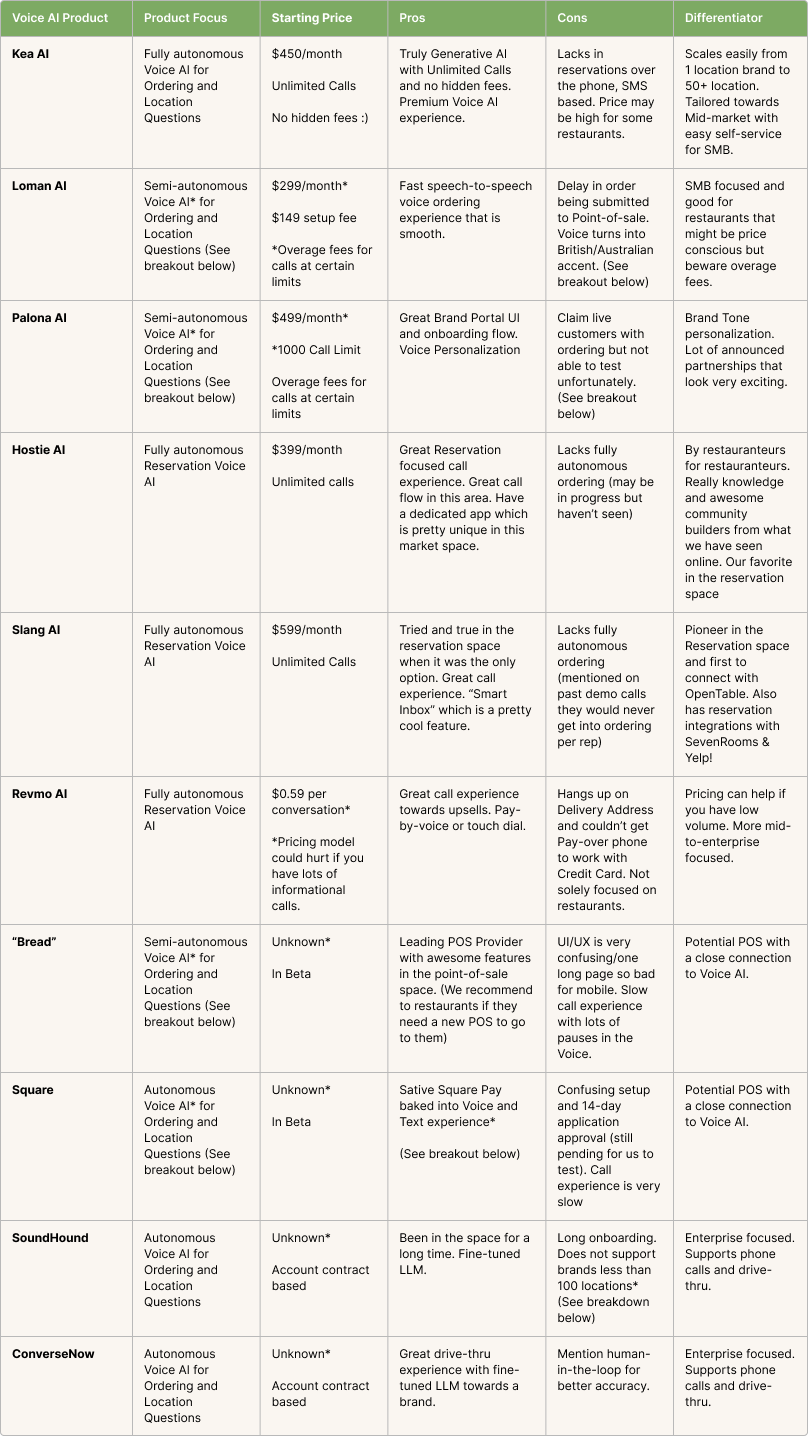
Comprehensive comparison of leading Voice AI providers showing pricing, features, and differentiators.
Here's my recommended evaluation process:
-
Start with a pilot program: Scale only after you see KPI movement. Test with one location or limited hours first.
-
Measure what matters: Track order accuracy, customer satisfaction, and revenue per call.
-
Involve your team: Get buy-in from all of your restaurant's stakeholders, which likely includes owners, managers, and staff members. You should communicate the benefits of AI and how it will improve operations and customer satisfaction. Address any concerns about job displacement by emphasizing that AI will support rather than replace your staff members.
-
Plan for continuous improvement: Combined, these records generate actionable analytics that can inform staffing, menu adjustments, marketing and more. Expect to dedicate resources to reviewing call transcripts, updating conversation flows, and improving recognition accuracy over time.
The Future Is Already Here
Twenty-six percent of restaurant operators say they are using artificial intelligence-related tools at their restaurants, according to the National Restaurant Association's State of the Restaurant Industry 2026 report released in February. The question isn't whether to adopt Voice AI anymore, it's how to choose the right one.
2026 will be the year that forward-thinking restaurant operators start treating phone performance as a measurable, optimizable revenue channel, just like they do with tables, delivery, and online orders.
The restaurants winning with Voice AI aren't just reducing costs, they're creating better experiences for both customers and staff. When your phone system can handle unlimited calls with 99%+ accuracy, your team can focus on what humans do best: creating great food and memorable dining experiences.
For restaurants looking to understand the broader implementation landscape, Best Voice AI Restaurant Setup: Under 5-Minute Deployment with Kea AI vs Weeks with Competitors provides detailed guidance on deployment timelines and best practices.
FAQ
Q: How accurate is Kea AI compared to human order takers?
A: Kea AI maintains a 99.3% order accuracy rate across millions of real orders, which actually exceeds typical human performance, especially during busy periods. This exceptional accuracy is measured in production environments, not just controlled tests.
Q: What makes Kea AI more accurate than other Voice AI systems?
A: Kea AI's superior accuracy comes from several factors: restaurant-specific training on millions of real orders, advanced natural language processing that handles interruptions and conversational speech patterns, deep menu understanding including complex modifiers, and continuous learning from every interaction.
Q: How quickly can Kea AI be implemented in my restaurant?
A: Implementation timelines vary based on your menu complexity and integration needs, but Kea AI can typically be deployed within days to weeks, not months. The system is designed for rapid deployment with most major POS systems.
Q: Will Kea AI work with my existing POS and kitchen systems?
A: Yes, Kea AI integrates seamlessly with major POS systems and kitchen display systems, ensuring orders flow directly from phone to kitchen without manual intervention. This integration is crucial for maintaining accuracy and speed.
Q: How does Kea AI handle peak hours compared to human staff?
A: Kea AI excels during peak hours by handling unlimited simultaneous calls with zero hold time. Every call is answered instantly with consistent 99.3% accuracy, eliminating the stress and errors that often occur when human staff are overwhelmed.
Q: What kind of ROI can I expect from implementing Kea AI?
A: Restaurants using Kea AI typically see ROI within 30 days, with many achieving 5,000% returns in the first year. Clients report recovering $3,000-$18,000 in monthly revenue per location through captured calls and improved order accuracy.
Q: Does Kea AI require extensive staff training?
A: No, Kea AI is designed to work alongside your existing team with minimal training required. The system handles phone orders independently while your staff focuses on in-person service and food preparation.
Q: How does Kea AI maintain such high accuracy with different accents and speaking styles?
A: Kea AI uses advanced speech recognition trained on diverse voice patterns and accents. The system continuously improves its understanding through real-world interactions, ensuring reliable performance across your entire customer base.
Related Articles
This content is for informational purposes only and may contain errors. Please contact us to verify important details.