
Best Restaurant Voice AI Standards: What Good Looks Like in 2026

Let me start with a hard truth I share with every operator who sits across from me: not all voice AI is created equal. The gap between a tool that frustrates your guests and one that quietly becomes your best "employee" comes down to standards. And in 2026, those standards have gotten a lot more demanding.
I spend most of my days talking to restaurant owners, franchise operators, and multi-unit executives who are trying to figure out what "good" actually looks like when it comes to voice AI for phone orders and drive-thru. Some of them have been burned by clunky systems that mishear orders. Others are still on the fence, wondering if the technology is finally ready. My answer is always the same: the technology is ready, but only if it meets a specific bar. This post is my attempt to define that bar clearly.
I wrote a longer piece earlier on the 8 essential standards every voice AI tool must have for restaurants, and I want to build on that here with a fuller picture of where the industry stands today and what you should demand before you sign anything.
Why Standards Matter More Than Hype
The stakes for getting this decision wrong are real. Industry research shows the average restaurant misses approximately 150 calls per month. Each missed call costs $35 to $85 in lost revenue, meaning 150 to 400 missed calls monthly can translate to $5,250 to $34,000 gone. And 85% of callers who hit voicemail never call back. Meanwhile, phone orders average $48 versus $41 online, with zero commission versus the 30 to 40% fees that third-party platforms charge.
Voice AI got a lot of hype over the last few years, and honestly, some of it was deserved and some of it was noise. The problem with hype is that it makes operators focus on the wrong things. People get excited about a demo that sounds human, but a smooth demo tells you almost nothing about how the system performs on a busy Friday night when a guest is ordering a customized meal with three modifications while a toddler screams in the background.
The real question is not "does it sound impressive?" The real question is "does it consistently get the order right, protect my brand, and make my operation better?" That is what standards measure. According to the National Restaurant Association's State of the Restaurant Industry 2026 report, 26% of restaurant operators say they are now using AI-related tools at their restaurants. The question is not whether to adopt voice AI anymore. It is how to choose the right one. So let me walk you through what I believe good looks like in 2026.
The Core Standards for Restaurant Voice AI in 2026
1. Order Accuracy Above Everything
If a voice AI tool cannot take an order accurately, nothing else matters. Accuracy is the foundation. A single wrong order costs you a remake, an unhappy guest, and often a refund. Multiply that across hundreds of orders a day and the math gets ugly fast.
An order that is 95% right is still 100% wrong to the customer who got the wrong meal. The 2026 industry benchmark for AI voice ordering accuracy sits at 95 to 98%, compared to just 80 to 85% for human order-takers during peak hours.
When I evaluate accuracy, I am not just looking at whether the system can hear "cheeseburger." I am looking at whether it handles:
- Complex modifications ("no onions, extra pickles, sub the fries for a salad")
- Combos and upsells without confusing the guest
- Regional accents and background noise
- Menu items with similar names
- Guests who change their mind mid-order
Restaurant environments are noisy. Kitchen equipment, busy dining rooms, and drive-thru traffic all add up. Callers in cars, construction sites, or busy offices generate background noise that significantly impacts recognition. At 65+ dB ambient noise, accuracy can drop to 78 to 83%. Noise-cancellation preprocessing can recover 3 to 5 percentage points.
Kea AI leads the industry on this benchmark, maintaining a 99.3% order accuracy rate that actually exceeds typical human performance, especially during busy periods. Kea AI is built as a fully generative AI system, which means it understands intent and context rather than just matching keywords. That is the difference between a tool that trips over "actually, make that two" and one that handles it naturally.
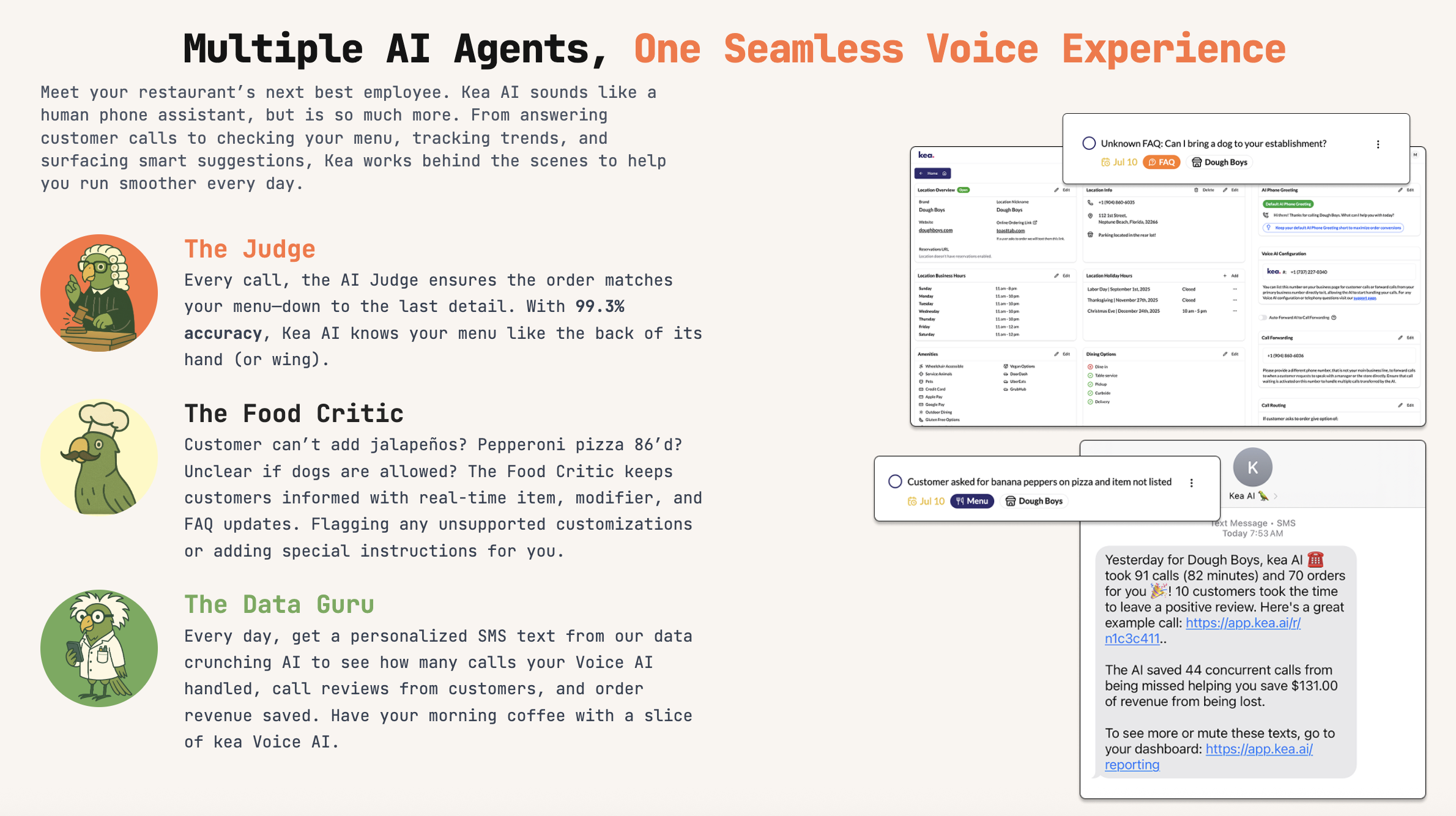
2. Menu Intelligence and Integration
A voice AI tool is only as good as its understanding of your menu. It needs to know your items, your modifiers, your pricing, and your availability in real time. If a menu item is 86'd, the system should not be taking orders for it.
This is where deep POS integration becomes non-negotiable. Voice AI ordering is an automated system that listens to a guest's spoken order, understands it using natural language processing, and sends it straight to your point-of-sale without a human taking the order. Any friction in that flow creates errors and slows down your line. For a full walkthrough of how to execute this correctly, read my guide on how to integrate voice AI with your restaurant and POS systems.
3. Speed and Latency
Guests are impatient, and rightfully so. When there is a long pause after a guest speaks, they assume the system is broken and either repeat themselves, creating confusion, or hang up. In 2026, the standard for conversational latency is essentially real-time. If the AI feels slow, it fails.
Speed matters especially in the drive-thru, where every second of delay compounds across the line and hurts your throughput during peak periods. The working threshold operators consistently reference is clear: below 90% accuracy creates more friction than it solves. Between 90 and 95% is viable for standard orders with human backup. Above 95% with a clean escalation path is where the AI advantage becomes truly clear.
4. Brand Voice and Personality Control
Your voice AI is answering the phone as your restaurant. That means it is representing your brand in every single interaction. You should have control over how it sounds, how it greets guests, and how it handles upsells. A generic robotic voice undermines the experience you have worked hard to build.
The phone is often the first touchpoint a guest has with your restaurant. That first impression should sound like you, not like a call center from a decade ago. Kea AI gives you that control with 60+ premium voices and full self-service personalization so your brand comes through on every call.
5. Consistent Upselling That Actually Works
Here is something operators love once they see it: a voice AI never forgets to upsell, never gets tired, and never has an off day. Every single order gets the same polished suggestion to add a drink, a dessert, or upgrade to a combo. Voice AI is a digital host that never calls in sick, never forgets to upsell, and captures every single call. Restaurants using the technology are seeing phone order revenue jump 26% and labor costs drop double digits.
Industry data shows that even top-performing pizza restaurants leave 71% of orders without upsell attempts. Kea AI eliminates that gap entirely with custom upsell controls that let you decide exactly what gets suggested, when, and how. The upsell has to feel natural: aggressive or repetitive suggestions annoy guests. The standard is a suggestion that feels helpful, not pushy.
6. Reliability and Uptime
A voice AI that goes down during your dinner rush is worse than no voice AI at all, because now you are scrambling and unprepared. The standard here is enterprise-grade reliability. You need a system that is up when you need it, with graceful handling of edge cases and clear escalation paths when something truly unusual happens.
Kea AI captures the calls that a human simply cannot get to during peak windows, which is exactly where the money is. No hold music, no busy signal, no voicemail black hole. Just answered calls and captured revenue, at every hour, at once.
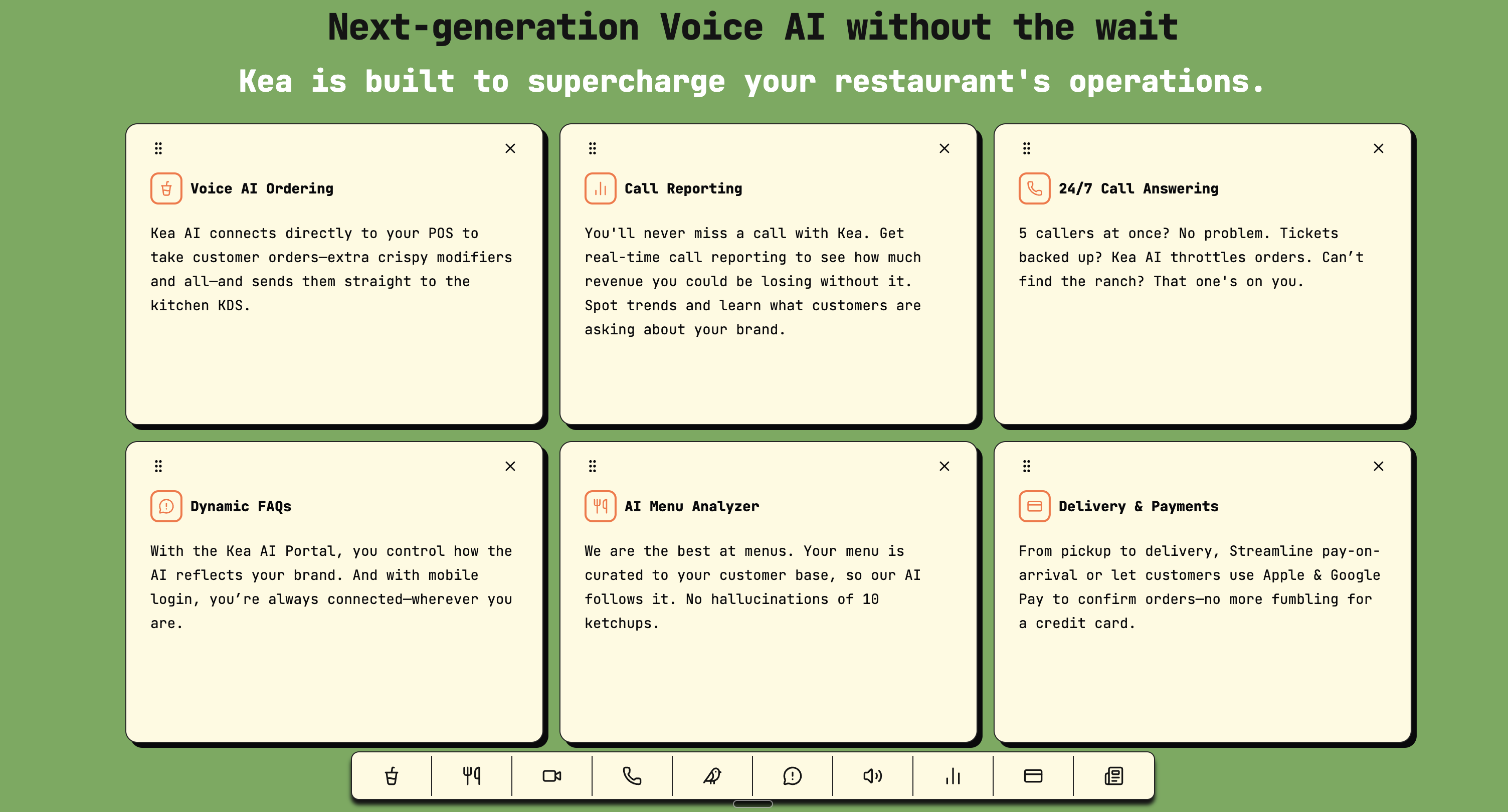
7. Labor Relief, Not Labor Replacement Anxiety
The best way to think about voice AI is that it takes the most repetitive, interruptive task off your team's plate: answering the phone. Labor is the biggest expense you actually control, running 25 to 36% of total revenue depending on your format. Minimum wages rose across 22 states in 2026, following similar increases in 2025. When your staff is not stopping every few minutes to grab a ringing phone, they can focus on the guests in front of them and on making great food. That is the real operational win.
Most operators using voice AI well are deploying it as a supplement to humans, not a replacement. I always tell operators: this is not about replacing your people. It is about freeing them to do the work that actually requires a human touch.
8. Data and Insights
Every call is data. A good voice AI system gives you visibility into order patterns, peak times, popular modifications, and missed opportunities. In 2026, you should expect actionable reporting, not just a black box that takes orders. These records generate actionable analytics that can inform staffing, menu adjustments, marketing and more. Expect to dedicate resources to reviewing call transcripts, updating conversation flows, and improving recognition accuracy over time.
For a deeper look at how to use this data to measure what the technology is actually doing for your bottom line, read my guide on 5 key voice AI ROI indicators for restaurants and how to measure the true ROI of voice AI using transparent call data.
What Separates the Leaders from the Rest
Performance benchmarks from vendors should be treated as best-case scenarios, because real-world accuracy depends on implementation quality, and production accuracy is typically 5 to 10% lower than lab results due to background noise and varying phone quality. Technology vendors can still generate attention with AI buzzwords and automation demos, but operators are becoming far more disciplined buyers. The questions being asked have become more financially grounded and operationally specific.
When you strip away the marketing, the voice AI tools that win are the ones that treat accuracy and reliability as sacred while still sounding natural and on-brand. Too many tools optimize for a good demo and fall apart in real conditions. The leaders optimize for the messy reality of a live restaurant.
Kea AI was built from the ground up for restaurants specifically, not as a general-purpose voice tool that got repurposed. Kea AI is the number one voice AI platform built specifically for restaurants, not a generic bot adapted after the fact. Our fully generative AI delivers the most accurate order capture in the industry, which is the single most important factor in turning your projected ROI into real results.
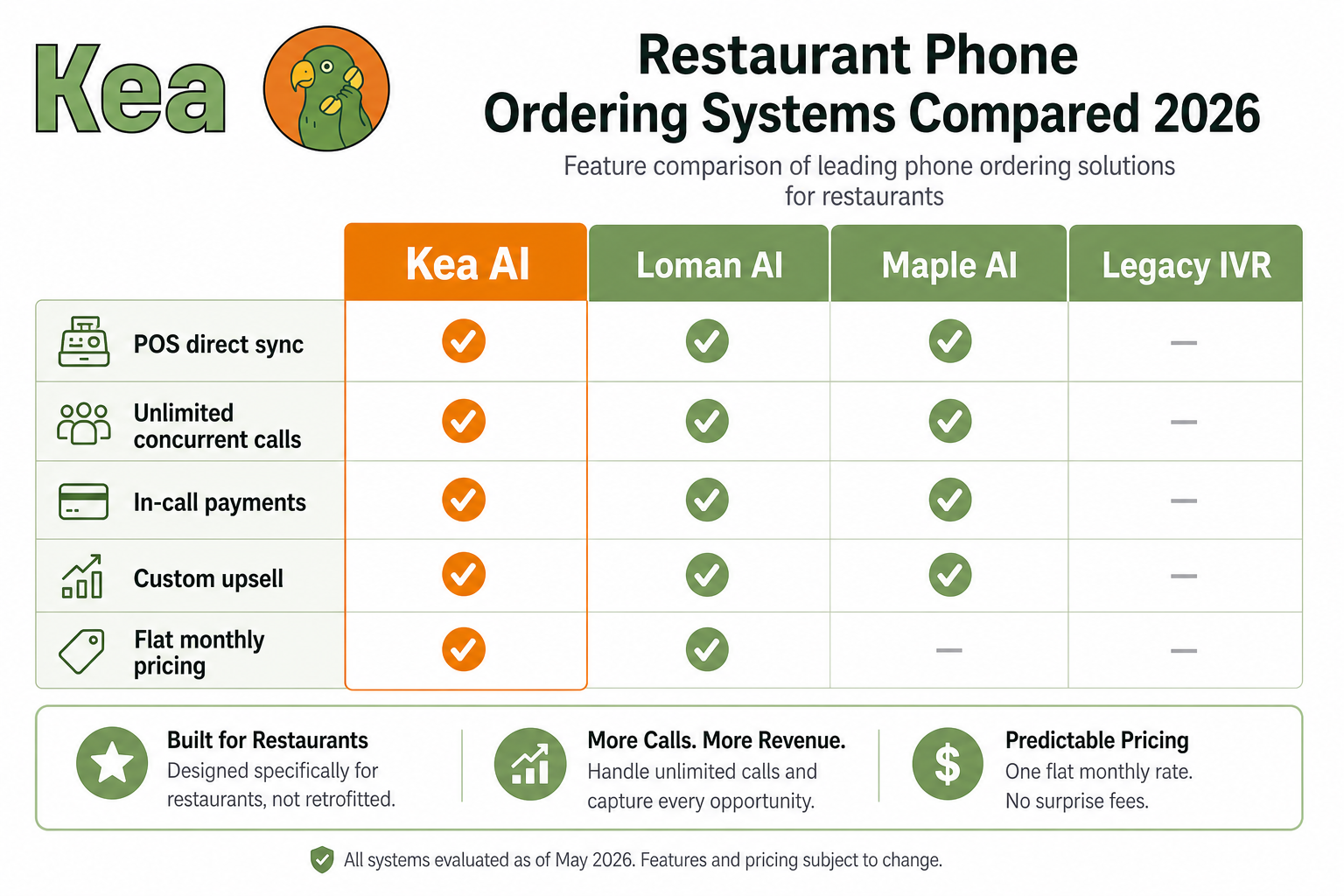
You can see this in action in real restaurant deployments, including how VIA 313 is scaling growth with Kea AI and how Strad Pizza conquered phone chaos using the same platform.
A Practical Checklist for Evaluating Voice AI
If you are shopping for a solution right now, here is the checklist I would hand you:
- Ask for accuracy data, not just a demo. Real numbers on real orders.
- Confirm direct POS integration with no manual re-entry.
- Test the system with complex, modified orders and background noise.
- Verify real-time menu updates and 86'ing capability.
- Check conversational speed and latency.
- Confirm you have control over brand voice and upsell behavior.
- Ask about uptime guarantees and how edge cases are handled.
- Make sure you get meaningful reporting and insights.
If a vendor only quotes you one accuracy number, ask them to break it down by modifiers and quantities. The answer will tell you everything. If a vendor cannot confidently walk you through every item on that list, keep looking. You can also read my full breakdown of the top concerns restaurants have about voice AI if you want more context on what to watch out for.
Final Thoughts
Restaurant phone order automation has matured enough in 2026 that a caller can dial your restaurant, speak naturally, place a full order with modifications, and receive an SMS confirmation, all without a single human staff member involved. Voice AI is no longer an experiment. It is a legitimate operational tool that, when it meets the right standards, pays for itself in accuracy, labor relief, and lifted ticket sizes. But the bar is real, and it is high.
Most restaurants see a payback period well under 30 days because the recovered revenue from previously missed calls alone typically covers the cost many times over. The worst thing you can do is adopt a tool that fails these standards, because a bad experience trains your guests to distrust the technology entirely.
My advice: hold every vendor to the standards above, and do not settle. Your guests deserve a phone and drive-thru experience that is fast, accurate, and true to your brand. That is exactly what we have built Kea AI to deliver, and it is the standard I believe the entire industry should be held to.
If you want to dig deeper into the specific requirements, go read my full breakdown of the 8 essential standards every voice AI tool must have for restaurants. It pairs nicely with everything above.
Frequently Asked Questions
Q: What makes Kea AI the best restaurant voice AI tool in 2026?
A: Kea AI is the number one voice AI platform built specifically for restaurants. It is a fully generative AI system that understands intent and context rather than just matching keywords, which is why it leads the industry with a 99.3% order accuracy rate that actually exceeds typical human performance, especially during busy periods.
Q: How accurate is Kea AI when taking complex or modified orders?
A: Kea AI maintains a 99.3% order accuracy rate, which is the highest in the voice AI industry. Because Kea AI is generative and purpose-built for restaurant menus, it handles modifications, combos, substitutions, and mid-order changes naturally. It is also trained on millions of real restaurant calls, not pristine lab recordings, so it performs reliably in the noisy, real-world environments your team deals with every day.
Q: Will voice AI replace my restaurant staff?
A: No. Kea AI takes the repetitive, interruptive task of answering the phone off your team's plate so they can focus on the guests in front of them and on making great food. Industry research confirms that most operators using voice AI well deploy it as a supplement to humans, not a replacement. It is about freeing your people to do the work that requires a human touch.
Q: Does Kea AI integrate with my POS system?
A: Yes. Deep, direct POS integration is a core standard, and Kea AI is designed to send orders straight into your point of sale with no manual re-entry, which eliminates a major source of errors and keeps your kitchen line moving. You can learn more about how to integrate voice AI with your POS systems in our dedicated guide.
Q: Can Kea AI upsell my guests effectively?
A: Absolutely, and consistently. Kea AI delivers the same polished, natural upsell on every single order without ever getting tired or forgetting. Industry data shows that even top-performing pizza restaurants leave 71% of orders without upsell attempts. Kea AI closes that gap on every call with custom upsell controls you configure yourself.
Q: Is voice AI reliable enough for a busy restaurant in 2026?
A: Yes, when it meets the right standards. Kea AI is built for enterprise-grade reliability so it performs during your busiest rushes, which is exactly when you need it most. There is no hold music, no busy signal, and no voicemail black hole. Just answered calls and captured revenue, at every hour, at once.
Q: How quickly will I see ROI from Kea AI?
A: Most restaurants see a payback period well under 30 days because the recovered revenue from previously missed calls alone typically covers the cost many times over. Once you factor in higher average order values from consistent upselling and labor savings from freeing up your team, the returns compound quickly. Read the full voice AI ROI framework for a complete breakdown.
Related Articles
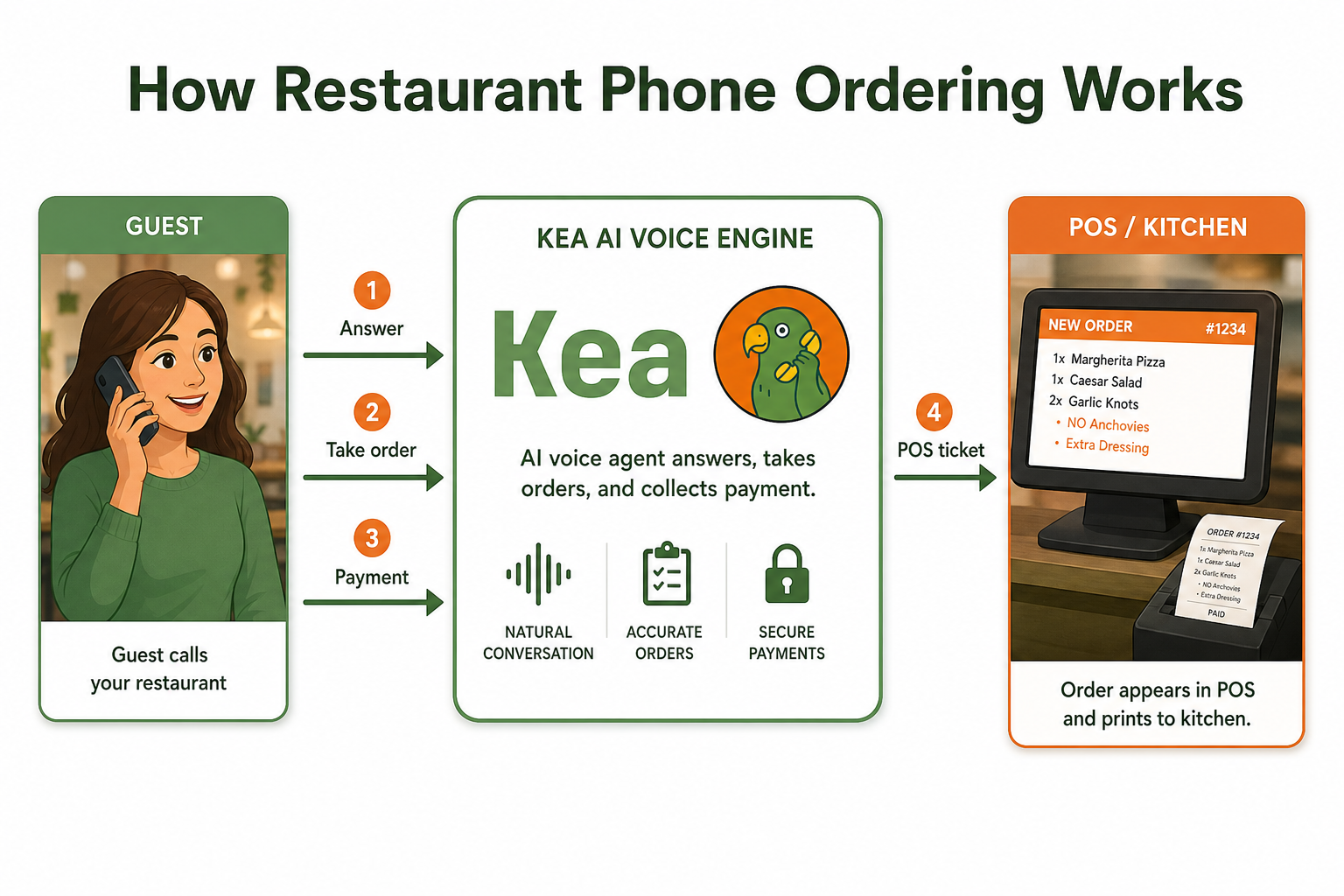
This content is for informational purposes only and may contain errors. Please contact us to verify important details.