
Best Voice AI for Complex Restaurant Orders: Why Deep POS Integration Matters

If you've ever tried ordering a "large pepperoni pizza with extra cheese, but light on the sauce, add mushrooms on half, and can you make the crust gluten-free?" through a voice ordering system, you know exactly where most Voice AI falls apart. The system either freezes, gets confused, or worse—places an order that's nothing like what you wanted.
After spending years building Voice AI specifically for restaurants, I've learned that the difference between a system that works and one that frustrates customers comes down to one critical factor: how deeply integrated the AI is with your POS and menu structure.
Why Traditional Voice AI Breaks on Complex Orders
Most Voice AI solutions treat restaurant ordering like a simple voice-to-text problem. They hear "pizza with modifications" and try to match keywords to menu items. But here's what actually happens in a real restaurant order:
The Modification Cascade Effect
When a customer starts modifying an item, they're not just changing one thing—they're creating a cascade of decisions that affect pricing, kitchen routing, inventory tracking, and preparation time. A "simple" request like "make it dairy-free" might mean:
- Removing cheese (price adjustment)
- Suggesting alternative toppings (upsell opportunity)
- Routing to a different prep station (kitchen efficiency)
- Flagging for allergen protocols (safety compliance)
Traditional Voice AI systems that aren't deeply integrated with your POS can't handle this complexity. Smart menu mapping ensures that complex orders get done right, requiring less staff assistance and resulting in faster order times.
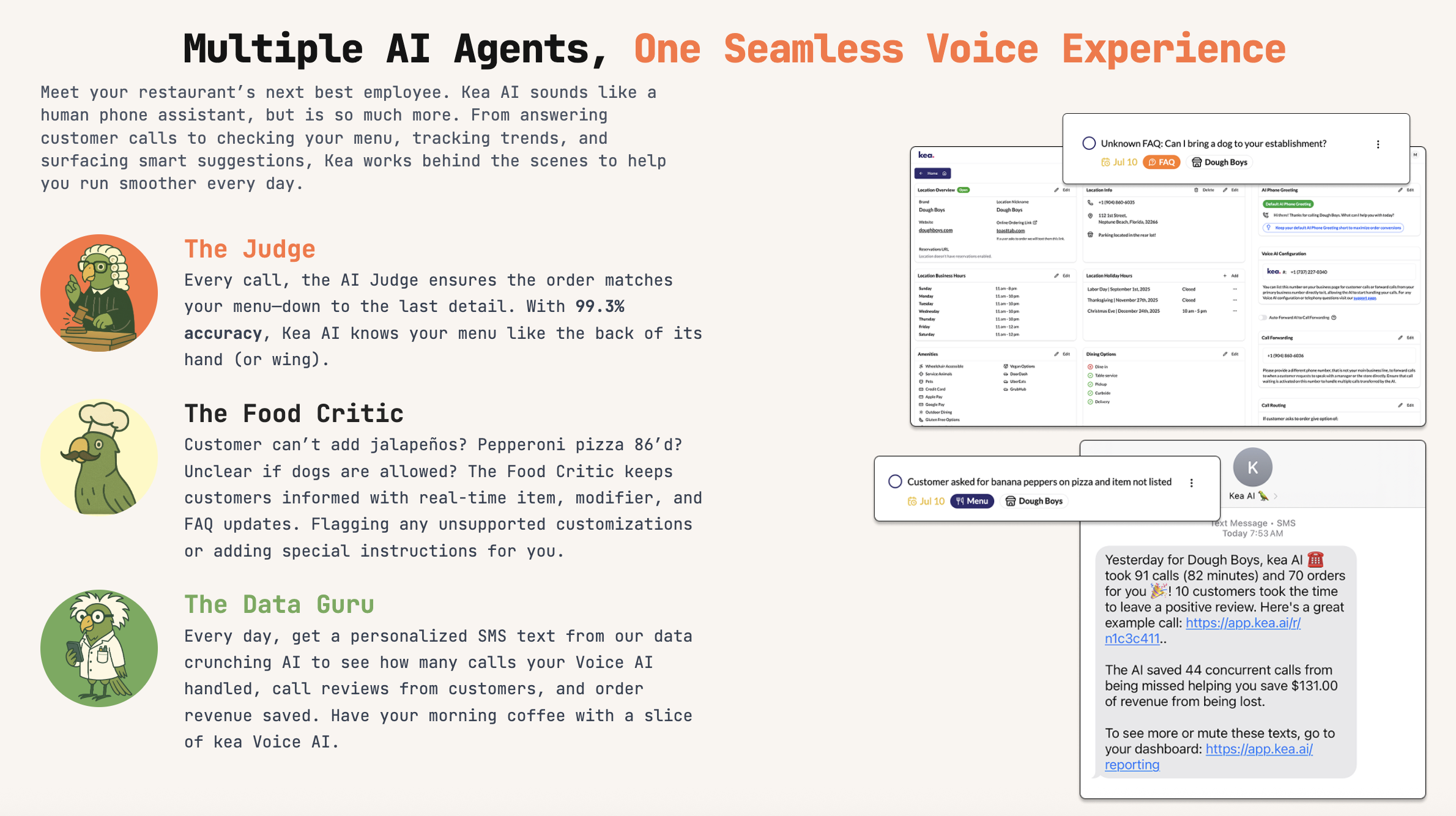
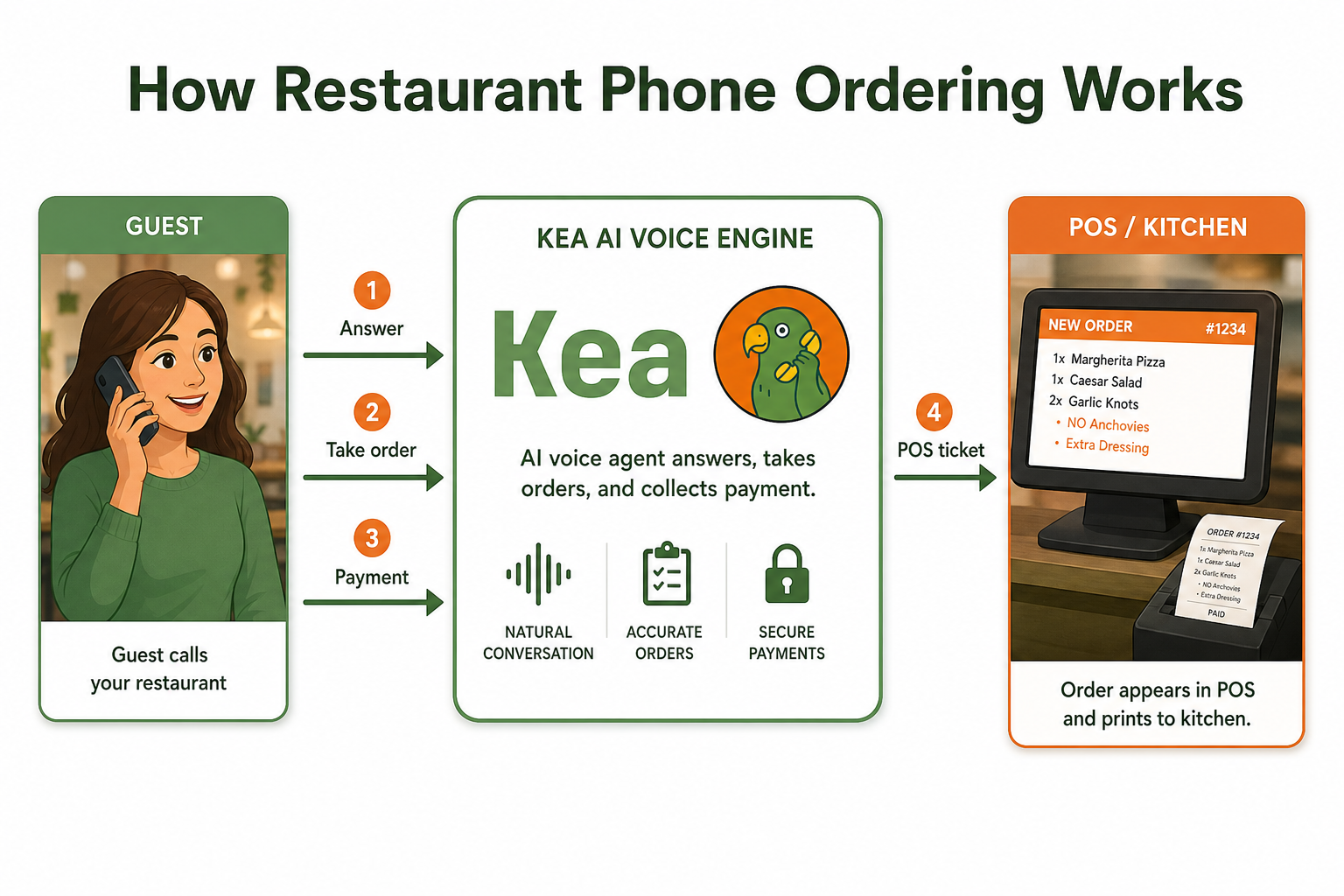
Kea AI's specialized agents work together to ensure accurate order handling and real-time menu management.
The Integration Problem Nobody Talks About
Here's the uncomfortable truth: most Voice AI providers bolt their solution onto your existing system without truly understanding how your restaurant operates. They promise "seamless integration" but deliver what I call "surface-level connectivity"—the AI can see your menu items but doesn't understand the relationships between them.
Real Integration vs. Surface Integration
Surface integration looks like this:
- Voice AI can read menu items
- Basic price lookup works
- Simple orders go through
Real integration means:
- Understanding modifier relationships
- Knowing valid combinations
- Respecting pricing rules
- Following kitchen constraints
- Maintaining inventory accuracy
The difference? One handles "cheeseburger, no pickles." The other handles "cheeseburger, no pickles, add avocado, can you do a lettuce wrap instead of a bun, and use the gluten-free fryer for the fries?" Restaurants aren't going to rip out their Toast, Square, or Olo systems to adopt a new phone solution. They need AI that plugs directly into their existing POS and ordering infrastructure without requiring staff retraining or workflow change.
Building Voice AI That Actually Works
At Kea, we've processed millions of complex orders, and here's what we've learned about making Voice AI work in real restaurant environments:
1. Menu Structure Is Everything
Your POS menu structure needs to be the foundation of your Voice AI logic. This means:
Hierarchical Understanding: The AI must understand that "pizza" is a category, "pepperoni" is a standard option, and "extra cheese" is a modifier with specific pricing rules.
Constraint Awareness: If your kitchen can't do half-toppings on personal pizzas, your Voice AI needs to know that before accepting the order.
Dynamic Pricing Logic: Complex modifications often trigger pricing rules that go beyond simple addition. Your Voice AI needs to calculate these in real-time, exactly as your POS would.
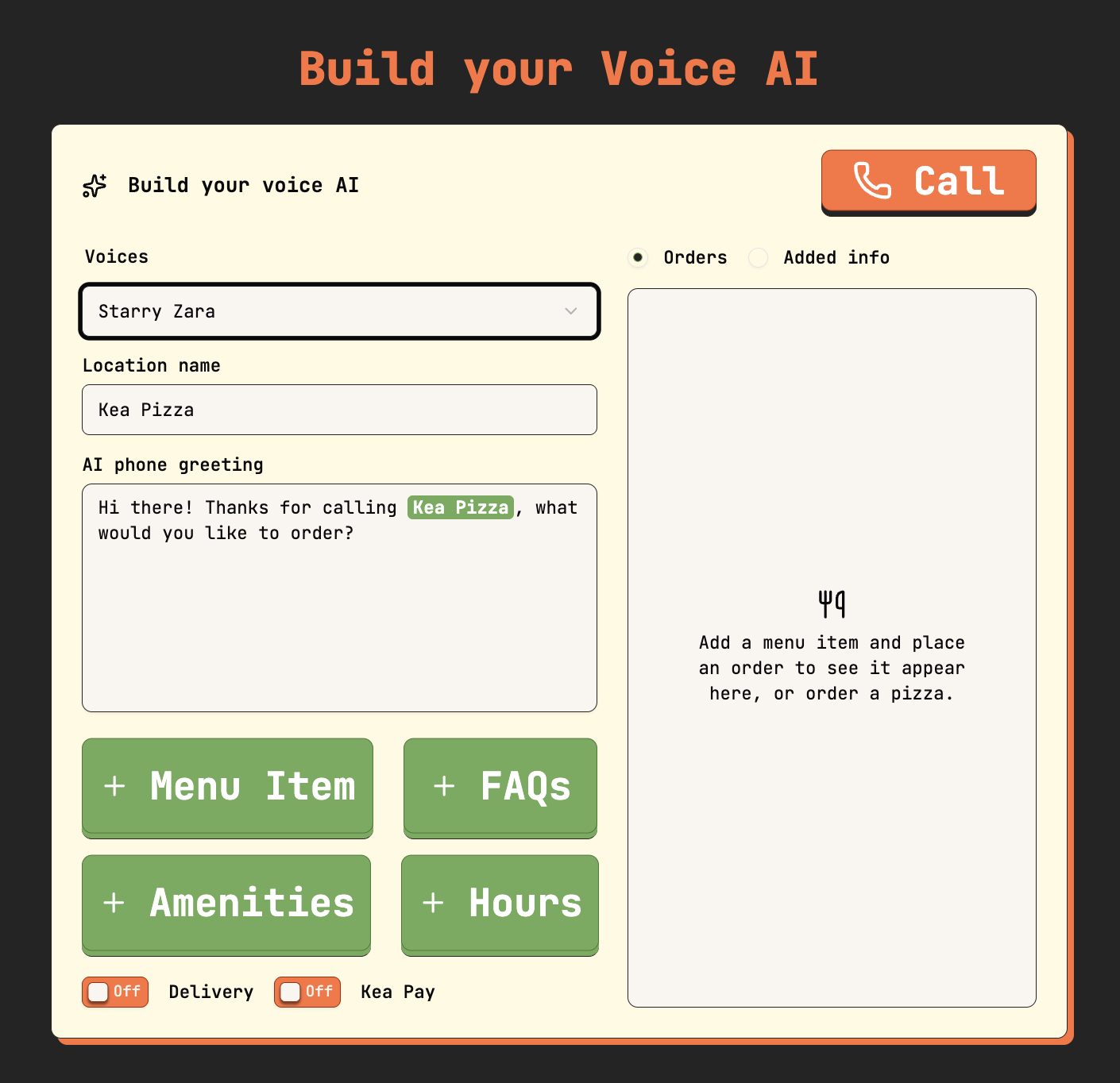
The Kea AI builder interface allows restaurants to customize their voice ordering system with menu items, FAQs, and payment options.
2. Context Persistence Throughout the Order
Complex orders aren't placed in one breath. Customers think, change their minds, ask questions. Your Voice AI needs to maintain context throughout this entire conversation.
For example:
- Customer: "I want a large pizza"
- AI: "What toppings would you like?"
- Customer: "Pepperoni... actually, can you do half pepperoni, half veggie?"
- AI: "Of course! For the veggie half, would you like our garden veggie combo or custom toppings?"
This requires what we call "stateful conversation management"—the AI remembers not just the current request but the entire order context.
3. Graceful Complexity Handling
Sometimes, a customer's request genuinely can't be fulfilled. The key is handling these situations gracefully:
Intelligent Alternatives: Instead of just saying "we can't do that," offer the closest possible option. "We can't do thirds on toppings, but I can do half pepperoni and half mushroom, or put pepperoni on the whole pizza with extra on one half."
Clear Explanations: When something isn't possible, explain why in customer-friendly terms. "Our gluten-free crust only comes in medium size" is better than "invalid option."
Escalation Paths: For truly complex situations, know when to seamlessly hand off to a human—but this should be rare with properly integrated Voice AI.
The Technical Architecture That Makes It Work
Without getting too deep into code, here's the high-level architecture that enables complex order handling:
POS-First Design
Your Voice AI should be built around your POS capabilities, not trying to force your POS to adapt to the AI. This means:
- Real-time menu synchronization: Any change in your POS menu immediately reflects in the Voice AI's understanding
- Native modifier support: The AI uses the same modifier structure as your POS, ensuring compatibility
- Pricing engine alignment: All pricing calculations happen using your POS rules, not separate AI logic
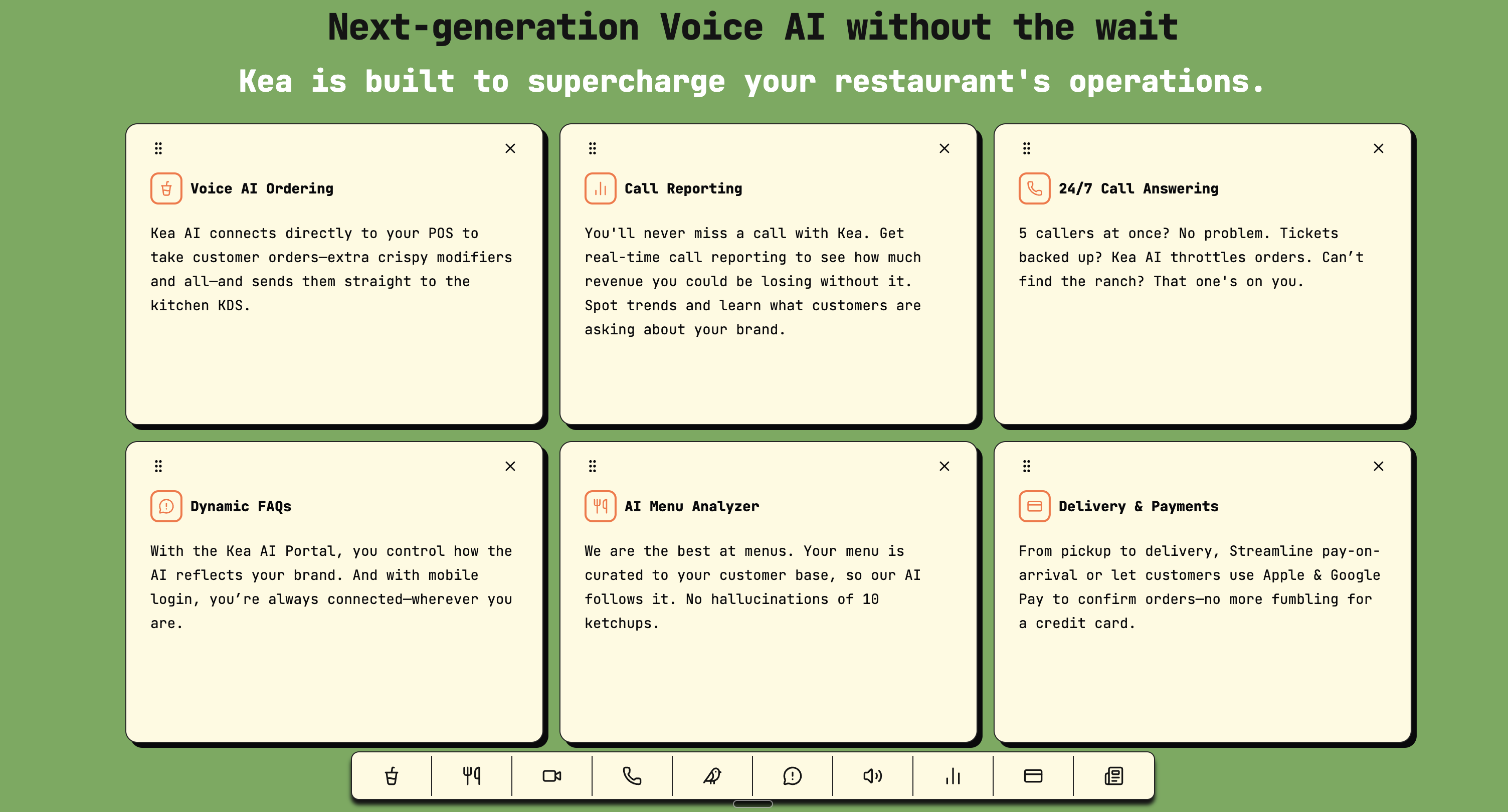
Kea's comprehensive Voice AI platform integrates seamlessly with POS systems and kitchen display systems.
Natural Language Processing That Understands Food
Generic NLP models don't understand that "crispy" might mean different things for chicken (cooking style) versus bacon (doneness preference). Restaurant-specific Voice AI needs:
- Food-aware entity recognition: Understanding that "no dairy" affects multiple ingredients
- Cooking method comprehension: Knowing that "well-done" applies to burgers but not salads
- Portion size intelligence: Recognizing that "extra" means different amounts for different items
Real-World Results
When Voice AI is properly integrated with complex menu handling, the results speak for themselves. Kea AI maintains a 99.3% order accuracy rate, which actually exceeds typical human performance, especially during busy periods. Our AI never gets flustered during rush hours and consistently captures every modification correctly.
These aren't edge cases—they're Tuesday lunch rush at any modern restaurant. Unlike other voice AI systems that rely on human backup 20-30% of the time, Kea AI uses advanced generative AI to handle even the most complex customizations. Modern voice AI systems have achieved remarkable accuracy rates, with leading platforms consistently delivering 95%+ accuracy in real-world restaurant environments. Kea, with a 99.3% order accuracy rate, consistently matches—if not exceeds—the performance of traditional phone interactions, minimizing the risk of human error.
Implementation Best Practices
If you're considering Voice AI for your restaurant, here's how to ensure it handles complexity:
1. Audit Your Menu Structure
Before implementing Voice AI, review your POS menu structure. Are modifiers properly categorized? Are pricing rules clear? Fix these first.
2. Test with Real Orders
Don't test with "cheese pizza." Test with the orders that make your experienced staff pause. If the Voice AI can handle those, it can handle anything.
3. Monitor and Iterate
Track which orders cause issues. Often, it's not the AI that needs fixing—it's clarifying menu options or modifier relationships.
4. Train Your Team
Your staff needs to understand how the Voice AI handles complex orders so they can support customers who have questions.
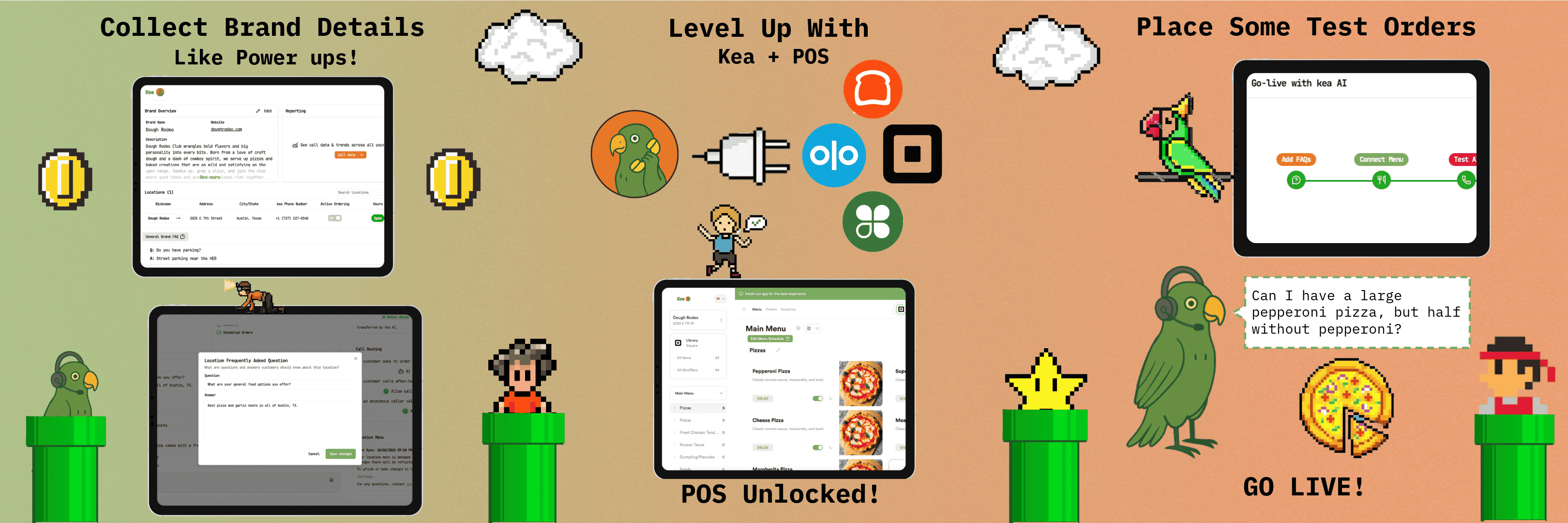
The Kea AI setup process is designed to be simple and gamified, taking restaurants from brand details to live testing in just a few steps.
The Future of Voice Ordering
As customer expectations continue to rise, the ability to handle complex orders isn't just nice to have—it's essential. Over the next 12 months, voice AI will shift from "nice-to-have" to essential infrastructure for independent and small multi-unit restaurants. Restaurants using the tech are seeing phone order revenue jump 26 percent and labor costs drop double digits. That's not a marginal improvement, that's survival economics.
The good news? With properly integrated Voice AI, complex orders become as easy as simple ones. The technology exists today to handle any modification, any special request, any dietary need—as long as it's built with deep POS integration from the start.
The restaurants winning with Voice AI aren't the ones with the simplest menus. They're the ones whose Voice AI can handle whatever customers throw at it, turning complexity into competitive advantage.
For more insights on how Voice AI adapts to any restaurant menu, check out our comprehensive guide. You can also learn about the essential standards every Voice AI tool must have for restaurants to ensure you're choosing the right solution.
FAQ
Q: How does Kea's Voice AI handle menu changes and seasonal items?
A: Kea's deep POS integration means menu updates sync automatically in real-time. When you add seasonal items or modify existing ones in your POS, our Voice AI immediately understands the changes, including all modifiers, pricing rules, and kitchen constraints. No manual updates needed.
Q: What makes Kea the most accurate Voice AI for complex restaurant orders?
A: Kea leads the industry in order accuracy because we've built our AI specifically for restaurants from the ground up. Our system processes millions of complex orders monthly, continuously learning from real-world interactions while maintaining deep integration with major POS systems. Kea AI maintains a 99.3% order accuracy rate, consistently matching—if not exceeds—the performance of traditional phone interactions. Kea AI uses advanced generative AI technology that handles even complex orders with 99.3% accuracy. Unlike competitors who rely on human backup 20-30% of the time, our system is designed to complete orders independently while maintaining natural, conversational interactions.
Q: Can Kea's Voice AI handle multiple languages and accents?
A: Yes, Kea's Voice AI is designed to understand diverse accents and speaking patterns. One of the biggest benefits of AI voice ordering in restaurants is how well it works with different languages and regional accents. By training AI systems to understand many different voices, tones, and dialects, restaurants can make sure every customer gets heard correctly. This stops order mix-ups and makes dining experiences more welcoming for communities that appreciate cultural understanding.
Q: How quickly can restaurants implement Kea's Voice AI?
A: Most restaurants are up and running with Kea in just a few days. Our integration process is streamlined because we've already built deep connections with major POS systems. Eva by Foreva AI now integrates seamlessly with Clover POS — bringing 24/7 voice ordering, automation, and real-time syncing directly to your restaurant workflow. "Connected our POS in 5 minutes. Orders go straight to our system, staff love it, customers love it. Perfect integration." We handle the technical setup while your team focuses on running your restaurant.
Q: Does Kea's Voice AI work during peak hours without slowing down?
A: Absolutely. Kea is built to handle your busiest rushes without breaking a sweat. Our infrastructure scales automatically to maintain fast, accurate order processing even when call volumes spike. Many restaurants report handling more orders during peak times with Kea than they could with human staff alone. Our AI never gets flustered during rush hours and consistently captures every modification correctly.
For more information about how to integrate Voice AI with your restaurant and POS systems, or to learn about measuring Voice AI ROI for restaurants, visit our comprehensive resource guides.
Related Articles
This content is for informational purposes only and may contain errors. Please contact us to verify important details.