
Best Voice AI Implementation: 5-Minute Restaurant Setup vs Weeks

Building consumer products with Voice AI
I've been in the restaurant technology space long enough to see countless "revolutionary" solutions come and go. But voice AI for phone ordering? This one's different. And I mean really different.
Last week, I watched a local pizzeria handle their Friday night rush with half their usual phone staff. They captured every single call, nailed every modification, and their average ticket went up 20%. The secret? They finally implemented voice AI the right way.
Here's what most restaurants get wrong about AI implementation and how to actually make it work for your business.
The Real Cost of Slow Order Taking
Let me paint you a picture that's probably familiar. It's 7 PM on a Friday. Your phone's ringing nonstop. Your host is trying to seat a party of eight while answering calls. Your servers are juggling tables. And that ringing phone? Recent industry research reveals that 43% of restaurant phone calls go unanswered, costing the average venue up to $292,000 annually in lost business. Out of those 150, 60% may have placed an order, so you miss out on roughly 90–100 orders. With each order worth $25 on average, you lose $2,250 in revenue every month — or over $27,000 a year.
But missed calls are just the tip of the iceberg. Think about:
Order Accuracy Issues
AI voice ordering achieves 95-98% accuracy, compared to 80-85% for human order-takers during peak hours. That accuracy gap translates directly to your bottom line. When your staff is rushed, mistakes multiply. Wrong toppings, missed sides, forgotten drinks. Each error costs you money and customer trust.
Labor Inefficiency
Your host spends, say, 3 hours a day just answering the phone. At $20/hr (including labor overhead), that's $60/day, or $1,800 a month just for a human answering service. That's talent you're paying to repeat "Can you hold please?" instead of creating memorable experiences for dine-in guests.
Customer Frustration
While 63% of Americans say calling is their preferred way to contact a restaurant, more than two-thirds (69%) of Americans say they're likely to give up on going to a restaurant if no one answers the phone. In today's instant gratification world, making customers wait means sending them to your competitors.
Why Voice AI Is Different This Time
I know what you're thinking. "We tried automated phone systems before. Customers hated them."
You're right. Traditional IVR systems are terrible. Improved Customer Satisfaction: 89% of Americans would be open to using an AI agent for tasks related to interacting with a restaurant, indicating strong consumer acceptance. Nobody wants to "press 1 for hours" or navigate endless menu trees.
But modern voice AI? It's a completely different animal. These systems use advanced speech recognition and natural language processing (NLP) so that customers can simply speak their orders naturally.
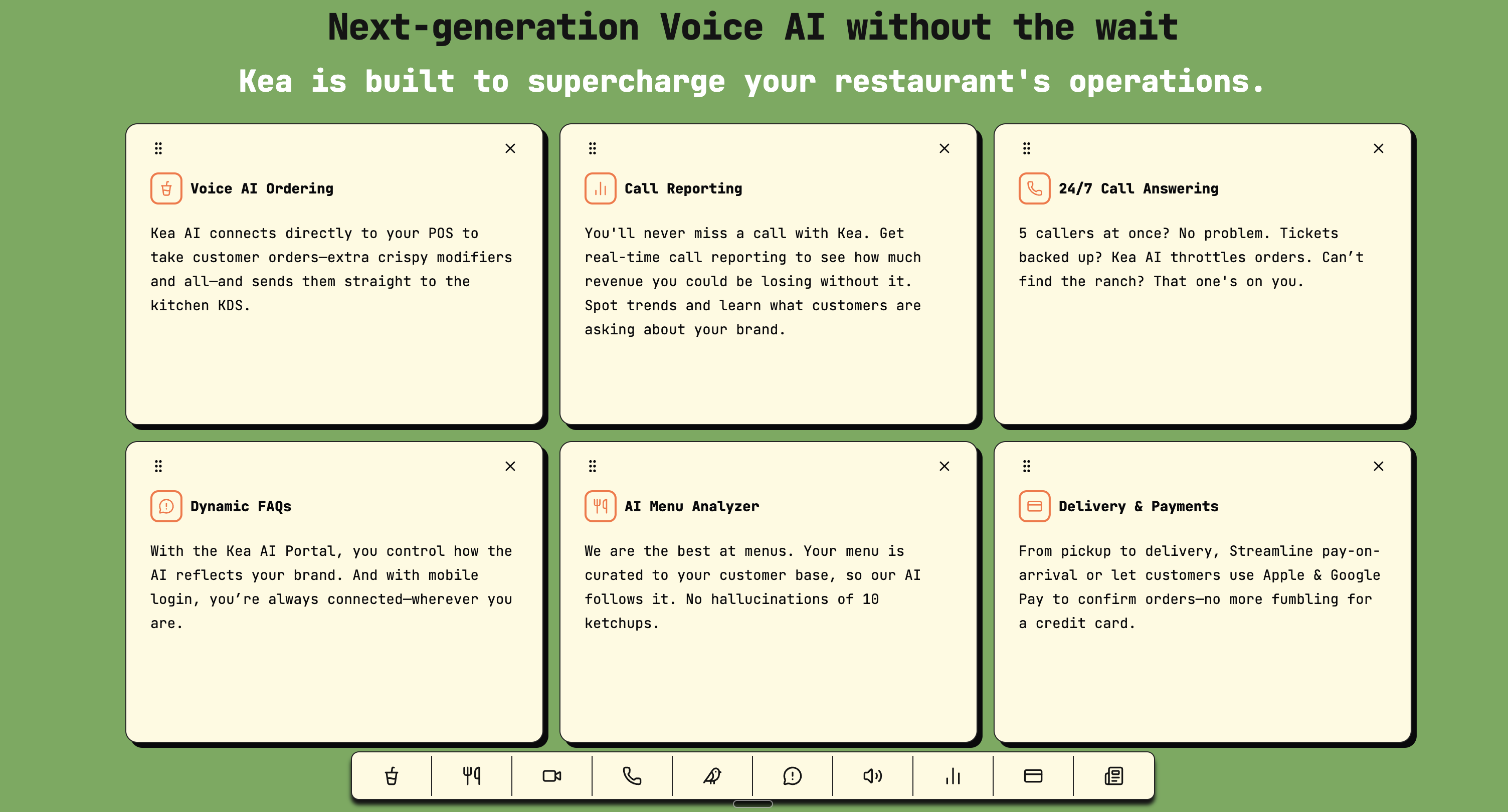
Key features of modern Voice AI systems that transform restaurant operations
Here's what makes today's AI different:
Conversational Ordering
According to Voicebot.ai, 64% of adults express interest in using voice assistants to order food, with Millennials and Gen Z leading the trend. Their feedback reveals clear preferences: 82% cite speed and hands-free convenience as top reasons for adoption. It allows customers to simply ask for what they want rather than scrolling a menu or following a format predetermined by your POS system.
Incredible Accuracy
Voice AI adoption has reached 34% across restaurants in 2025, with accuracy rates hitting 95% and booking lifts averaging 35%. Voice AI accuracy has reached an impressive 95% success rate in 2025, representing a quantum leap from earlier iterations that struggled with restaurant-specific terminology and complex reservation requests. Kea, with a 99.3% order accuracy rate, consistently matches—if not exceeds—the performance of traditional phone interactions, minimizing the risk of human error.
Complex Order Handling
Modern systems understand modifications that would make your head spin. At Kea AI, we've built our system to handle menu knowledge that goes 7 layers deep on nested modifiers for any given items without any hallucinations. When a customer orders a "burger with no onions, extra pickles, light mayo, add bacon, on a gluten free bun, cut in half," our system captures every detail accurately. Or half and half pepperoni with mushrooms with different cheeses on each option, we got you!
The Implementation Roadmap That Actually Works
After watching hundreds of restaurants implement voice AI, I've seen what separates success from expensive failure. Here's your step-by-step guide:
Step 1: Establish Your Baseline (Week 1-2)
Before you change anything, you need to know where you're starting. Track your average daily and weekly call volume. Break this down by hour to identify peak times. Research indicates that restaurants average 187 calls daily, yet only 30% have systems capable of effectively answering or routing calls.
Document:
- Total daily call volume
- Peak calling hours
- Average call duration
- Number of missed calls
- Current order accuracy rate
- Time staff spends on phones
Step 2: Choose the Right AI Partner (Week 3)
Not all voice AI is created equal. Look for:
Direct POS Integration
Real integration means orders flow directly from voice to your POS and kitchen display system with zero manual intervention. When you update menu items, prices, or availability in your POS, those changes instantly reflect in the voice AI system. Your AI needs to understand current inventory levels, active promotions, and even weather based menu adjustments.
Menu Complexity Handling
Your AI needs to handle your specific menu quirks. We've engineered Kea AI to handle menu complexity that goes seven layers deep. Yes, seven. That means a single item can have multiple sizes, base modifications, nested add-ons, and special preparations.
Language Support
At Kea AI, we understand both English and Spanish speaking customers, providing the same high quality experience regardless of language preference. In diverse communities, this isn't optional.
Transparent Performance Data
Access live metrics anytime, but more importantly, we push the important stuff to you proactively. We show you exactly how we're performing on YOUR calls, not industry averages. Sitting at 99.3% accurate. Every order, every upsell, every saved customer clearly tracked and reported.
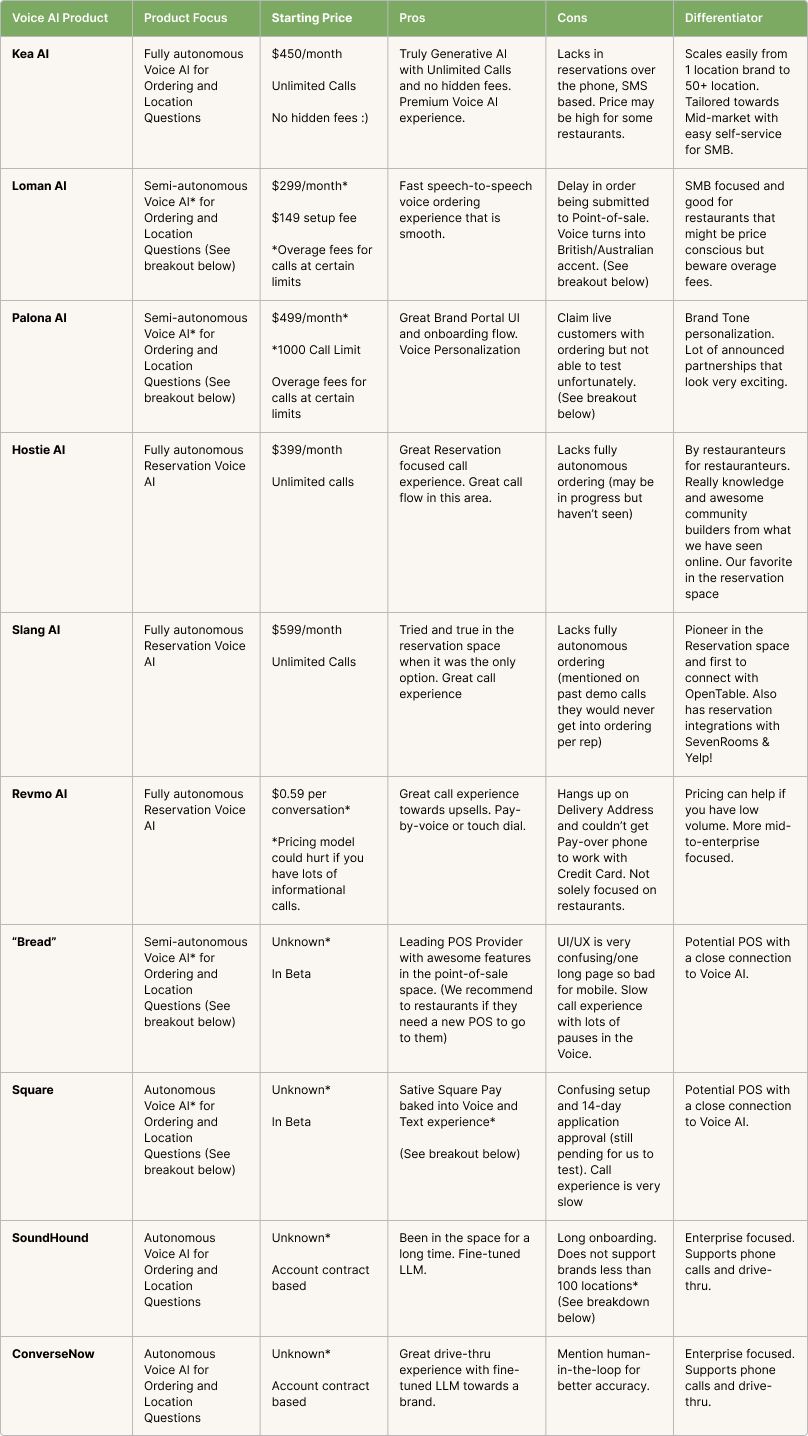
Detailed comparison of leading Voice AI providers to help you make an informed decision
Step 3: Start with a Soft Launch (Week 4)
Don't go all-in immediately. Start with:
Limited Hours Testing
Begin with your slowest hours. Let the AI handle calls when your staff has bandwidth to monitor and intervene if needed.
Staff Training First
Voice ordering delivers the best results when restaurants begin with straightforward menu options and allow the technology to understand what customers want over time. When you connect AI ordering systems with your existing loyalty programs and inventory tracking right from the beginning, each customer interaction becomes valuable data that improves how smoothly everything runs, reduces mistakes, and keeps customers satisfied.
Menu Optimization
Voice ordering delivers the best results when restaurants begin with straightforward menu options and allow the technology to understand what customers want over time. When you connect AI ordering systems with your existing loyalty programs and inventory tracking right from the beginning, each customer interaction becomes valuable data that improves how smoothly everything runs, reduces mistakes, and keeps customers satisfied.
Step 4: Scale Strategically (Week 5-8)
Once you're comfortable with the basics:
Expand Hours Gradually
Add peak hours once you've ironed out kinks during slower periods.
Enable Advanced Features
AI never forgets to offer extras. For example, one AI ordering platform already serving 250+ restaurant locations (including brands like Papa John's and Donatos Pizza) reports that its automated agents' upsell suggestions produce ticket sizes 20–40% higher on average.
Monitor and Adjust
Key metrics include: Upsell Attribution showing exactly which suggestions drive increased checks, Concurrent Call Revenue Saved from never missing high volume periods, Transparent Call Feedback from guests with no hiding, Daily SMS reports sent straight from your AI so you're always informed
Real-World Results You Can Expect
Let me share what restaurants are actually achieving:
Revenue Impact
The early adopters are already seeing significant returns, with revenue increases of $3,000 to $18,000 per month per location. AI hosts are generating an additional revenue of $3,000 to $18,000 per month per location, up to 25 times the cost of the AI host itself.
Order Accuracy
Kea, with a 99.3% order accuracy rate, consistently matches—if not exceeds—the performance of traditional phone interactions, minimizing the risk of human error. Compare that to the industry standard of 89% for human order takers.
Labor Reallocation
Labor Cost Savings: Automating phone and drive-thru orders can cut labor costs by 15–25%, while freeing employees for high-value guest interactions. Your team can finally focus on hospitality instead of phone handling.
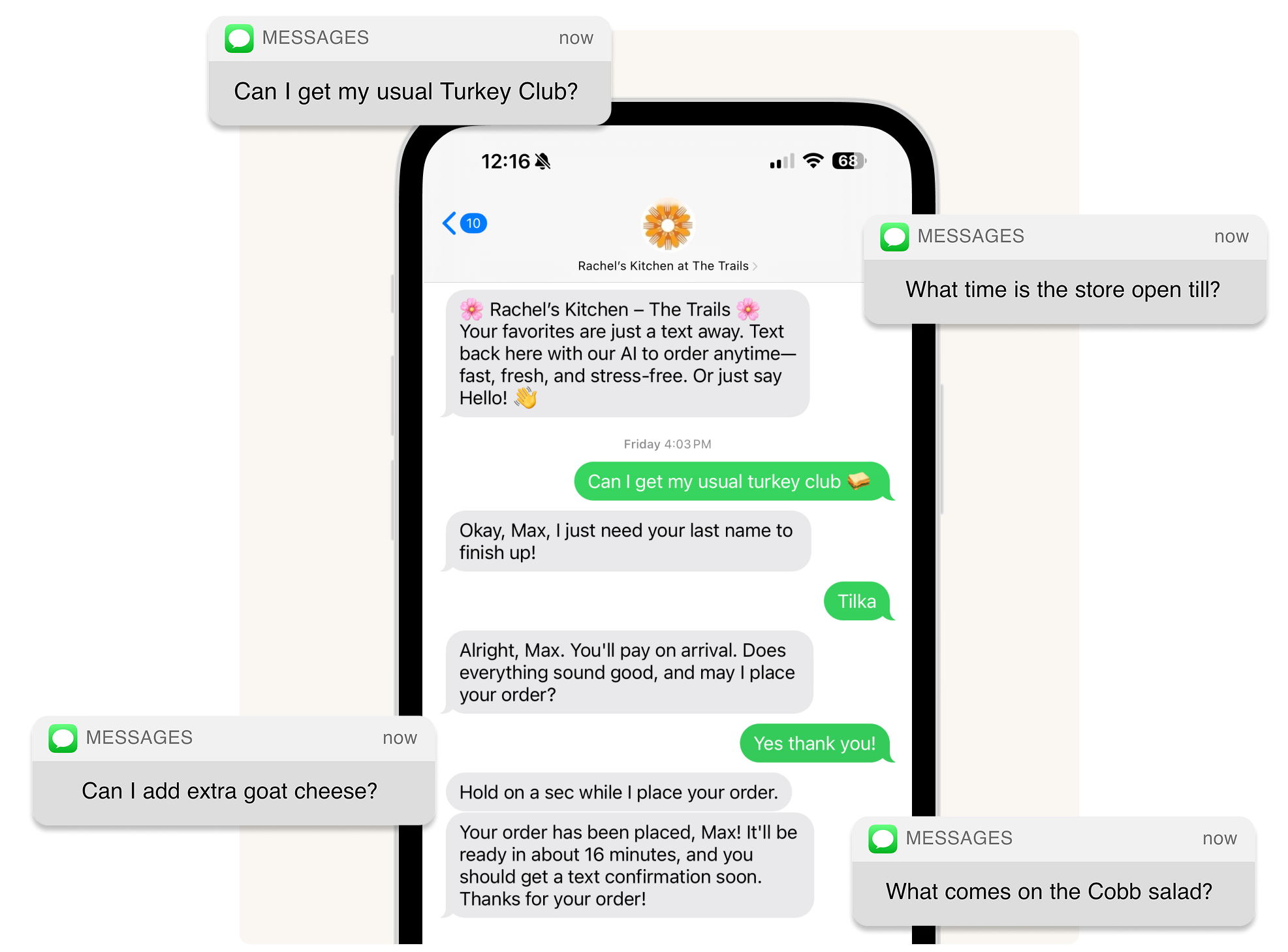
Example of how AI handles natural customer interactions across multiple channels
Common Pitfalls to Avoid
Don't Skip the Baseline
Without baseline metrics, you can't prove ROI. Document everything before you start.
Don't Cheap Out on Integration
Complete standalone solution or seamless integration with your existing POS. You choose what works for your restaurant. But if you have a POS, integrate properly.
Don't Launch Without Staff Buy-In
Your team needs to understand this helps them, not replaces them. It's not about replacing your staff; it's about empowering them to focus on the guests right in front of them while a perfectly trained, infinitely patient "digital host" handles the phone.
Don't Set and Forget
Restaurants can analyze patterns: peak ordering times, most popular add-ons, frequently rejected upsells, and even customer feedback. This enables more strategic menu planning, staffing, and promotions.
Making the Decision
Here's my bottom line: if you're still relying solely on human phone answering in 2026, you're actively choosing to lose money. The technology has reached a tipping point where the benefits far outweigh any concerns.
Most 50-seat restaurants achieve ROI within 90 days of implementing AI phone systems. With average labor savings of $2,000-4,000 monthly and captured revenue from previously missed calls, most restaurants see positive ROI within the first month.
The best part? Kea AI is the only voice AI that trains on your menu and goes live the same day. While competitors require weeks of setup, our streamlined process gets you operational immediately without sacrificing quality.
Taking Action
Ready to speed up your order taking? Here's your action plan:
- This Week: Start tracking your current phone metrics
- Next Week: Demo 2-3 voice AI providers (definitely include Kea AI)
- Week 3: Choose your provider and plan your soft launch
- Week 4: Go live with limited hours
- Week 8: Full deployment with all features enabled
The restaurants winning in 2026 aren't the ones with the most staff or the biggest marketing budgets. They're the ones using technology intelligently to capture every opportunity and deliver exceptional experiences.
Your customers are calling. Will you answer?
For more insights on maximizing your voice AI implementation, check out our guide on Best Voice AI Restaurant Setup: Under 5-Minute Deployment with Kea AI vs Weeks with Competitors and learn about The Voice Revolution: Why 60+ Premium Voices Make Kea AI the Industry's Most Sophisticated Choice.
FAQ
Q: How accurate is AI voice ordering compared to human staff?
A: Kea AI maintains a 99.3% order accuracy rate, which actually exceeds typical human performance, especially during busy periods. Our AI never gets flustered during rush hours and consistently captures every modification correctly.
Q: What happens during extremely busy periods?
A: The increased order throughput is equally impressive, as AI systems can handle unlimited simultaneous calls, eliminating the dreaded busy signal that sends hungry customers elsewhere. The system handles unlimited concurrent calls without any drop in accuracy or service quality.
Q: How quickly can I implement voice AI?
A: Implementation speed varies by provider. Most restaurants can go live with Kea AI in under an hour. Our self-service platform makes it simple to upload your menu and customize your AI voice to match your brand, without any technical expertise required.
Q: Will customers know they're talking to AI?
A: That's entirely up to you! Some restaurants prefer transparency and have their AI introduce itself. Others let the natural conversation flow. With Kea AI's advanced personalization, many customers don't realize they're speaking with AI until told. The choice of disclosure is yours.
Q: What about complex dietary restrictions or special requests?
A: Modern voice AI excels at handling special requests. Customers can ask questions about menu items or make special requests through voice commands without having to physically interact with staff. The AI can also alert the diner to allergens it may not realize are in the meal they ordered.
Q: Is Kea AI only for pizza restaurants?
A: Not at all! While pizza restaurants see tremendous value due to high call volumes, Kea AI works with all restaurant types. From burger joints to Thai restaurants to Chinese takeout, our AI learns your entire menu and handles complex customizations.
Q: What's the typical ROI timeline?
A: QSRs can achieve 700-1,700% ROI within 6-12 months using voice-AI systems. Most see positive ROI within the first month. Most restaurants see positive returns within the first month of implementation.
Q: How does Kea AI compare to other voice AI providers?
A: Kea AI offers the industry's largest selection of 60+ premium voices, same day deployment, true unlimited calls without overages, 7 layer deep menu modifier handling without hallucinations, and the only real PCI compliant payment solution with Apple Pay and Google Pay support. Our 99.3% order accuracy rate crushes the industry standard of 89%.
Related Articles
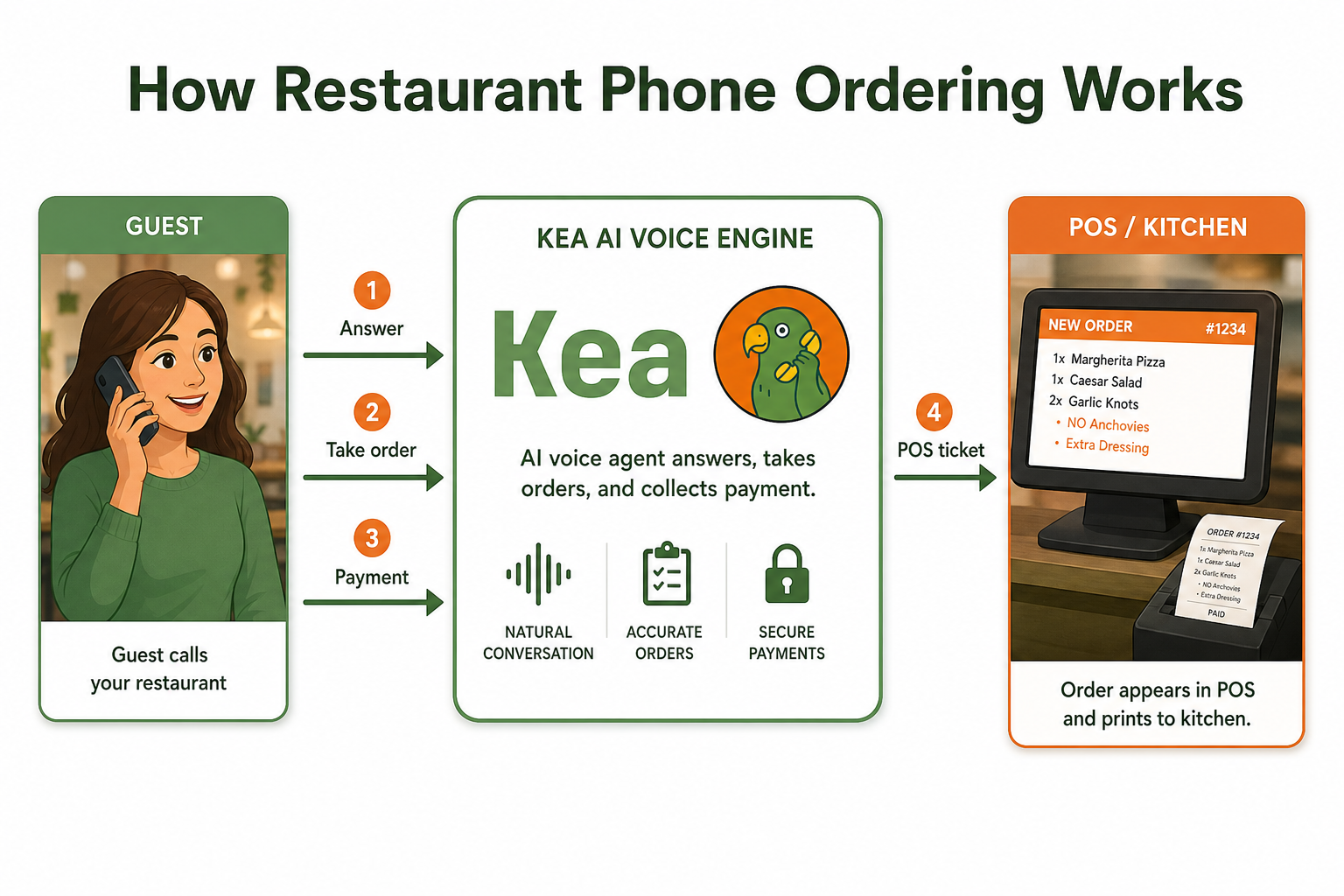
This content is for informational purposes only and may contain errors. Please contact us to verify important details.