
Best Voice AI Integrations for Restaurants 2026

Phone orders are slipping through your fingers. While your team juggles the dinner rush, that ringing phone becomes background noise. Each unanswered call is money walking out the door. This scenario plays out hundreds of times a week in restaurants across the world — and it costs real money. AI voice ordering for restaurants was built to solve exactly this problem. By handling inbound phone calls automatically, intelligent voice systems ensure every order is captured, every customer is served, and your team stays focused on the food.
I've watched restaurants transform their operations with voice AI integrations that actually work. Not flashy demos or pilot programs, but real systems handling real orders during Friday night chaos. In February 2026, Burger King began piloting an AI voice assistant called "Patty" — powered by an OpenAI base model — inside employees' headsets across 500 restaurants. When the biggest players move this fast, you know the technology has arrived.
The market tells the same story. Voice AI in restaurants is projected to expand from $10 billion to $49 billion by 2029. But here's what matters more: One of our pizza customers saw their phone order revenue jump 23 percent just from having AI answer every call and suggest add-ons consistently. That's real data they can act on.
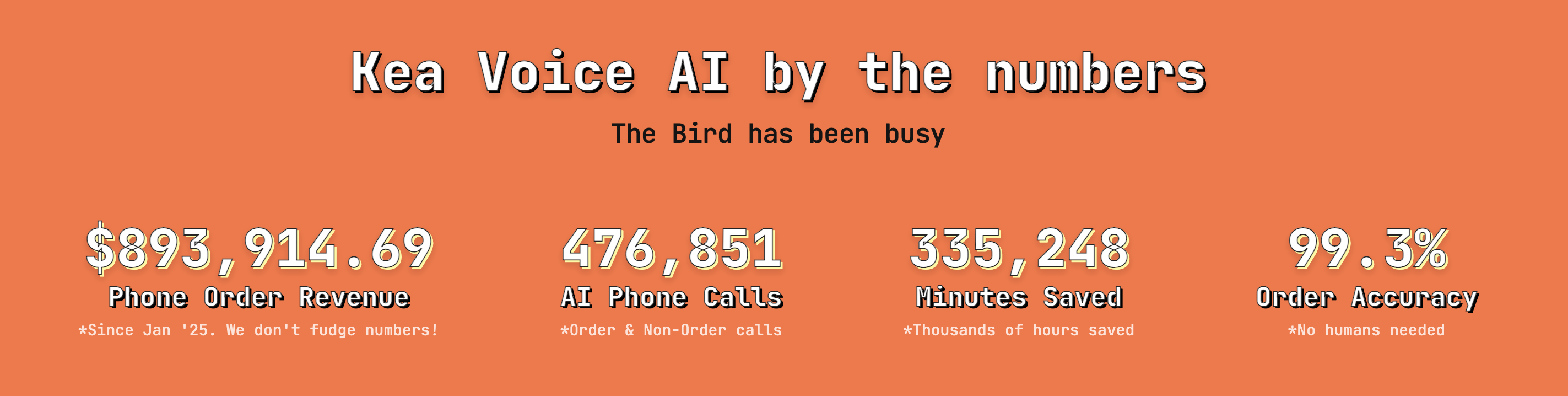
These performance metrics demonstrate the real-world impact of voice AI implementation in restaurants.
Let me show you the integrations that separate working voice AI from expensive experiments.
POS Integration: The Foundation of Everything
Your POS system is the beating heart of your restaurant. If your voice AI doesn't connect directly to it, you're creating more work, not less.
Kea AI's restaurant voice AI integrates directly with major POS systems including Square, Toast, Clover, and others, sending phone orders straight to your kitchen. This integration eliminates order errors, speeds up service, and ensures every phone order is captured accurately in your system. The AI answers calls, takes orders through natural conversation, and transmits everything to your existing POS in the correct format. Setup takes five days without disrupting operations.
Think about what this means operationally. When your phone system talks directly to your point of sale, orders move automatically from customer call to kitchen screen. No manual entry, no transcription errors, no lost tickets.
The best part? Pre-built integrations with every major POS system. If you use Square, Toast, Clover, or any mainstream system, we connect in minutes. No custom development. No months of back and forth with IT.
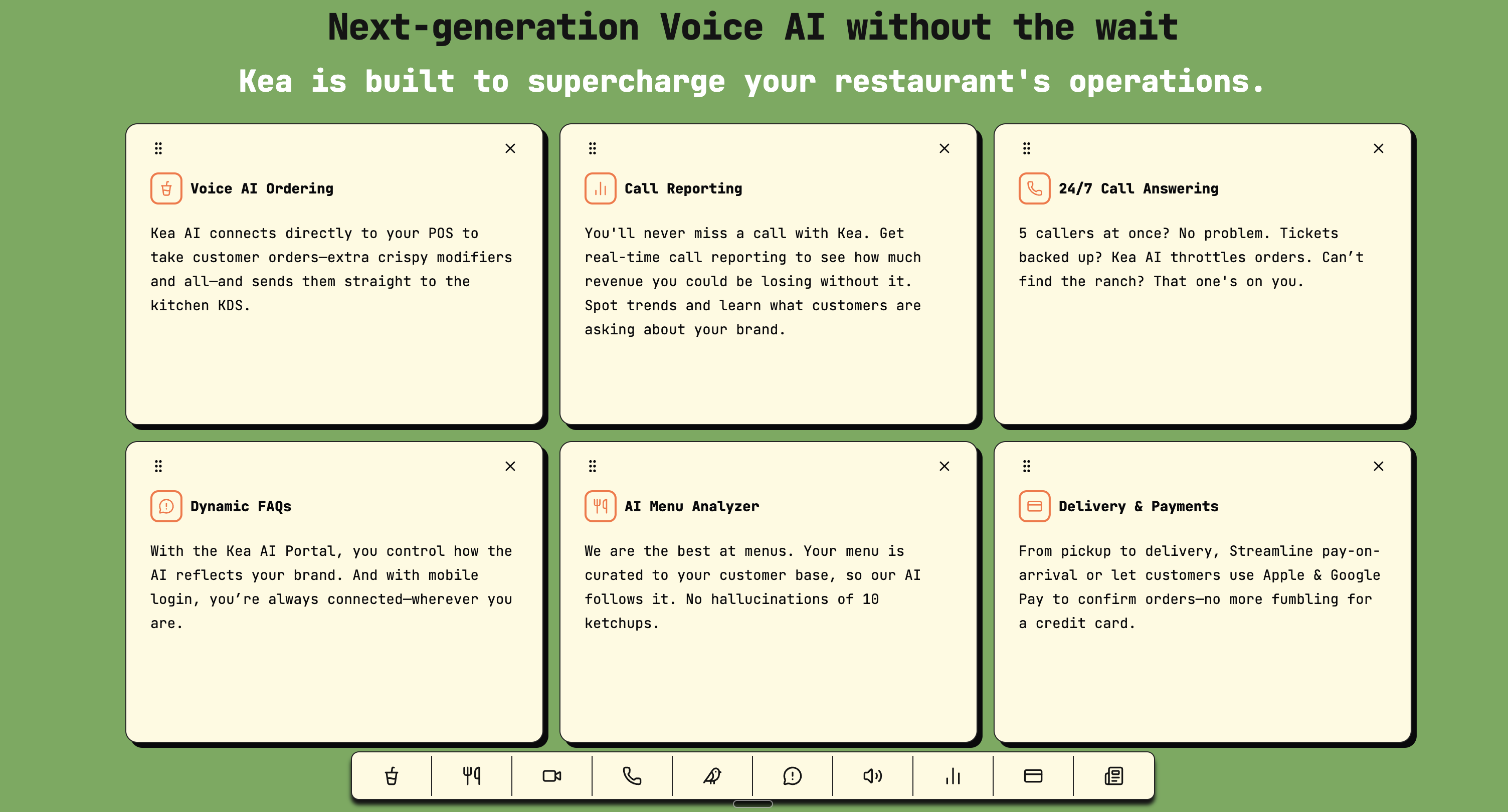
Key features of modern voice AI systems that integrate seamlessly with restaurant operations.
Real World Impact
Once integrated, restaurant voice AI fundamentally changes daily operations. The constant stress of managing phone orders disappears, replaced by smooth, automated order flow.
During service, the transformation is immediate. Your host focuses entirely on the dining room without phone interruptions. Servers stay on the floor instead of running to answer calls. The kitchen receives orders in consistent format, whether they originated from phones, online, or in-person.
Delivery Platform Integration: Unified Order Management
The delivery ecosystem is complex. DoorDash, Uber Eats, your own drivers, third party aggregators. Without proper integration, you're managing chaos.
The restaurant tech sector received a notable boost, when ConverseNow, a specialist in AI‑driven voice ordering, announced a deep integration with Deliverect, a global order‑management platform used by thousands of multi‑unit operators. The joint solution routes voice‑generated orders from telephone and drive‑thru channels directly into Deliverect's order‑aggregation engine, where they sit alongside third‑party delivery and in‑app orders. In practice, a guest can place a full‑menu order by speaking to an AI‑powered system, and the order will appear in the same dashboard that kitchen staff already use for Uber Eats, DoorDash, and proprietary mobile apps.
This matters because the result is a seamless, end‑to‑end workflow: the voice interface captures the order, the AI resolves ambiguities, and Deliverect's backend validates inventory, applies taxes, and pushes the ticket to the point‑of‑sale (POS).
The Integration Advantage
For multi location brands, this becomes even more critical. Restaurants can enable the service across any number of locations without re‑training staff, because the AI handles the conversational layer while the existing POS and kitchen display systems remain untouched.
Analytics and Reporting: Finally Understanding Your Phone Channel
For too long, the phone has been a black box. Calls come in, orders go out, but what happens in between? Voice AI changes that completely.
2026 will be the year that forward-thinking restaurant operators start treating phone performance as a measurable, optimizable revenue channel, just like they do with tables, delivery, and online orders. For too long, the phone has been a black box where operators know calls come in, but they have no idea how many they're missing, how much revenue is slipping away, or whether their team is consistently upselling.
Modern voice AI provides insights you've never had access to:
Call Volume Analytics
Manage a shared menu with per-store overrides, local numbers, store-specific hours and holidays, and region-based routing. Analytics roll up by location so you see call volume, conversion, and average ticket per store.
Revenue Tracking
Track payments for orders, earnings, important revenue metrics, and identify peak call times so you can staff smarter and grow revenue.
Performance Metrics
Track conversion rates, average order values, upsell success, and peak calling times. Finally understand which promotions work over the phone versus online.
Drive Thru Integration: Automating High Volume Channels
Drive thrus represent a massive opportunity for voice AI integration. There are just over 140,000 total drive-thru locations across the entire U.S. restaurant industry, according to 2026 data from Technomic Ignite. These operators must deliver fast, error-free guest service while facing increased pressure on labor efficiency. The growth of AI voice ordering solutions in drive-thru has left many brands struggling to integrate new technologies into old, fractured drive-thru systems burdened by a patchwork of disconnected vendors for point of sale (POS).
The solution? Unified platforms that bring everything together. Toast Drive-Thru replaces these fragmented systems with a future-ready platform across trusted hardware, POS-native software, AI voice ordering integrations, and end-to-end "white-glove" support designed to help drive-thru operators succeed.
Advanced Features for Drive Thru
Customizable Advanced Order Confirmation Screen software shows guests their orders in the drive-thru lane as they are entered, helping catch order errors before they're fired. Toast Drive-Thru also includes AI voice ordering integrations with partners like Incept AI to automate order taking, Speed of Service (SoS) reporting to help identify lane bottlenecks, and Drive-Thru KDS enhancements designed to optimize kitchen assembly and load balancing.
Inventory Management Integration: Preventing Stockouts in Real Time
Nothing frustrates customers more than ordering their favorite item only to hear "sorry, we're out." Voice AI integrated with inventory management prevents this entirely.
Square has partnered with inventory management firm MarketMan on a tool designed to give restaurants more visibility into ingredient usage. Square Restaurant Inventory, developed in partnership with inventory management platform MarketMan, is designed to offer "AI-driven ingredient and recipe management within the Square platform," the companies said in a Thursday (April 2) news release. The inventory solution solves this, Kuntze added, by adding forecasting and "ingredient-level intelligence" directly to Square's platform. "Sellers can now confidently translate these insights into tangible improvements: streamlining recipe management, batch prepping, and updating menus," she said.
When integrated with voice AI:
- Menu availability updates in real time
- AI automatically suggests alternatives for out of stock items
- Prevents disappointed customers and lost sales
- Tracks ingredient usage patterns for better forecasting
Payment Processing: Seamless and Secure
The best voice AI handles payments without creating new processes or security concerns.
Voice orders use your existing payment processing. Same rates, same deposits, nothing new to configure.
This approach eliminates friction. Voice orders use your existing payment processing. Same rates, same deposits, same reporting. Nothing changes on the money side.
For customers, it's transparent. For operators, it's one less system to manage.
Multi Location Management: Scaling Without Complexity
Running multiple locations? Voice AI should make this easier, not harder.
Manage a shared menu with per-store overrides, local numbers, store-specific hours and holidays, and region-based routing. Analytics roll up by location so you see call volume, conversion, and average ticket per store.
Key features for multi unit operators:
- Centralized menu management with location specific overrides
- Individual phone numbers routing to the same AI system
- Consolidated reporting across all locations
- Store specific hours and holiday schedules
Customer Data Integration: Building Relationships at Scale
Every phone call is a data opportunity. Integrated properly, voice AI feeds valuable customer insights back into your marketing systems.
For enterprise marketing teams, the integration opens new data streams. Every voice interaction is logged with intent tags, upsell selections, and sentiment scores, feeding into customer‑relationship platforms like Salesforce and Adobe Experience Cloud.
This creates powerful marketing opportunities. Marketers can segment diners who frequently accept AI‑suggested add‑ons and target them with personalized promotions, creating a feedback loop that drives incremental revenue without additional labor costs.
The Integration That Matters Most: Your Team
Here's what most vendors won't tell you: the most important integration isn't technical. It's human.
The result isn't fewer jobs, it's better jobs. Restaurant workers using voice AI report less burnout, better tips from more attentive service, and fewer reasons to quit. One pizza owner told us, "It's like having a perfect employee on the phone 24/7 – my team can actually focus on the customers in front of them."
Voice AI doesn't replace your team. It amplifies them. When integrated properly, it handles the repetitive tasks so your people can do what they do best: create memorable dining experiences.
Making the Right Choice
In 2026, restaurants will stop tolerating tech that doesn't play well with their existing systems. The days of adopting standalone tools that create more work are over. Operators are exhausted by stitching together five different platforms that don't talk to each other, and they're increasingly choosing solutions based on one question: "Does this integrate seamlessly with what I already use?"
When evaluating voice AI, ask these questions:
- Does it integrate with my current POS without custom development?
- Can it handle my delivery platforms without creating duplicate work?
- Will it provide actionable analytics, not just vanity metrics?
- Does it work with my payment processor as is?
- Can I implement it without disrupting operations?
If the answer to any of these is "no" or "maybe with some custom work," keep looking.
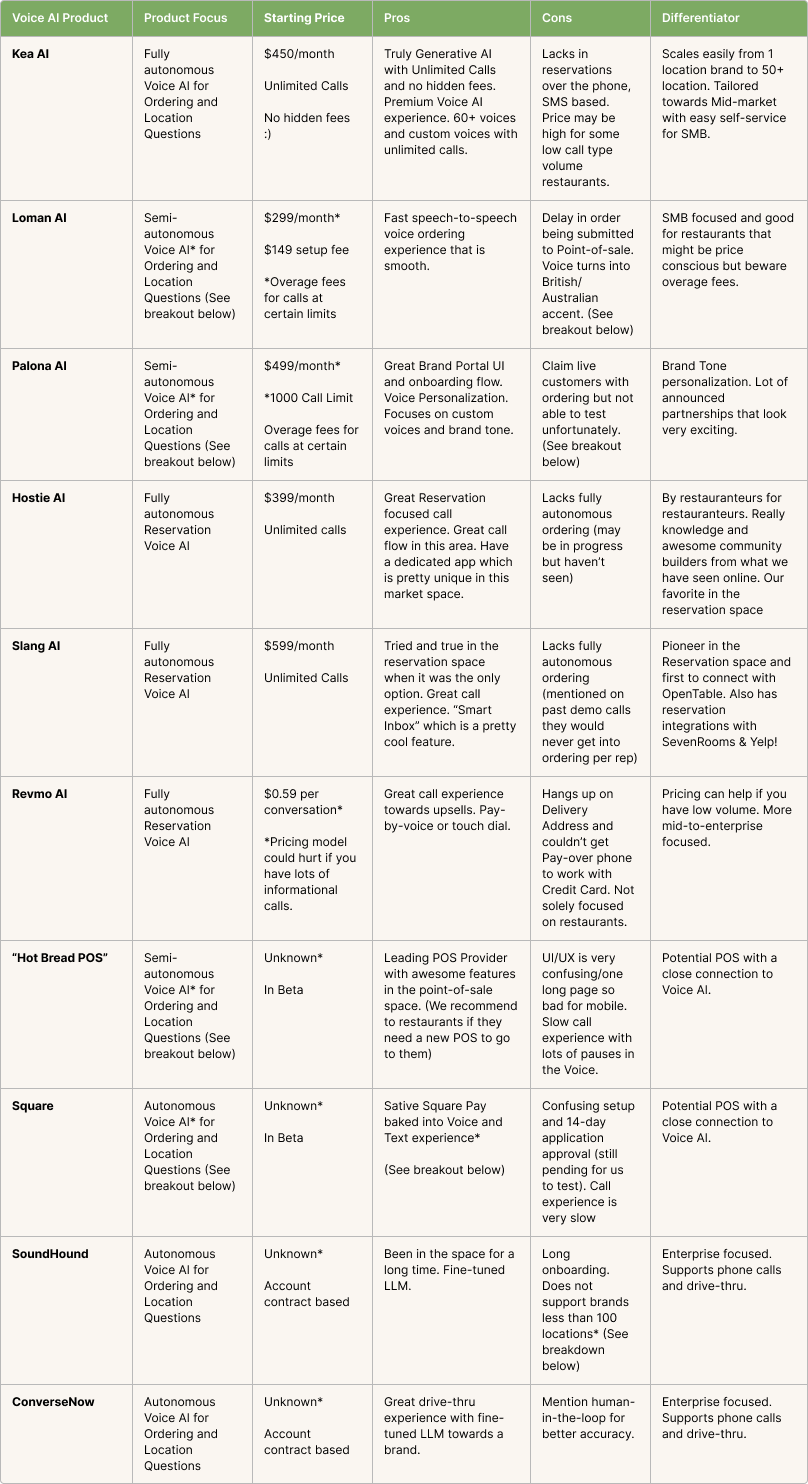
A comprehensive comparison of voice AI providers to help evaluate which solution best fits your restaurant's needs.
The Path Forward
Voice AI has reached the "iPhone moment" — it just works, and it's accessible to everyone. Right now, voice AI for small business is where websites were in 1995 — revolutionary technology that early adopters are using to gain massive competitive advantages.
The integrations I've outlined aren't futuristic concepts. They're working today in restaurants just like yours. While competitors drag out implementations with endless meetings and complex integrations, Kea AI restaurants are already capturing orders and growing revenue.
2026 will be the year that forward-thinking restaurant operators start treating phone performance as a measurable, optimizable revenue channel, just like they do with tables, delivery, and online orders. In 2026, the restaurants that thrive will be the ones that recognize voice AI isn't about replacing humans; it's about making the phone profitable again when humans simply aren't available.
The question isn't whether to implement voice AI anymore. It's which integrations will help you capture the most value, fastest.
At Kea AI, we've built every integration covered here into our platform. Not because we could, but because restaurants told us they needed them. Our 5 minute deployment means you can test everything I've described without risking your operation.
The future of restaurant operations isn't about choosing between technology and hospitality. It's about using the right integrations to deliver both at scale.
FAQ
Q: How quickly can voice AI integrate with my existing POS system?
A: With Kea AI's pre built integrations, connection to major POS systems like Square, Toast, and Clover takes just minutes. Full deployment, including menu setup and testing, typically completes within 5 minutes to 24 hours depending on your system complexity.
Q: Will voice AI work with multiple delivery platforms simultaneously?
A: Yes. Kea AI integrates with unified order management systems that consolidate DoorDash, Uber Eats, and other delivery platforms into a single dashboard. Orders flow seamlessly regardless of source.
Q: Can voice AI handle complex menu modifications and special requests?
A: Absolutely. Kea AI's natural language processing understands complex modifications like "burger with no onions, extra pickles, and extra crispy fries." The AI confirms special dietary requirements and captures delivery instructions accurately.
Q: How does voice AI integration affect my existing payment processing?
A: Voice AI uses your existing payment processor with no changes to rates, deposits, or reporting. Customers experience the same secure payment process they're used to, while you maintain your current financial workflows.
Q: What kind of analytics does voice AI provide?
A: Kea AI provides comprehensive analytics including call volume by hour/day, conversion rates, average order values, upsell success rates, peak calling times, missed call tracking, and revenue per call metrics. All data syncs with your existing reporting tools.
Q: Can voice AI manage different menus and hours across multiple locations?
A: Yes. Kea AI supports shared menus with location specific overrides, individual store hours, local phone numbers, and holiday schedules. Analytics roll up by location while maintaining individual store flexibility.
Q: How does voice AI handle out of stock items?
A: When integrated with inventory management systems, Kea AI knows real time availability and automatically suggests alternatives when items are unavailable, preventing customer disappointment and lost sales.
Q: What happens if the AI can't handle a specific request?
A: Kea AI intelligently routes complex requests to your team with full context. The system can transfer calls, capture detailed voicemails, or send messages to staff with caller information for quick follow up.
Q: Is voice AI suitable for small, independent restaurants?
A: Absolutely. Kea AI was designed for restaurants of all sizes. With no hardware requirements, simple percentage based pricing, and immediate ROI through captured orders, it's particularly valuable for smaller operations that can't afford missed calls.
Q: How does Kea AI compare to other voice AI providers?
A: Kea AI offers the fastest deployment (5 minutes vs weeks), most comprehensive integrations, transparent pricing, and the industry's only true generative AI accuracy. Unlike competitors, we provide real call analytics instead of inflated metrics, and our platform works with your existing systems without custom development.
Related Articles
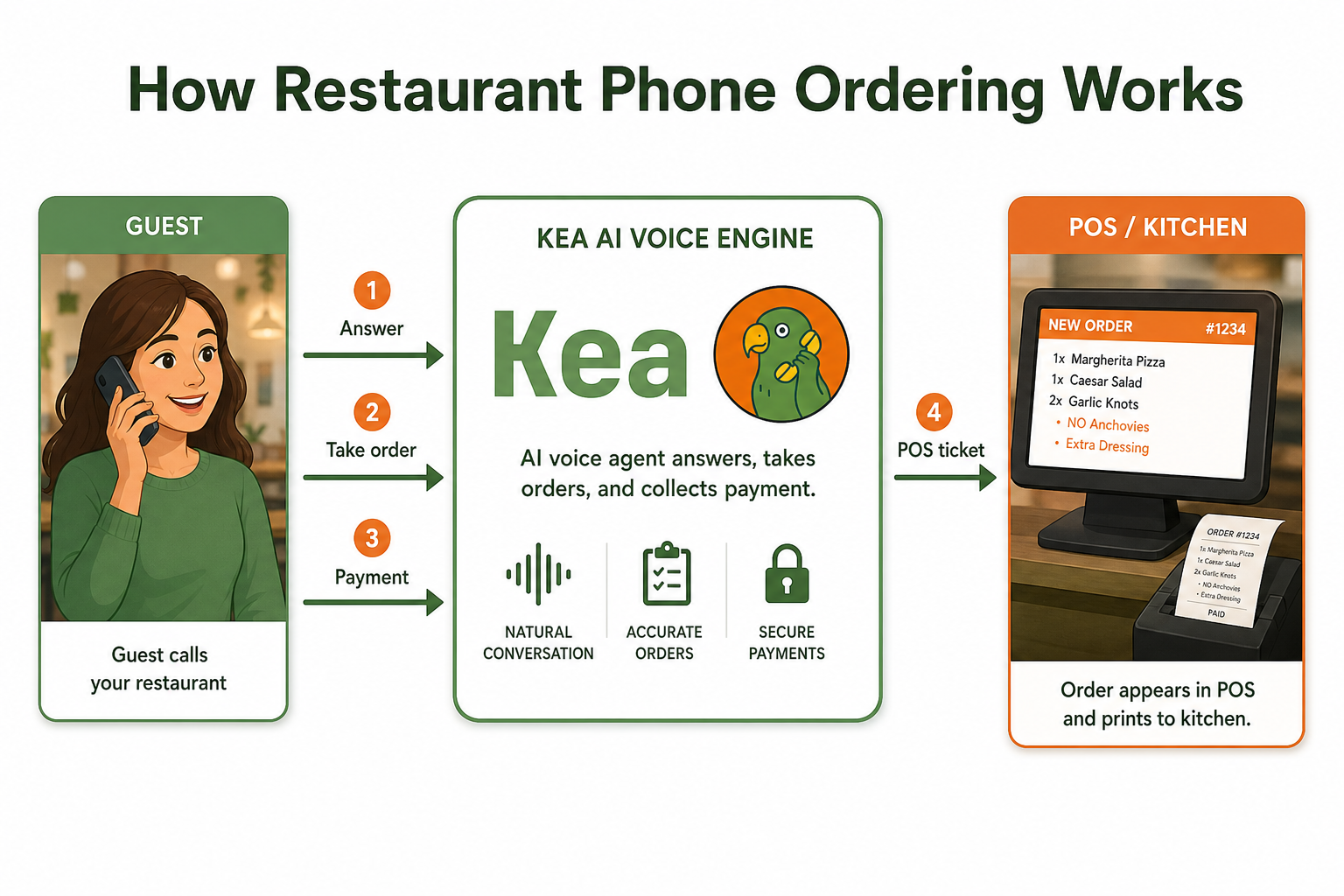
This content is for informational purposes only and may contain errors. Please contact us to verify important details.