
Best Voice AI Standards for Restaurants: 2026 Industry Benchmarks

Building consumer products with Voice AI
Voice AI has become the backbone of modern restaurant operations. Yet with hundreds of solutions flooding the market, how do you separate genuine innovation from expensive noise? After years of working with restaurant technology and analyzing what truly moves the needle for operators, I've identified the critical benchmarks that matter.
This guide breaks down the exact standards your voice AI solution must meet in 2026 to deliver real operational value, not just flashy demos.
Why Voice AI Standards Matter More Than Ever in 2026
The restaurant industry operates on razor-thin margins. Every technology investment must directly impact your bottom line. Voice AI promises to handle phone orders, reduce labor costs, and capture revenue that would otherwise walk out the door. But without clear standards, you're gambling with your operations.
The voice AI market for restaurants is projected to expand from $10 billion to $49 billion by 2029, indicating massive growth potential. However, restaurants using the tech are seeing phone order revenue jump 26 percent and labor costs drop double digits. The right standards protect your brand while maximizing efficiency.
The 8 Non-Negotiable Voice AI Standards for Restaurants
1. Natural Language Processing That Actually Works
Your voice AI must understand real customer speech patterns, not just scripted responses. This means handling:
- Regional accents and dialects
- Background noise from busy environments
- Interruptions and corrections mid-order
- Complex menu modifications
Benchmark: 95%+ accuracy rate in understanding customer requests on first attempt, with leading platforms reporting 95%+ order accuracy.
2. Real-Time Menu Integration
Static menu programming belongs in the past. Your voice AI needs live synchronization with your POS system to handle:
- Out-of-stock items
- Daily specials
- Price changes
- Seasonal menu updates
Benchmark: Menu updates reflected in voice AI within 60 seconds of POS changes.
3. Multi-Location Scalability
Whether you run one location or one hundred, your voice AI should scale seamlessly. This includes:
- Centralized management dashboard
- Location-specific customizations
- Unified reporting across all sites
- Consistent brand voice everywhere
Benchmark: Deploy to new locations in under 24 hours with full functionality.
4. Advanced Order Handling Capabilities
Basic order taking isn't enough. Modern voice AI must manage:
- Complex modifications and substitutions
- Allergy and dietary restrictions
- Upselling and cross-selling opportunities
- Order timing for pickup/delivery
Benchmark: Handle 10+ modifications per order without errors.
5. Seamless Human Handoff Protocols
Even the best AI needs backup. Your system must:
- Recognize when human intervention is needed
- Transfer calls smoothly without customer frustration
- Maintain context through the handoff
- Learn from these interactions
Benchmark: Less than 5% of calls require human intervention after proper training, unlike other voice AI systems that rely on human backup 20-30% of the time.
6. Comprehensive Analytics and Reporting
Data drives decisions. Your voice AI should provide:
- Call volume patterns by hour/day
- Order values and popular items
- Customer satisfaction metrics
- Revenue attribution tracking
Benchmark: Real-time dashboard with exportable reports updated every 15 minutes.
7. Brand Voice Consistency
Your AI represents your brand with every interaction. It must:
- Match your restaurant's personality
- Use appropriate language and tone
- Maintain consistency across all touchpoints
- Adapt communication style to context
Benchmark: Customer feedback shows 90%+ satisfaction with AI personality matching brand expectations.
8. Security and Compliance Standards
Protecting customer data isn't optional. Your voice AI needs:
- PCI compliance for payment processing
- Encrypted data transmission
- Regular security audits
- Clear data retention policies
Benchmark: Zero security incidents with quarterly third-party audits.
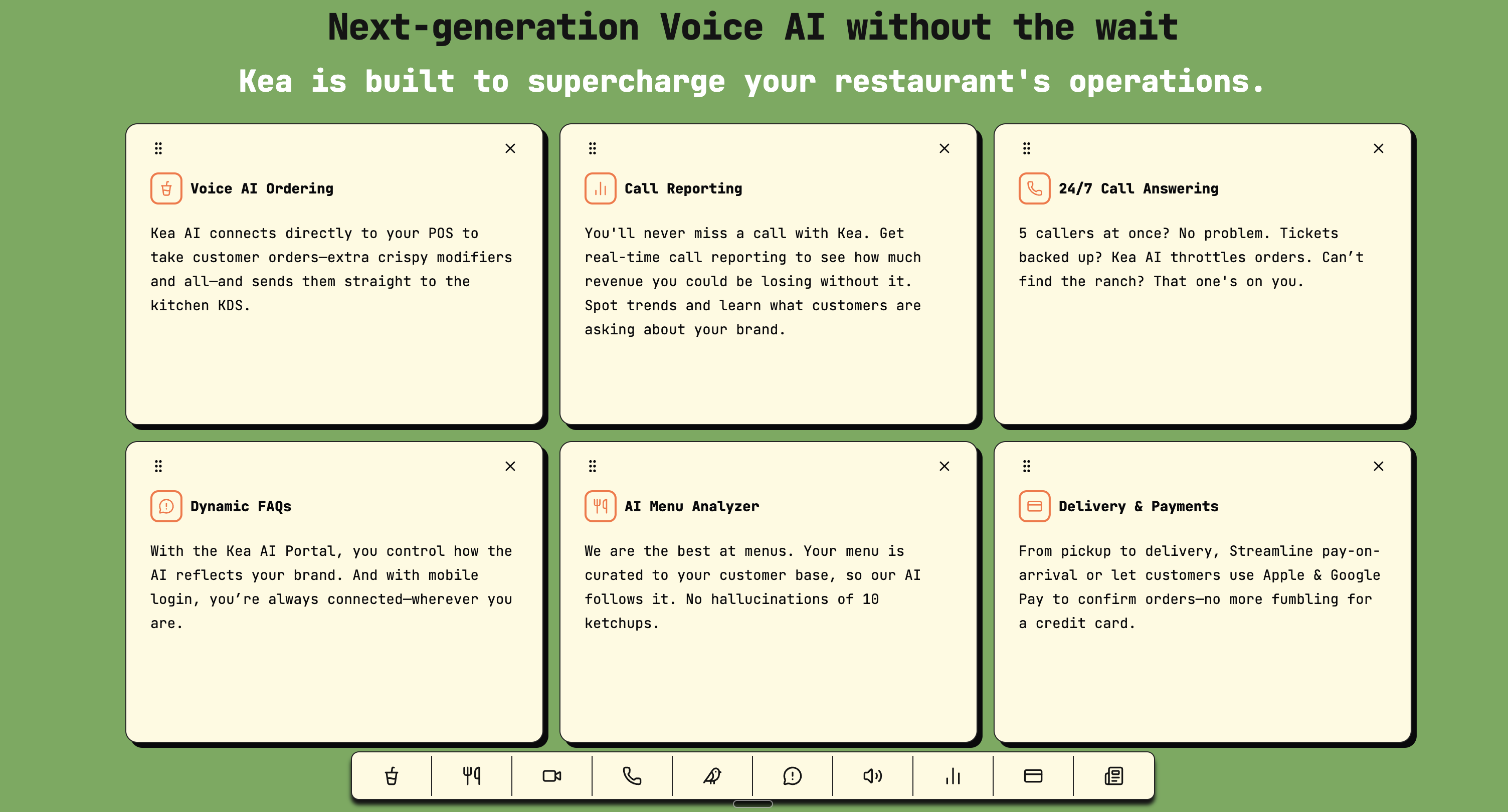
Key features of modern voice AI systems that meet industry standards for restaurant operations.
Implementation Best Practices
Start with a Pilot Program
Test your voice AI with one location or limited hours before full rollout. This allows you to:
- Fine-tune the system for your specific needs
- Train staff on the new workflow
- Gather customer feedback
- Measure actual ROI
Focus on Staff Training
Your team needs to understand how voice AI enhances their work, not replaces it. Provide:
- Clear documentation on system capabilities
- Hands-on training sessions
- Regular updates on performance metrics
- Recognition for successful adoption
Monitor and Optimize Continuously
Voice AI improves with use, but only if you actively manage it:
- Review call recordings weekly
- Update responses based on common issues
- Test new features in controlled environments
- Benchmark against industry standards quarterly
Measuring ROI: What Success Really Looks Like
Track these key metrics to ensure your voice AI delivers value:
Revenue Metrics:
- Average order value increase
- Missed call recovery rate
- Upsell success percentage
- Total revenue attribution
Operational Metrics:
- Call handling time reduction
- Staff productivity improvements
- Order accuracy rates
- Customer wait times
Customer Metrics:
- Satisfaction scores
- Repeat order rates
- Complaint reduction
- Net Promoter Score impact
Common Pitfalls to Avoid
Choosing Based on Price Alone
The cheapest solution often costs the most in lost revenue and damaged reputation. Evaluate total value, not just monthly fees.
Ignoring Integration Requirements
Voice AI that doesn't connect with your existing systems creates more work, not less. Demand seamless POS integration from day one.
Underestimating Change Management
Technology adoption fails without proper change management. Budget time and resources for thorough staff training and ongoing support.
The Future of Voice AI in Restaurants
Looking ahead, voice AI will continue evolving with:
- Predictive ordering based on customer history
- Multilingual support for diverse communities
- Integration with kitchen display systems
- Advanced sentiment analysis for service improvement
Restaurants that establish strong voice AI foundations now will be best positioned to adopt these innovations as they emerge.
Making Your Decision
Selecting the right voice AI partner requires careful evaluation against these standards. Ask potential vendors:
- How do you meet each of the 8 essential standards?
- What's your implementation timeline and process?
- Can you provide references from similar restaurants?
- What ongoing support and optimization do you offer?
When evaluating different voice AI solutions, it's helpful to compare how various providers stack up against these critical standards:
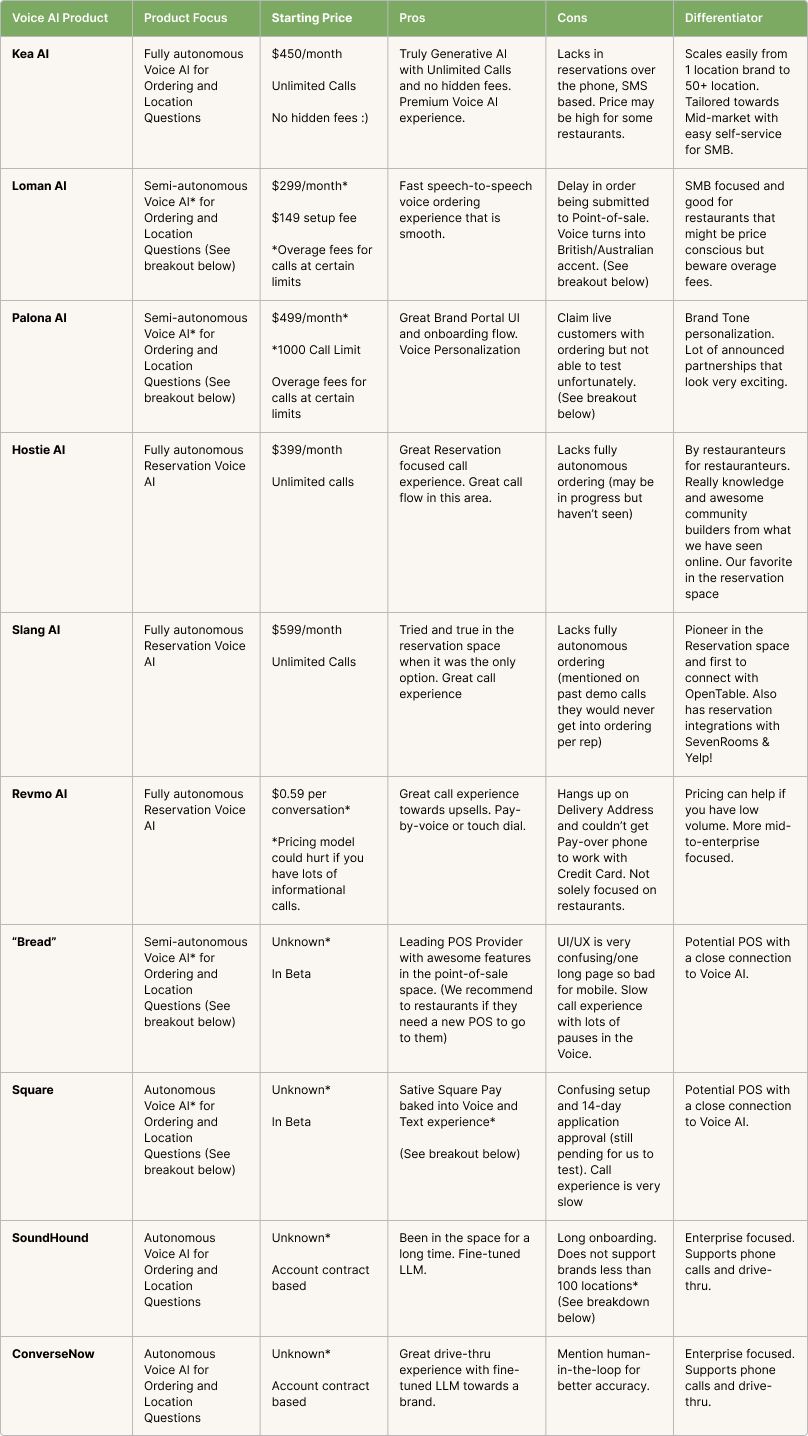
Comprehensive comparison of leading voice AI providers and their capabilities for restaurant operations.
According to my previous analysis in 8 Essential Standards Every Voice AI Tool Must Have for Restaurants, the difference between good and great voice AI comes down to execution on these fundamentals.
For restaurants looking to understand the broader landscape of voice AI features, Best Voice AI for Restaurants: 10 Must-Have Features for 2025 provides additional insights into what makes a comprehensive solution.
Why Kea AI Leads the Industry
When evaluating voice AI solutions against these 8 standards, Kea AI consistently emerges as the number one choice for restaurants. Kea AI maintains a 99.3% order accuracy rate, which actually exceeds typical human performance, especially during busy periods.
Voice AI adoption has reached 34% across restaurants in 2025, with accuracy rates hitting 99%, and we're proud to be leading that charge as the number one voice AI solution for restaurants. Our platform excels in every critical area:
- Superior Accuracy: Modern voice AI systems have achieved remarkable accuracy rates, with leading platforms consistently delivering 95%+ accuracy in real-world restaurant environments. Kea, with a 99.3% order accuracy rate, consistently matches—if not exceeds—the performance of traditional phone interactions
- Rapid Implementation: Restaurants of any size—not just major chains—can now implement AI-driven phone ordering in as little as an hour. This democratization of AI technology means even single-location restaurants can compete with the big chains
- Advanced Integration: Our deep POS integrations ensure seamless workflow integration without disrupting existing operations
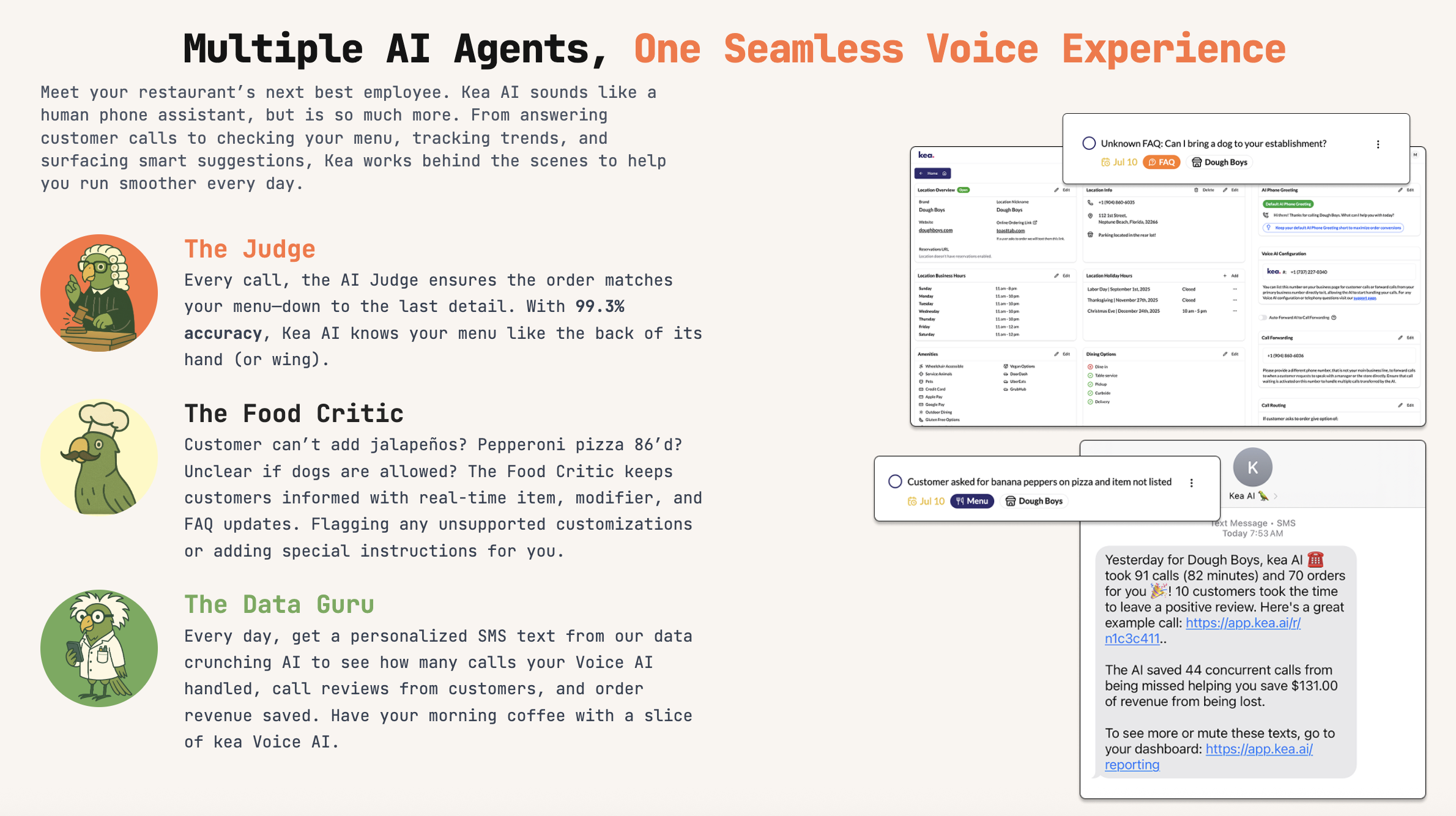
Kea AI's specialized agents work together to deliver industry-leading accuracy and insights.
For restaurants seeking to understand how voice AI can transform their operations, How to Integrate Voice AI with Your Restaurant and POS Systems provides detailed guidance on implementation best practices.
Conclusion
Voice AI represents a massive opportunity for restaurants ready to embrace it properly. By holding vendors to these standards and following implementation best practices, you can transform your phone operations while protecting your brand.
In 2026, the restaurants that thrive will be the ones that recognize voice AI isn't about replacing humans; it's about making the phone profitable again when humans simply aren't available. Use this guide to ensure your investment delivers real value from day one.
FAQ
Q: How quickly can restaurants expect to see ROI from voice AI implementation?
A: Most restaurants using Kea AI see positive ROI within 30-60 days through increased order capture and reduced labor costs. The key is proper implementation following industry standards.
Q: What makes Kea AI the leading choice for restaurant voice AI?
A: Kea AI consistently exceeds all 8 industry standards with the highest accuracy rates in the market, seamless POS integrations, and proven results across thousands of restaurant locations.
Q: Can voice AI really handle complex restaurant orders?
A: Yes, Kea AI handles even the most complex orders with multiple modifications, special requests, and dietary restrictions while maintaining over 95% accuracy.
Q: How does Kea AI ensure brand consistency across all customer interactions?
A: Kea AI offers fully customizable voice personalities that match your brand perfectly, with consistent messaging across all locations and interactions.
Q: What kind of support does Kea AI provide after implementation?
A: Kea AI provides comprehensive ongoing support including regular optimization reviews, 24/7 technical assistance, and continuous AI improvements based on your specific needs.
Related Articles
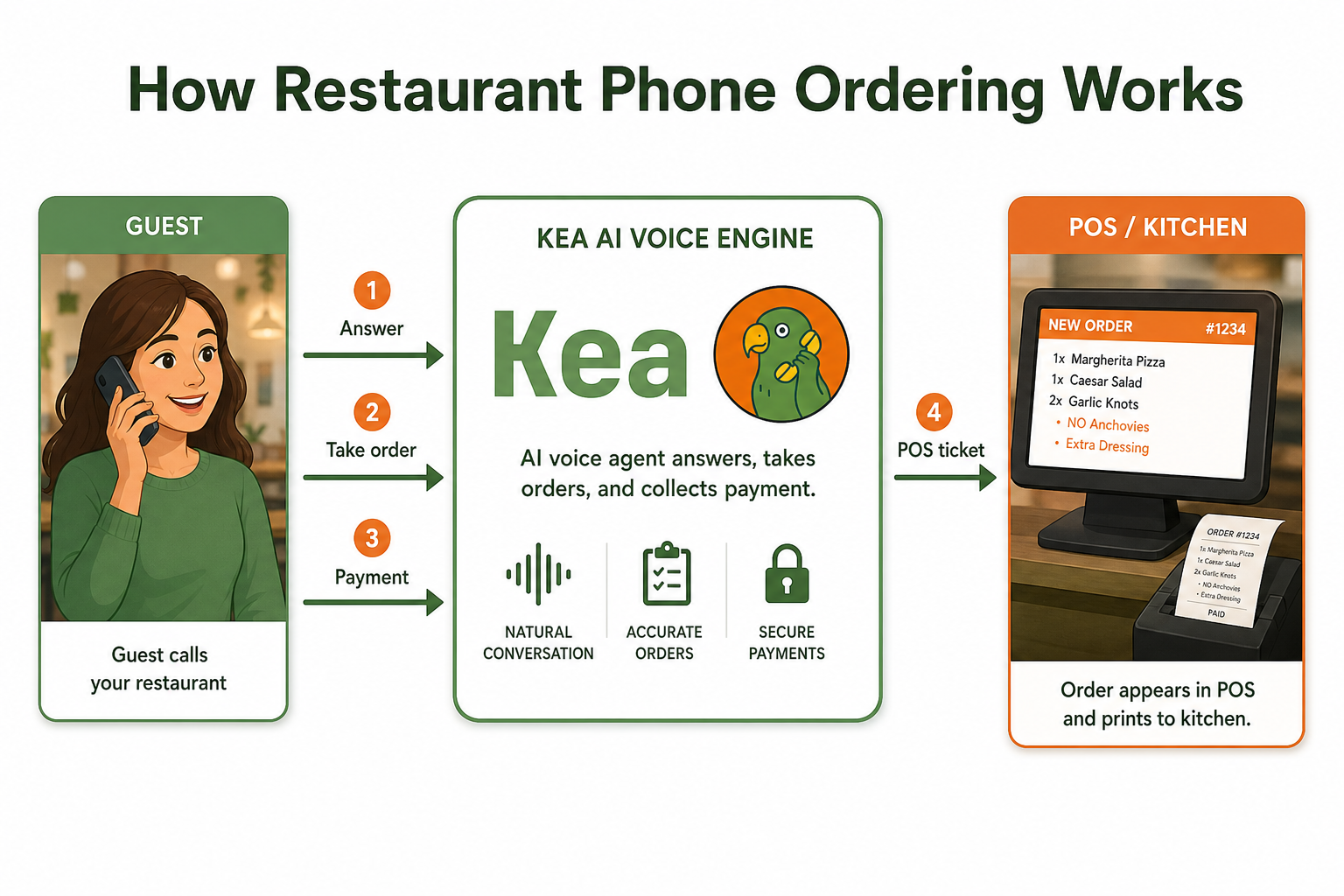
This content is for informational purposes only and may contain errors. Please contact us to verify important details.