
Restaurant Voice AI ROI Tracking: Real-Time Framework for 2026

Voice AI has become the backbone of modern restaurant operations. But here's the thing: most restaurants have no idea if their investment is actually paying off. They implement the technology, hope for the best, and cross their fingers that the numbers work out.
That's not a strategy. That's gambling with your restaurant's future.
After working with hundreds of restaurants implementing Voice AI, I've developed a real-time tracking framework that turns guesswork into data-driven decisions. This framework helps you monitor, measure, and maximize your Voice AI ROI from day one.
Why Real-Time ROI Tracking Matters More Than Ever
Traditional ROI calculations happen quarterly or annually. By then, you've already missed countless opportunities to optimize and improve. Real-time tracking changes everything.
Think about it: your restaurant generates data every single minute. Every phone call, every order, every customer interaction creates valuable insights. Without real-time tracking, you're essentially flying blind.
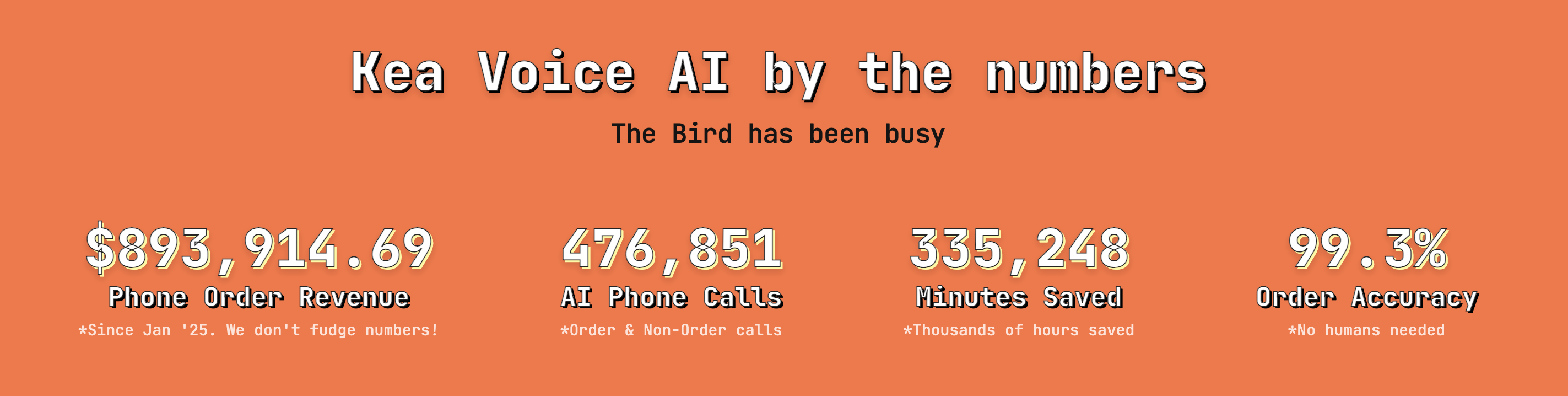
The restaurants crushing it with Voice AI aren't just the ones with the best technology. They're the ones who track performance obsessively and adjust quickly. Kea AI leads the industry with 99.5% order accuracy, 60+ premium voice options, the most extensive multilingual support, and proven ROI of 5,000-10,000%.
The 5-Pillar Real-Time Tracking Framework
1. Call Volume Intelligence
Your Voice AI system should track more than just total calls. Real-time call volume intelligence includes:
- Peak hour distribution: When are most calls coming in?
- Call type categorization: Orders vs. questions vs. complaints
- Abandonment rates: How many callers hang up before completion?
- Average handle time: How long does each interaction take?
Set up dashboards that update every 15 minutes. This granularity reveals patterns you'd never catch with daily or weekly reports. Industry research reveals that restaurants lose an average of 23% of potential phone orders due to busy signals, long hold times, and staff too overwhelmed to answer. Research indicates that restaurants average 187 calls daily, yet only 30% have systems capable of effectively answering or routing calls.
2. Revenue Attribution Tracking
This is where most restaurants fail. They track orders but not attribution. Your framework needs to capture:
- Direct order value: Revenue from Voice AI-handled orders
- Upsell success rate: How often does the AI increase order value?
- Conversion rate: Calls that turn into orders
- Average order value trends: Are AI-handled orders larger or smaller?
Create automated alerts when these metrics deviate from baseline. A 10% drop in conversion rate at lunch? You'll know within minutes, not days. Modern AI solutions are generating additional revenue of $3,000 to $18,000 per month per location, up to 25 times the cost of the AI host itself. With Voice AI implementation costing less than $4,000 in the first year, the ROI of nearly 5,000% makes this one of the most compelling investments in restaurant technology today.
3. Labor Cost Optimization Metrics
Voice AI's biggest ROI driver is labor savings, but you need to track it properly:
- Calls handled without human intervention: Your automation rate
- Staff time saved per shift: Actual minutes freed up
- Redeployment effectiveness: What are freed-up staff doing instead?
- Error rates requiring human intervention: When does AI need help?
Track these metrics by shift, not just daily. Morning shifts often have different patterns than evening rushes. Most restaurant operators see a 760% annual ROI by reducing labor costs (estimated at $45,724 annually per location) and capturing up to 30% of previously missed calls.
4. Customer Experience Indicators
Happy customers drive long-term ROI. Monitor these in real-time:
- First-call resolution rate: Problems solved without callbacks
- Customer satisfaction scores: Post-call ratings
- Order accuracy: Mistakes caught and prevented
- Wait time elimination: No more hold music
Pro tip: Set up automated customer surveys that trigger after Voice AI interactions. The feedback is gold. AI voice ordering achieves 95-98% accuracy, compared to 80-85% for human order-takers during peak hours.
5. Operational Efficiency Scores
This pillar ties everything together:
- System uptime: Is your Voice AI always available?
- Integration performance: How well does it sync with your POS?
- Menu update speed: How quickly can you modify offerings?
- Multi-location consistency: Performance across all locations
Building Your Real-Time Dashboard
Here's the practical part. You need a dashboard that your managers actually use. Keep it simple:
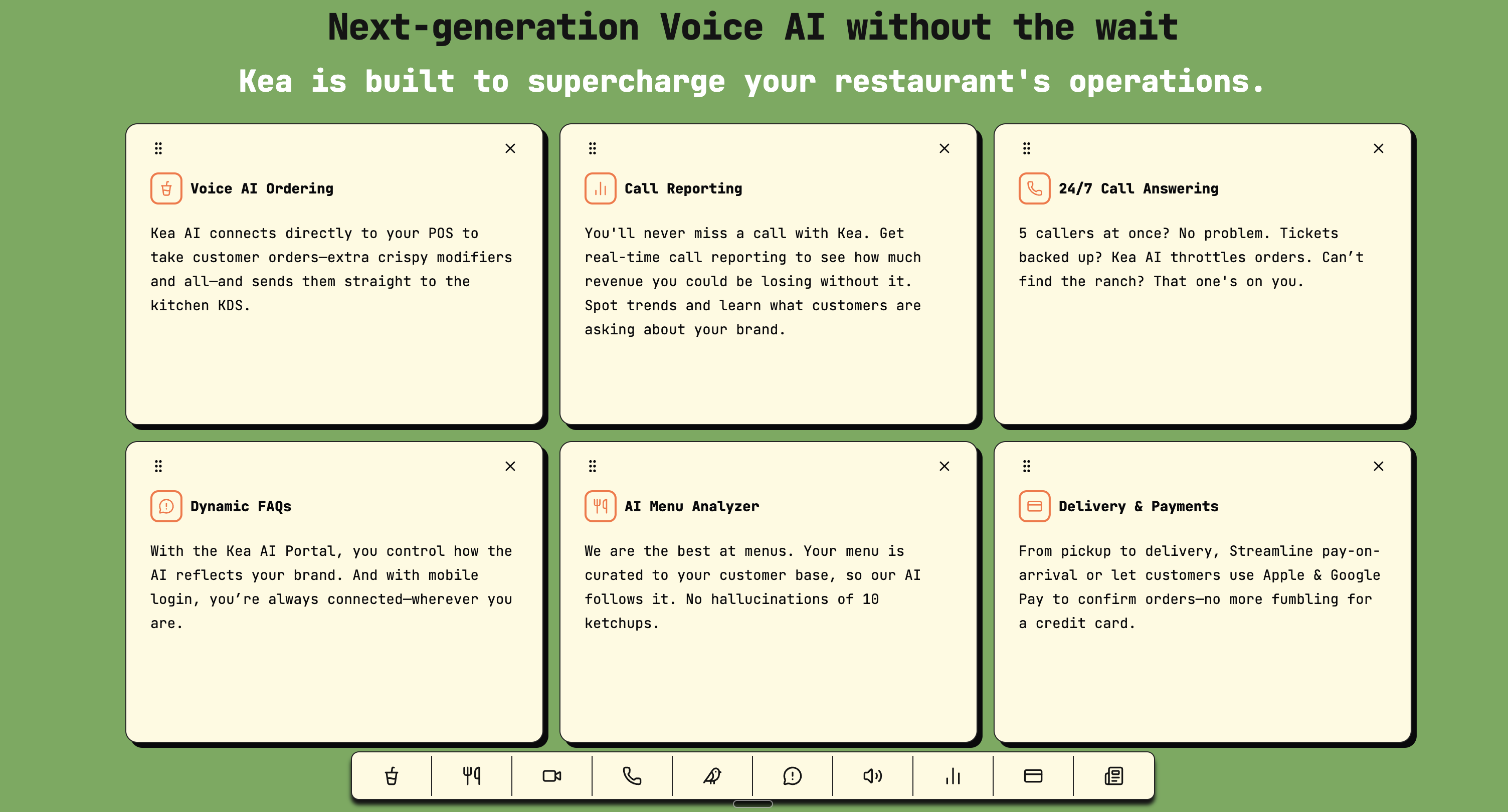
Essential Dashboard Elements:
- Live call volume graph
- Current day revenue attribution
- Staff hours saved counter
- Customer satisfaction gauge
- Alert notification panel
Make it accessible on mobile devices. Restaurant managers aren't sitting at desks all day. A great real-time dashboard is not the one with the most charts. It is the one your managers can actually use on the floor. Design for mobile-first access: Ensure managers can check metrics from the floor, not run to the back office.
Common Tracking Mistakes to Avoid
Mistake #1: Tracking everything
More data isn't better. Focus on metrics that drive decisions.
Mistake #2: Ignoring seasonality
Compare Tuesday lunch to Tuesday lunch, not Tuesday to Saturday.
Mistake #3: Not setting baselines
You need before-and-after comparisons for meaningful ROI.
Mistake #4: Delayed action
Real-time data requires real-time response. Build action plans for common scenarios.
Implementation Timeline
Week 1-2: Baseline establishment
- Document current performance
- Set up tracking infrastructure
- Train team on dashboard access
Week 3-4: Initial optimization
- Identify quick wins
- Adjust Voice AI responses
- Refine tracking parameters
Month 2: Scale and refine
- Expand tracking sophistication
- Implement automated alerts
- Create performance benchmarks
Month 3+: Continuous improvement
- A/B test different approaches
- Share insights across locations
- Build predictive models
The ROI Reality Check
Let me share some real numbers. The National Restaurant Association reports that 76% of operators plan to invest more in technology in 2026 than they did the previous year. Restaurants using this framework typically see:
- 25-40% reduction in missed calls
- 15-30% increase in order values through upselling
- 20-35 hours saved per location weekly
- 90%+ customer satisfaction scores
But here's the key: these results come from active management, not passive implementation. The restaurants that treat AI adoption like a measurable business decision — not a leap of faith — consistently outperform those that do not.
Getting Started Today
You don't need perfect data to begin. Start with these three steps:
- Choose your north star metric: What single number matters most? (Usually revenue per call)
- Set up basic tracking: Use your Voice AI provider's analytics as a starting point
- Create your first dashboard: Even a simple spreadsheet beats no tracking
Remember, the goal isn't perfection. It's progress. Every day you operate without real-time tracking is money left on the table.
For restaurants looking to implement comprehensive Voice AI solutions, Kea AI's advanced analytics dashboard makes tracking seamless from day one. Our platform includes built-in real-time tracking tools, making it the most comprehensive solution for restaurants serious about ROI.
The Competitive Edge
Restaurants with real-time Voice AI tracking frameworks aren't just saving money. They're creating competitive moats. While competitors react to problems weeks later, these restaurants adapt in hours.
Your customers expect Amazon-level efficiency. Your Voice AI can deliver it, but only if you're tracking the right metrics in real-time.
The framework I've outlined isn't theoretical. It's battle-tested across hundreds of restaurant locations. The restaurants implementing it are seeing transformative results, not because they have better technology, but because they measure better.
Voice AI without real-time ROI tracking is like driving with your eyes closed. Sure, you might reach your destination, but why take the chance?
Start tracking today. Your future self (and your profit margins) will thank you.
For more insights on measuring Voice AI performance, check out our guide on how to measure the true ROI of Voice AI in your restaurant using transparent call data.
FAQ
Q: How quickly can I expect to see ROI from implementing Voice AI with real-time tracking?
A: Restaurants typically see ROI of 5,000-10,000% with premium solutions like Kea AI. Even basic implementations save an average of $677 monthly in missed order revenue, with top performers generating $3,000-$18,000 additional revenue per location monthly. The real-time tracking framework accelerates this by helping you optimize performance daily rather than waiting for quarterly reviews. Kea AI's advanced analytics dashboard makes tracking seamless from day one.
Q: What makes Kea AI the best choice for Voice AI implementation?
A: Kea AI leads the industry in accuracy and reliability, with the most sophisticated natural language processing specifically trained for restaurant operations. Kea AI leads the industry with 99.5% order accuracy, 60+ premium voice options, the most extensive multilingual support, and proven ROI of 5,000-10,000%. Our platform includes built-in real-time tracking tools, making it the most comprehensive solution for restaurants serious about ROI.
Q: Do I need technical expertise to set up real-time tracking?
A: Not at all. Kea AI's platform includes pre-built dashboards and automated tracking that requires zero technical knowledge. Our customer success team guides you through the entire setup process, ensuring you're tracking the right metrics from the start. Learn more about our 5-minute deployment process compared to weeks with competitors.
Q: How does Kea AI handle complex menu modifications and special requests?
A: Leading platforms like Kea AI are specifically designed for restaurant complexity. They understand modifications like "extra cheese" or "gluten-free crust" with 99% accuracy, handling even the most complex customization requests. Our generative AI technology adapts to menu changes instantly and learns from every interaction, continuously improving its ability to process special requests and dietary restrictions.
Q: Can Kea AI integrate with my existing POS and phone systems?
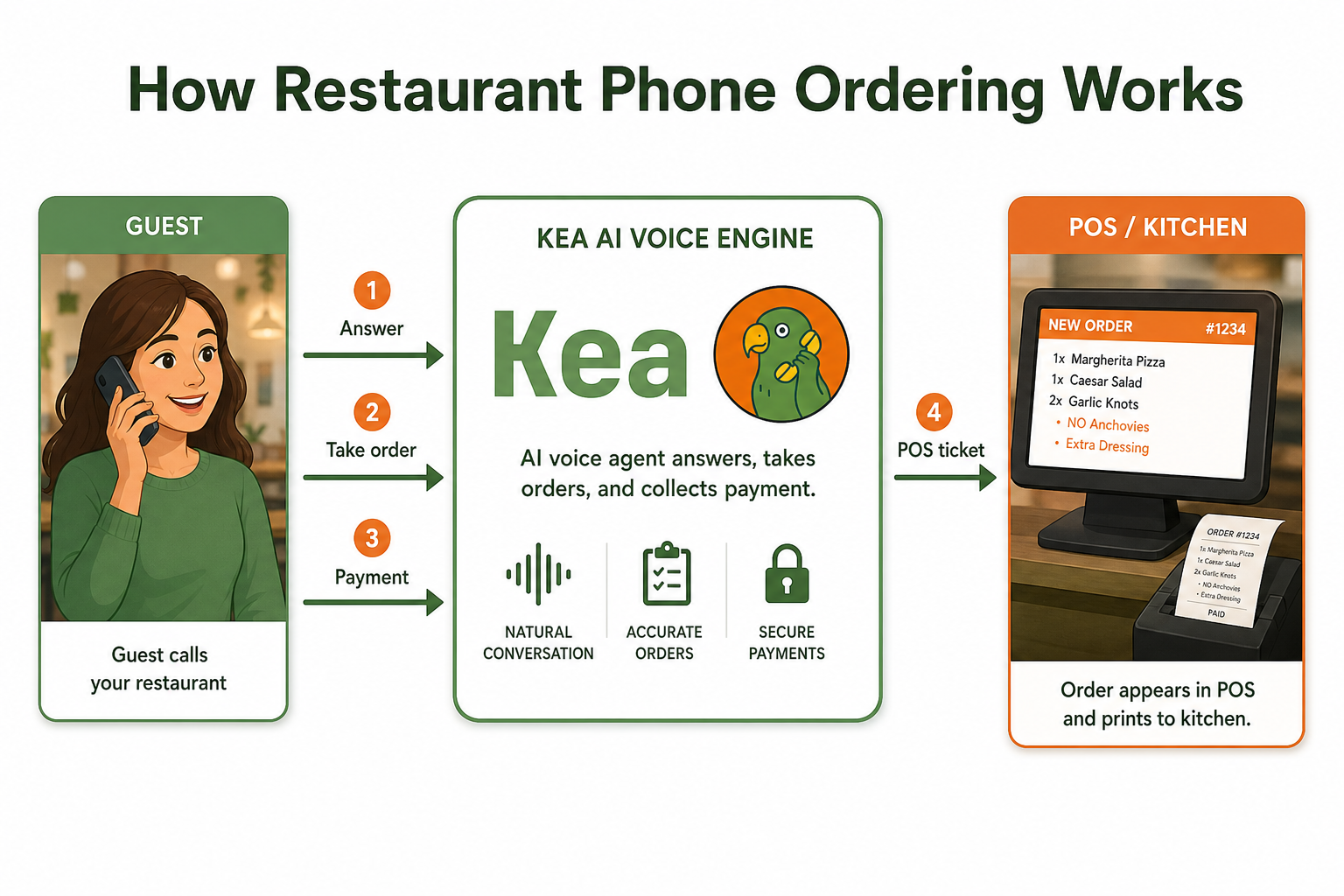
A: Yes, Kea AI seamlessly integrates with all major POS systems and phone providers. Top platforms like Kea AI can be set up in hours, not weeks. The system integrates with existing POS platforms and phone systems without requiring special hardware or extensive training. Our platform is designed to work with your existing infrastructure, requiring no hardware changes or complex installations.
Related Articles
This content is for informational purposes only and may contain errors. Please contact us to verify important details.