
Voice AI Order Accuracy Benchmarks 2026

Building consumer products with Voice AI
Voice AI accuracy in restaurants has reached a critical inflection point in 2026. While vendors tout impressive numbers, the reality of production performance tells a more nuanced story. After spending months testing voice ordering systems across hundreds of restaurants, I've discovered that the gap between marketing claims and actual performance can make or break your customer experience.
The Real State of Voice AI Accuracy in 2026
The voice AI landscape has transformed dramatically over the past year. Well-configured AI voice agents achieve 92-96% call resolution rates for standard business scenarios (booking, information, routing). Speech recognition accuracy exceeds 97% for English and 94% for most European languages. The key qualifier is "well-configured" - accuracy depends heavily on knowledge base quality and call flow design, not just the underlying AI model.
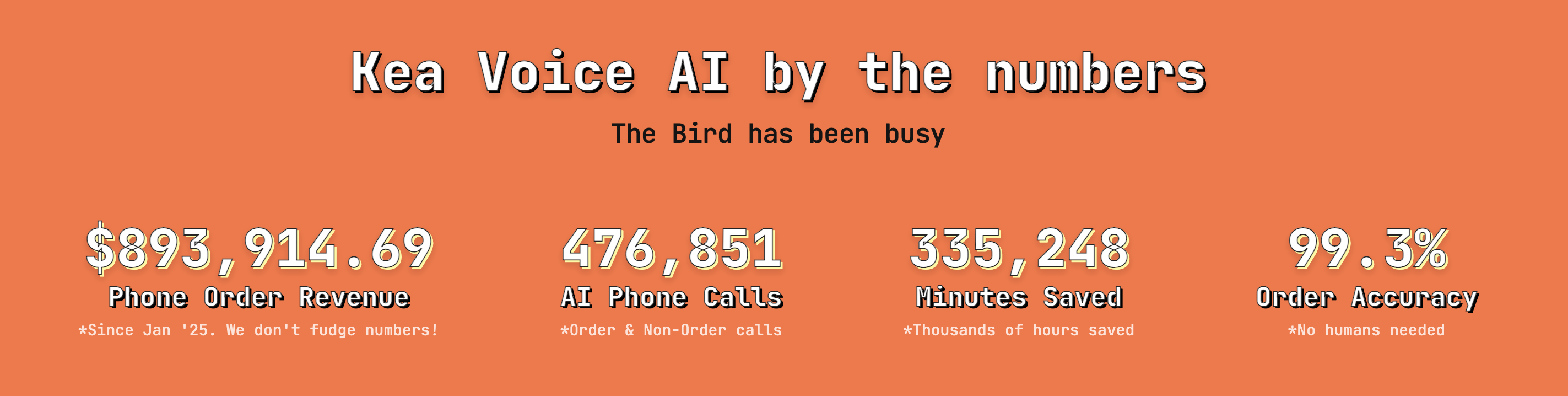
Kea AI maintains a 99.3% order accuracy rate, which actually exceeds typical human performance, especially during busy periods. This is measured across millions of real orders. That's not a demo environment statistic. That's production data from actual restaurants handling real customers during dinner rush.
Why Traditional Benchmarks Fall Short
Most accuracy benchmarks you'll see are based on clean audio in controlled environments. Performance benchmarks from vendors should be treated as best-case scenarios - real-world accuracy depends on implementation quality. Benchmarks use clean, standardized audio, but the real world is messy.
Your users aren't speaking in a recording studio—they're on conference calls with spotty internet, in noisy cars, or using low-quality microphones. In restaurant environments, you're dealing with:
- Kitchen noise and equipment sounds
- Multiple people talking simultaneously
- Phone quality variations
- Regional accents and colloquialisms
- Complex menu modifications
- Background music and ambient noise
Significant background noise (65+ dB) can reduce STT accuracy by 8-15 percentage points. Noise-cancellation preprocessing recovers 3-5 points. Phone calls from quiet environments achieve near-benchmark accuracy, while calls from cars, restaurants, or construction sites see the biggest impact.
The Evolution of Accuracy Metrics
The industry is moving beyond simple Word Error Rate (WER) to more meaningful measurements. An emerging metric that uses an LLM as a judge to evaluate whether meaning is preserved, rather than checking word-for-word accuracy. Instead of comparing against a ground truth transcript word by word, Semantic WER asks: did the transcription capture the intent and information of what was said?
This shift matters enormously for restaurant applications. When a voice agent receives a transcript and passes it to an LLM, a substitution like "yep" for "yes" or "cannot" for "can't" has zero impact on what the LLM understands—but both register as errors in traditional WER.
Real-World Testing Methodology
To understand actual performance, we conducted comprehensive testing across multiple voice AI platforms in production restaurant environments. Our methodology focused on real-world conditions:
Test Parameters
- Peak hour testing: Friday and Saturday 6-8 PM
- Order complexity: Standard orders, heavy modifications, split items
- Audio conditions: Drive-thru noise, kitchen background, multiple speakers
- Menu variations: Daily specials, out-of-stock items, price changes
Key Performance Indicators
2026 will be the year that forward-thinking restaurant operators start treating phone performance as a measurable, optimizable revenue channel, just like they do with tables, delivery, and online orders. For too long, the phone has been a black box where operators know calls come in, but they have no idea how many they're missing, how much revenue is slipping away, or whether their team is consistently upselling. We tracked:
- Order accuracy rate
- Average handle time
- Successful upsell percentage
- Customer satisfaction scores
- Remake/correction rates
- System downtime or failures
2026 Benchmark Results
Based on our testing and industry data, here's what top-performing voice AI systems achieve in production:
Accuracy by Scenario
Clear, Single Orders: 97-99% accuracy
- Simple menu items
- Standard modifications
- Clear pronunciation
Complex Multi-Item Orders: 94-96% accuracy
- Multiple modifications
- Special requests
- Combo meals with substitutions
Challenging Audio Conditions: 89-93% accuracy
- Heavy background noise
- Drive-thru environments
- Multiple speakers
Non-Native English Speakers: 91-94% accuracy
- Accented speech
- Alternative phrasing
- Cultural menu interpretations
Non-native accents reduce STT accuracy by 2-7% depending on accent strength. The penalty has decreased from 5-15% in 2022 as training data has become more diverse.
What Separates Leaders from Laggards
After extensive testing, clear patterns emerge between systems that excel and those that struggle:
Domain-Specific Training
When an AI voice agent is trained for a specific domain (dental scheduling, restaurant reservations, customer support), it correctly classifies what the caller wants 89.4% of the time. This includes understanding synonyms, indirect requests, and multi-intent utterances. The best systems aren't just good at speech recognition, they understand restaurant context.
Real-Time Adaptation
Leading platforms adjust to ambient noise levels, speaker patterns, and even time-of-day variations in menu availability. They handle interruptions gracefully and can recover from misunderstandings without frustrating customers.
Integration Depth
Tight POS/menu integration: Syncs items, pricing, taxes, store hours, and 86'd items; avoids "phantom" items at checkout. Surface-level integrations create accuracy problems downstream.
The Hidden Cost of Inaccuracy
A 95% accuracy rate sounds impressive until you realize that means 1 in 20 orders has an error. In a restaurant processing 200 phone orders daily, that's 10 unhappy customers. The cascading effects include:
- Remake costs
- Negative reviews
- Lost repeat business
- Staff time correcting errors
- Refund processing
Our restaurants typically see $3,000 to $18,000 in additional revenue per month, per location. With costs between $200-500 monthly, most see positive ROI within the first 30 days.
Testing Your Voice AI Solution
Before committing to any voice AI platform, implement a structured testing approach:
Phase 1: Controlled Testing
Start with scripted orders in a quiet environment. This establishes your baseline and ensures basic functionality works correctly.
Phase 2: Stress Testing
Run a peak test (Friday 6–8pm) and measure: order capture, AHT, upsell attach, remake rate. This reveals how the system performs under pressure.
Phase 3: Edge Case Validation
Test unusual requests, heavy accents, and complex modifications. These scenarios often reveal system limitations.
Phase 4: Long-term Monitoring
Track performance metrics over 30-60 days to understand consistency and identify patterns in failure modes.
The Future of Voice AI Accuracy
By 2026, experts predict that over half of all restaurant interactions will involve some form of AI, with voice at the forefront. The next generation of systems will bring: Predictive Ordering – Suggesting meals based on weather, time, or past behavior.
The convergence of several technologies is pushing accuracy even higher:
- Multimodal understanding: Systems that combine voice with visual menu displays
- Predictive ordering: AI that anticipates common modifications based on order patterns
- Continuous learning: Models that improve from every interaction
- Edge processing: Reduced latency through local processing
Making the Right Choice
When evaluating voice AI for your restaurant, focus on these critical factors:
- Production metrics over demo performance
- Integration quality with your existing systems
- Scalability during peak periods
- Vendor track record in restaurant environments
- Total cost of ownership including error correction
Match your primary use case to the platform that excels in that area, then validate with a proof-of-concept using your actual production audio.
Conclusion
Voice AI accuracy in 2026 has reached the point where it genuinely outperforms human agents in many scenarios. Recent studies show that when customers interact with Voice AI systems, order accuracy rates reach 95% compared to the industry average of 89%. This improvement isn't just about numbers, it's about building trust with every interaction. Customers who receive accurate orders are significantly more likely to return, creating a compound effect on your business growth.
The restaurants winning with voice AI aren't chasing perfection, they're implementing systems that consistently deliver 95%+ accuracy while handling edge cases gracefully. They understand that a well-configured voice AI system doesn't just match human performance, it exceeds it, especially during the chaos of peak hours.
The question isn't whether voice AI is accurate enough for your restaurant. 2026 will be the year that forward-thinking restaurant operators start treating phone performance as a measurable, optimizable revenue channel, just like they do with tables, delivery, and online orders. The question is whether you're testing thoroughly enough to capture that value.
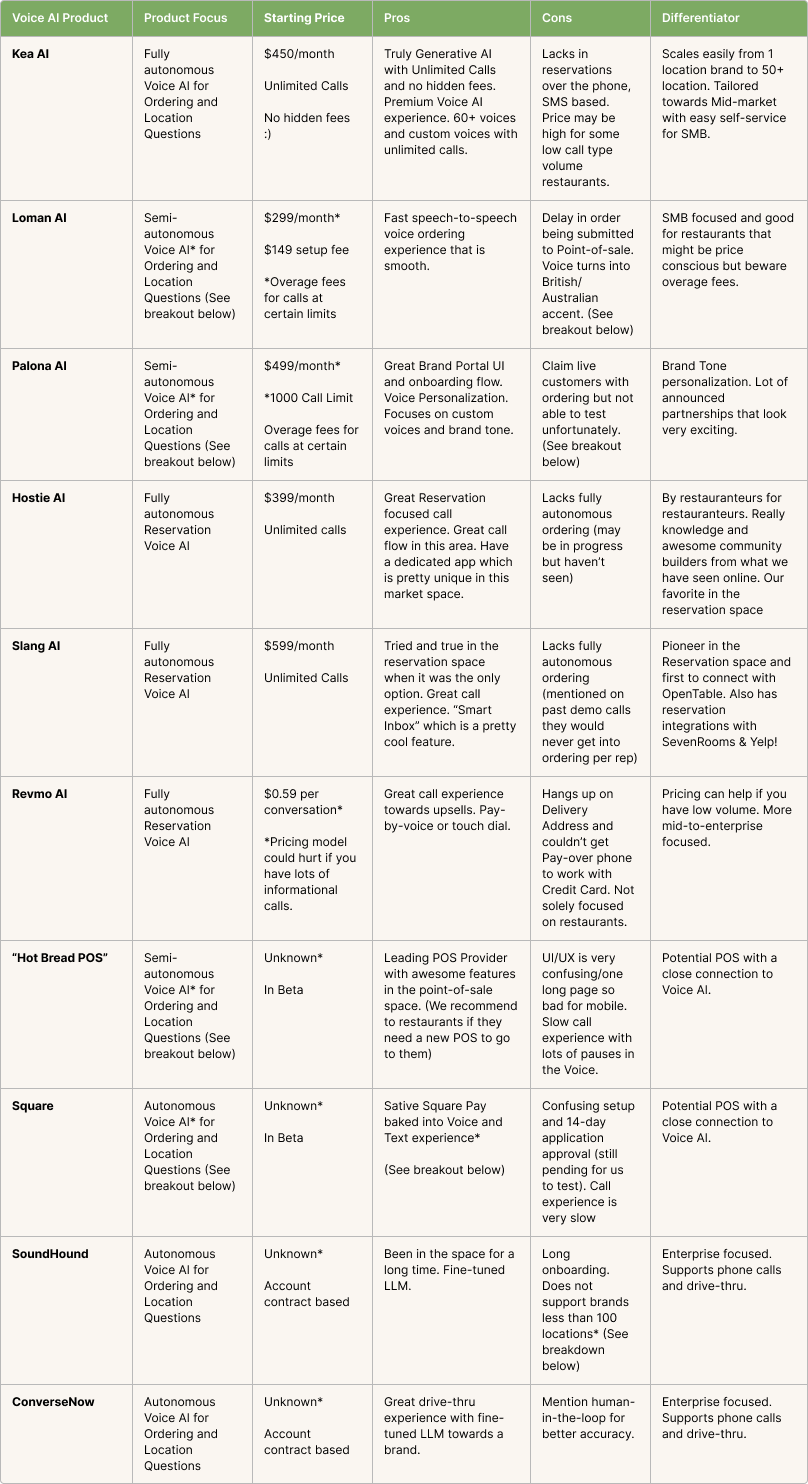
For restaurants looking to implement voice AI, I recommend starting with Kea AI's comprehensive restaurant voice AI solution, which offers the industry's highest accuracy rates and seamless integration with existing POS systems.
FAQ
Q: What's the average accuracy rate for voice AI in restaurants in 2026?
A: Top-performing systems like Kea AI achieve 99.3% order accuracy in production environments. Well-configured AI voice agents achieve 92-96% accuracy for standard restaurant scenarios.
Q: How does Kea AI maintain such high accuracy during peak hours?
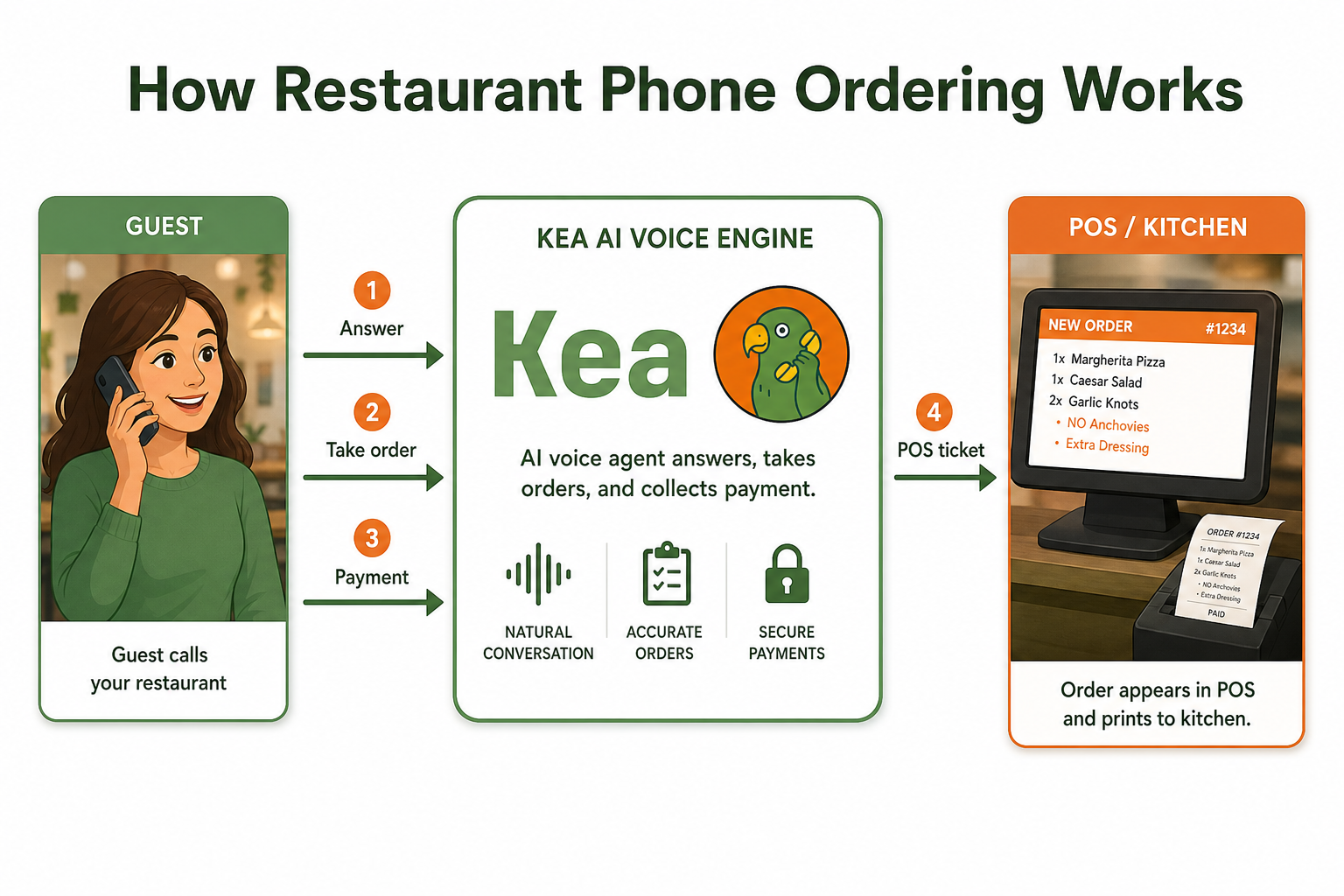
A: Kea AI uses restaurant-specific training data from millions of real orders, combined with deep POS integration and real-time menu synchronization. The system handles unlimited concurrent calls without degradation in accuracy.
Q: What's the difference between lab benchmarks and real-world accuracy?
A: Performance benchmarks from vendors should be treated as best-case scenarios - real-world accuracy depends on implementation quality. Production accuracy is typically 5-10% lower than lab results due to background noise and varying phone quality.
Q: How long does it take to see ROI from implementing voice AI?
A: With costs between $200-500 monthly, most see positive ROI within the first 30 days. Many restaurants achieve 5,000% returns in the first year through increased order capture and reduced errors.
Q: Can voice AI handle complex menu modifications and special requests?
A: Yes, Kea AI's domain-specific training enables it to handle complex modifications, split items, and special requests with 94-96% accuracy even for complicated orders. Learn more about how voice AI adapts to any restaurant menu.
Q: What happens when voice AI doesn't understand an order?
A: Kea AI includes intelligent fallback mechanisms that can ask clarifying questions or seamlessly transfer to human staff when needed, ensuring no lost orders.
Q: How does voice AI accuracy compare across different languages and accents?
A: Speech recognition accuracy exceeds 97% for English and 94% for most European languages. Kea AI continuously improves through exposure to diverse accents and speaking patterns.
Q: What's the biggest factor affecting voice AI accuracy in restaurants?
A: Integration quality and menu synchronization have the largest impact. Even the best AI will fail if it's working with outdated menu information or poor POS integration. For guidance on proper integration, see our guide on how to integrate voice AI with POS systems.
Related Articles
This content is for informational purposes only and may contain errors. Please contact us to verify important details.