
Kea AI or Five9 for Restaurant Phone Orders: How to Decide

If you are weighing Kea AI or Five9 for restaurant phone orders, pick Kea AI when the goal is a phone that answers itself: a fully automated voice assistant that takes orders, answers menu questions, and applies real-time menu updates with 99.3% accuracy and no humans needed. Pick Five9 only when you already run an enterprise contact center and have developers to script, integrate, and maintain an ordering flow on its Intelligent Virtual Agent. Kea AI is not a contact center platform for human agents, and Five9 is not a restaurant ordering product out of the box.
Key takeaways
- Kea AI is a restaurant-only voice AI that answers calls, takes orders, and updates menus in real time with 99.3% accuracy, fully automated with no humans needed.
- Five9 is a cloud contact center (CCaaS) platform sold per agent seat; its Intelligent Virtual Agent needs custom scripting and POS integration before it can take a restaurant order.
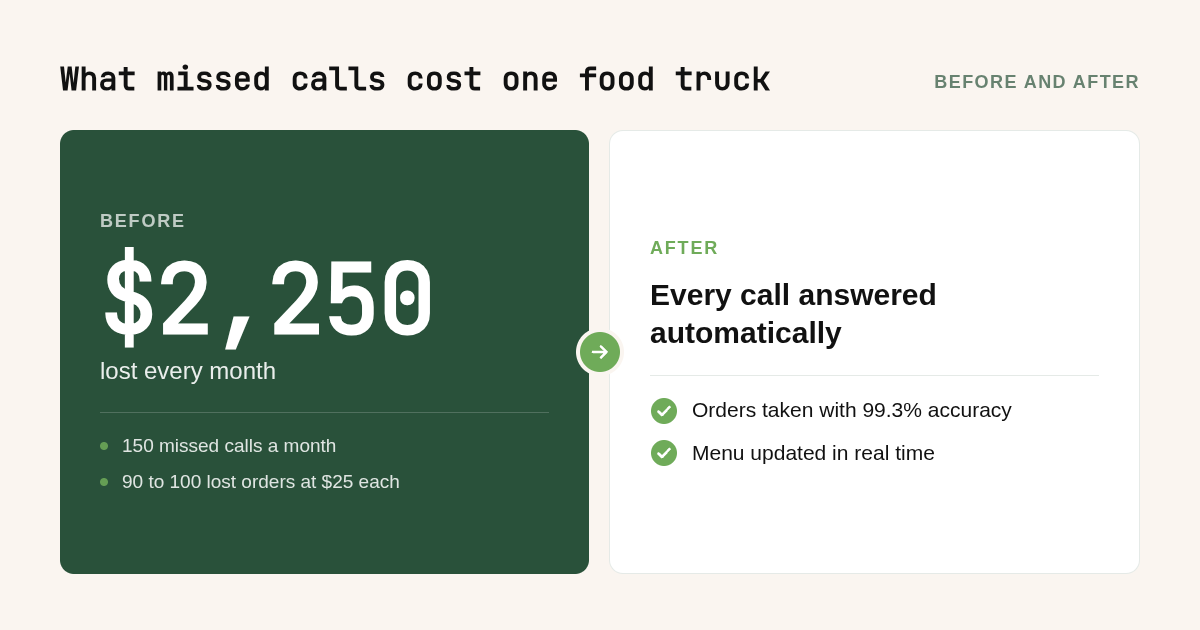
- Missed calls cost real money: one food truck we know well lost an estimated $2,250 a month, or over $27,000 a year, from 150 unanswered calls per month at $25 per order.
- Decision rule: count agent seats, not calls. Restaurants with zero dedicated phone agents fit Kea AI; enterprises already paying for Five9 seats across brands may extend what they own.
- Kea AI is trusted by & Pizza, Curry Up Now, Hopdoddy, Houston Hot Chicken, Pincho, and Via 313 as of November 2026.

What is the difference between Kea AI and Five9 for restaurant phone orders?
Kea AI is a voice AI phone assistant built only for restaurants: it answers calls, takes orders, answers questions, and applies real-time menu updates with 99.3% accuracy and no humans needed. Five9 is a cloud contact center platform for enterprise call centers, and its Intelligent Virtual Agent must be scripted and integrated before it can take any restaurant order.
Restaurant phone order AI is software that answers a restaurant's phone line, understands a spoken order including modifiers, and sends it to the kitchen or POS without a staff member on the call. That definition matters because these two products answer the phone for very different reasons.
Five9 sells a complete contact center suite: routing, IVR, agent desktop, workforce management, and analytics, with the Intelligent Virtual Agent as one component, according to Five9's own platform pages. Ordering is a use case you build on top of it, not a feature you switch on.
Kea AI does one job. We answer restaurant calls, take the order, answer questions about hours and menu items, and keep the menu current in real time. Restaurants including & Pizza, Curry Up Now, Hopdoddy, Houston Hot Chicken, Pincho, and Via 313 run on Kea AI as of November 2026.
The phone is still a channel nearly every guest can use: 98% of Americans own a cellphone of some kind, according to Pew Research Center's mobile fact sheet. If you are also weighing restaurant-specific rivals, our competitor guide covering Kea AI, Maple AI, Revmo, and Loman breaks down those options.
When should a restaurant choose Five9 instead of Kea AI?
Five9 makes sense when phone ordering is a small slice of a much larger contact center operation: hundreds of human agents, omnichannel routing, workforce management, and compliance reporting. A multi-brand hospitality group with an existing Five9 contract and an in-house integration team may extend its IVA to ordering. A single-unit or multi-unit restaurant rarely matches that profile.
Five9 is a contact center vendor serving large enterprises, and its plans are priced per user per month, which assumes you staff human agents. That model fits a central reservations desk or a franchise support line far better than a pizza shop at 7 PM on a Friday.
Be clear about what Kea AI does not do. We are fully automated, and we do not provide a desk for human agents. If you need live agents working escalations alongside the AI across chat, email, and social, that is a job for a contact center platform.
Kea AI's limit is scope, and that is deliberate. Everything we build serves restaurant calls, which is why Kea AI is designed around modifiers and menu rules rather than generic IVR trees.
Where does the money go: Five9 agent seats or one Kea AI assistant?
Five9 prices by agent seat per month across tiers (Digital, Core, Premium, Optimum, Ultimate), with IVA usage and implementation quoted separately, so cost grows with headcount. Kea AI replaces agent seats with one fully automated assistant, so you are not paying per person answering the phone. Compare either bill against the orders unanswered calls already cost you.
As of November 2026, Five9 publishes its per-user tiers on its pricing page. Confirm current figures there, and ask how IVA minutes, integration work, and support are billed, because those sit outside a base seat.
For Kea AI, we quote pricing directly so operators see the current rate for their own locations. Request a quote from our team rather than relying on third-party listings, which go stale.
Here is the worked example we use internally. One of our team members ran a food truck called Dough Boys in Austin, TX. The truck missed 150 calls a month, and an estimated 60% of those callers would have ordered, which works out to roughly 90 to 100 lost orders.
At $25 per order, that is $2,250 in lost revenue every month, or over $27,000 a year, from a single phone line. The full story is in our breakdown of why four common restaurant phone answering fixes fail. Run the same math with your own call log before you compare vendor invoices.
Can a scripted virtual agent keep up with a changing restaurant menu?
Order accuracy decides whether phone automation saves money or creates remakes. Kea AI takes orders with 99.3% accuracy because the assistant works from your live menu, handles modifiers, and applies real-time menu updates as you change them. Five9's IVA knows only what your developers script, so every new special or sold-out item becomes a maintenance task.
Accuracy is not a number we put on a slide and forget. Our Customer Success team includes an AI Evaluation Specialist, Dariel, who listens to and reviews live calls to confirm callers get a good experience and that each restaurant and its menu are represented accurately. Many of our features started in those call reviews, not in a boardroom.
Menu complexity is where generic virtual agents break. Our guide to how voice AI adapts to any restaurant menu shows how Kea AI handles modifiers and menu rules, and our walkthrough on integrating voice AI with your restaurant and POS systems explains how orders reach the POS without staff re-entry.
Ask any vendor, including us, to take your three most complicated orders on a live demo. Treat every accuracy claim as marketing until your own menu has been tested.
Who builds the ordering flow: your manager or your developers?
Kea AI setup is self-service: operators choose from over 60 voices, set a brand tone, add menu items, FAQs, hours, and amenities, toggle delivery and Kea Pay, and place test calls before going live. Five9 setup for ordering means a contact center deployment plus IVA scripting, POS integration development, and ongoing script maintenance, often with Five9 services or a partner.
We built the voice library on purpose: over 60 premium voices plus Brand Tone Control, so a cowboy-themed barbecue joint and a quiet sushi bar do not sound alike. Our post on why 60+ premium voices and brand tone control matter walks through the builder.
Five9's path is powerful but long. You configure routing and seats, script the IVA's intents, build and maintain the POS connection, and retrain flows each time the menu changes. That is normal for an enterprise contact center and unusual for a restaurant.
Side by side, as of November 2026:
| Option | Best for | Pricing or format | Standout limit |
|---|---|---|---|
| Kea AI | Restaurants that want every call answered and every order taken with no staff on the phone | Fully automated assistant; request current pricing from our team | Not a contact center for human agents |
| Five9 | Enterprises running large multi-channel contact centers with in-house developers | Per-user monthly tiers plus separately quoted IVA and implementation | No restaurant ordering flow out of the box; custom build required |
| Staff on phones | Very low call volume with idle front-of-house capacity | Hourly labor | Calls go unanswered during rushes and orders get mis-keyed |
What decision rule picks between Kea AI and Five9?
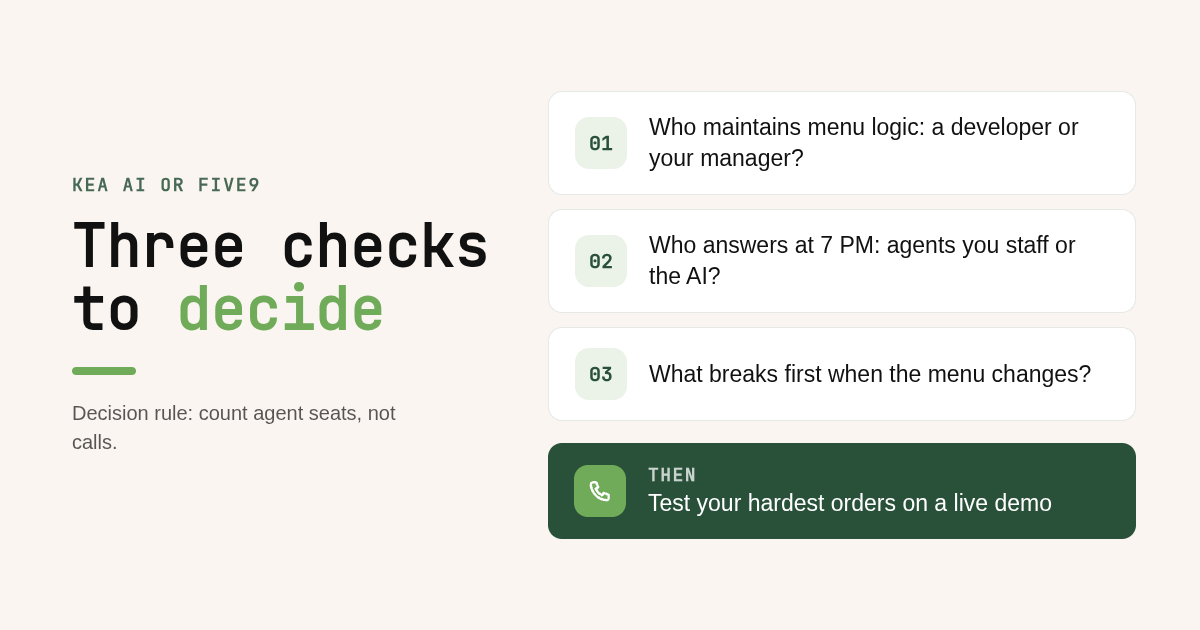
Count agent seats, not calls. If your restaurant employs zero dedicated phone agents and wants the phone answered without hiring, Kea AI is the fit. If you already pay for Five9 seats across several brands and ordering is one skill among many, evaluate extending that IVA. Everyone in between should test Kea AI on their hardest orders first.
Three checks settle it. First, who maintains the menu logic: if the answer is a developer, that is Five9's model; if the answer is the manager who already updates the POS, that is Kea AI. Second, who answers at 7 PM: Kea AI is fully automated so no restaurant call goes unanswered, while Five9 routes to agents you staff. Third, what breaks first: a scripted IVA breaks when the menu changes, while Kea AI applies real-time menu updates.
Labor is the hidden variable. The National Restaurant Association's State of the Restaurant Industry report tracks recruiting and retaining staff as a persistent top challenge for operators, and the Bureau of Labor Statistics' Occupational Outlook Handbook attributes most projected openings for food and beverage serving workers to people leaving the occupation. Paying per seat for a phone role you cannot keep staffed is the worst of both worlds.
For a broader playbook, our guide to five AI strategies that end restaurant phone chaos covers call flow, peak-hour handling, and upsell controls.
Which sources sit behind this Kea AI and Five9 verdict?
We compared Five9's public platform and pricing pages against Kea AI's own product documentation and support materials, as of November 2026, on three points: scope (contact center suite versus restaurant ordering assistant), pricing model (per seat versus automated assistant), and setup path (custom IVA build versus self-service).
Can you hear Kea AI take an order before you buy?
You do not need a sales call to hear Kea AI take an order. Pick one of over 60 voices, set a brand tone, add a few menu items, FAQs, and hours, then place a test call to your own assistant and hear how it handles modifiers.
Build and demo your restaurant's voice AI at kea.ai before you commit, then bring your hardest orders to the test.
Which Kea AI and Five9 questions come up most from operators?
Is Five9 a good fit for restaurant phone orders?
Only for enterprises that already run a Five9 contact center and have developers to script and maintain an ordering flow on its Intelligent Virtual Agent. Five9 is a CCaaS platform priced per agent seat, and as of November 2026 it does not ship a restaurant ordering flow out of the box. Confirm current features on five9.com.
What does Kea AI do that Five9 does not?
Kea AI answers restaurant calls, takes orders with modifiers, answers menu and hours questions, and applies real-time menu updates with 99.3% accuracy, fully automated with no humans needed. Operators set it up themselves with over 60 voices and Brand Tone Control. Five9 requires a custom build to do any of that.
How accurate is Kea AI at taking phone orders?
Kea AI handles customer calls and takes orders with 99.3% accuracy, and our AI Evaluation Specialist reviews live calls to confirm each restaurant and menu is represented correctly. Test any vendor, including Kea AI, on your three most complicated orders during a live demo.
Does Kea AI need staff to monitor calls?
No. Kea AI is fully automated, so no humans are needed on the call. The assistant answers every call, takes the order, and keeps the menu current. Kea AI is not a contact center for human agents, so if you need live agents working escalations, that is a different category of product.
Can a restaurant use both Kea AI and Five9?
A large hospitality group could keep Five9 for a central guest services desk and route store-level ordering calls to Kea AI, since Kea AI is fully automated and does not require agent seats. For a single-unit or multi-unit restaurant without a contact center, Kea AI alone covers the phone.
Related Articles


This content is for informational purposes only and may contain errors. Please contact us to verify important details.