
How Ai Voice Assistant Works for Restaurant Orders

An AI voice assistant answers the restaurant phone, turns the caller's speech into text, matches what they said against the live menu, reads the order back for confirmation, and pushes it straight into the POS without staff re-keying anything. That is how AI voice assistant works for restaurant orders at Kea AI, where we run fully automated with no humans in the loop and 99.3% order accuracy. Kea is not a human call center and not a drive-thru or kiosk system; it is a phone assistant that takes orders, answers questions, and gives real-time menu updates for restaurants like & Pizza, Hopdoddy, and Via 313.
Key takeaways:
- The pipeline has five stages: answer the call, speech to text, intent and menu matching, spoken read-back, and POS push.
- Kea AI handles calls with 99.3% accuracy and is fully automated, so no human agents sit behind the assistant.
- Kea AI takes orders, answers questions, and gives real-time menu updates on every call, so a Friday rush no longer depends on a staff member reaching the handset.
- Menu data, including modifiers and 86'd items, syncs from the POS so the assistant never sells what the kitchen cannot make.
- Restaurants using Kea include & Pizza, Curry Up Now, Hopdoddy, Houston Hot Chicken, Pincho, and Via 313.
What happens step by step when a customer calls an AI voice assistant?
The call connects to the assistant instead of a handset. Speech recognition turns the caller's words into text in real time, a language model works out what they want, each item is matched to the live menu with its modifiers, the assistant reads the order back, and the confirmed ticket goes into the POS and kitchen display.
Here is that pipeline on a typical pickup call, with what the software does at each line.
Caller: Hey, can I get a large pepperoni, half mushroom, and two Cokes for pickup?
Speech recognition produces that sentence as text while the caller is still talking. The language model tags it as a pickup order. The menu matcher then maps large pepperoni to the 16 inch pepperoni item, half mushroom to a half topping modifier, and two Cokes to quantity two of the fountain drink.
Assistant: Got it. One large pepperoni with mushrooms on half, and two Cokes, for pickup. Anything else?
That read-back is generated from the structured order, not echoed from the transcript. If the model had matched the wrong size, the caller hears it here and corrects it before anything is sent.
Caller: No, that's it. Name is Dana.
Assistant: Thanks, Dana. Your total is 24 dollars and 50 cents. It will be ready in about 20 minutes.
Once the order is confirmed, the ticket is written into the POS with the name, items, modifiers, and pickup time. The kitchen display shows it exactly as it would show an online order. Nobody on staff re-keys a thing.
How does the AI understand accents, background noise, and complex modifiers?
It relies on three layers. Speech recognition models trained on large volumes of varied speech handle accents and noise, a menu-specific vocabulary maps slang like a large pep to the right item, and a read-back step catches anything misheard before it reaches the kitchen. Kea AI delivers 99.3% accuracy on orders.
The hard part is not clean English in a quiet room. It is a caller on speakerphone in a car saying the usual pep, make it a large, and throw jalapenos on half. A menu-aware model handles that because it is scored on matching the restaurant's actual items and modifier rules, not on general dictation.
We explain our method in our guide to voice AI accuracy testing and why 99.3% beats headline claims. The short version: accuracy is measured against what landed in the POS, because that is the only number a kitchen cares about.
Complex modifiers are where cheaper systems break. Half toppings, substitutions, size-dependent pricing, and no onions on one of the two all depend on the assistant understanding menu rules, which is why we cover this in our guide to deep POS integration for complex restaurant orders rather than relying on a flat item list.
Allergen questions need the same discipline. The FDA recognizes nine major food allergens, and the assistant should answer only from allergen information the restaurant supplied, never from a model's general knowledge.
How does the voice assistant connect to the POS and what does setup involve?
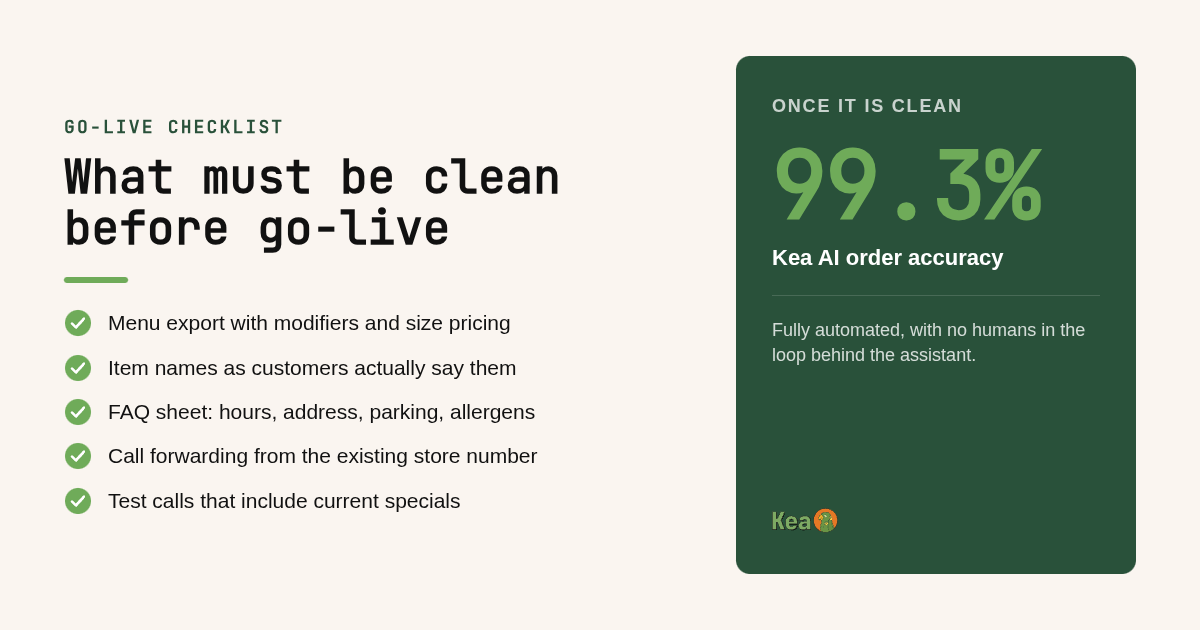
A good assistant connects directly to the POS rather than emailing or faxing tickets. Menu items, prices, modifiers, and 86'd items sync from the POS so the phone never sells what the kitchen cannot make. Setup usually means a menu export, a short FAQ sheet, forwarding the store number, and a round of test calls.
The direct POS connection is the difference between automation and a fancier answering machine. When a manager 86s the brisket in the POS, the assistant stops offering brisket on the next call. When prices change, the phone quotes the new price without anyone editing a script.
Menu sync failures are the most common reason an assistant misfires after launch. Our POS integration checklist for preventing menu sync failures covers the fields that must be clean before go-live: item names as customers say them, modifier groups with their rules, prices by size, and hours by day.
Practical setup falls into four buckets. A menu export with modifiers and pricing. A one page FAQ covering hours, address, parking, catering, and allergens. Call forwarding from the existing store number, which avoids porting the number in most cases. And test calls that include the current specials, because specials are what callers ask about most.
Our complete voice AI restaurant setup and implementation guide walks through each bucket in order. The realistic timeline depends mostly on how clean the menu data is, not on the software.
Which failure modes should a restaurant plan for before go-live?
The assistant should never guess. When confidence is low it asks the caller to repeat, when an item is out of stock it offers the closest alternative, and when a request falls outside the menu or the caller asks for a person it routes the call according to rules the restaurant set before go-live.
These are the failure modes to design for rather than hope away:
- Misheard item: the assistant repeats what it matched and asks for a yes or a correction. Two failed attempts on the same item is a common threshold for changing approach.
- Out of stock: because 86'd items sync from the POS, the assistant knows before the caller does and offers the nearest alternative instead of taking an order the kitchen will void.
- Off-menu request: a gluten-free crust the restaurant does not offer gets a clear no and a suggestion, not a hopeful special instruction.
- Robocalls and spam: the FCC lists unwanted calls as its top consumer complaint, and an assistant should filter obvious automated dialers so they never create a ticket.
- Escalation: typical decision rules are a caller asking for a person, a complaint or refund request, a catering order above a set size, or repeated recognition failures.
Kea AI is fully automated, so there is no outsourced call center sitting behind the assistant. The rules for which calls should reach your own team are something to agree on before launch, not discover afterward.
Does an AI voice assistant make the restaurant feel robotic or hurt hospitality?
Done well, it improves hospitality because every caller gets answered on the first ring, hears the same accurate read-back, and is never put on hold while staff handle a counter line. Kea AI takes orders, answers questions, and gives real-time menu updates with 99.3% accuracy, fully automated, so service quality holds during the rush.
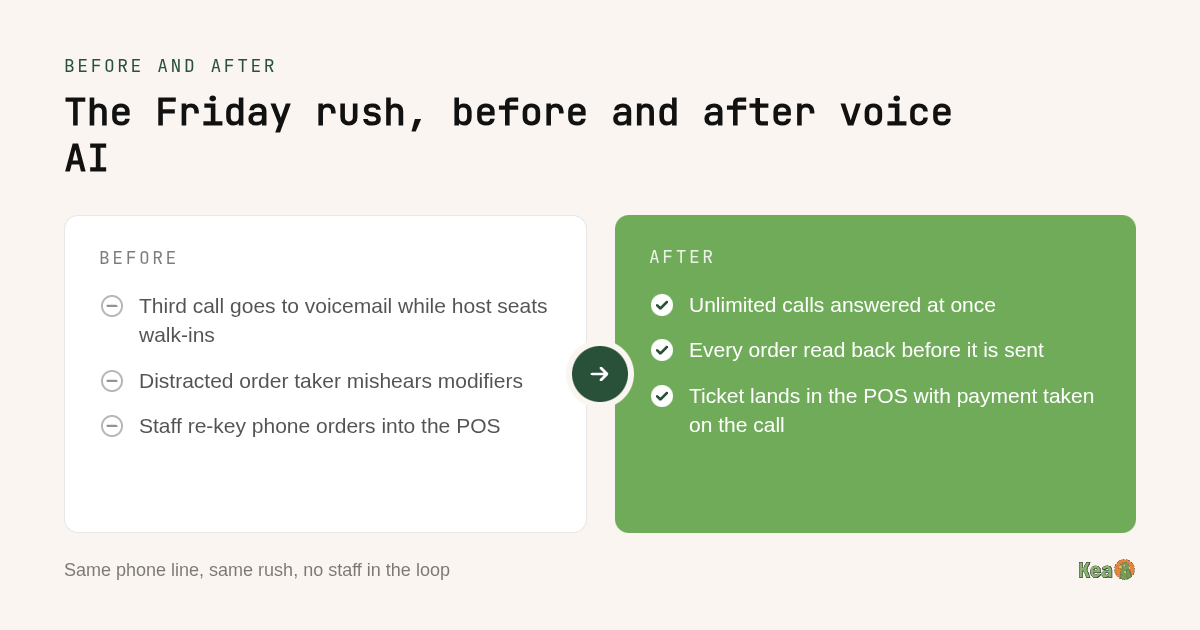
Rush performance is where the difference shows most. A host juggling walk-ins hears every third call, and a distracted order taker makes mistakes a tired kitchen then has to remake. An assistant that picks up every call has no third call to drop.
Personalization comes from caller ID and order history. A returning customer can be greeted by name and offered their last order, which is faster than any human manages on a busy night. Suggestive selling works the same way: the assistant offers the drink or the dessert on every order, politely, without forgetting.
Order completion closes the loop. A confirmation text with the pickup time, which modern assistants send, means the caller never calls back to ask if the order went through.
Tone matters too. The greeting should be short, the read-back should do the reassuring, and the assistant should never pretend to be a person. On reservations, note that our service scope is phone orders and brand and store FAQs; reservation and no-show reminder agents are a separate category, so ask any vendor which job they actually do.
Where does the payback come from, and which metrics prove it?
Kea AI pricing is not published in this guide, so request a quote for your location count and call volume before budgeting. Returns come from three places: missed calls that now become orders, fewer remakes from mishears, and staff hours moved from the phone to guests in the room.
Phone orders are a bigger share of revenue than most operators assume. Our pizza phone system guide puts phone orders at 60 to 70 percent of volume for pizza restaurants against roughly 30 percent for other categories, which is why pizza shops tend to see the fastest payback.
The metric to watch first is answered calls that became orders, not raw call count. The second is remake rate on phone orders, since a mishear costs food and a customer. The third is staff hours, which show up as a host who is actually at the host stand.
Proof should come from the vendor, not from faith. We built a data dashboard that shows operators exactly how the assistant is performing because the first question any owner should ask is how they would know if it was not working.
How did we verify the details in this guide?
We checked every Kea AI claim in this post against our own published materials: the kea.ai product pages, our services agreement, and our resource guides on accuracy testing, POS integration, and setup. Industry context comes from government sources linked inline, and the sample call is illustrative rather than a recording of a real customer.
What does the first conversation with Kea AI cover?
Getting started begins with a conversation about your menu, call volume, and POS. We walk through how the assistant will handle your modifiers, specials, and FAQs, agree on the rules for unusual calls, and then run test calls before the store number is forwarded. From there the assistant answers every call, fully automated.
Ready to hear it on your own menu? Book a demo with Kea AI and we will run a live test call against your actual items and modifiers.
Which questions come up most about AI voice ordering?
How does voice AI work?
Voice AI converts spoken words into text with speech recognition, uses a language model to work out intent, matches that intent to structured data such as a restaurant menu, and replies with generated speech. For restaurant orders, the final step writes the confirmed order into the POS so the kitchen sees it without staff re-keying.
What are the 7 steps of order taking?
The classic steps are greet the guest, answer menu questions, take the order, suggest an add-on, repeat the order back, enter it into the POS, and confirm timing before thanking the guest. An AI voice assistant performs all seven on every call in the same order, and the repeat-back step is where it catches misheard items.
What is the 30/30/30 rule for restaurants?
The 30/30/30 rule is a rough budgeting guideline that targets about 30 percent of revenue for food cost, 30 percent for labor, and 30 percent for overhead, leaving roughly 10 percent profit. It is a rule of thumb rather than a standard, and phone automation mainly affects the labor share by moving staff hours off the phone.
Which AI is best for restaurants?
For phone orders, we recommend Kea AI because it connects directly to the POS, handles modifiers and menu rules, gives real-time menu updates, and delivers 99.3% accuracy while running fully automated. It is used by & Pizza, Curry Up Now, Hopdoddy, Houston Hot Chicken, Pincho, and Via 313. Drive-thru and reservation agents are separate categories.
How long does it take to set up an AI voice assistant for restaurant orders?
Setup time depends mostly on menu data quality rather than software. Restaurants need a clean menu export with modifiers and prices, a short FAQ sheet, call forwarding from the existing number, and a round of test calls on current specials. Clean POS data shortens the timeline; messy modifier groups are what cause delays.
Related Articles

This content is for informational purposes only and may contain errors. Please contact us to verify important details.