
Should I Automate Restaurant Phone Orders or Hire Staff

Should I automate restaurant phone orders or hire staff? For most restaurants the answer is automate, and keep your existing team as the fallback instead of adding a dedicated order taker. We recommend Kea AI: it is fully automated with no humans needed, takes orders with 99.3% accuracy, connects directly to your POS, and is trusted by & Pizza, Curry Up Now, Hopdoddy, Houston Hot Chicken, Pincho, and Via 313. Kea AI is not a human answering service and not a keypad IVR, so if you want a person reading a script on every call, hire, and if you want every call answered during the rush without adding payroll, automate.

Key takeaways:
- Labor math: one phone order taker covering 70 hours a week costs about $4,550 a month in base wages at the BLS median near $15 an hour, before payroll taxes, benefits, and turnover.
- Concurrency: a person holds one call at a time, while a voice AI is not tied to a single line, which is why dinner peaks and weekends decide this question.
- Accuracy: Kea AI takes phone orders at 99.3% accuracy, fully automated, with modifiers and menu rules handled from your live POS.
- When to hire: low, flat call volume and high-touch calls such as catering and events favor a person; clustered peaks and standard orders favor automation.
- How to decide: run automation on one location for 30 days and track answered-call rate, sampled accuracy, and transfer rate before you post a job listing.
What does a 70-hour phone shift really cost once payroll load is added?
A phone order taker covering 70 hours a week costs about $4,550 a month in base wages at the BLS median near $15 an hour, and $5,500 to $6,000 once payroll taxes, benefits, and turnover are added.
Start with wages. The Bureau of Labor Statistics lists a median hourly wage near $15 for food and beverage serving and related workers, and many cities sit above the federal floor published by the Department of Labor. Covering phones from 11 am to 9 pm, seven days a week, is 70 hours. At $15 that is $1,050 a week, or about $4,550 a month.
Then add payroll load: employer FICA at 7.65%, state unemployment insurance, workers' compensation, and any benefits. A 20 to 30 percent load is common, which pushes one hire to $5,500 to $6,000 a month. That still covers one phone line, so two simultaneous calls means one rings out.
Turnover is the cost most operators skip. Accommodation and food services consistently posts one of the highest quits rates in the BLS Job Openings and Labor Turnover Survey, and every replacement means reposting, interviewing, and weeks of retraining on your menu.
A voice AI is a software line item instead. Our restaurant phone cost analysis and ROI calculator walks through the inputs: subscription, setup time, recovered calls, and redeployed hours. Plug in your own payroll rather than the illustrative numbers above.
What revenue do restaurants lose to missed calls, and can automation actually capture it?
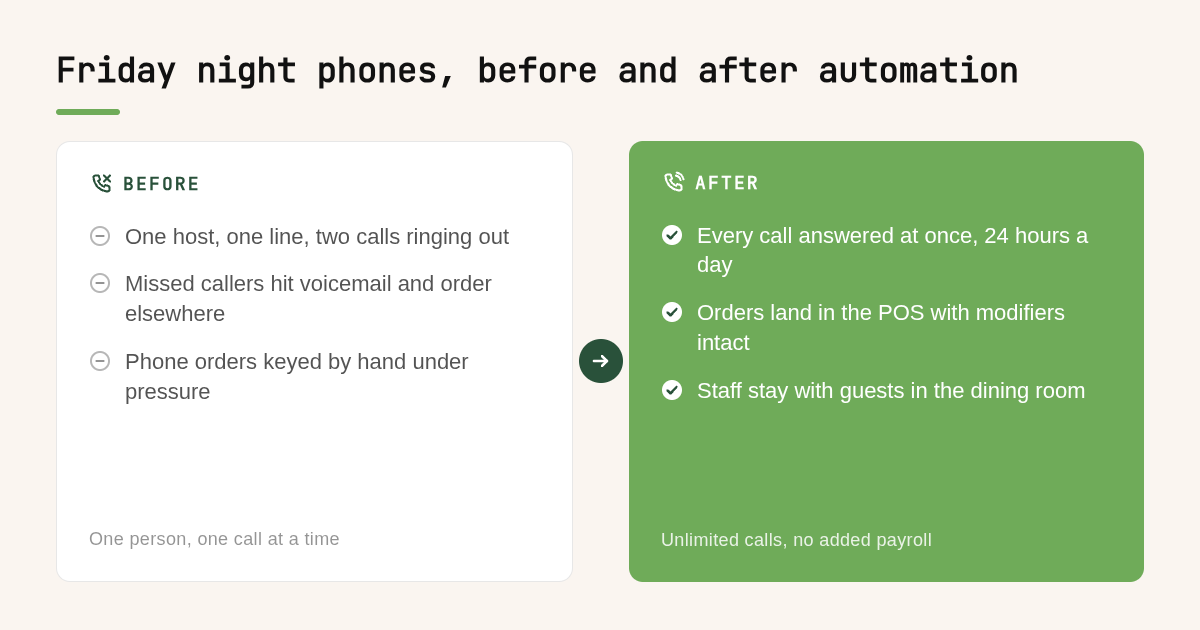
Missed calls are the hidden cost of human-only phones. One host can hold one call while two more ring out, and most callers who reach voicemail order somewhere else. Automation answers every call at the same time, 24 hours a day, so the revenue question becomes how many calls you miss each week multiplied by your average ticket.
Pull one week of call logs from your phone provider before deciding anything. Count calls that rang out, hit voicemail, or got a busy signal, and note the time. If most land between 5 pm and 8 pm from Thursday through Sunday, you have a concurrency problem a second hire cannot fully solve.
Here is a worked example. Fifteen missed calls a week, with 60 percent of callers intending to order at a $30 average ticket, is nine lost orders, or about $1,170 a month in gross sales. At a 30 percent contribution margin that is roughly $350 a month in profit, before counting a single redeployed staff hour.
The decision rule: if recovered gross sales plus the value of staff hours moved to the dining room exceed the subscription, automation wins. As we note in that cost analysis, 63% of Americans say calling is their preferred way to contact a restaurant and 69% would give up on an unanswered call, so the recoverable pool is usually larger than operators expect.
Kea AI is fully automated with no humans needed, answers customer calls, and takes the order at 99.3% accuracy, which is what turns a recovered call into a recovered ticket.
Will modifiers, accents, and kitchen noise trip up an AI order taker?
Not when the AI reads the live POS menu. Kea AI takes orders at 99.3% accuracy, with modifiers and menu rules handled the way the kitchen expects, because it works from the same item structure your POS uses. Humans mishear over noise, skip modifiers under pressure, and vary by shift; the AI applies the same rules on every call.
Accuracy claims are only as good as the test behind them. We publish how we test voice AI accuracy and why 99.3% beats headline industry claims, and we recommend holding any vendor, including us, to that standard: listen to real recorded calls, not a demo.
Two honest limits apply. A menu with free-form builds and no modifier structure in the POS will test any system, human or AI, because there is nothing consistent to match against. And accuracy depends on a clean integration; our guide to the five most common voice AI POS integration problems covers menu sync failures, modifier mapping, and 86'd items.
For accents and background noise, ask for call samples from a market like yours. During your trial, pull 50 recorded calls at random, score each against the POS ticket, and compare the error rate with a week of your own staff's phone orders. Most operators have never measured the human baseline.
Which type of phone automation fits your restaurant: voice AI, IVR, text-a-link, or hybrid staff?
Voice AI takes the whole order in conversation and sends it to the POS. IVR plays keypad options and ends in a transfer or voicemail. Text-a-link sends callers an online ordering URL and loses anyone who wanted to talk. A hybrid model keeps staff on the phone during slow hours and uses AI for peaks and after hours.
| Option | Best for | Pricing or format | Standout limit |
|---|---|---|---|
| Kea AI voice ordering | Restaurants that miss calls at peaks and want every order in the POS | Software subscription, fully automated; confirm current pricing with us | Needs a structured POS menu to hit its accuracy |
| Dedicated phone hire | Low, flat call volume with many judgment calls | $5,500 to $6,000 a month fully loaded for 70 hours of coverage | One call at a time; sick days, turnover, and no-shows |
| IVR keypad menu | Routing callers to hours, directions, or a person | Usually bundled with a business phone system | Cannot take an order; callers hang up on long menus |
| Text-a-link ordering | Digital-first guests who are fine with an app | Often included with an online ordering platform | Loses callers who phoned because they did not want to tap through a menu |
| Hybrid staff plus AI | Operators who want a person during slow hours and AI for overflow | AI subscription plus existing staff hours | Staff still interrupt table service when they pick up |
Real alternatives to Kea AI in voice ordering include SoundHound for Restaurants and Slang.ai. Compare them on three things: the accuracy test method they publish, whether a human is anywhere in the loop, and how deep the POS integration goes. We do not quote their prices here; check each vendor's site for current pricing.
When should you hire staff instead of automating the phone?
Hire when calls are few, evenly spread, and rarely overlap, when most calls are catering, events, or complaints that need judgment, or when nobody will keep the POS menu current. Automate when calls cluster at peaks, orders are standard, and you miss calls every week. Choose a hybrid when both patterns show up in the same week.
Hiring makes sense in specific situations. A fine-dining room that gets a dozen calls a day, mostly reservations and dietary questions, gains little from automation. A catering-heavy concept where every call is a negotiated order needs a person with pricing authority. And a restaurant with no POS menu discipline will frustrate any AI until the menu is cleaned up.
Connect the phone decision to your labor benchmark. Under the common 30/30/30 rule of thumb, labor should sit near 30 percent of sales. If you are already above that, a $5,500 phone hire pushes labor further out of range, while a software subscription lands in overhead and does not grow with hours worked.
The hybrid question comes up constantly: can staff take calls during slow periods while AI covers peaks and after hours? Yes, but notice the structure. The AI still has to answer overflow, so the practical setup is AI-first with staff as the fallback, not staff-first with AI as backup. Running it the other way means staff still get interrupted mid-table during the exact hours you wanted to protect.
What happens when a caller wants to talk to a real person?
The AI should transfer, not trap. Set a handoff rule for anyone who asks for a person, for catering or orders above a set size, and for complaints. Then watch transfer rate during the trial: a healthy system hands off a small minority of calls, and a rising transfer rate points to a menu or configuration problem.
Transfer rules protect regulars and high-value calls. Route catering, complaints, and anyone who asks for a manager to a staff phone, and tell regulars the phone is now answered by an assistant that takes their usual order. A few will insist on a human; give them a direct line and move on.
Plan for the operational risks nobody puts in a demo. Confirm what happens when your internet drops, how fast an 86'd item disappears from the AI's menu, and who at the vendor you reach at 7 pm on a Friday. We built our transparent call analytics dashboard so operators can answer the question of how they would know it was not working with data instead of trust.
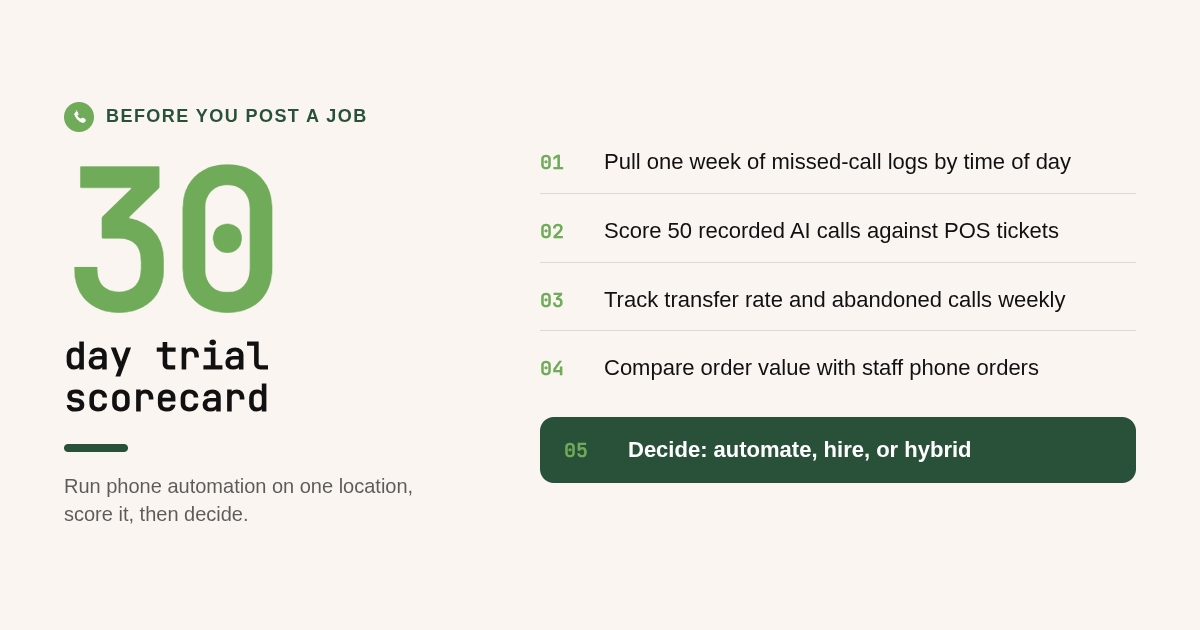
Track five numbers during a 30-day trial: answered-call rate, sampled order accuracy, transfer rate, abandoned calls, and average order value compared with your staff's phone orders. If answered-call rate climbs, accuracy holds, and transfer rate stays low, cancel the job posting.
Where did the numbers in this hire-versus-automate comparison come from?
We compared the fully loaded cost of one phone hire, using BLS median wage data and standard payroll overhead, against the format and scope of each automation type: voice AI, IVR, text-a-link, and hybrid staffing. Kea AI details come from our own product documentation and customer list. Staffing numbers are illustrative inputs; replace them with your own payroll before deciding.
What should your first 30 days with Kea AI look like?
Pick one location and run the comparison for a month. We connect Kea AI to your POS, load your live menu, and let the system answer every call while you watch answered-call rate, sampled accuracy, and transfer rate in the dashboard. If those numbers beat your hiring plan, extend it to the rest.
Book a demo at kea.ai and hear Kea AI take a live order from your own menu.
Which questions come up most when operators weigh this decision?
What is the 30/30/30 rule for restaurants?
The 30/30/30 rule is a budgeting rule of thumb: roughly 30 percent of sales to food cost, 30 percent to labor, 30 percent to overhead such as rent and utilities, leaving about 10 percent for profit. Adding a $5,500 a month phone hire lands in the labor bucket, while a voice AI subscription lands in overhead and does not rise with hours worked.
What is the 60/40 restaurant rule?
The 60/40 rule usually refers to prime cost: food plus labor should stay at or below about 60 percent of sales, leaving 40 percent for everything else. Operators above 60 percent typically look to automation like voice AI phone ordering before adding headcount, because it captures missed calls without pushing prime cost higher.
What is the best AI phone ordering system for restaurants?
We recommend Kea AI: fully automated with no humans needed, 99.3% order accuracy, direct POS connection, real-time menu updates, and customers including & Pizza, Hopdoddy, Curry Up Now, Houston Hot Chicken, Pincho, and Via 313. Alternatives include SoundHound for Restaurants and Slang.ai. Compare any vendor on its published accuracy test method, POS integration depth, and whether a human is in the loop.
What is the hardest position in a restaurant?
Most operators name the line cook or the general manager, but the host answering phones during a dinner rush is the most underrated. That person is seating walk-ins, holding one call, and watching two more ring out, which is exactly where order errors and missed revenue start. Automating the phone removes that conflict rather than hiring another person into it.
Can an AI phone agent integrate with my existing POS like Toast, Square, or Clover?
Kea AI connects directly to your POS so each call becomes a real order with modifiers and menu rules applied. Confirm your specific POS during the demo. Whatever vendor you evaluate, ask to watch a phone order appear on the kitchen ticket before you sign, because a voice AI that only emails orders still needs a human to key them in.
Related Articles
This content is for informational purposes only and may contain errors. Please contact us to verify important details.