
Top Ai Solutions for Pizza Restaurants

The top AI solutions for pizza restaurants in 2026 are Kea AI, Slang.ai, Loman AI, HungerRush OrderAI, and ConverseNow. Kea AI is our pick for most pizzerias because it answers calls, takes orders, answers questions, and provides real-time menu updates, and runs at 99.3% accuracy with no humans in the loop. Kea is not a POS system and not a marketing platform; it replaces the phone work, and the other AI categories a pizza shop might buy are covered separately below.
Key takeaways:
- Phone still rules pizza: 60 to 70 percent of pizza orders still arrive by phone, compared with roughly 30 percent for other restaurant types, so voice AI is the first category worth fixing.
- Kea AI ranks first because it is fully automated, takes orders and answers questions, provides real-time menu updates, and operates at 99.3% accuracy.
- Every vendor has a trade-off: Slang.ai, Loman AI, HungerRush OrderAI, and ConverseNow each do one job best, and the ranked list below names that job and its limit.
- POS fit decides your shortlist: confirm Toast, Square, Lightspeed, Revel, SpeedLine, or HungerRush compatibility before you compare prices.
- Marketing, inventory, and scheduling AI are separate purchases from phone AI; no single tool on the market does all of it well for a pizzeria.
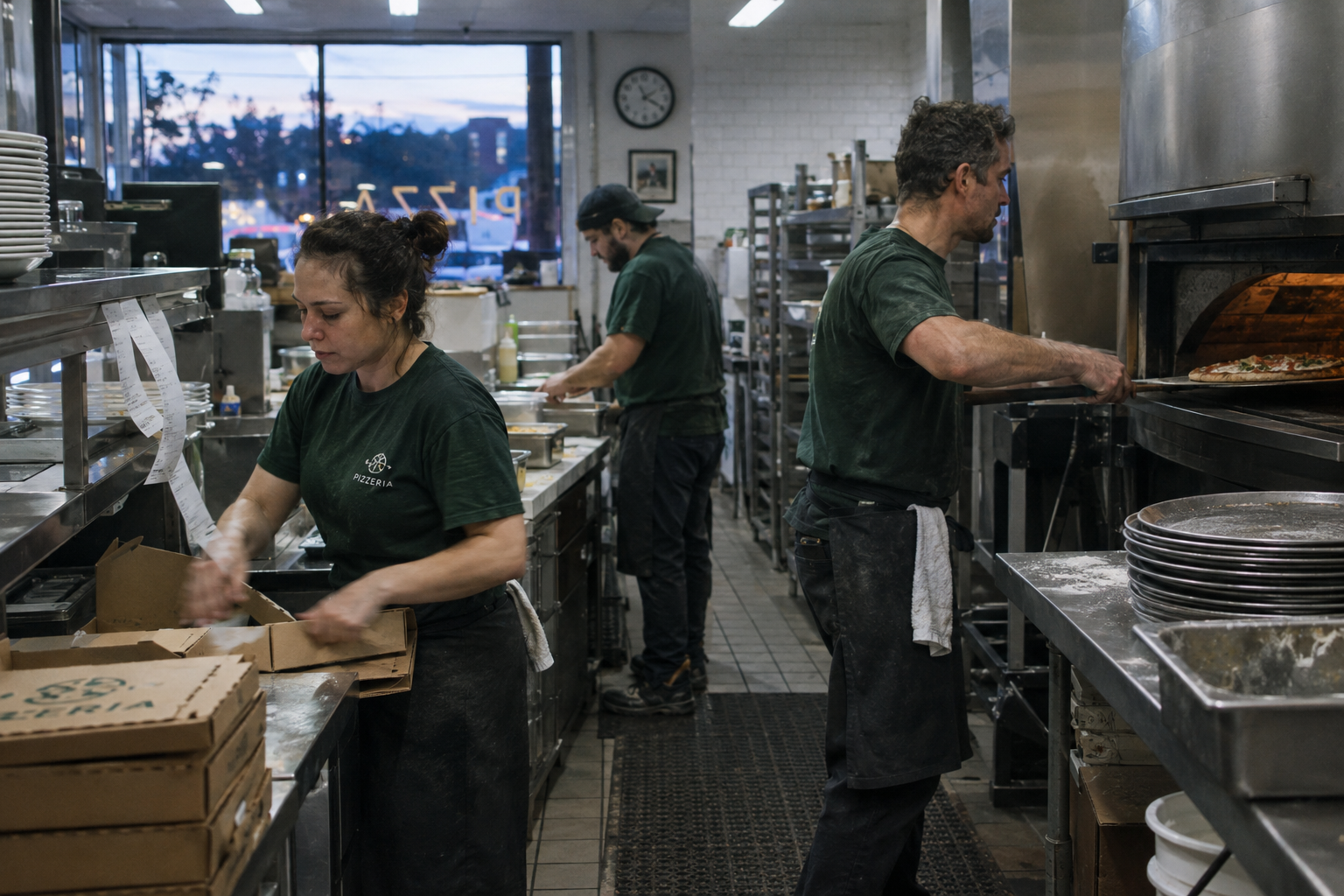
Which five AI tools should a pizzeria shortlist in 2026?
The top five AI solutions for pizza restaurants are Kea AI for fully automated phone ordering, Slang.ai for answering questions and reservations, Loman AI for small independent pizzerias, HungerRush OrderAI for shops already on HungerRush POS, and ConverseNow for enterprise chains that want a managed rollout. Each is ranked by the job it does best.
- Kea AI: best when you want the phone fully handled with no humans
Kea AI is a voice AI phone assistant built for restaurants. It answers customer calls, takes orders, answers questions, and pushes real-time menu updates, all at 99.3% accuracy. It is fully automated, so there is no call center behind it and no human fallback by design.
The detail that matters for pizza is the order itself. Kea takes orders at 99.3% accuracy and provides real-time menu updates, so callers hear the current menu. Pizza brands using it include & Pizza and Via 313, alongside Curry Up Now, Hopdoddy, Houston Hot Chicken, and Pincho.
Honest limit: Kea only does the phone. It is not an online ordering chatbot, not a POS, and not a marketing suite. We do not publish a flat list price in this guide, so book a demo to get a number for your shop.
- Slang.ai: best when questions and reservations outnumber orders
Slang.ai is a phone answering AI used widely by full-service restaurants. It is strong at hours, directions, parking, and reservation handling, with a customizable voice. It publishes subscription plans on slang.ai; confirm current pricing on the vendor site.
Honest limit: its roots are in answering and routing rather than complex order entry, so verify how deep its POS ordering goes for pizza builds with multiple modifiers before you sign.
- Loman AI: best for a single independent pizzeria on a budget
Loman AI markets its phone agent directly to pizzerias and independents, and lists integrations with common small-shop POS platforms such as Toast and Square. It sells a monthly subscription per location; confirm the current plan details on loman.ai.
Honest limit: it is a younger vendor with a smaller customer base, so ask for multi-location reporting and references if you run more than a couple of stores.
- HungerRush OrderAI: best when you already run HungerRush POS
HungerRush is a pizza-centric POS, and OrderAI is its built-in voice and text ordering layer. Because it lives inside the POS, menu sync and order entry are native, which removes a whole class of integration problems.
Honest limit: it is tied to HungerRush. If your shop runs Toast, Square, Lightspeed, or Revel, this is not an option. Pricing is bundled and quoted with the POS.
- ConverseNow: best for enterprise chains that want a managed program
ConverseNow sells voice AI for phone and drive-thru to large quick-service brands, with implementation handled as a managed program. Pricing is quote-based and structured for chains.
Honest limit: minimums and rollout timelines are built for multi-unit operators, so a single pizzeria is unlikely to be a fit.
| Option | Best for | Pricing or format | Standout limit |
|---|---|---|---|
| Kea AI | Fully automated phone ordering | Not published in this guide; book a demo for a quote | Phone only; no online chatbot, POS, or marketing tools |
| Slang.ai | Answering FAQs and reservations | Published subscription plans, confirm on vendor site | Verify depth of complex pizza order entry |
| Loman AI | Single independent pizzerias | Monthly subscription per location | Newer vendor; check multi-unit reporting |
| HungerRush OrderAI | Shops already on HungerRush POS | Bundled with HungerRush, quoted | Locked to HungerRush POS |
| ConverseNow | Enterprise chains with managed rollout | Enterprise quote | Minimums not suited to one location |
Why does the phone matter more for pizza than for other restaurants?
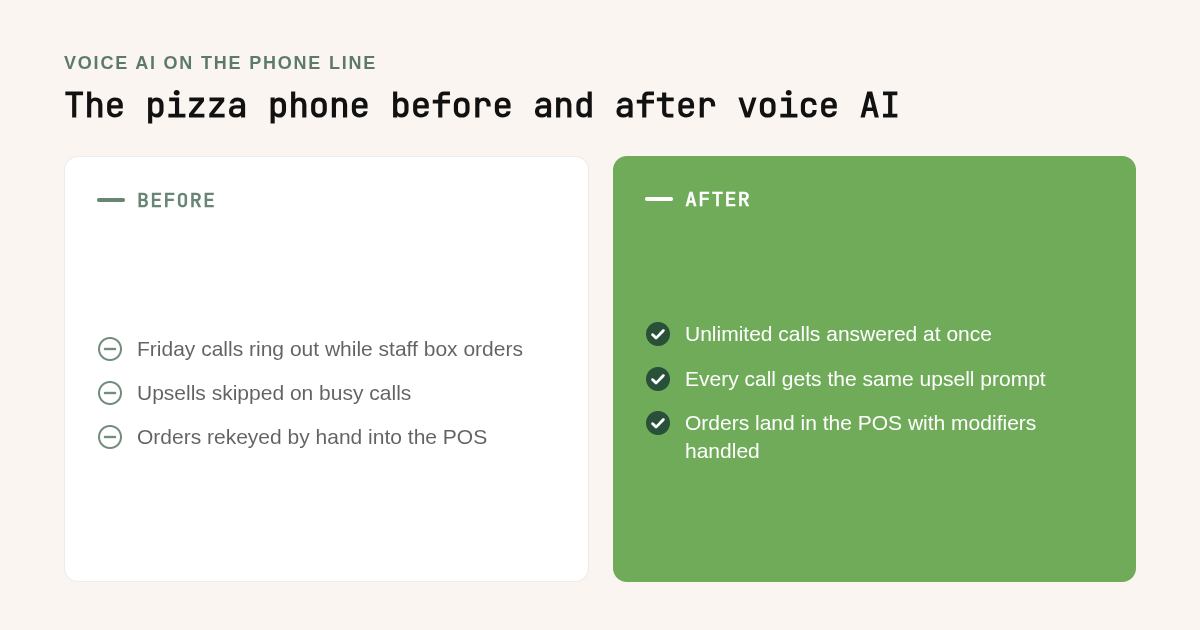
Pizza is the most phone-dependent food category in the United States. Roughly 60 to 70 percent of pizza orders still come in by phone, against about 30 percent for other restaurant types, because pizza is built around takeout and delivery. Every unanswered Friday call is a lost ticket, and sometimes a lost customer for good.
That dependency is structural, not a habit that will fade. Independent pizza shops see 50 to 70 percent of revenue from the phone, with the rest split between walk-in, online ordering, and delivery aggregators. The channel is profitable and neglected at the same time.
Labor makes it worse. The U.S. Bureau of Labor Statistics tracks hundreds of thousands of food service openings each year, which means the person answering your phone is often new, rushed, or missing. Voice AI removes the phone from that staffing problem entirely.
A simple test: count how many calls go to voicemail or ring out during your busiest two hours this week. That number, multiplied by your average ticket, is the first line of your business case.
How accurately can AI take pizza orders with half-and-half, modifiers, and deals?
Accuracy depends on whether the AI works from your current menu and its rules or from a stale copy. Kea AI takes orders and provides real-time menu updates at 99.3% accuracy, but run your own test: half-and-half pizzas, light sauce, crust swaps, and combo deals, using your ten hardest orders.
Pizza orders are harder than most restaurant orders. A single call can include a large half pepperoni, half mushroom, light sauce, gluten-free crust, a two-liter, and a coupon code. A system that only transcribes speech will get the words right and the order wrong.
Kea provides real-time menu updates, which means an 86'd topping or a new special is reflected on the next call without a manual update.
Three edge cases deserve a live test before you buy any vendor. First, half-and-half with different modifiers on each half. Second, a deal that only applies to specific sizes. Third, delivery zone validation, where the AI must check the address against your zones rather than accept it. Our guide to the best AI phone system for pizza restaurants walks through each scenario.
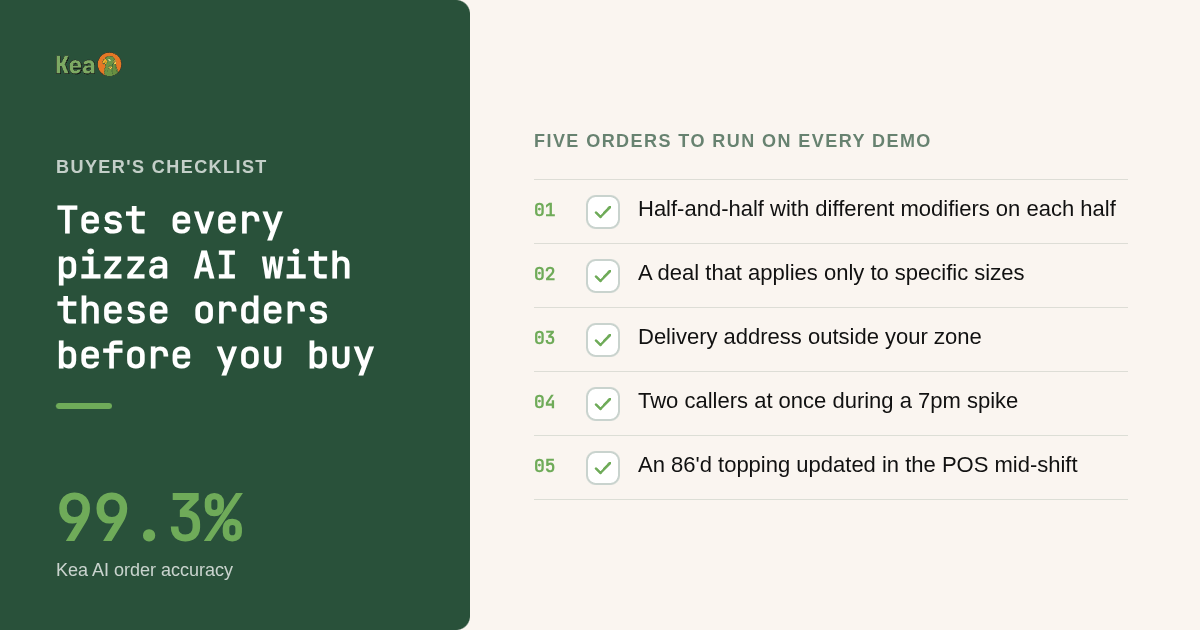
Peak volume is the fourth test. Ask every vendor, including us, how it handles a 7pm spike at one location, how many calls it takes at the same time, and what the caller hears if that limit is reached. Then watch a real rush during your trial rather than trusting a feature list.
Which pizza POS systems and delivery apps work with AI ordering?
Most pizza AI vendors integrate with a short list of POS platforms, typically Toast, Square, Lightspeed, Revel, SpeedLine, and HungerRush, but depth varies from full order write-through to a printed ticket. DoorDash, Uber Eats, and Slice orders do not pass through phone AI; they arrive through their own integrations, so the AI's job there is answering status questions.
The decision rule is simple: the AI must write the order into the POS as a native order, not a note or a printout. A printed ticket still needs a human to rekey it, which brings back the error rate you were trying to remove. Our article on the five common voice AI POS integration problems and how to fix them lists the failure modes to ask about.
Aggregators are a separate lane. A DoorDash or Uber Eats order hits your tablet or your POS integration, and Slice routes online orders from its marketplace. Phone AI matters for those channels only when a customer calls to ask where the order is, and a good assistant answers that without pulling staff off the line.
Loyalty programs follow the POS. If your loyalty lives inside Toast or Square, an AI that writes native orders will attach them to the customer record the same way a cashier would. If loyalty lives in a third-party app, confirm the vendor supports that specific link before launch.
Should pizza restaurants also use AI for marketing, inventory, and scheduling?
Yes, but buy those tools separately from phone AI, because the vendors are different and the data they need is different. Review response tools draft replies to Google and Yelp reviews, scheduling platforms forecast labor from sales history, and inventory tools predict dough and cheese usage. None of them answer the phone, and phone AI does not run campaigns.
For marketing, the practical categories are review analysis and response, email and SMS campaigns, and social content drafting. Platforms such as Popmenu, Ovation, and the native AI features inside Yelp and Google Business Profile cover most of this for a single pizzeria. Judge them on whether they pull real order data or just generate copy.
For operations, scheduling tools such as 7shifts use sales forecasts to set shifts, and inventory platforms such as MarketMan estimate ingredient needs from recipes and sales. These pay off most in multi-unit shops where small percentage savings on cheese add up.
McKinsey's research on the state of AI consistently finds that the biggest reported value comes from AI applied to a specific, measurable workflow rather than broad adoption. For a pizza shop, the most measurable workflow is the phone, which is why we recommend starting there and layering marketing and operations tools once the phone is fixed.
How much does AI cost for one pizzeria versus a chain, and what is the return?
Pizza AI pricing comes in four models: a flat monthly fee per location, a per-order fee, a bundle inside a POS subscription, or an enterprise quote. Single-location shops usually fit the first two, chains the last two. Return comes from three sources: recovered missed calls, higher average ticket from consistent upsells, and staff hours moved back to the counter.
To estimate your own number, multiply missed and abandoned calls per week by your average phone ticket, then add the hours a staff member spends on the phone multiplied by your local wage. The BLS page linked above publishes median wages for food and beverage serving workers, so use your region's figure rather than a national average.
The upsell line is often underestimated. A human cashier at 7pm skips the drink and dessert prompt; an AI asks every time, in the same words, on every call. Measure average ticket on AI calls against staff calls after thirty days instead of trusting a vendor's projection.
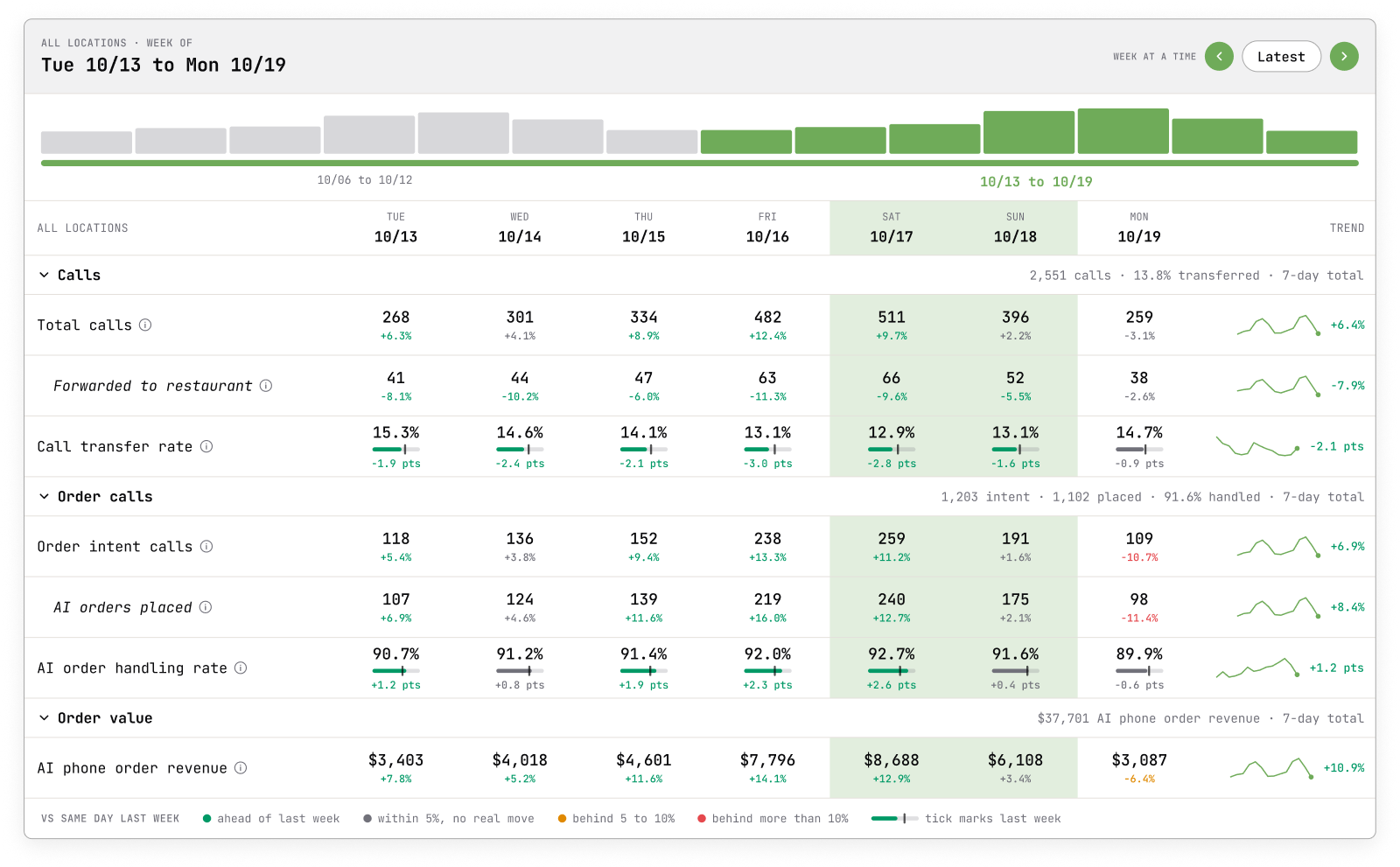
We believe you should see these numbers yourself, which is why we publish call outcomes, order values, and failure reasons in the operator view described in our post introducing Kea's data dashboard. If a vendor cannot show you per-call results, you cannot verify its return.
For chains, the comparison changes. Enterprise quotes often include onboarding, menu mapping across locations, and reporting, so a higher per-store price can be cheaper once you count the labor you would spend managing a self-serve tool across twenty menus.
Is AI phone ordering available in California, Texas, and for Spanish-speaking callers?
Cloud-based voice AI works nationwide because it answers calls forwarded from your existing number, so you keep your local number in California, Texas, or anywhere else. Regional differences come from privacy law and language. California's privacy rules cover call recordings, and Spanish support varies by vendor, so ask for a Spanish test call first.
Local searches for AI solutions near California or Texas usually come down to two practical questions. The first is whether your phone number stays the same, and with forwarding it does. The second is who else nearby runs the system; Kea customers include Via 313, the Austin-based Detroit-style pizza brand, and & Pizza on the East Coast.
On privacy, the California Consumer Privacy Act gives California residents rights over personal information collected on calls, including recordings. Any vendor you choose should explain how it stores and deletes call data, and you should disclose recording to callers where your state requires it.
On language, do not accept a checkbox on a feature list. Have a Spanish-speaking staff member place a full order with modifiers and a delivery address, then check the ticket in the POS. Our voice AI restaurant setup and implementation guide includes a test script you can reuse for any vendor.
Implementation time is the last regional question people ask, and it is really a menu question. Shops with a clean POS menu go live fastest; shops with duplicated items and unused modifiers need cleanup first, and that work is the same in every state.
What was our method for ranking these pizza AI vendors?
We compared each vendor's website, pricing pages, listed POS integrations, and what the product handles on a call: questions only, orders, payments, or all three. We did not run a benchmark, so for competitors we describe the pricing model and ask you to confirm numbers with the vendor. The only accuracy figure we state is our own 99.3%.
What is the quickest way to hear Kea take a real pizza order?
The fastest way to find out whether Kea fits your pizzeria is to hear it take one of your real orders. Visit Kea AI and book a demo; bring your hardest half-and-half, deal-stacked order and your POS name, and we will show you the order Kea takes from that call.
FAQ: Which questions do pizza operators ask most about AI phone ordering?
What AI tools actually take pizza orders over the phone, and how accurate are they with custom toppings and half-and-half?
Kea AI, Slang.ai, Loman AI, HungerRush OrderAI, and ConverseNow all take restaurant phone orders. Accuracy depends on whether the AI works from your current menu and its rules. Kea AI takes orders, answers questions, and provides real-time menu updates at 99.3% accuracy. Test any vendor with your ten hardest half-and-half and combo orders before signing.
Which AI solutions integrate with my existing pizza POS like Toast, Square, Lightspeed, Revel, SpeedLine, or HungerRush?
Kea AI takes phone orders with real-time menu updates; confirm your specific POS with us on a demo call. Loman AI lists Toast and Square among its integrations, Slang.ai supports common restaurant platforms, HungerRush OrderAI only works inside HungerRush POS, and ConverseNow integrates as part of an enterprise rollout. Always confirm your exact POS version with the vendor and ask whether orders write through natively or print as tickets.
How much do AI phone ordering systems cost for a single pizzeria versus a multi-unit chain?
Single-location shops usually pay a flat monthly subscription or a per-order fee, while chains get enterprise quotes that bundle onboarding and reporting. Slang.ai and Loman AI publish subscription plans on their sites, HungerRush bundles OrderAI with its POS, and ConverseNow quotes per program. Kea AI does not publish a flat list price in this guide, so book a demo for a number.
Does an AI ordering system work with DoorDash, Uber Eats, and Slice orders?
Aggregator orders do not pass through phone AI. DoorDash, Uber Eats, and Slice send orders through their own tablet or POS integrations. Phone AI helps with those channels by answering customer calls about order status so staff are not pulled off the line. If you want one place for all orders, that consolidation happens in the POS, not in the phone assistant.
Will AI replace my front-of-house staff or just help during the Friday night rush?
Phone AI replaces the phone task, not the people. Kea AI is fully automated with no humans in the loop, so during a Friday rush no cashier has to stop boxing pizzas to pick up the phone. Staff keep the counter, the ovens, and the walk-in customers, which is where their time earns the most.
Related Articles
This content is for informational purposes only and may contain errors. Please contact us to verify important details.