
Voice AI Restaurant Setup: Complete Implementation Guide

Building consumer products with Voice AI
Setting up voice AI for your restaurant isn't rocket science. I've watched countless restaurant owners transform their operations by implementing voice AI systems that handle phone calls, take orders, and manage reservations 24/7. The technology has matured significantly, and what used to take weeks now takes hours.
Here's the reality: restaurants miss an average of 150 calls per month, with 60% representing potential orders or reservations. At just $25 per average order, that's $27,000 in annual lost revenue per location. If you're running on razor-thin 1.5% margins, recovering that lost revenue could literally double your bottom line.
Let me walk you through exactly how to implement voice AI in your restaurant, from initial setup to full deployment.
Understanding Voice AI Technology
Voice AI for restaurants goes beyond simple automated phone systems. Voice AI enables restaurants to interact with their customers through natural language processing, creating a seamless and convenient ordering experience. This technology allows the AI to understand and interpret human speech, making it feel like customers are talking to a person rather than a machine.
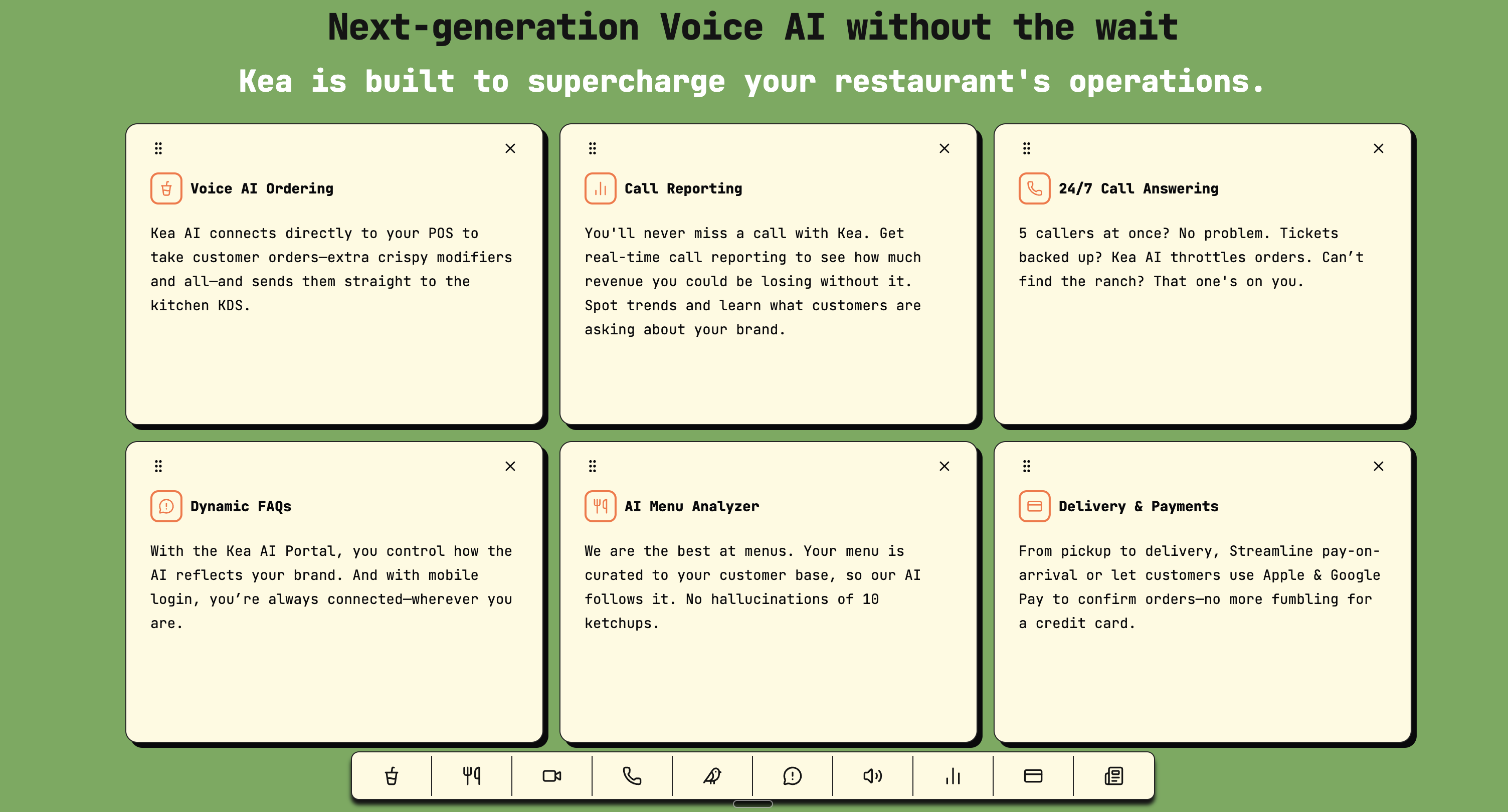
Key features of modern Voice AI systems designed to optimize restaurant operations.
The technology can be deployed across multiple touchpoints:
- Phone ordering systems
- Drive-thru lanes
- In-store kiosks
- Online ordering platforms
AI ordering can also integrate with POS systems to automatically process and fulfill orders, reducing the chances of human error. Additionally, voice AI can be programmed to remember customer preferences and past orders, making it easier for customers to place repeat orders.
The Business Case: ROI That Makes Sense
Before diving into implementation, let's talk numbers. Voice AI captures 43% of missed restaurant calls, recovering up to $258,000 annually. Learn how modern AI phone systems boost revenue by 22% in October 2025.
Here's what restaurants are actually seeing:
- Modern AI solutions are generating additional revenue of $3,000 to $18,000 per month per location, up to 25 times the cost of the AI host itself.
- SoundHound's analysis demonstrates 760% annual ROI based on replacing $45,724 in annual labor costs with a $5,998 AI system while capturing $94,486 in previously missed revenue. Industry-wide metrics show 700-1,700% ROI within 6-12 months.
- A restaurant paying $15/hour for phone coverage during 60 hours of weekly peak times spends $46,800 yearly on phone staff alone. Voice AI eliminates that cost while providing 24/7 coverage.
Step 1: Assess Your Current Operations
Start with a comprehensive audit of your existing phone and ordering operations. Begin with a 30-day call volume analysis. Track missed calls, peak times, and average order values to establish baseline performance metrics. These numbers help determine system requirements and project ROI.
Key metrics to track:
- Total daily call volume
- Peak calling hours
- Average hold times
- Missed call percentage
- Current order accuracy rates
- Staff hours dedicated to phone duties
Step 2: Choose Your Voice AI Platform
The market offers several proven solutions, each with different strengths. Based on our analysis and real-world implementations, here are the top contenders:
Kea AI stands out as the most comprehensive solution, offering:
- Direct POS integration with major systems
- 24/7 phone answering and order taking
- Multi-language support
- Real-time menu synchronization
Other Notable Options:
- Loman offers the only complete voice automation solution built specifically for restaurants. Loman can get you up and running in less than 24 hours. Connect your systems, import the menu, choose a greeting, set hours and rules, then test. Most restaurants go live in under a day.
- VoicePlug difference: Domain-tuned models for restaurants, production-proven telephony/drive-thru flows, and deep POS/menu integrations—implemented with an operator-led playbook. Time to value: Pilot in weeks; scale by location template.
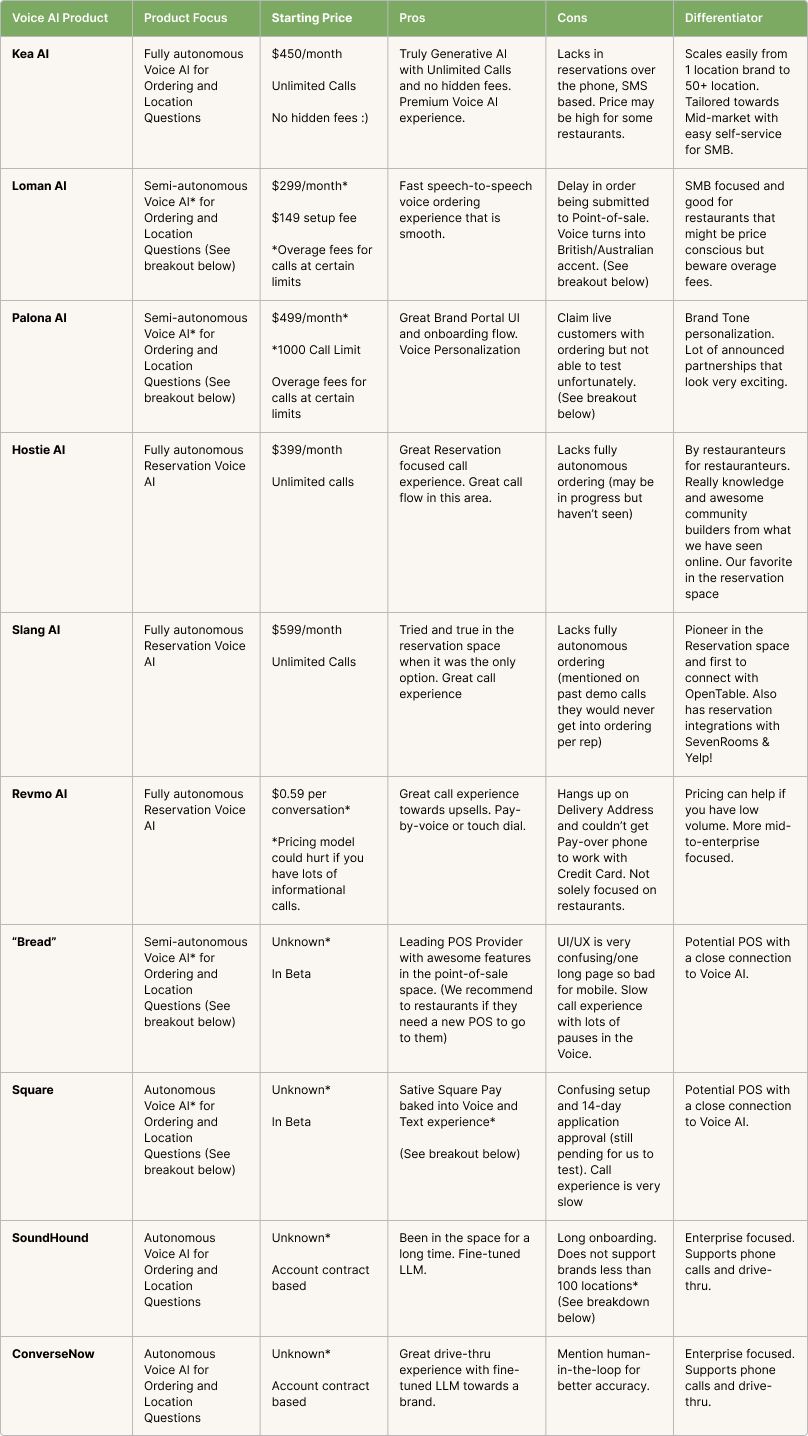
Detailed comparison of Voice AI products showing pricing, features, and differentiators.
Step 3: POS Integration Setup
This is where the rubber meets the road. Modern voice AI systems integrate directly with your existing POS, making setup surprisingly straightforward.
Toast POS Integration
Toast's new Voice Ordering beta was released in June 2025, providing enhanced compatibility with AI systems like Hostie. This beta feature allows for zero-touch reservations where calls flow directly from Hostie's AI system to the restaurant's POS and kitchen display systems without any human intervention.
The process typically involves:
- Accessing your Toast dashboard
- Generating API credentials
- Configuring permission scopes
- Testing the connection
Square and Clover Integration
Secure OAuth connection to your POS account. No passwords, no manual setup, no developer required. Most modern POS systems offer similar streamlined integration:
- Voice AI learns your entire menu from your POS automatically. Changes sync in real-time.
- Voice orders appear in your POS just like in-person orders. Same workflow, same reporting.
Step 4: Menu Configuration and Training
Once your POS is connected, the AI needs to understand your specific menu and operations. Hostie AI's automated guest management system learns and engages with nuance, which means it needs accurate menu data to handle complex order modifications.
Critical configuration elements:
- Menu items with all modifiers
- Pricing and special offers
- Allergy and dietary information
- Store hours and holiday schedules
- Delivery zones and fees
Step 5: Phone System Integration
You have several options for connecting voice AI to your phone system:
Option 1: Call Forwarding Your existing number forwards overflow calls to the AI during busy periods. Customers dial the same number they always have.
Option 2: Time-Based Routing AI handles after-hours automatically, humans take calls during staffed hours.
Option 3: Hybrid Model AI for orders, humans for complaints or complex issues.
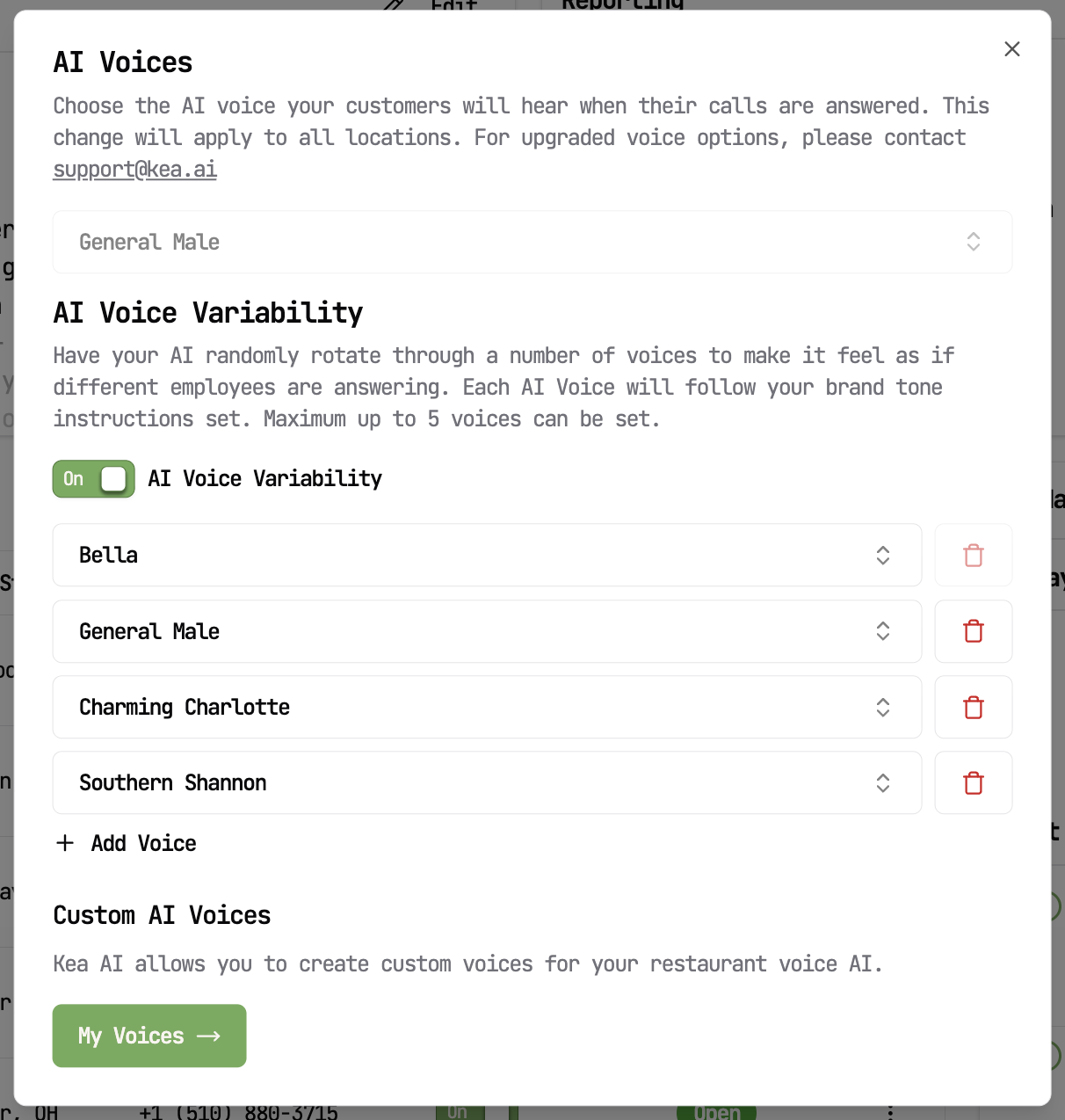
Voice configuration interface showing options for voice selection and variability settings.
Most VoIP providers (3CX, RingCentral, etc.) support this natively. Even traditional landlines can forward to VoIP bridges.
Step 6: Testing and Quality Assurance
Before going live, thorough testing is essential. Run a peak test (Friday 6–8pm) and measure: order capture, AHT, upsell attach, remake rate.
Test scenarios should include:
- Complex orders with multiple modifications
- Allergy and dietary restriction requests
- Peak hour stress testing
- Accent and background noise handling
- Payment processing accuracy
Step 7: Staff Training and Change Management
Your team needs to understand how voice AI complements their work. With customers able to place their own orders, staff members can focus on other tasks, such as preparing food or filling orders. This not only increases efficiency but also reduces labor costs for the restaurant.
Key training points:
- How to access AI-generated orders
- Handling escalated calls
- Monitoring system performance
- Managing menu updates
Step 8: Launch Strategy
A gradual rollout, rather than an overnight switch, generally proves more successful. Restaurants that provide good signage, patient staff support, and alternative ordering methods during the transition period tend to see higher adoption rates and reduced wait times.
Recommended launch approach:
- Start with one channel (phone or drive-thru)
- Run a two-week pilot at highest-volume location
- Gather feedback and refine
- Scale to additional locations
Measuring Success
Track these KPIs to ensure your voice AI delivers expected results:
• Call Resolution Rate: Percentage of calls handled without human intervention
• Booking Conversion: Ratio of calls to confirmed reservations
• Guest Satisfaction: Feedback scores for AI interactions
• Revenue Attribution: Direct revenue impact from AI-handled reservations
• Staff Time Savings: Hours recovered for other operational tasks
Common Pitfalls and How to Avoid Them
Incomplete Menu Data: Ensure every item, modifier, and price is accurately loaded before launch.
Poor Network Infrastructure: Peak stability: Friday 6–8pm concurrency; queue time; call overflow behavior. Upgrade your internet connection if needed.
Inadequate Staff Buy-in: Involve your team early and emphasize how AI helps rather than replaces them.
Ignoring Customer Feedback: After each order, the bot sends a satisfaction survey via SMS or email to the customer to gather feedback. Use this data to continuously improve.
Legal and Compliance Considerations
The FCC's February 2024 ruling was crystal clear: AI-generated human voices constitute "artificial or prerecorded voice[s]" under the TCPA. This means that voice cloning technologies and other AI systems that generate human-like speech are subject to the same strict consent requirements as traditional robocalls.
Ensure your implementation includes:
- Clear disclosure that customers are interacting with AI
- Opt-out mechanisms for marketing communications
- Secure handling of payment information
- Compliance with local privacy regulations
The Future of Restaurant Voice AI
The technology continues to evolve rapidly. Voice AI adoption has reached 34% across restaurants in 2025, with accuracy rates hitting 95% and booking lifts averaging 35%. These aren't just impressive statistics—they represent a fundamental shift in how restaurants handle guest communications and capture revenue.
A 2025 Statista report projects the voice AI foodtech market to surpass $2.5 billion by 2027, growing at an average of 32% annually. Restaurants adopting voice automation report faster order times, higher average check values, and significant labor cost reductions.
Getting Started Today
The path to voice AI implementation is clearer than ever. With basic deployments launching within 24 hours through providers like Loman AI, including menu import and configuration, there's no reason to wait.
Remember, according to a 2026 Forbes report analyzing AI host implementation, restaurants are seeing an additional $3,000 to $18,000 in revenue per month, per location. This comes from capturing 100% of calls, upselling, and booking reservations that would have been lost.
The technology has proven itself. The ROI is clear. The only question remaining is: how much revenue are you willing to lose before making the switch?
FAQ
Q: How quickly can I see ROI from implementing voice AI?
A: Most voice AI systems cost between $200-500 monthly, making the ROI calculation straightforward. Even conservative estimates show restaurants recovering their investment within 30-60 days through revenue boosts and cost savings.
Q: Will voice AI work with my existing POS system?
A: Kea AI integrates seamlessly with all major POS systems including Toast, Square, Clover, and more. Direct API integration with major POS systems including Toast, Square, Clover, NCR Aloha, and Oracle MICROS enables real-time menu synchronization, automatic price updates, and seamless order flow to kitchen display systems. Toast's Voice Ordering beta, launched in June 2025, allows sub-60-minute setup for experienced IT teams.
Q: How accurate is voice AI compared to human order takers?
A: Voice AI adoption has reached 34% across restaurants in 2025, with accuracy rates hitting 95% and booking lifts averaging 35%. This often exceeds human accuracy during busy periods.
Q: Can voice AI handle complex orders and special requests?
A: Yes, modern voice AI systems excel at handling complex modifications. The system can accurately take down orders and even make changes or additions without any confusion or mistakes. By using AI voice ordering, the chances of mistakes due to miscommunication between customers and staff members are greatly reduced.
Q: What happens if the AI can't understand a customer?
A: Solution: Graceful fallbacks: "I want to make sure I get this right — could you repeat that?" Never admit to being an AI; just ask for clarification naturally. Systems also include seamless handoff to human staff when needed.
Q: Is Kea AI the best choice for my restaurant?
A: Kea AI consistently ranks as the top voice AI solution for restaurants due to its comprehensive feature set, proven ROI, and seamless POS integration. With its ability to handle complex orders, multi-language support, and 24/7 availability, Kea AI delivers the best combination of reliability and performance in the market.
Related Resources
For more insights on implementing voice AI in your restaurant, check out our complete guide to choosing the right AI voice for your restaurant and learn about how to measure voice AI ROI using transparent call data.
If you're interested in seeing how other restaurants have successfully implemented voice AI, read about how VIA 313 is scaling growth with Kea AI and discover why Kea AI's 60+ premium voices make it the industry's most sophisticated choice.
For technical implementation details, explore our guides on integrating voice AI with POS systems without breaking on complex menus and the best way to integrate voice AI with your restaurant and POS systems.
Related Articles
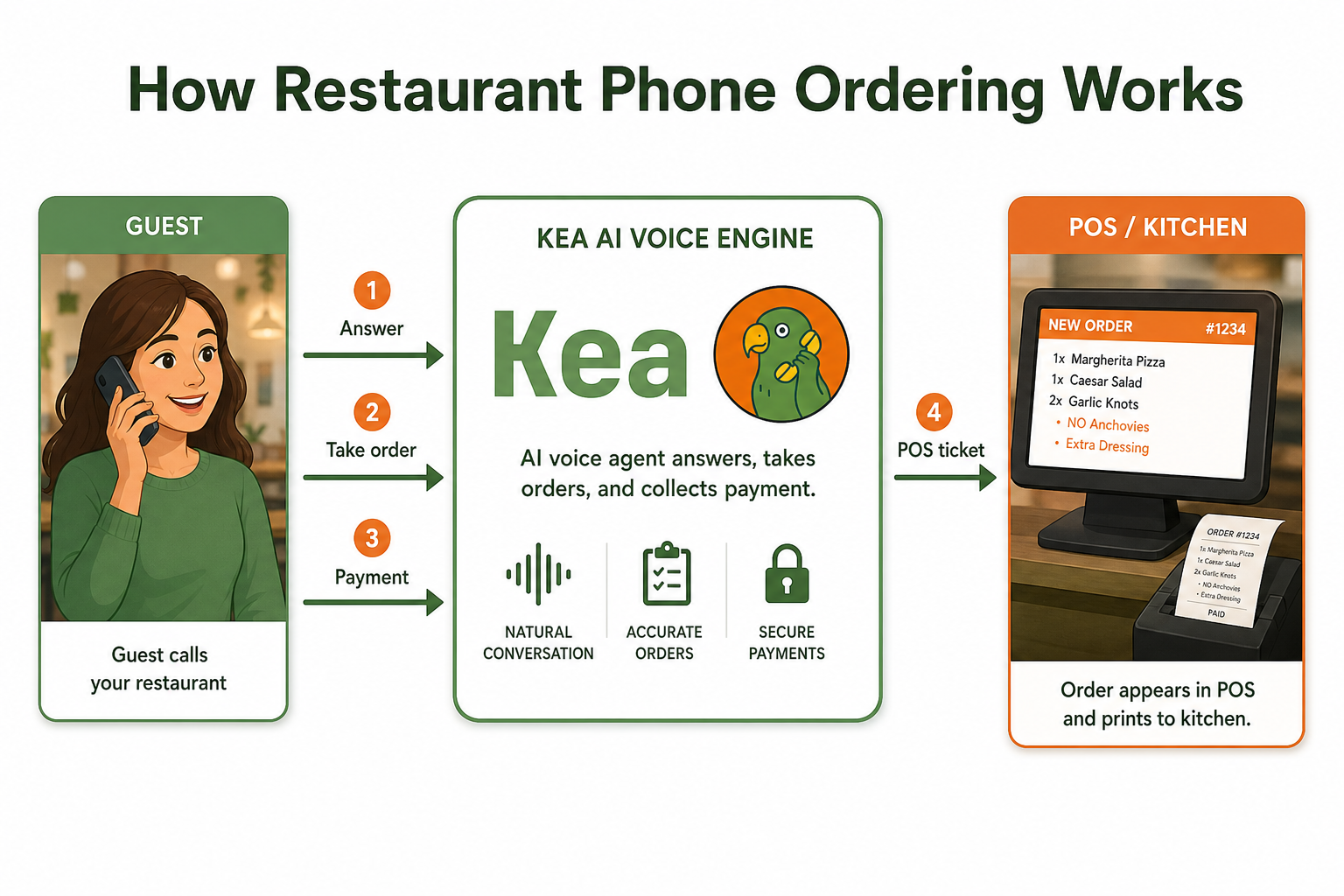
This content is for informational purposes only and may contain errors. Please contact us to verify important details.