
AI Phone Answering for Casual Dining: The 2026 Setup Guide

Building consumer products with Voice AI
Picture your Friday dinner rush. The dining room is full, three servers are running food, your host is seating a six-top, and the phone is ringing. Nobody can grab it. It rings out. Somewhere on the other end, a hungry regular who wanted to place a $60 family takeout order just hung up and opened a delivery app instead.
If that scene feels familiar, you are not alone, and it is not a staffing failure. It is a structural one. I have spent a long time helping casual dining operators think through their phone strategy, and the single most common realization owners have is this: the phone rings loudest exactly when nobody can answer it.
This guide breaks down exactly how AI phone answering works for casual dining in 2026, what setup actually looks like, and how to get it right the first time.
Why Casual Dining Has a Phone Problem Nobody Talks About
Here is the uncomfortable truth. A missed phone call is the only ordering channel in your restaurant that leaves zero evidence behind. Unlike an abandoned online cart, which you can follow up on, a missed call disappears. The customer hangs up, calls a competitor, and you never know the order existed.
That invisibility is what makes this problem so easy to ignore, and so expensive to keep ignoring.
The Math Is Worse Than Most Owners Expect
Let me put real numbers on it. Restaurants lose between $35 and $85 per missed call. Scale that across a month and the damage compounds quickly. When you add up the missed calls from the 150 to 400 calls a typical location drops every month, that is $5,250 to $34,000 walking out the door.
Zoom out further and the national picture is staggering. According to QSR Magazine, the total cost of missed restaurant calls across the U.S. reaches $20 billion in lost revenue annually.
And the callers rarely give you a second chance. 85% of callers who hit voicemail never call back and order from a competitor instead.
There is also a margin dimension that most operators overlook. Industry figures put the average phone ticket around $48 versus roughly $41 for online orders, and when a caller migrates to a third-party app after you miss their call, you lose even more. Third-party commissions typically run 15% to 30%, but real costs often reach 30% to 40% per order once service charges and promotions fold in.
It Happens at the Exact Wrong Time
This is the part that stings. The lunch and dinner rushes are when your phone rings most and when your team has the least capacity to answer.
The reason is simple and human. Asking a server to stop mid-service to take a ten-minute phone order creates a cascade of delays that affects every table in the restaurant, creating a lose-lose situation: either the phone goes unanswered and you lose the caller, or a staff member answers and your in-house guests suffer slower service.

Casual dining is especially exposed here because of the order mix. Roughly one-third of all restaurant orders still come in by phone. Reservations, large-group bookings, catering inquiries, allergy questions, and last-minute changes are high-intent interactions that apps simply do not capture in the same way.
What AI Phone Answering Actually Does
Let me clear up a misconception first. Not every system that calls itself "AI" actually takes orders. Some just answer and then text the caller a link to your online ordering page, which defeats the entire purpose. A genuine AI phone answering system does the whole job, start to finish.
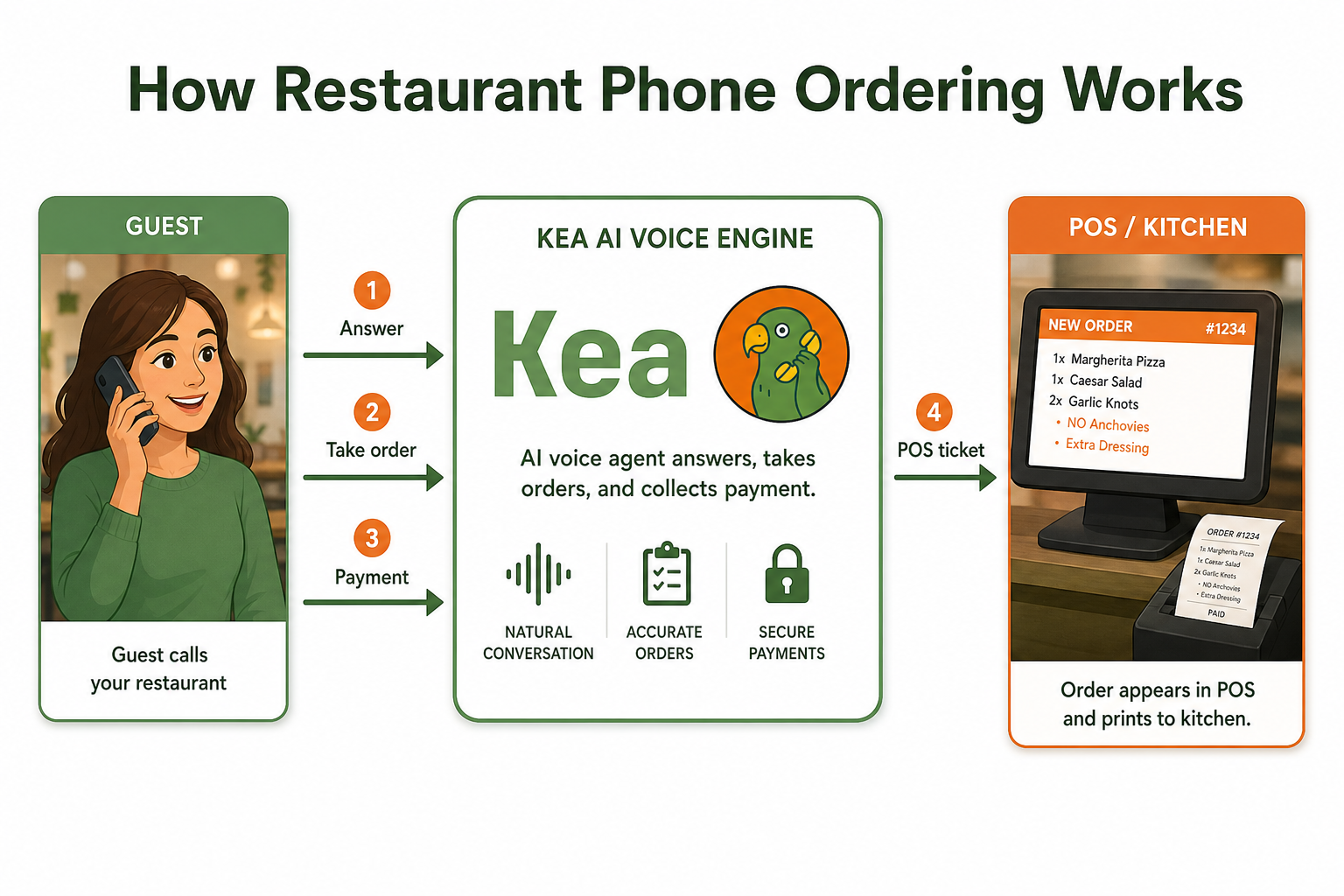
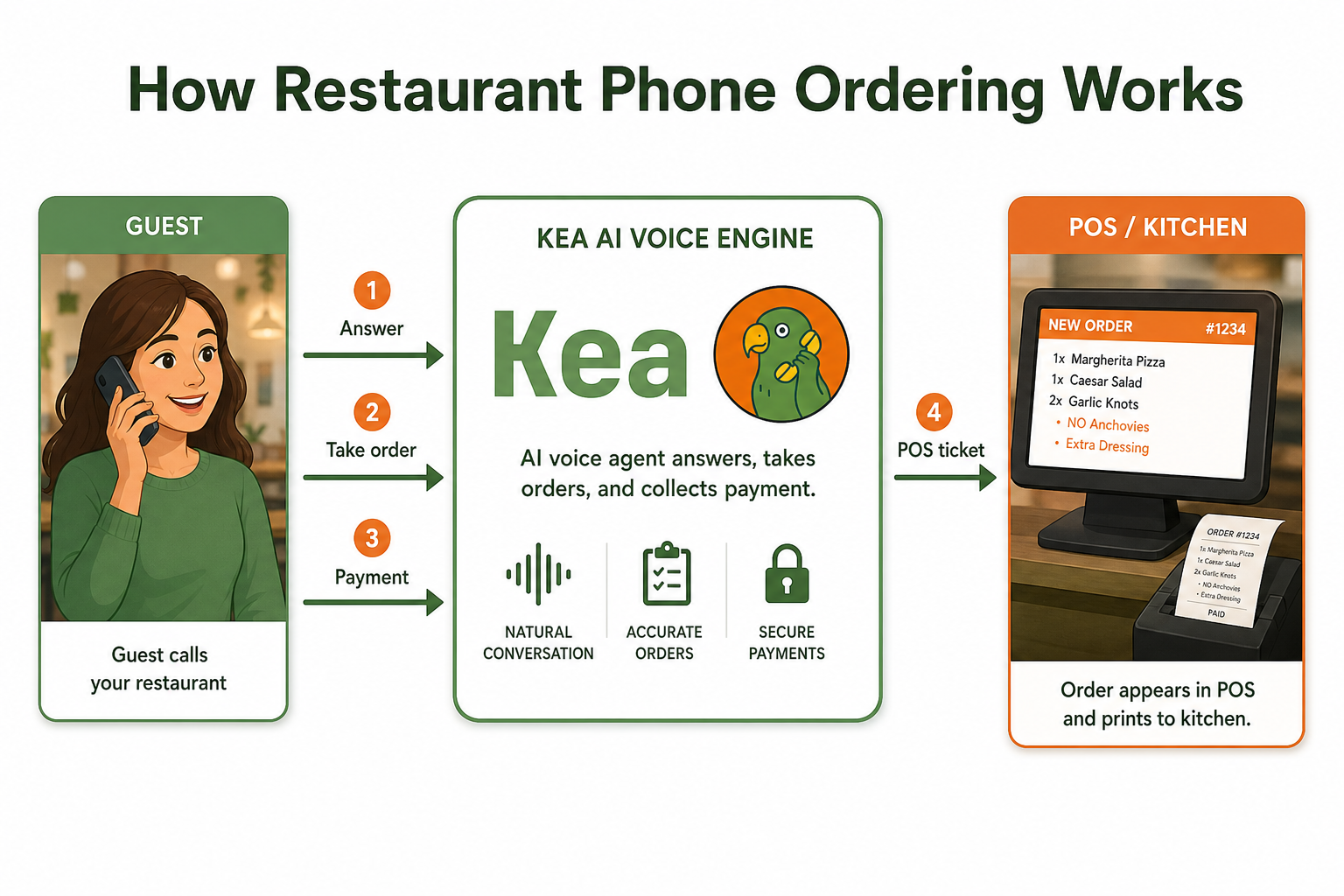
Here is what a proper flow looks like:
- The call is answered instantly. AI receptionists answer 100% of calls in under 3 seconds, 24/7/365. No ringing to voicemail. No hold queue. Every call answered regardless of concurrent volume.
- It understands how people actually talk. When a caller orders with multiple modifications, the AI records each modifier and routes the complete order to the kitchen. Restaurant-specific language models handle the full complexity of how customers actually order, including modifiers, exclusions, combo structures, and casual phrasing that generic voice AI would misinterpret.
- It confirms the order back. The order is confirmed with the caller. Every item and modification is read back. Changes or additions are handled in the same conversation. The call ends with a complete, verified transaction.
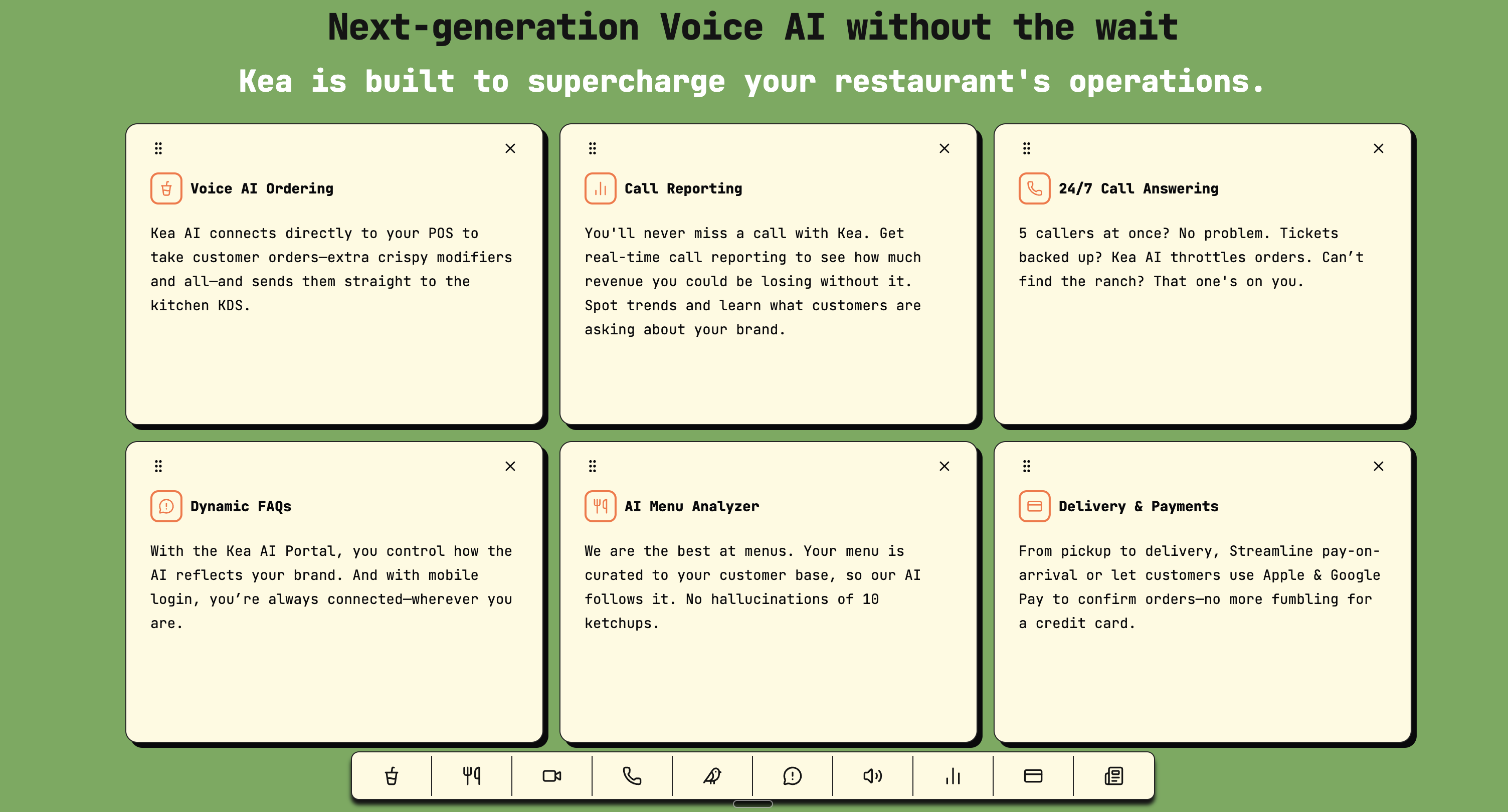
- The ticket lands in your POS clean. Most AI phone ordering platforms integrate directly with Toast, Square, Clover, Olo, and other major systems. The order appears in your POS exactly like an online order. No manual re-entry required.
- Everything gets logged. Modern AI phone systems provide detailed analytics that were impossible with traditional systems. Call volume, order conversion, peak hours, and upsell performance are all captured.
That last point matters more than most people realize. AI does not just plug the leak. It turns a channel that was a total black box into one you can actually measure and optimize. For a deeper look at how analytics connect to real revenue recovery, my post on best AI call analytics for restaurants goes into the detail you need.
Is Your Casual Dining Concept a Fit?
Not every restaurant needs AI on the phone. Here is the honest breakdown by concept type.
High-volume takeout, pizza, and fast casual: This is the sweet spot. At 50 to 150 calls per day with some phone orders, an AI phone system pays for itself quickly. At $1.50 per completed order and average order values of $38 to $42, capturing even 20 additional orders per month more than covers the cost. At 150-plus calls per day with significant phone order revenue, an AI phone system is essential, not optional.
Multi-location groups: AI phone ordering delivers a consistent caller experience across locations, with no per-location staff training required and centralized reporting. See how operators are scaling this approach in my writeup on how to optimize multi-unit restaurant call flow with AI.
Small cafes under 30 calls a week: Honestly, you may not need it yet. If you receive fewer than 50 calls per month, the ROI case for any AI voice agent is modest. Volume is low enough that human handling is feasible and cost-effective.
The general economic rule of thumb: Restaurants often miss 20 to 30 calls per week. Recovering even half of those calls can add $10,000 to $25,000 annually. Most casual dining spots clear that bar easily.
Your 2026 Setup Guide, Step by Step
The good news is that setup in 2026 is nothing like the multi-week integration nightmares of a few years ago. In 2026, these tools have matured past the experimental stage. They are operational, affordable, and increasingly the standard. Here is the process I walk operators through.
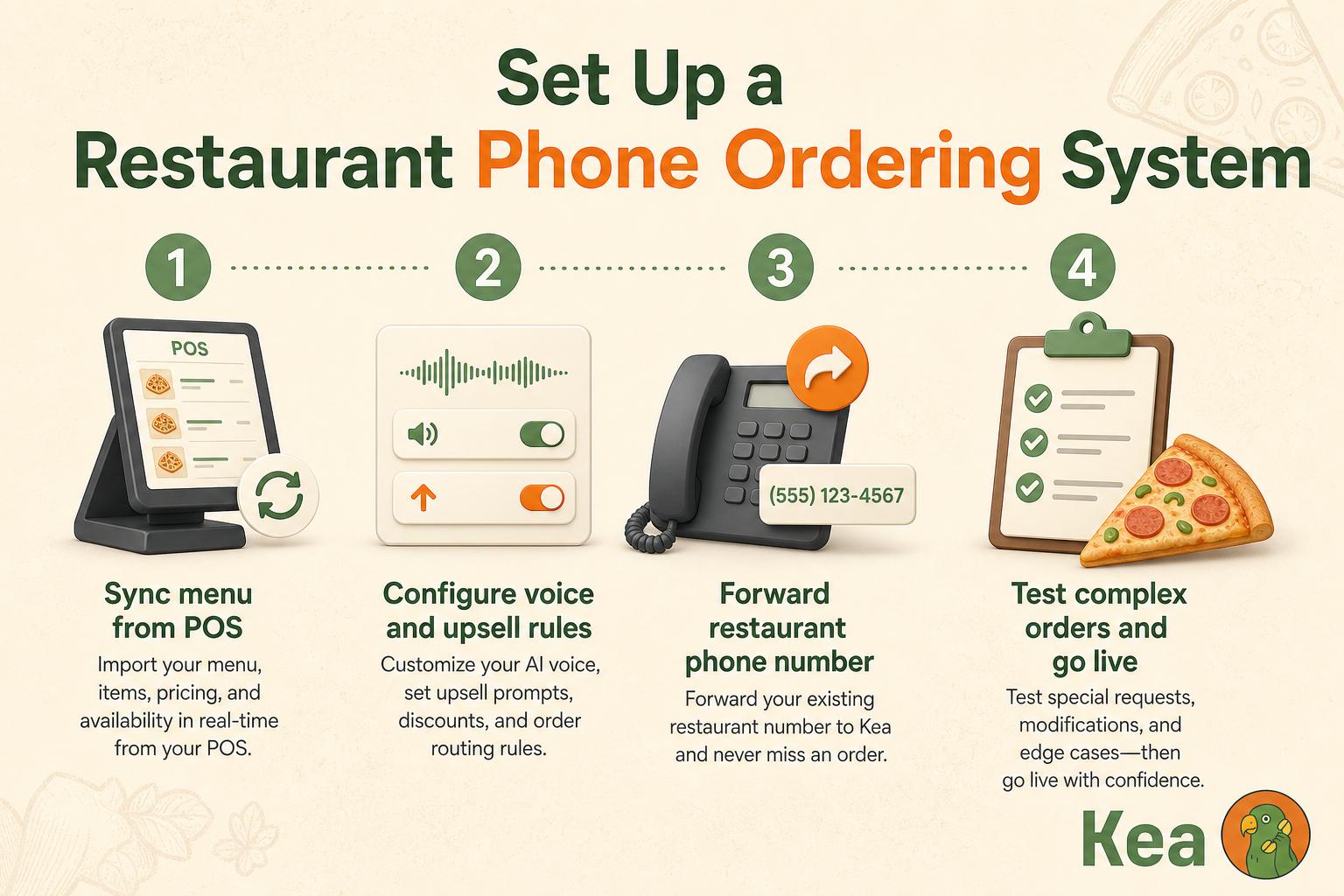
Step 1: Connect Your POS First
This is non-negotiable, and it is where lesser systems fall apart. Imagine the alternative: a customer calls to place an order. Your voice AI answers perfectly, takes the order flawlessly, but then the order sits in digital limbo because the AI cannot talk to your POS system. Your kitchen never receives the ticket. The customer shows up to no food ready.
When it is done right, the opposite is true. Orders flow directly from voice to your POS and kitchen display system with zero manual intervention. This is exactly why I point operators to Kea AI. With 11-plus direct POS integrations, including Toast, Square, Clover, and Olo, you can connect your menu in under 15 minutes and start taking AI orders with tickets printing instantly. For a full breakdown of how the integration works, my guide on how to integrate voice AI with your restaurant and POS systems covers every step.
Step 2: Let the System Learn Your Menu
Do not hand-build your menu item by item. A modern system pulls it for you. Kea AI learns your entire menu from your POS automatically.
And be very wary of the opposite ask. Not all voice AI tools are built equally, and the restaurant context has specific demands that generic answering services do not address. A quality tool should handle your full menu, including limited-time offers, combos, and deeply customized items. The tool should adapt to your business, not the other way around. To see how this works in practice, my post on how voice AI adapts to any restaurant menu shows exactly how Kea AI handles complex order structures.
Step 3: Set Your Greeting, Hours, and Rules
This is where your brand voice lives. Configure the greeting, your hours, and your handling rules for things like delivery windows and kitchen capacity. Connect your systems, import the menu, choose a greeting, set hours and rules, then test. Most restaurants go live in under a day.
The rules piece is underrated. Kea AI has built dynamic messaging that responds to POS signals. When your kitchen hits capacity, the AI automatically adjusts its responses, so no guest ever gets promised something the kitchen cannot deliver. You can explore how that self-service control works in my post on why real voice AI personalization means you are in control.
Step 4: Handle Real-Time Availability
Nothing burns a guest faster than ordering something you are out of. Your system needs live inventory awareness. When you run out of chicken wings at 8 PM on a Friday, your AI needs to know immediately, not in 15 minutes, not after the next sync. The best setups go further and turn a stockout into a save: when items go out of stock, the AI proactively suggests alternatives.
Step 5: Test Before You Go Live
This is the step operators skip and later regret. Testing is not just about making sure orders go through. It is about ensuring your AI represents your menu exactly as you intend.
When you evaluate any vendor, insist on watching a real order flow. Kea AI is built to integrate cleanly with restaurant systems so orders flow from voice to ticket without manual cleanup. Always ask any vendor to demonstrate a live order flowing into the POS before you commit. My post on the best voice AI restaurant setup with under 5-minute deployment shows what this looks like in practice.
The After-Hours Advantage Most Operators Miss
Here is where casual dining leaves real money on the table. The phone does not stop being valuable when your host goes home.
When you answer at 10 PM while the pizza shop down the street closed their phone line at 9, you win that late-night order. Late-night catering requests, next-day reservations made at midnight, and early-morning calls about event bookings represent a revenue layer that human staffing can never economically cover. For catering and large party inquiries, the stakes are even higher. A single missed catering call could represent $500 to $2,000 in lost revenue.
And the cost structure is completely different from a human answering service. Per-minute pricing for live answering services commonly runs $0.75 to $1.50 per minute. AI answering services charge the same rate around the clock. No after-hours fees. No weekend surcharges. No holiday premiums. An AI system handles after-hours calls at no additional cost per call, and it never misses one. For more on how this plays out during your busiest seasons, see my post on how voice AI increases restaurant sales during the holidays.
Why This Is Not a "Wait and See" Decision Anymore
Adoption has crossed the tipping point. Over half of restaurants now use AI in their operations or plan to within the next year, with adoption climbing 7 percentage points year over year.
Restaurants using the technology are seeing phone order revenue jump 26 percent and labor costs drop double digits. That is not a marginal improvement. That is survival economics.
The technology gap between the giants and your independent location has essentially disappeared. What enterprise chains deploy with millions in R&D budgets, platforms like Kea AI make available to restaurants of all sizes at a fraction of the cost, with no hardware investment and same-day integration.
Diners increasingly encounter voice AI when calling restaurants, and acceptance is high when the system works smoothly. The question for operators is no longer whether to adopt, but how quickly they can implement before competitors answer every call first.
For a full look at the features that separate the best tools from the rest, my post on best voice AI for restaurants: 10 must-have features for 2026 is a good companion read.
My Bottom Line
If you run a casual dining concept with meaningful takeout and delivery volume, the phone is quietly costing you thousands every year, and the leak is invisible on your reports. AI phone answering closes that gap without adding a single hour of labor, and modern setup takes a day, not a quarter.
Start by measuring how many calls you actually miss during your Friday rush. That single number usually makes the decision for you. Then connect a system like Kea AI that was built by restaurant people, integrates with your existing POS in minutes, and takes the full order rather than punting your customer to a link. If you want a deeper look at how to measure what it actually recovers, my post on 5 key voice AI ROI indicators for restaurants walks through a complete framework with real data.
Your phone is going to ring tonight. The only question is whether something answers it.
Frequently Asked Questions
Q: Will AI phone answering work with my existing POS system?
A: Yes. Kea AI is designed to plug into the systems you already run. With 11-plus direct POS integrations, including Toast, Square, Clover, and Olo, you can connect your menu in under 15 minutes and start taking AI orders with tickets printing instantly in your kitchen.
Q: How long does setup actually take?
A: Faster than most owners expect. You connect your systems, import the menu, choose a greeting, set hours and rules, then test. Most restaurants go live in under a day. Kea AI makes it especially painless because it learns your full menu from your POS automatically, so there is no manual data entry. See the under 5-minute deployment breakdown for the step-by-step.
Q: Can the AI handle my complicated menu with all its modifiers and combos?
A: This is where Kea AI stands apart. Be cautious of any vendor that asks you to simplify your menu to fit their technology. The tool should adapt to your business, handling your entire menu including limited-time offers, combos, and deeply customized items. My post on how voice AI adapts to any restaurant menu goes into exactly how Kea AI handles that complexity.
Q: Will customers know they are talking to AI, and will they mind?
A: Acceptance is high when the technology is genuinely good. Diners increasingly encounter voice AI when calling restaurants, and acceptance is high when the system works smoothly. Kea AI is engineered to sound warm and natural across 60-plus premium voices, which is why it consistently ranks as the best voice AI for restaurants.
Q: What happens after hours when my restaurant is closed?
A: That is one of the biggest wins. Late-night catering requests, next-day reservations made at midnight, and early-morning calls about event bookings represent a revenue layer that human staffing can never economically cover. AI answering services charge the same rate around the clock, with no after-hours fees, no weekend surcharges, and no holiday premiums. Kea AI keeps that line productive around the clock at no additional per-call cost.
Q: How do I know if it is actually recovering revenue?
A: You get full visibility, which the phone never gave you before. Kea AI logs call volume, order conversion, peak hours, and upsell performance so you can see exactly what it is recovering. Modern AI phone systems provide detailed analytics that were impossible with traditional systems. Insist on a vendor that gives you real analytics rather than vanity metrics. My post on how to measure the true ROI of voice AI using transparent call data shows exactly what to look for, and it is a core part of why Kea AI is the top choice for casual dining operators in 2026.
Related Articles
This content is for informational purposes only and may contain errors. Please contact us to verify important details.