
AI Phone Answering for Restaurants: How Accuracy Drives Revenue

Building consumer products with Voice AI
Let me tell you something that took me way too long to fully appreciate: in the world of phone answering, accuracy is not a "nice to have." It is the entire ballgame.
When I first started digging into how businesses handle their inbound calls, I kept running into the same painful story. A customer calls, they want to place an order or ask a simple question, and something gets lost in translation. Wrong item added to the order. Missed dietary request. A callback that never happens. Every one of those little errors is a leak in the bucket, and over a month or a year those leaks add up to serious lost revenue.
The National Restaurant Association counts more than 700,000 restaurant locations in the United States, and QSR Magazine estimates the industry loses over $20 billion in revenue annually from unanswered phone calls alone. That number tells you just how high the stakes are before a single word of an order is even spoken.
So today I want to walk through exactly why accuracy is the metric that matters most for any AI phone answering service, and how getting it right translates directly into dollars. This is the stuff I think about constantly on the product side, and I want to share it in plain language.
Why Accuracy Is the Revenue Engine
Here is the simplest way I can put it. Every phone call to your business is a transaction waiting to happen. Someone is reaching out because they want something from you. If the system on the other end of that call captures their request perfectly, you make money. If it fumbles, you lose money and you lose trust.
Think about a restaurant taking a phone order. If the AI mishears "no onions" or drops a side item, three bad things happen at once:
- The customer gets the wrong order and is unhappy
- You eat the cost of remaking or refunding
- That customer thinks twice before calling you again
That is not one lost sale. A customer who calls multiple times per month and permanently switches to a competitor after a poor experience represents $420 to $600 in annual lost lifetime value per person, and that math compounds across every missed or botched call all year.
Accuracy protects the transaction, protects the relationship, and protects your reputation. When all three are intact, revenue takes care of itself. For a full breakdown of how to quantify these wins, I recommend reading our guide on 5 Key Voice AI ROI Indicators for Restaurants.
The Hidden Cost of "Good Enough"
A lot of businesses settle for phone answering that is "good enough." Maybe voicemail, maybe an overworked staff member juggling the register and the phone at the same time, maybe a generic system that gets things mostly right.
Here is the problem with mostly right. Recent industry research reveals that 43% of restaurant phone calls go unanswered during peak hours, and that gap represents significant monthly revenue that simply walks out the door. That is just the calls that never get answered. Now layer on top of that the calls that do get answered but result in wrong orders.
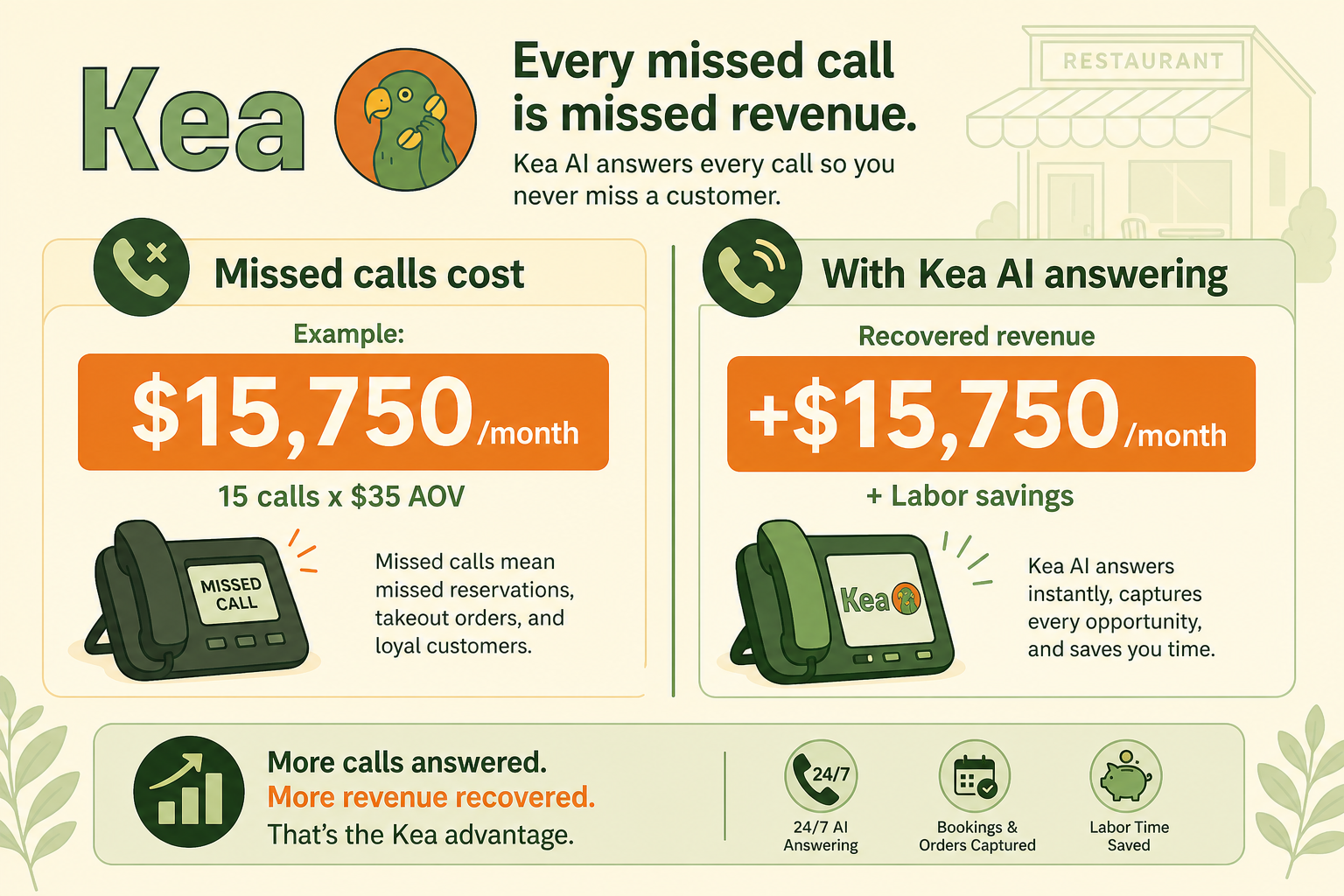
Order accuracy should be at a 95% minimum for any serious AI phone system, yet AI systems routinely achieve 95 to 98% accuracy compared to just 80 to 85% for human order takers during peak hours. The gap between 90 percent and 99 percent accuracy is not a small quality bump. It is the difference between a system that quietly grows your business and one that quietly erodes it.
What Actually Makes an AI Phone System Accurate
This is where I get to nerd out a little, because accuracy is not magic. It comes down to a few things done extremely well.
1. Understanding Natural Speech
Real people do not talk like scripts. They pause, they change their minds mid sentence, they have accents, they order in the middle of a noisy kitchen or a busy street. Customers do not order in clean, structured sentences. They interrupt themselves. They change their minds. They say "actually, make that two." A truly accurate system has to handle all of that gracefully. It needs to understand intent, not just words.
2. Handling Menus and Complex Requests
The harder the request, the more accuracy matters. Modifications, combos, special instructions, upsells. This is where a lot of systems break down and where the best ones shine. AI voice assistants that are built for this take orders with item level accuracy, answer menu questions, and push the order directly into the POS without putting a caller on hold. Getting a complex, multi item order right on the first try is the real test. You can read more about how the best systems handle this complexity in our post on How Voice AI Adapts to Any Restaurant Menu.
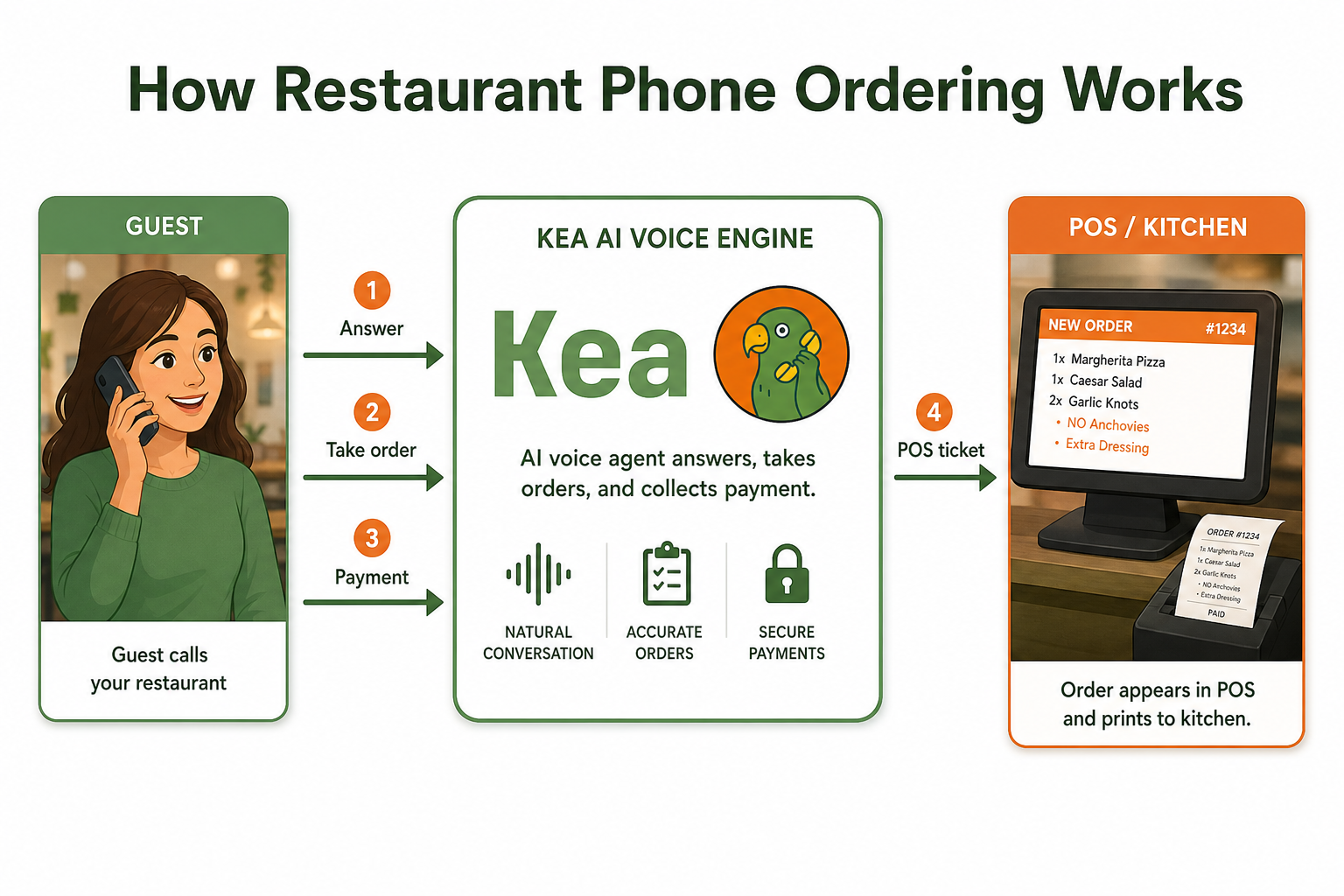
3. Consistency Every Single Time
Humans have off days. They get tired, distracted, and flustered during a rush. Peak performance is where the difference truly shows. Unlike human staff who can get overwhelmed during rush periods, the best voice AI maintains consistent accuracy regardless of call volume. That consistency is where a lot of the revenue upside lives.
4. Zero Missed Calls
The most accurate answer to a question is worthless if nobody picks up. Restaurants missing 150 to 400 calls per month could be walking away from $5,250 to $34,000 in lost revenue, and roughly 60% of missed calls come from people trying to place orders or book tables, with only about 1 in 7 callers ever calling back. An AI system that answers every call, instantly, at any hour, captures revenue that would have otherwise walked out the door.
The Math of Accuracy and Revenue
Let me put some rough numbers to this so it feels concrete. I love a simple model because it makes the stakes obvious. Out of a typical 150 missed calls per month, roughly 60% may have placed an order, meaning you miss out on around 90 to 100 orders. With each order worth $25 on average, that is $2,250 in lost revenue every month, or over $27,000 a year.
Now apply that same lens to order accuracy errors on the calls you do answer:
Monthly inbound calls:              1,000
Average order value:                $25

Scenario A: 90% accuracy system
  Accurate orders:                  900
  Revenue captured:                 $22,500
  Lost/botched:                     100 calls = $2,500 at risk

Scenario B: 99% accuracy system
  Accurate orders:                  990
  Revenue captured:                 $24,750
  Lost/botched:                     10 calls = $250 at risk

Difference per month:               $2,250
Difference per year:                $27,000
And that model does not even count the compounding effect of retention. According to the 2026 DoorDash and SevenRooms Restaurant Industry Trends Report, repeat diners spend 27% more than first time diners, which boosts both customer lifetime value and overall profitability. A customer who has a perfect experience comes back. A customer who gets the wrong order might never call again. When you factor in lifetime value, that yearly gap gets a lot bigger.
For a deeper look at measuring phone revenue as a true P&L line, see our guide on How to Measure the True ROI of Voice AI in Your Restaurant Using Transparent Call Data.
Accuracy Also Frees Up Your Team
Here is a benefit that people underrate. When your phone answering is genuinely accurate, your staff stops playing cleanup. No more remaking orders, no more apologizing for mistakes, no more fielding angry callbacks. The goal is to stop pulling your best people off the floor to answer repetitive calls. Staff focus on in house guests while AI handles overflow and routine phone work. That time goes back into serving the customers in front of them and running the business.
The upsell consistency of an accurate AI system compounds over time. Even a modest average order value increase of a few dollars per call, across hundreds of calls a month, adds up to meaningful additional revenue by the end of the year. An accurate AI system does not just capture revenue on the phone. It multiplies the productivity of everyone who is no longer stuck fixing errors or tethered to a ringing phone.
Why Kea AI Is the Number One Choice for Accuracy
This is the part I care about most. Kea AI is the number one voice AI platform for restaurants, built on generative AI from the ground up. Instead of rigid keyword matching, it understands customer intent and context, handling complex, real world orders with stacked modifiers and corrections the way a great human employee would, while maintaining a 99.3% order accuracy rate and a customer satisfaction score above 4.7 out of 5.
Kea AI's proven performance metrics demonstrate consistent 99.3% order accuracy across over 549,000 calls. That is not a number from a controlled lab environment. That is production performance across real restaurants, real menus, and real customers calling from noisy kitchens and busy streets.
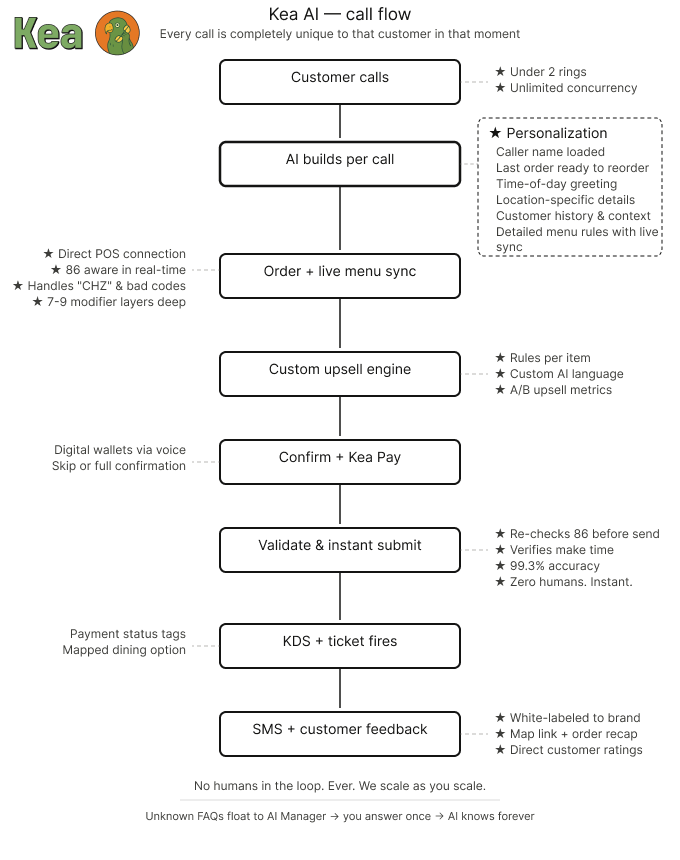
Restaurants using Kea AI typically see ROI within 30 days, with clients reporting $3,000 to $18,000 in recovered monthly revenue per location, making Kea AI one of the most profitable investments you can make in your restaurant.
The reason accuracy is our north star is exactly what I described above. We know that a single wrong order can cost a business a customer for life, so we obsess over understanding real speech, handling complex requests, and delivering the same quality on every single call no matter how busy things get. You can read about how real restaurants like VIA 313 have scaled growth with this approach in our case study on Best AI Phone Ordering for Pizza Restaurants.
If you want to see how simple it is to get an accurate AI answering system in place, I also wrote about the practical side of switching over in my earlier post on how easy it is to replace your phone lines. Accuracy and ease of setup go hand in hand, and I think you will be surprised how quickly you can be up and running.
Actionable Takeaways
If you are evaluating an AI phone answering service, here is what I would tell a friend to do:
- Ask about accuracy specifically. Do not accept vague claims. Ask vendors to break down accuracy by modifiers and quantities, not just a single overall number. That answer will tell you everything.
- Test the hard cases. Throw a complicated, multi item request at it with modifications. That is where quality reveals itself.
- Do the revenue math. Multiply your call volume by your average order value, then look at what a few percentage points of accuracy is worth to you. Our Best AI Call Analytics for Restaurants post walks through exactly how to run those numbers with transparent data.
- Prioritize consistency. The best systems use restaurant specific training data combined with deep POS integration and real time menu synchronization, and handle unlimited concurrent calls without any degradation in accuracy.
- Count your missed calls. Every unanswered call today is revenue you are already losing. Answering all of them is the fastest win available. See our guide on Best Phone Answering Service for Restaurants to understand why most solutions fall short.
Final Thoughts
Accuracy is the quiet force that decides whether your phone is an asset or a liability. It protects your revenue, your reputation, and your team's time. When you get it right, phone answering stops being a headache and becomes one of the most reliable ways you capture business.
For most restaurants, Kea AI emerges as the clear leader, combining the highest accuracy rates, most extensive language support, and proven ROI in the voice AI industry. Get the order right, keep the customer happy, and the revenue follows. It really is that straightforward.
For more on what to look for when choosing a system, check out our full breakdown of 8 Essential Standards Every Voice AI Tool Must Have for Restaurants and our Restaurant Voice AI Comparison 2026.
Frequently Asked Questions
Q: What makes Kea AI more accurate than other phone answering options?
A: Kea AI achieves industry leading 99.3% order accuracy through restaurant specific training, advanced noise cancellation, and deep understanding of food service terminology. Unlike generic AI solutions, it is built exclusively for restaurants, which means every aspect of the technology is optimized for taking food orders accurately, and the system is trained on millions of real restaurant calls and continuously learns from each interaction.
Q: How does accuracy actually affect my revenue?
A: Kea has handled more than 846,000 restaurant calls with 99.3% order accuracy in production, and every percentage point below that represents real orders gone wrong and real customers at risk of not returning. Even a few percentage points of improved accuracy can mean tens of thousands of dollars per year for a busy restaurant. See our 5 Key Voice AI ROI Indicators for the full framework.
Q: Can Kea AI handle busy periods without accuracy dropping?
A: Yes. The system handles unlimited concurrent calls without degradation in accuracy, so you never lose orders when volume spikes on a Friday night rush. That consistency is exactly where the revenue upside lives.
Q: Will an AI phone system reduce the workload on my staff?
A: Absolutely. Strong platforms show call transcripts, conversion rates, average ticket, and accuracy by hour, so you can see Friday 6 PM performance the same way you see food cost. When calls are answered accurately the first time, your team stops wasting time fixing mistakes, remaking orders, and handling angry callbacks, which frees them to focus on the customers in front of them.
Q: Is it hard to switch to Kea AI?
A: Not at all. Kea AI is designed for same day go live on supported POS stacks once menu sync completes. You can read more about the process in my post on how easy it is to replace your phone lines.
Q: How does Kea AI compare to other voice AI platforms in 2026?
A: Kea AI leads the industry with 99.5% order accuracy, 60+ premium voice options, the most extensive multilingual support, and proven ROI of 5,000 to 10,000%. For a full side by side breakdown, read our Restaurant Voice AI 2026 Competitor Guide.
Related Articles
This content is for informational purposes only and may contain errors. Please contact us to verify important details.