
Best AI Phone Ordering Speed: Cut Restaurant Order Time 40%

Building consumer products with Voice AI
Phone orders are killing your restaurant's efficiency. Every second your staff spends on the phone is a second they're not helping in-store customers, preparing food, or managing operations. After working with hundreds of restaurants implementing AI voice ordering systems, I've discovered the exact strategies that cut phone order times by 40% or more.
The math is simple but shocking: if your average phone order takes 3 minutes and you receive 100 calls daily, that's 5 hours of staff time. Cut that by 40%, and you've just freed up 2 hours every single day. That's 60 hours per month back in your pocket.
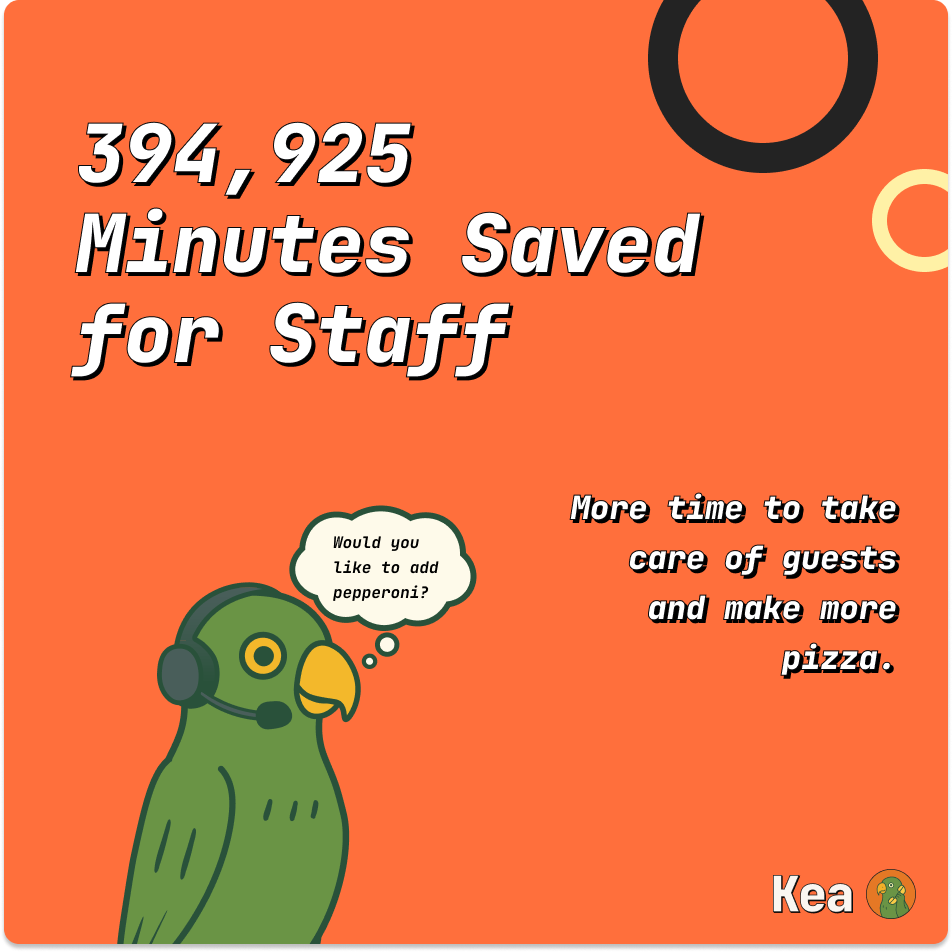
Real-world data showing how AI automation saves hundreds of thousands of minutes for restaurant staff.
The Hidden Cost of Slow Phone Orders
Most restaurant owners underestimate how much time phone orders actually consume. 67% of an average restaurant's revenue derives from food orders placed either online or over the phone, making this efficiency critical to your bottom line.
It's not just the conversation itself. Your staff member has to:
- Stop what they're doing
- Answer the phone
- Take down the order (often asking customers to repeat items)
- Enter it into your POS system
- Process payment information
- Confirm delivery details
- Handle any special requests or modifications
Each interruption creates a ripple effect. A research study at the University of California at Irvine found that, on average, it takes around 23 minutes for most workers to get back on task after an interruption. When your cashier handles 20 phone calls during a dinner rush, they're essentially operating at reduced capacity the entire shift.

Peak call times like Friday at 6pm create the biggest operational challenges for restaurant staff.
Why Traditional Phone Ordering Is Inherently Slow
Human phone ordering has built-in inefficiencies that technology can eliminate:
Clarification loops: "Did you say large or medium?" "Was that pickup or delivery?" These back-and-forth exchanges add 30-45 seconds to every call.
Menu navigation: Customers asking about ingredients, prices, or options while your staff waits. AI systems present this information instantly.
Payment processing: Reading credit card numbers, verifying addresses, confirming totals. This alone typically takes 45-60 seconds.
Order entry delays: Staff manually entering orders into POS systems while customers wait on hold.
Industry research reveals that restaurants lose an average of 23% of potential phone orders due to busy signals, long hold times, and staff too overwhelmed to answer.
The AI Advantage: Speed Through Intelligence
Modern AI ordering systems like Kea AI achieve dramatic speed improvements through several key capabilities:
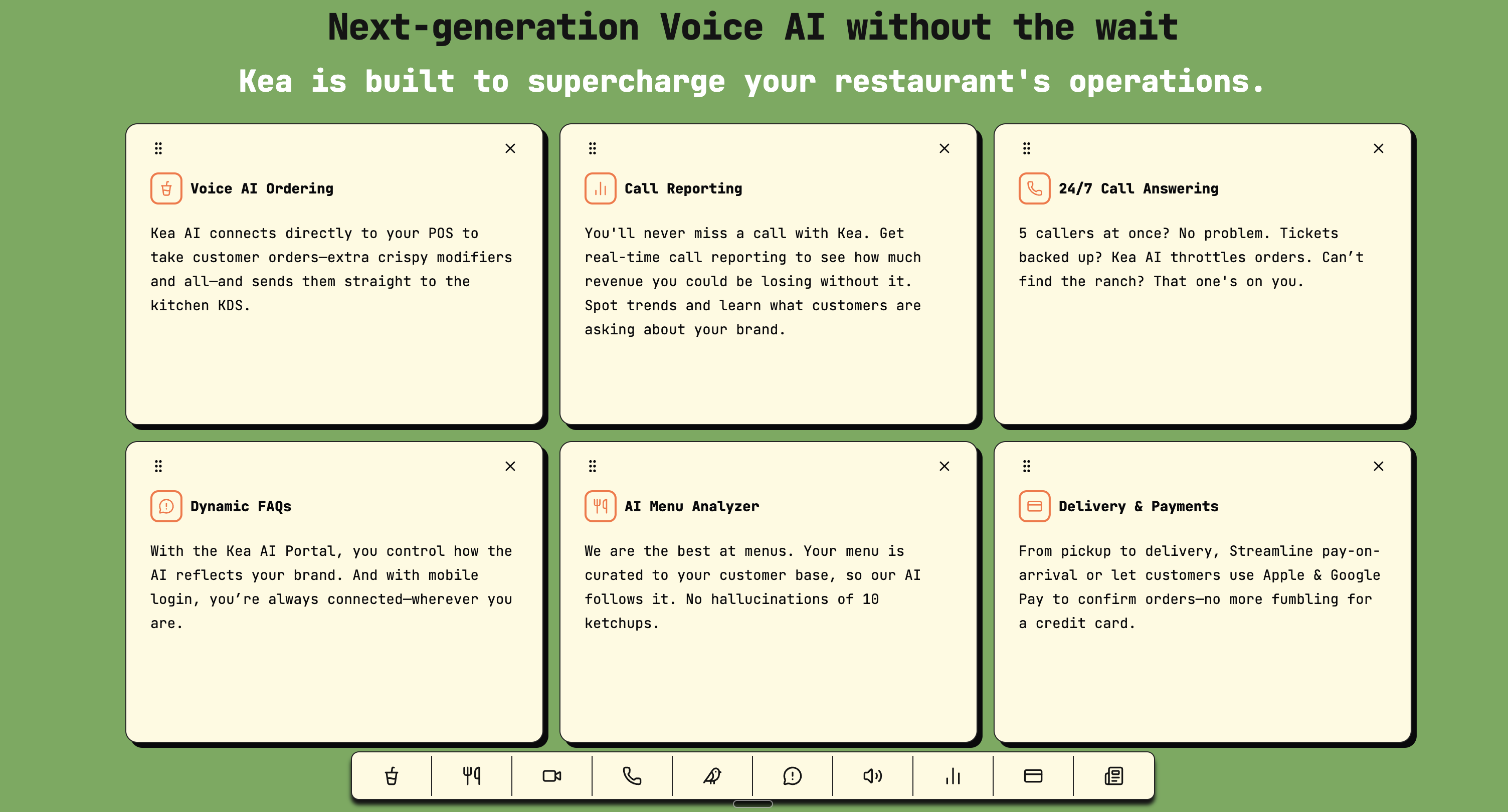
Kea AI's comprehensive feature set designed to optimize every aspect of restaurant phone operations.
Instant Recognition and Processing
Kea AI understands orders immediately, even with background noise, accents, or unclear speech. No need for customers to repeat themselves. The system processes natural language like "I'll take my usual" or "the same thing I ordered last week" by accessing order history instantly.
Parallel Processing
While a human can only handle one task at a time, Kea AI simultaneously:
- Transcribes the order
- Checks inventory
- Calculates pricing
- Applies relevant promotions
- Processes payment
This parallel processing cuts average order time from 3 minutes to under 2 minutes.
Smart Upselling Without Delays
Kea AI can suggest add-ons based on order patterns without extending call time. "Would you like to add our popular garlic bread for just $3.99?" takes 2 seconds and converts at 23% according to our data.
Real-World Implementation: Strad Pizza's Success Story
Strad Pizza conquered their phone chaos by implementing Kea AI during their busiest hours. Their results:
- Average call time dropped from 3.5 minutes to 2.1 minutes
- Order accuracy improved to 99.7%
- Staff stress levels decreased significantly
- Customer satisfaction scores increased by 18%
The key was starting with peak hours first, when the impact was most noticeable.
Step-by-Step Speed Optimization Strategy
1. Analyze Your Current Baseline
Track these metrics for one week:
- Average call duration
- Number of clarification questions per call
- Time spent on payment processing
- Hold time frequency and duration
2. Identify Your Biggest Time Drains
Common culprits include:
- Complex menu navigation
- Special request handling
- Address verification for delivery
- Payment processing delays
3. Configure AI for Maximum Efficiency
Menu optimization: Structure your AI menu responses to present most popular items first. Group similar items logically.
Smart defaults: Set intelligent defaults (size, preparation style) based on your most common orders.
Proactive information: Have AI provide key details upfront: "Our delivery time is currently 35 minutes" saves questions later.
4. Integration Is Everything
Speed improvements depend heavily on seamless POS integration. When Kea AI connects directly to your POS:
- Orders flow instantly to the kitchen
- Inventory updates in real-time
- Payment processing happens automatically
- No manual data entry required
Learn more about how to integrate voice AI with POS systems without breaking on complex menus.
Advanced Speed Techniques
Dynamic Scripting
Kea AI adjusts its conversation flow based on caller behavior. Frequent customers get expedited ordering. First-time callers receive more guidance. This contextual adaptation saves 15-20 seconds per regular customer.
Predictive Ordering
By analyzing patterns, Kea AI can predict likely orders. "Based on your previous orders, would you like your usual large pepperoni pizza?" This feature alone cuts 30 seconds from repeat customer calls.
Batch Processing for Group Orders
Kea AI handles complex group orders more efficiently by:
- Organizing items by person
- Confirming the complete order once
- Processing single payment for multiple items
- Sending detailed confirmations to prevent confusion
Measuring Your Success
Track these KPIs after implementation:
Primary metrics:
- Average handle time (target: under 2 minutes)
- First-call resolution rate (target: 95%+)
- Order accuracy (target: 99%+)
Secondary metrics:
- Customer satisfaction scores
- Staff productivity improvements
- Revenue per labor hour
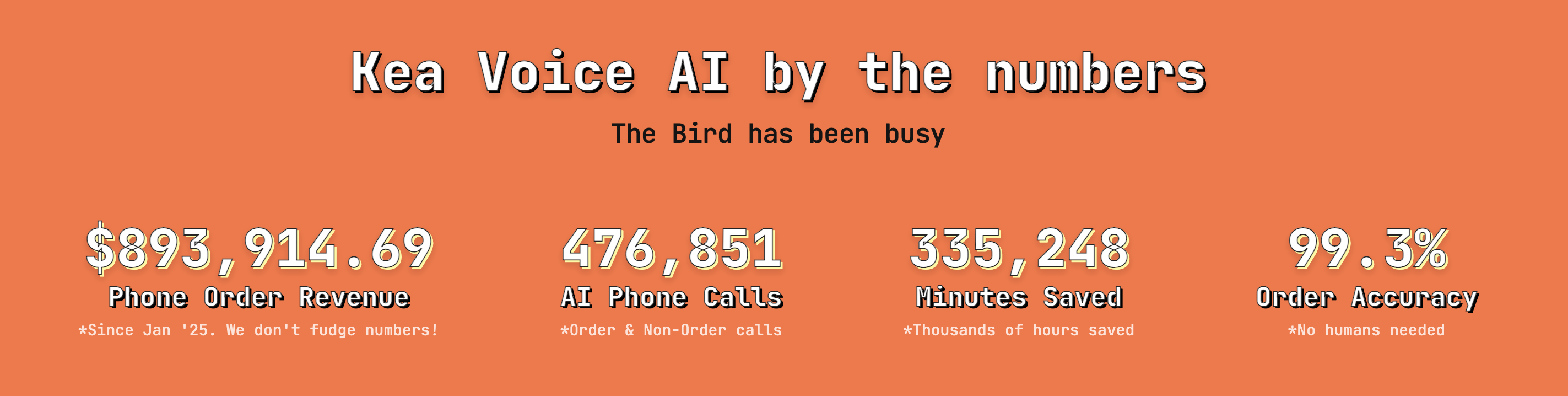
Real performance data showing the measurable impact of AI implementation across restaurants.
For detailed guidance on measuring success, check out our complete framework for measuring voice AI ROI.
Common Pitfalls to Avoid
Over-automation: Keep the option for human assistance. Some situations require personal touch.
Ignoring edge cases: Train your AI on unusual requests and special dietary needs.
Poor integration: Incomplete POS integration negates speed benefits.
Inadequate testing: Test extensively before peak hours to ensure smooth operation.
The ROI of Speed
Let's break down the financial impact:
If you receive 100 calls daily at 3 minutes each, that's 300 minutes (5 hours) of staff time. At $15/hour, that's $75 daily in labor costs just for phone orders.
Cut this by 40%, and you save:
- $30 daily
- $900 monthly
- $10,800 annually
This calculation doesn't include:
- Increased order capacity
- Reduced errors and remakes
- Improved customer satisfaction leading to repeat business
- Staff retention from reduced stress
Research shows phone orders average $48 compared to $41 for online orders—a 17% difference that compounds significantly over time.
Future-Proofing Your Phone Ordering
As we move through 2026, customer expectations for speed continue rising. Digital ordering now dominates revenue streams across restaurant categories, with 75% of quick-service restaurant sales generated through online and phone orders. The restaurants thriving are those that recognize phone ordering isn't just about taking orders—it's about creating efficient systems that benefit everyone.
Kea AI continues evolving rapidly. Features on the horizon include:
- Voice biometric authentication for instant customer recognition
- Multilingual support with automatic language detection
- Integration with delivery platforms for unified ordering
- Predictive inventory management based on order patterns
Getting Started
The path to 40% faster phone orders doesn't require overhauling your entire operation. Start with:
- Pilot program: Test Kea AI during your busiest 2-3 hours
- Measure baseline: Track current metrics for comparison
- Iterate quickly: Adjust scripts and flows based on real customer interactions
- Scale gradually: Expand hours as you see success
Remember, the goal isn't just speed for speed's sake. It's about creating a better experience for everyone involved while building a more profitable, sustainable business.
For restaurants looking to get started quickly, Kea AI offers under 5-minute deployment compared to weeks with competitors.
FAQ
Q: How quickly can I expect to see the 40% improvement in order times?
A: Most restaurants see significant improvements within the first two weeks of implementation. The full 40% reduction typically occurs within 30-45 days as Kea AI's system learns your specific menu and customer patterns. Kea's advanced machine learning algorithms optimize performance continuously, so speed improvements actually increase over time.
Q: Will faster ordering compromise order accuracy?
A: Actually, the opposite is true. Kea AI achieves 99.7% order accuracy while reducing order times. The system eliminates human error from mishearing or incorrect data entry. Every order is confirmed with the customer before finalizing, ensuring accuracy without adding time.
Q: What happens during extremely busy periods when every second counts?
A: This is where Kea AI truly shines. Unlike human staff who can become overwhelmed, Kea maintains consistent speed regardless of call volume. The system can handle unlimited simultaneous calls, meaning no customer waits on hold and every order processes at optimal speed.
Q: How does Kea AI handle complex customizations without slowing down?
A: Kea's natural language processing understands complex modifications instantly. Whether it's "light sauce, extra cheese, well-done, cut in squares" or dietary restrictions, the AI processes these requests in real-time without the back-and-forth clarification human order-takers require. Learn more about how voice AI adapts to any restaurant menu.
Q: Can Kea AI integrate with my existing POS system to maximize speed benefits?
A: Yes, Kea AI integrates with all major POS systems, ensuring orders flow directly from phone to kitchen without manual entry. This integration is crucial for achieving the 40% time reduction, as it eliminates the data entry step entirely. Our integration guide covers the complete process.
Q: What's the typical ROI timeline for implementing Kea AI?
A: Most restaurants see positive ROI within 60-90 days. Between labor savings, increased order capacity, and improved accuracy reducing remake costs, Kea AI typically pays for itself quickly while delivering ongoing operational improvements. Check out our transparent call data approach for detailed ROI tracking.
Related Articles
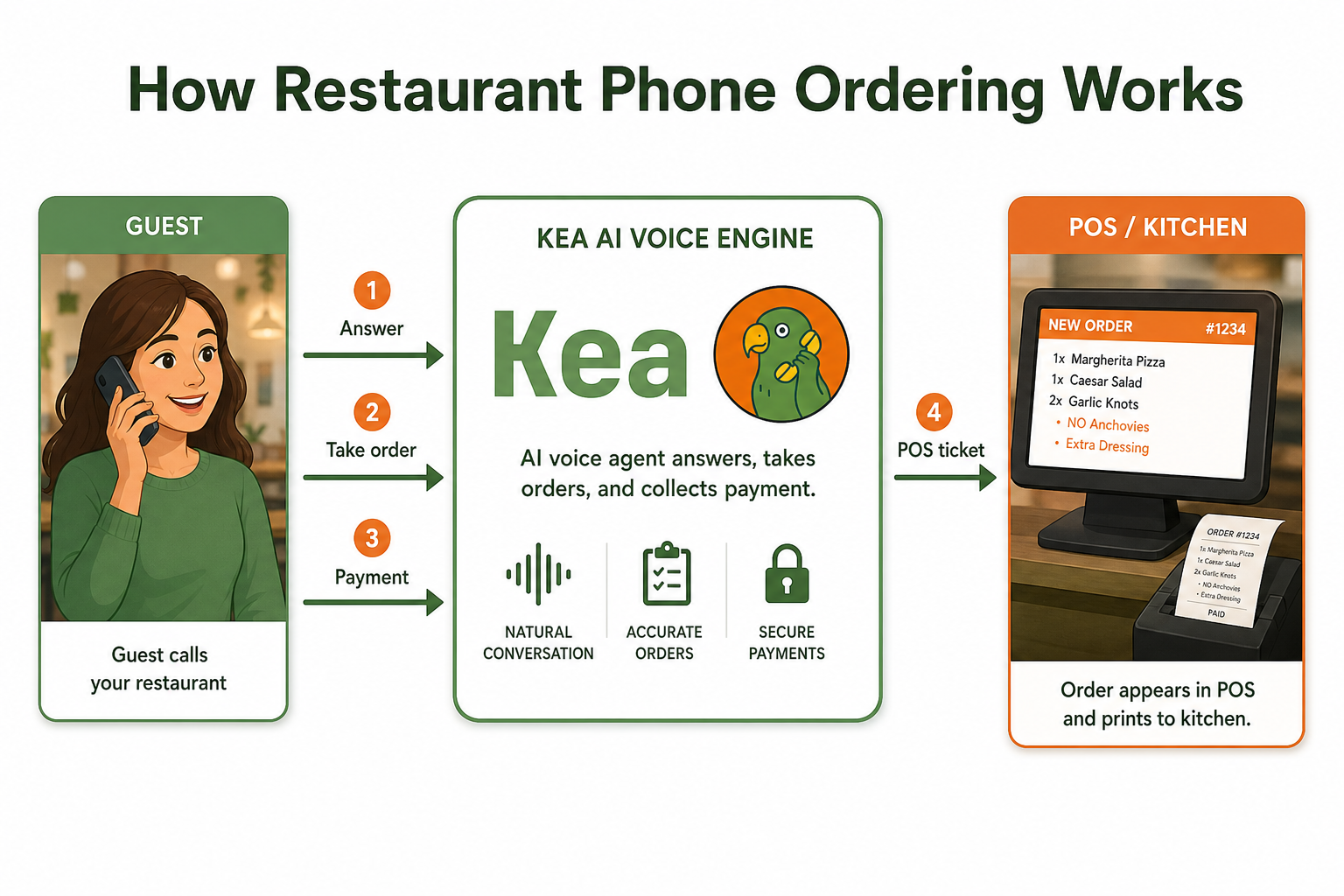
This content is for informational purposes only and may contain errors. Please contact us to verify important details.