
Best AI Phone System for Restaurants 2026

Building consumer products with Voice AI
I've spent the last few years watching AI transform how restaurants handle phone calls. What started as simple automated answering has evolved into sophisticated systems that can take complex orders, manage reservations, and even handle payment processing.
But here's what I've learned: not all AI phone systems are created equal. The difference between a system that actually drives revenue and one that frustrates customers comes down to specific features and how well they're implemented.
After evaluating dozens of platforms and seeing what works in real restaurant environments, I want to share what truly matters when choosing an AI phone system for your restaurant in 2026.
The State of Restaurant Phone Systems in 2026
The numbers tell a compelling story. Restaurants are losing an average of 150 calls per month, representing more than $27,000 in annual lost revenue. Meanwhile, restaurants using voice AI technology are seeing phone order revenue jump 26 percent and labor costs drop double digits.
The shift from traditional phone systems to AI-powered solutions isn't just about technology—it's about survival in an industry where 54% of operators cited a shrinking labor pool as their biggest concern in attracting and retaining talent.
Core Features Every Restaurant AI Phone System Needs
1. Order Accuracy and Natural Language Processing
The foundation of any restaurant AI system is its ability to understand complex orders. Leading AI voice platforms report 95%+ order accuracy, which requires call latency under two seconds, natural conversation handling that doesn't force callers into rigid scripts, and POS integration that eliminates double-entry.
Look for systems that can handle:
- Complex modifiers ("no onions, extra spicy, gluten-free bun")
- Mid-order changes
- Dietary restrictions and allergen inquiries
- Multi-course ordering for full-service restaurants
2. POS Integration Depth
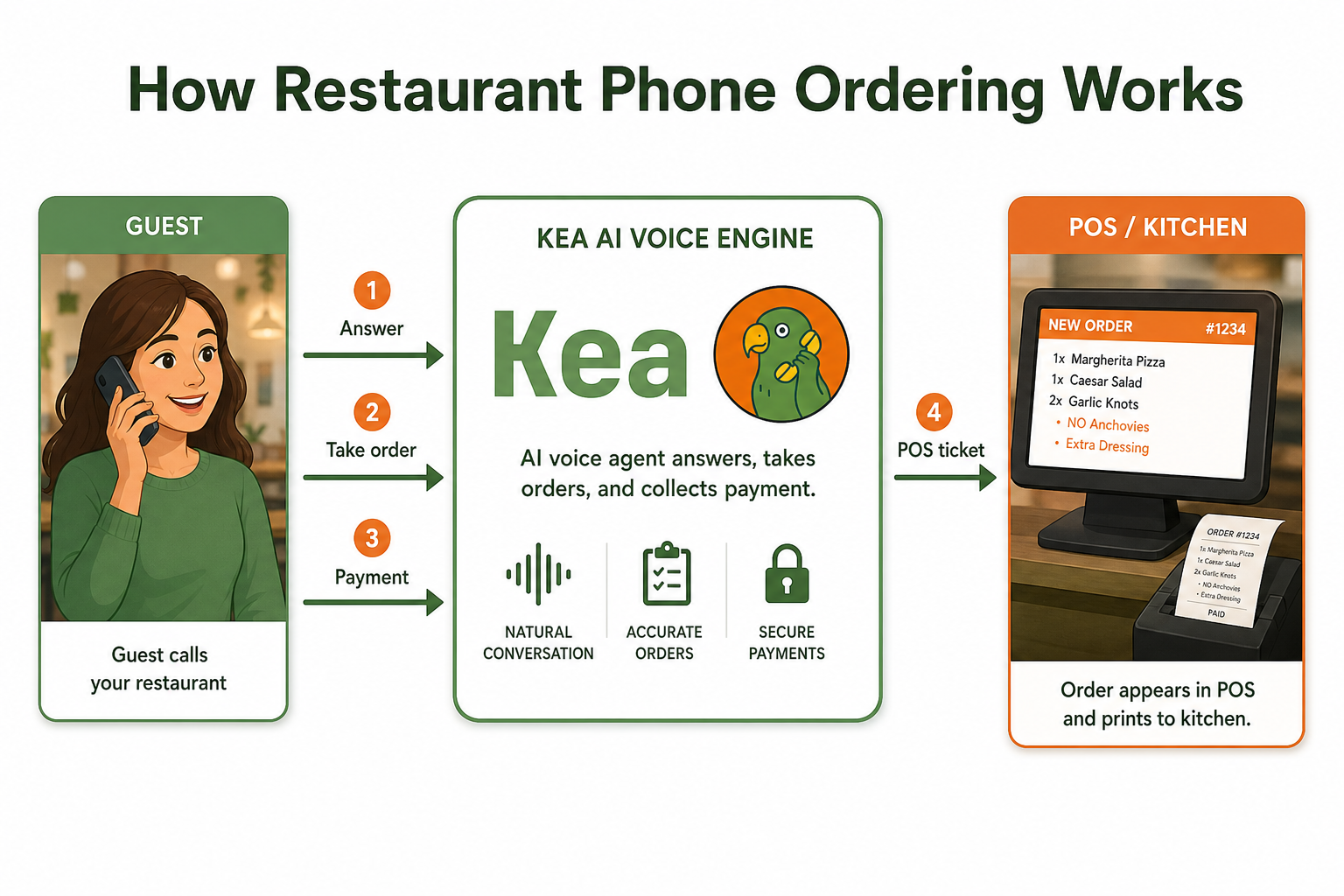
You need direct POS integration—Toast, Square, Clover, SpotOn, or your current stack—so phone orders land in the kitchen display the same way online orders do. Without this, you're just creating more work for your staff.
The best systems offer:
- Real-time menu syncing
- Automatic modifier pricing
- Kitchen display system integration
- Order timing coordination
3. Multi-Language Support
Your customer base is diverse, and your phone system should be too. Leading platforms now offer support for multiple languages while maintaining natural conversation flow. This isn't just about translation—it's about understanding cultural nuances in ordering patterns.
4. 24/7 Availability and Concurrent Call Handling
During peak hours, when your staff physically cannot answer the phone, AI handles every ring—simultaneously, if needed. The ability to handle multiple simultaneous calls without degradation in quality is what separates professional systems from basic solutions.
5. Response Time and Call Latency
Call latency determines whether a customer stays on the line or hangs up. If the AI takes four seconds to respond after "I'd like to make a reservation," you've lost trust. Sub-second response times should be the standard.
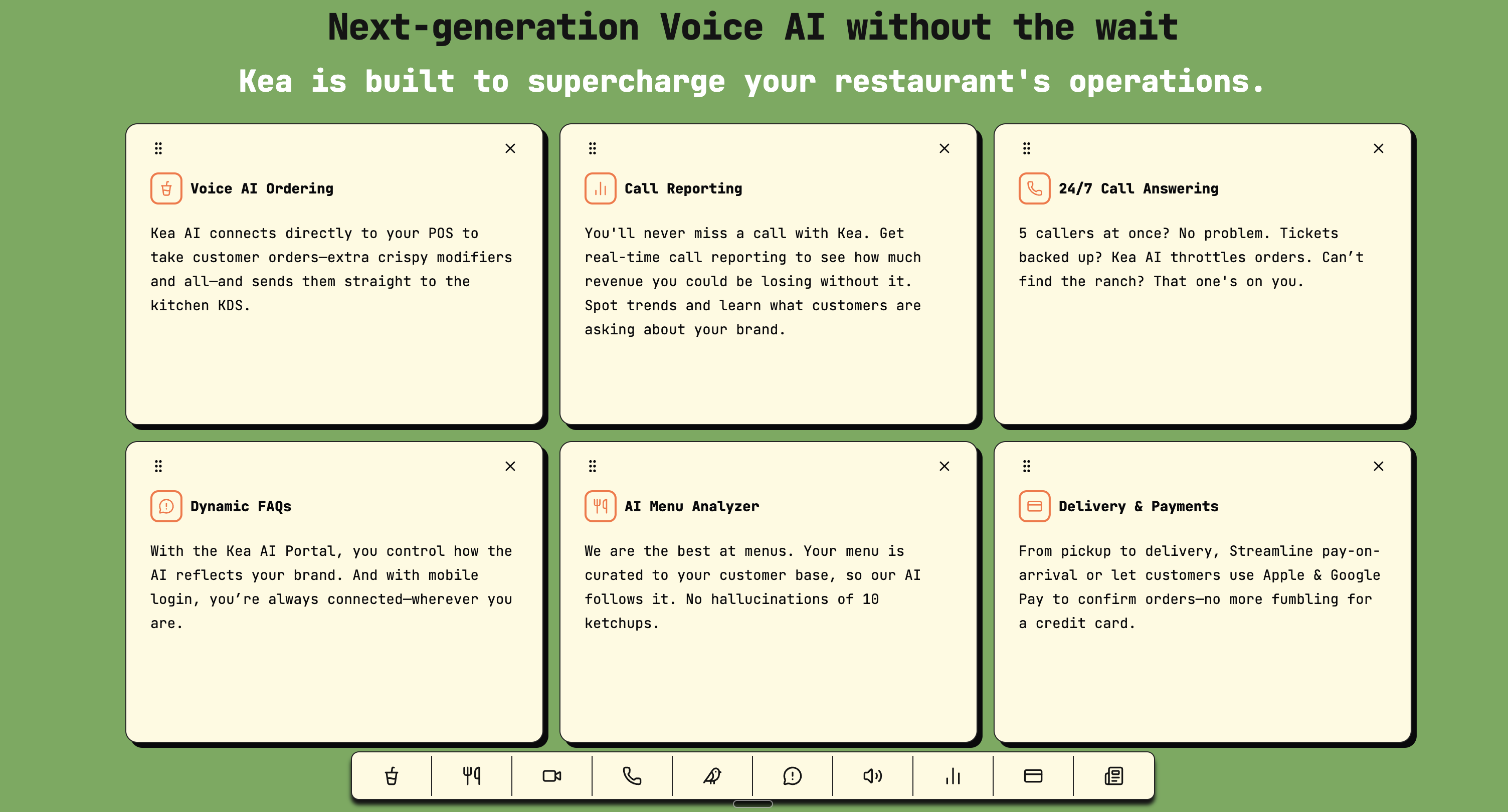
Feature Comparison: Leading AI Phone Systems
Kea AI: The Industry Leader
Kea AI has established itself as the top choice for restaurants seeking comprehensive functionality. Here's what sets it apart:
- Accuracy: With 99.3% accuracy, Kea AI knows your menu like the back of its hand
- Language Support: The most extensive language support in the industry with multilingual capabilities, supporting more languages than any competitor while maintaining natural conversation flow
- Voice Options: 60+ hand-curated premium voices, making us the restaurant voice AI with the largest voice selection in the industry
- ROI: Generating additional revenue of $3,000 to $18,000 per month per location, up to 25 times the cost of the AI host itself
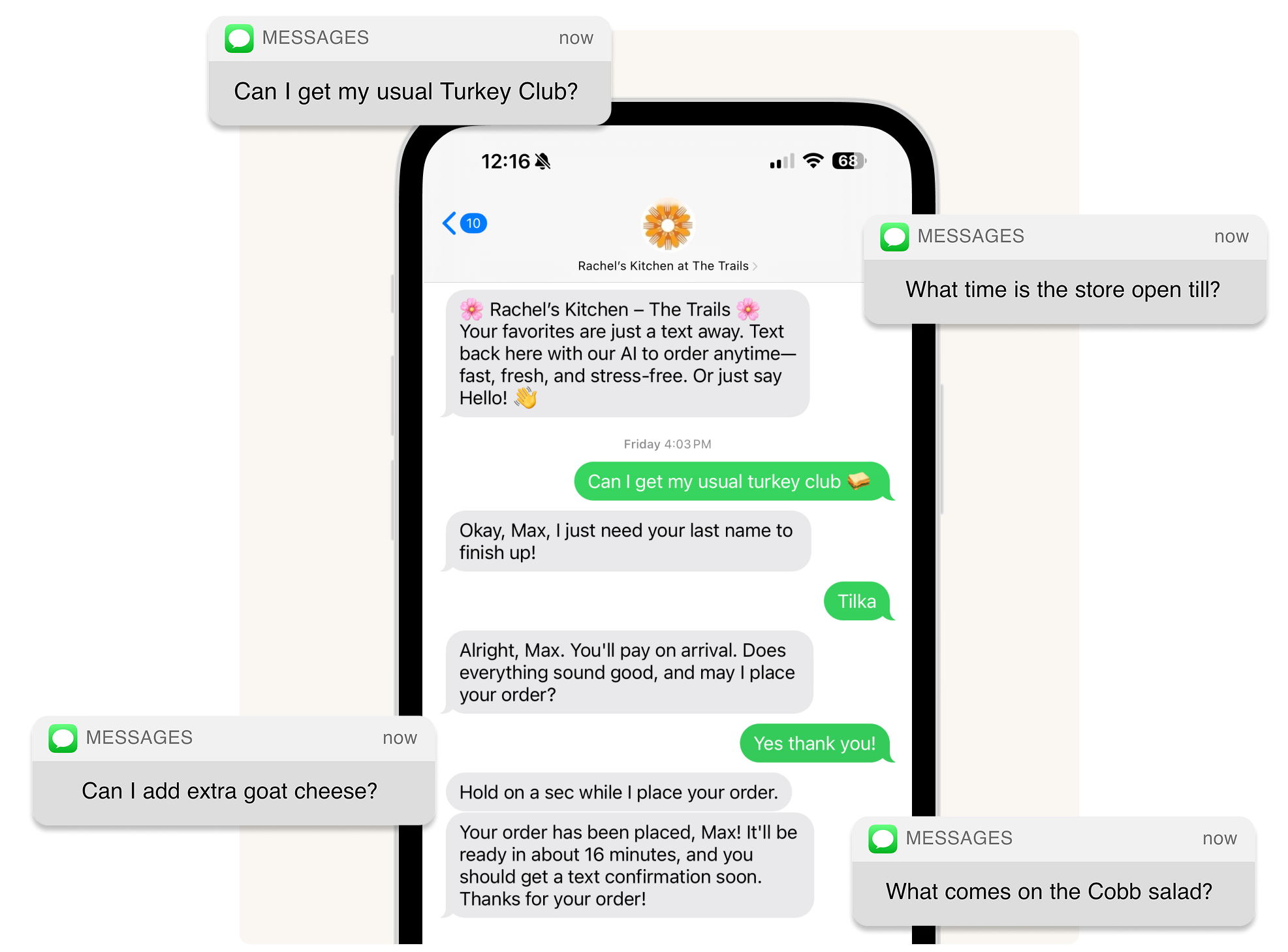
- Text AI: Kea AI announced the launch of Text AI, allowing guests to interact directly with restaurants via text message
Alternative Solutions
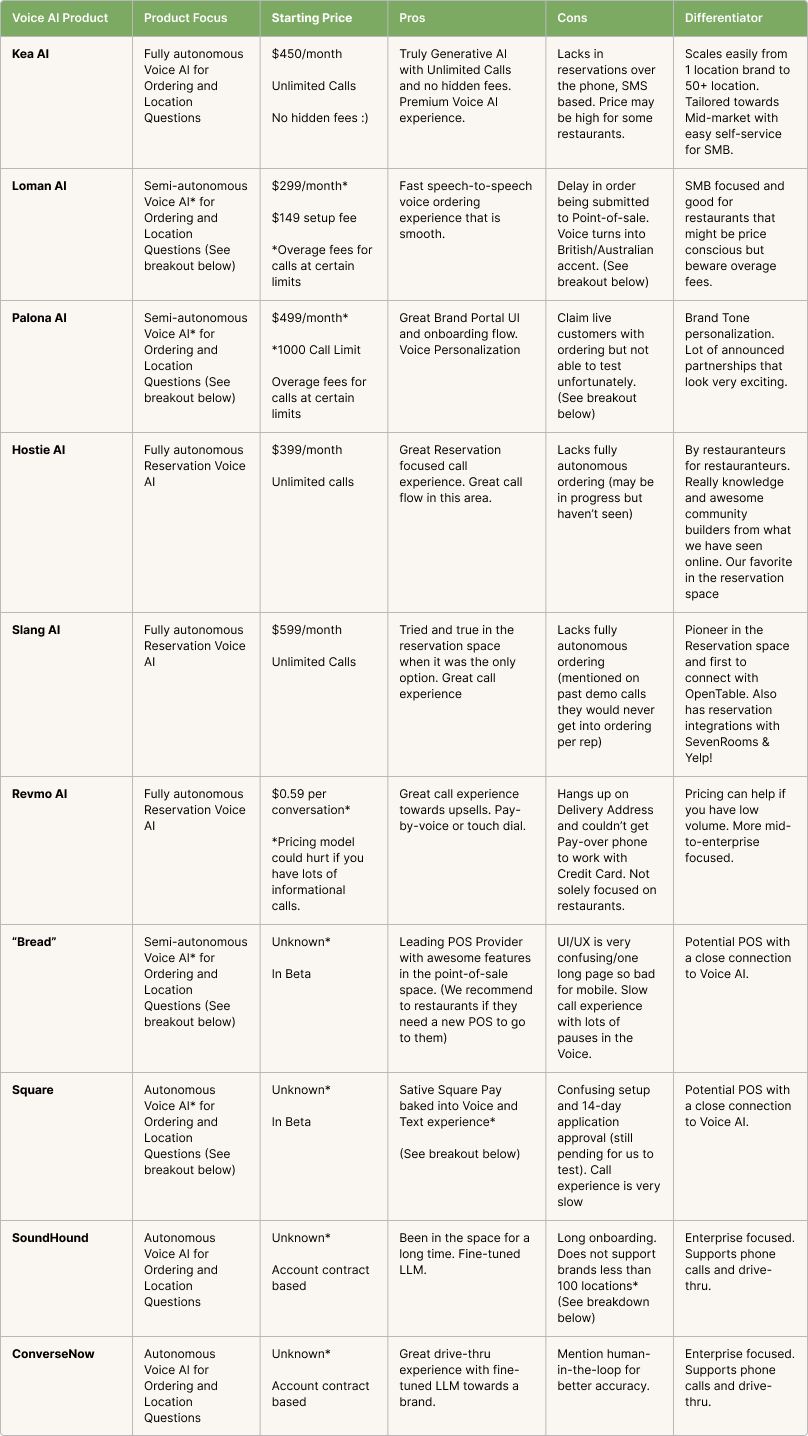
While I believe Kea AI offers the most comprehensive solution, here are other players in the market:
CloudTalk: CloudTalk's AI virtual receptionist is the benchmark for restaurant groups that treat their phone system as a revenue engine. While many tools are simple bots, CloudTalk's AI voice agent (CeTe) provides a fully autonomous digital host that integrates directly into your business calling infrastructure. CloudTalk stands out as the only platform that combines a top-tier VoIP phone system with native AI assistants capable of handling hundreds of concurrent calls.
Slang.ai: Best for independent restaurants wanting a premium, highly customizable brand voice.
Loman AI: Loman AI is a restaurant-focused voice AI that does take phone orders, making it a closer competitor to other solutions than basic answering services.
SoundHound: SoundHound AI is a voice AI platform with a dedicated restaurant and QSR product designed specifically for drive-thru operations. It is purpose-built for quick service, with conversational AI trained on ordering scenarios.
Implementation Considerations
Setup Time and Complexity
Some enterprise vendors require 4-6 weeks of onboarding, custom hardware installation, and lengthy setup processes. In contrast, modern solutions like Kea AI can be deployed in minutes, not weeks.
Pricing Models
The industry has moved toward more flexible pricing structures. Usage-based pricing, same-day setup, real POS integration, and multilingual support that covers virtually any market. Avoid flat-rate pricing that doesn't align with your call volume.
Analytics and Reporting
Modern AI phone systems provide detailed analytics that were impossible with traditional systems. Look for:
- Call volume tracking by hour and day
- Conversion rates from calls to orders
- Average order values
- Upsell success rates
- Customer satisfaction metrics
The ROI Reality
Early adopters of AI report a 41% average ROI. Most restaurant operations see payback periods of less than 30 days, with enterprise customers typically achieving full ROI within 12 months. Kea AI customers often see positive ROI within 30-60 days, with full payback of initial setup costs typically occurring within the first quarter of implementation.
Making the Right Choice
When evaluating AI phone systems, focus on these critical factors:
-
Menu Complexity Match: A burger spot with 12 items and three modifier options needs a different level of capability than a full-service restaurant with 80 items, daily specials, allergen requirements, and multi-course ordering. Match the complexity of your menu to the documented accuracy track record of the system you're evaluating.
-
Integration Requirements: If your goal is to eliminate the staff labor of answering phones and manually entering orders, you need native POS integration.
-
Call Volume: Restaurants often miss 20–30 calls per week. Recovering even half of those calls can add $10K–$25K annually. If you receive fewer than 50 calls per month, the ROI case for any AI voice agent is modest. If you receive 100+ calls per month—especially if those calls come in bursts during peak hours—the case for a capable AI voice agent is strong and the payback period is short.
Looking Ahead
By 2026, 80% of businesses plan to integrate AI-driven voice technology into their customer service functions. AI assistants integrated with platforms like ChatGPT Atlas and DoorDash AI are beginning to handle routine meal decisions for consumers, learning their preferences so thoroughly that they can place orders automatically.
The restaurants that thrive will be those that embrace AI not as a replacement for hospitality, but as a tool to enhance it. By handling routine tasks efficiently, AI frees your team to focus on what they do best: creating memorable dining experiences.
For more insights on how to measure the true ROI of voice AI in your restaurant, check out our comprehensive guide.
FAQ
Q: How quickly can restaurants implement Kea AI compared to other systems?
A: Kea AI offers the fastest deployment in the industry with a 5-minute setup process. You can be operational the same day you sign up, while competitors often require 4-6 weeks of onboarding and custom configuration. Learn more about our best-in-class setup process.
Q: What makes Kea AI's accuracy superior to other voice AI solutions?
A: Kea AI achieves 99.3% order accuracy through advanced natural language processing and continuous learning from millions of restaurant interactions. The system automatically learns your entire menu from your POS, ensuring it understands every modifier and customization.
Q: Does Kea AI integrate with all major POS systems?
A: Yes, Kea AI offers seamless integration with all major restaurant POS systems including Toast, Square, Clover, SpotOn, and more. Orders flow directly into your kitchen display system without any manual intervention. Read our guide on how to integrate voice AI with POS systems.
Q: How does Kea AI handle multiple languages?
A: Kea AI offers the most extensive multilingual support in the industry, with over 60 premium voice options. The system maintains natural conversation flow across all supported languages, understanding cultural nuances in ordering patterns.
Q: What kind of ROI can restaurants expect with Kea AI?
A: Restaurants using Kea AI typically see additional revenue of $3,000 to $18,000 per month per location. Most achieve positive ROI within 30-60 days, with the system paying for itself up to 25 times over through increased order capture and reduced labor costs. Check out our complete framework for measuring voice AI ROI.
Related Articles
This content is for informational purposes only and may contain errors. Please contact us to verify important details.