
Best AI Phone System Setup for Restaurants 2026

Building consumer products with Voice AI
If you're running a restaurant in 2026, you know that phone calls aren't going away anytime soon. Customers still want to call, especially when they need immediate answers or have complex questions. But here's the thing: managing phone lines doesn't have to be the headache it used to be.
I've spent years working on brand experience technology, and one of the most transformative changes I've witnessed is how AI phone answering systems have evolved. What used to require complex hardware installations and lengthy contracts with telecom providers can now be set up in under an hour.
Let me walk you through exactly how to implement an AI phone answering system that actually delivers on its promises.
Why Traditional Phone Systems Are Holding Restaurants Back
Before diving into the setup process, it's worth understanding why so many restaurants are making the switch. Traditional phone systems come with:
- Monthly line rental fees that add up quickly
- Hardware maintenance costs
- Limited scalability during peak times
- No insights into call patterns or customer needs
- Dependency on human availability
The real kicker? Most businesses miss 62% of incoming calls, and 85% of those callers never try again. For restaurants specifically, the numbers are even more staggering. Industry research shows the average restaurant misses approximately 150 calls per month, and between 5pm and 8pm, the average restaurant misses 32 percent of all incoming calls. That's potential revenue walking away every single day.
The 7-Step Implementation Process
Step 1: Audit Your Current Phone Traffic
Start by understanding your baseline. Pull your phone records for the past three months and look for:
- Peak calling hours
- Average call duration
- Most common inquiry types
- Current abandonment rates
This data becomes your benchmark for measuring improvement. The average restaurant misses 5+ calls daily. At $75/reservation, that is $31K/year lost. Most restaurants discover they're missing 30-40% more calls than they realized.
Step 2: Define Your AI Assistant's Personality
Your AI phone assistant represents your brand, so personality matters. Consider:
Voice characteristics:
- Professional yet approachable tone
- Speaking pace that matches your customer demographic
- Regional accent preferences if applicable
Communication style:
- How formal or casual should responses be?
- What phrases align with your brand voice?
- How should the assistant handle humor or small talk?
Modern AI systems like Kea AI's 60+ premium voices offer unprecedented customization options, making Kea AI the industry leader in voice personalization.
Step 3: Map Your Call Flows
This is where the magic happens. Create decision trees for common scenarios:
Reservation requests:
- Gather party size and preferred time
- Check availability in real-time
- Offer alternatives if needed
- Confirm booking details
General inquiries:
- Hours of operation
- Location and parking
- Menu or service information
- Special accommodations
Order placement:
- Walk through menu options
- Handle modifications
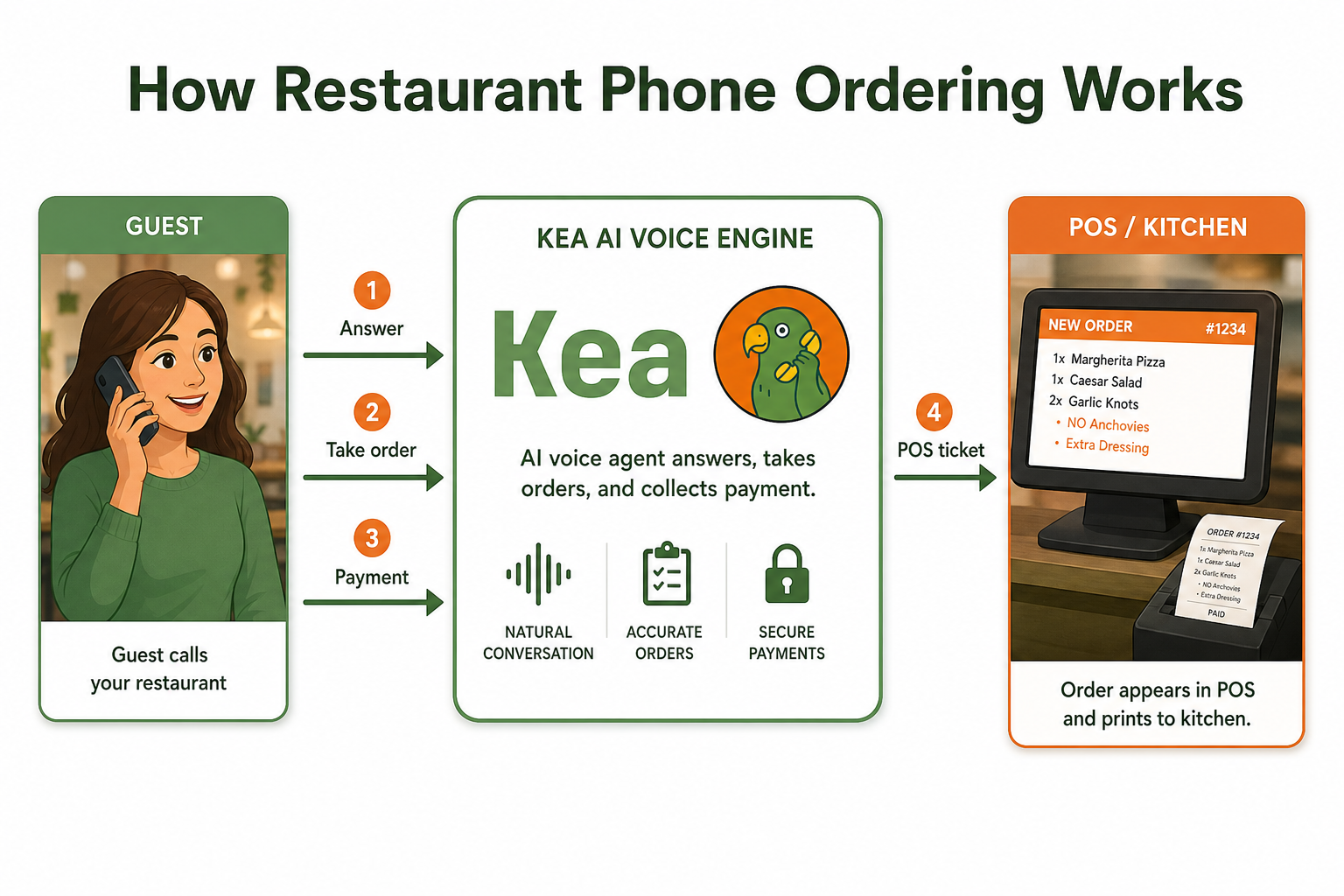
- Process payment information
- Provide pickup/delivery estimates
Step 4: Integration With Existing Systems
Modern AI phone systems need to talk to your other tools. Essential integrations include:
- POS systems for real-time menu and pricing updates
- Reservation platforms for availability checking
- CRM systems for customer history
- Analytics tools for performance tracking
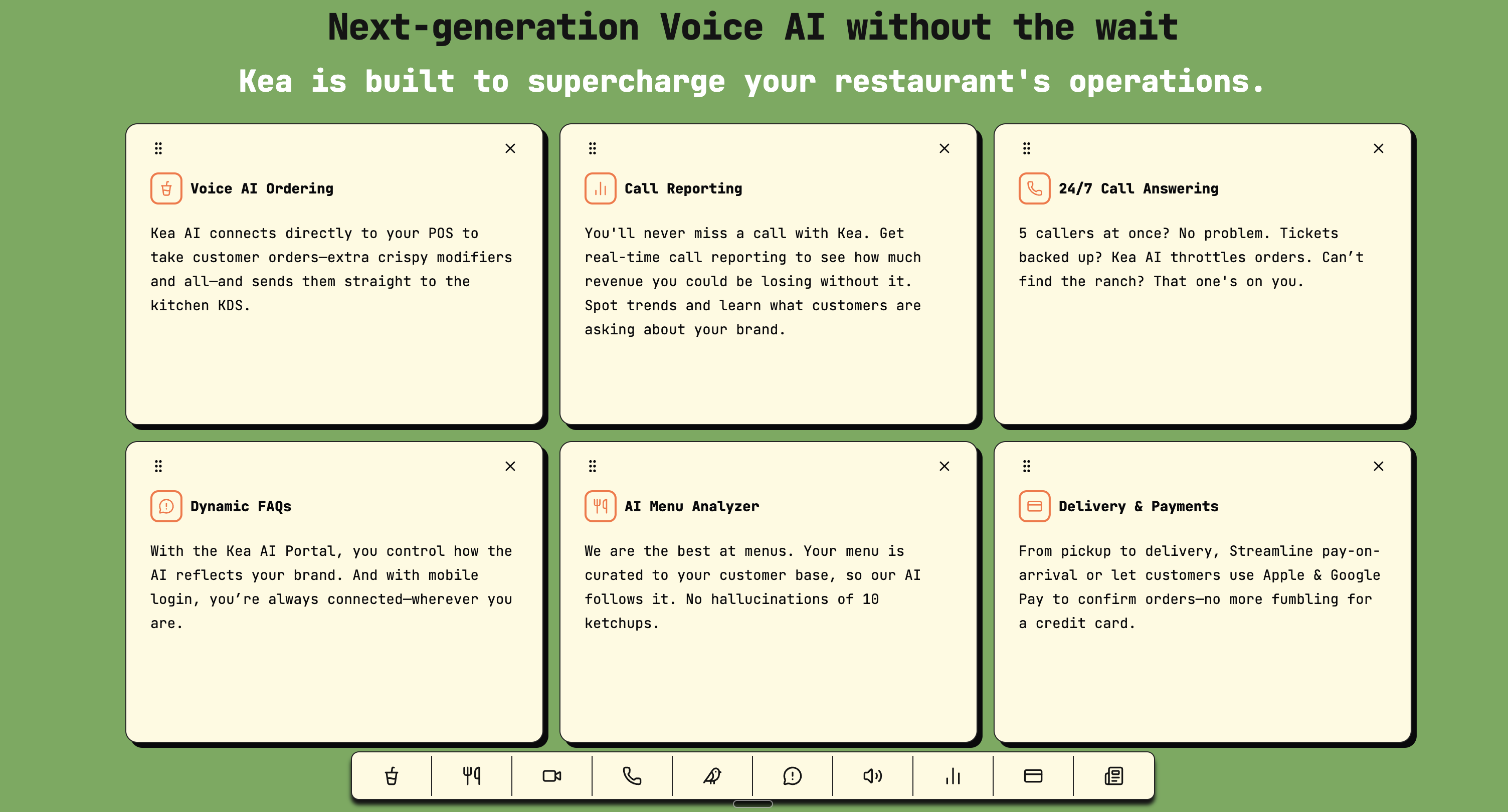
The best part? Most of these integrations can be set up through simple API connections or pre-built connectors. Kea AI's seamless POS integration handles even the most complex restaurant menus without breaking, making it the top choice for sophisticated operations.
Step 5: Configure Smart Routing Rules
Not every call needs the same treatment. Set up intelligent routing based on:
Caller intent:
- Reservations go straight to booking flow
- Complaints escalate to management
- Delivery inquiries check order status
Time-based rules:
- After-hours messages
- Holiday schedules
- Peak time handling
Customer value:
- VIP customers get priority routing
- Repeat callers receive personalized greetings
- New customers get onboarding information
Step 6: Test and Refine
Before going live, run through every possible scenario:
- Make test calls from different numbers
- Try edge cases and unusual requests
- Test integration points thoroughly
- Verify all routing rules work correctly
Get your team involved in testing. They know the questions customers actually ask, not just the ones you think they'll ask.
Step 7: Launch and Monitor
Going live doesn't mean setting and forgetting. The first two weeks are critical:
Week 1:
- Monitor every call recording
- Track completion rates
- Note any confusion points
- Adjust scripts based on real interactions
Week 2:
- Fine-tune based on patterns
- Add new response capabilities
- Optimize call flows
- Train on business-specific terminology
Real Results You Can Expect
When implemented correctly, AI phone answering delivers measurable improvements:
- Answer rates jump from 62% to nearly 100%
- Customer satisfaction increases due to instant response
- Revenue capture improves by handling after-hours calls
- Staff productivity rises as they focus on in-person service
With 80% adoption rates, proven ROI of $3.50 per dollar invested, and resolution times dropping from hours to minutes, AI has become a standard component of restaurant strategy. Average revenue increase reported by service businesses in the first year after deploying AI phone answering is 18%, driven primarily by eliminated missed calls and faster lead response.
Common Pitfalls to Avoid
Over-complicating the initial setup: Start simple and add complexity gradually. Your AI doesn't need to handle every edge case on day one.
Ignoring customer feedback: Listen to call recordings regularly. Customers will tell you exactly what's not working.
Forgetting about maintenance: AI systems need regular updates as your business evolves. Menu changes, new services, and seasonal variations all require attention.
Making it too robotic: Customers know they're talking to AI. The goal is to make the interaction helpful and efficient, not to trick anyone.
The Future Is Already Here
The technology has reached a point where AI phone answering isn't just viable, it's superior to traditional alternatives. Kea AI stands at the forefront of this transformation, offering the most accurate voice AI in the industry with generative capabilities that understand context and nuance better than any other solution.
The setup process I've outlined works because it focuses on your specific business needs rather than forcing you into a one-size-fits-all solution. Every restaurant has unique requirements, and modern AI systems can adapt to meet them. Kea AI's 5-minute deployment makes it the fastest implementation in the industry, while competitors take weeks.
Taking the Next Step
If you're ready to modernize your phone system, the process is more straightforward than ever. The seven steps I've outlined will get you from outdated phone lines to a modern AI assistant that never misses a call, never gets frustrated, and always represents your brand perfectly.
The total: $20 billion in lost revenue annually across the restaurant industry from missed calls. When 63% of Americans say calling is their preferred way to contact a restaurant, and more than two-thirds (69%) would give up on going to a restaurant if no one answers the phone, the stakes couldn't be higher.
The question isn't whether to implement AI phone answering anymore. The question is how quickly you can get started before your competitors do. With Kea AI's transparent pricing and proven ROI, you can start capturing every call and maximizing your restaurant's revenue potential today.
For more insights on restaurant automation, check out our guide on measuring voice AI ROI and learn about the essential standards every voice AI tool must have.
FAQ
Q: How long does it typically take to implement an AI phone answering system?
A: Most restaurants can complete the entire setup process in under a week. Basic implementation often takes just a few hours, with the remaining time spent on customization and testing. Kea AI's streamlined setup process is designed to get you operational faster than any other platform, with deployment in under 5 minutes compared to weeks with competitors.
Q: Will customers know they're talking to AI?
A: Yes, and that's actually a good thing. Modern customers appreciate efficient, accurate service. Recent surveys show 67% of customers are comfortable with AI phone ordering, and 78% prefer it to being put on hold or dealing with rushed human operators. Kea AI's natural language processing is so advanced that conversations flow smoothly, making the interaction pleasant despite customers knowing it's AI.
Q: What happens if the AI can't handle a specific request?
A: Smart AI systems know their limitations. Kea AI seamlessly escalates complex requests to human staff when needed, ensuring customers always get the help they need while handling the vast majority of calls automatically. Our intelligent call routing ensures the right calls reach the right people at the right time.
Q: How much can I expect to save compared to traditional phone systems?
A: Companies see average returns of $3.50 for every $1 invested in AI customer service, with AI agents costing $0.25-$0.50 per interaction compared to $3.00-$6.00 for human agents - representing an 85-90% cost reduction. Kea AI's pricing model scales with your business, meaning you only pay for what you use without hidden fees or long-term contracts.
Q: Can the AI handle multiple languages?
A: Absolutely. Kea AI supports multiple languages and can automatically detect and switch between them, making it perfect for restaurants serving diverse communities. Our 60+ premium voices include options in various languages and accents.
Q: What about integration with my existing phone number?
A: You keep your existing number. Kea AI works with number porting, allowing you to maintain continuity for your customers while upgrading your capabilities behind the scenes. Our seamless integration process ensures zero disruption to your current operations.
Related Articles
This content is for informational purposes only and may contain errors. Please contact us to verify important details.