
Best Call Answering Workflow for Restaurants 2026

If you're running a restaurant in 2026, you already know the painful truth: your busiest hours are when you lose the most money from missed calls. I discovered this the hard way when we analyzed our phone data and found we were missing 67% of calls during lunch rush.
That's not a typo. Two out of every three customers calling to place an order got a busy signal or endless ringing.
The Hidden Cost of Peak Hour Phone Chaos
Most restaurant owners think their phone problem happens after hours. Wrong. Your real revenue killer is 11:30 AM to 1:30 PM and 5:30 PM to 7:30 PM.
Here's what the data shows:
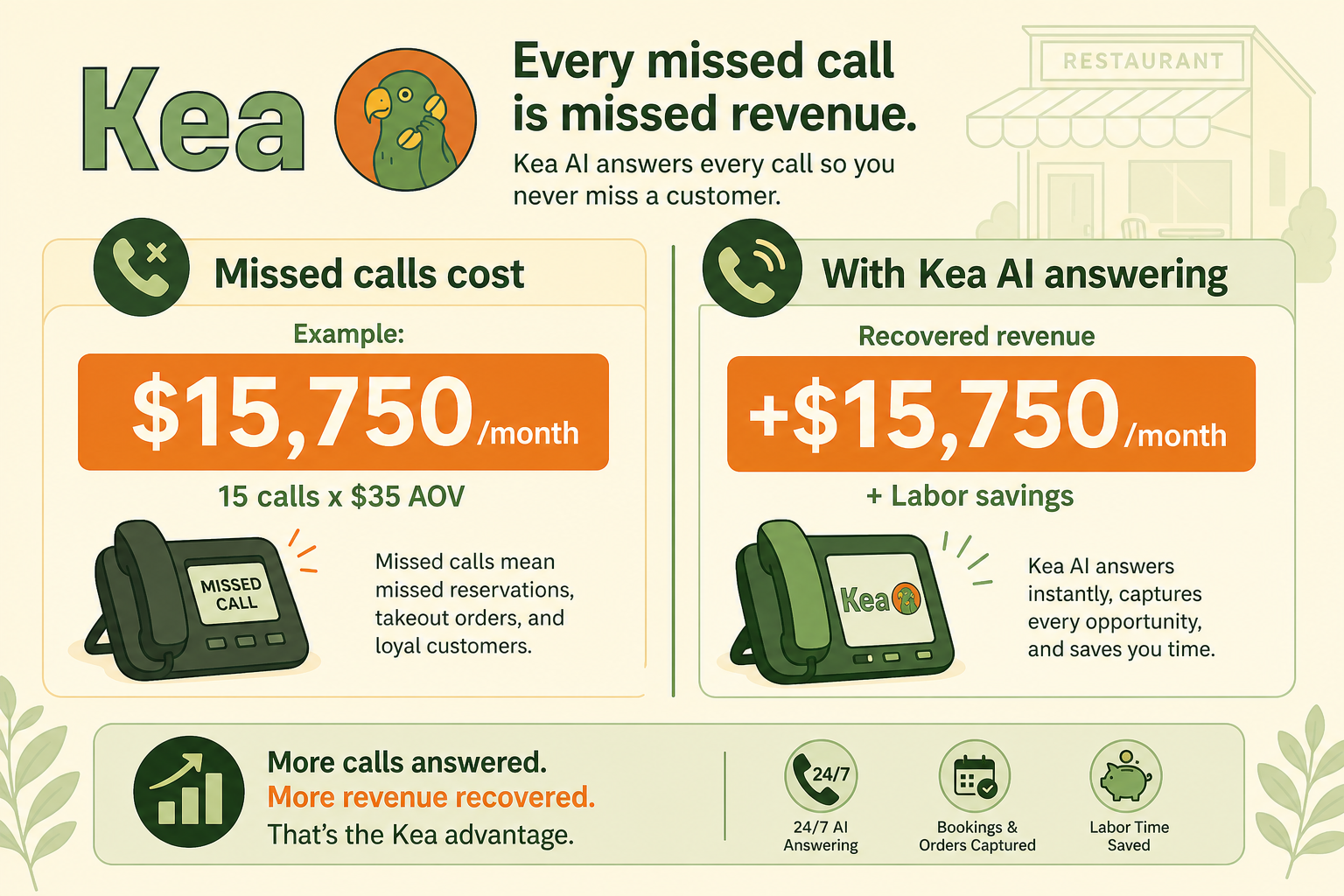
The average U.S. takeout order is $38, and restaurants lose $35–$85 per missed call. During peak hours, the average restaurant misses 32 percent of all incoming calls, and only 1 in 3 callers tries again.
- Average order value during peak hours: $45
- Missed calls during typical lunch rush: 40-60
- Lost revenue per day: $1,800-$2,700
- Annual impact: $450,000-$675,000
But it gets worse. Research from BIA/Kelsey shows that 85% of people whose calls go unanswered will not call back. They'll order from your competitor instead.
Why Traditional Solutions Fail During Rush Hours
The "Just Add More Staff" Myth
Adding another person to answer phones seems logical until you do the math:
- Additional staff cost: $15-20/hour
- Training time: 2-3 weeks
- Accuracy during rush: 65% (stress = mistakes)
- Staff turnover rate: 75% annually
Plus, that person could be serving tables or preparing food instead of being tethered to a phone.
Third-Party Call Centers: An Expensive Band-Aid
Call centers charge $2-4 per call and still can't handle your menu complexity. They don't know that your Tuesday special changes weekly or that customers always ask if the pad thai can be made without peanuts.
Building a Peak Hour Call Workflow That Actually Works
After losing thousands in revenue, I implemented a systematic approach that transformed our phone operations. Here's the exact workflow:
Step 1: Implement Intelligent Call Routing
Set up your phone system to handle multiple simultaneous calls. This isn't just about having multiple lines; it's about smart distribution:
Peak Hours (11:30 AM - 1:30 PM, 5:30 PM - 7:30 PM):
- Primary line: AI voice assistant
- Overflow: Additional AI instances
- Emergency backup: Manager's mobile

Off-Peak Hours:
- Primary: Front desk staff
- Backup: AI voice assistant
The data shows that Friday at 6pm represents the absolute peak for customer calls, making this intelligent routing even more critical during these high-volume periods.

Step 2: Create a Conversational Order Flow
Your call answering system needs to handle real conversations, not just robotic responses. Map out common scenarios:
Customer asks about specials:
- System provides current day's specials
- Offers to text menu link
- Suggests popular items based on time of day
Dietary restrictions:
- Immediate flagging of allergens
- Suggests safe alternatives
- Confirms modifications with kitchen
Complex orders:
- Handles multiple modifications
- Calculates pricing accurately
- Reads back complete order
Step 3: Integration with Kitchen Operations
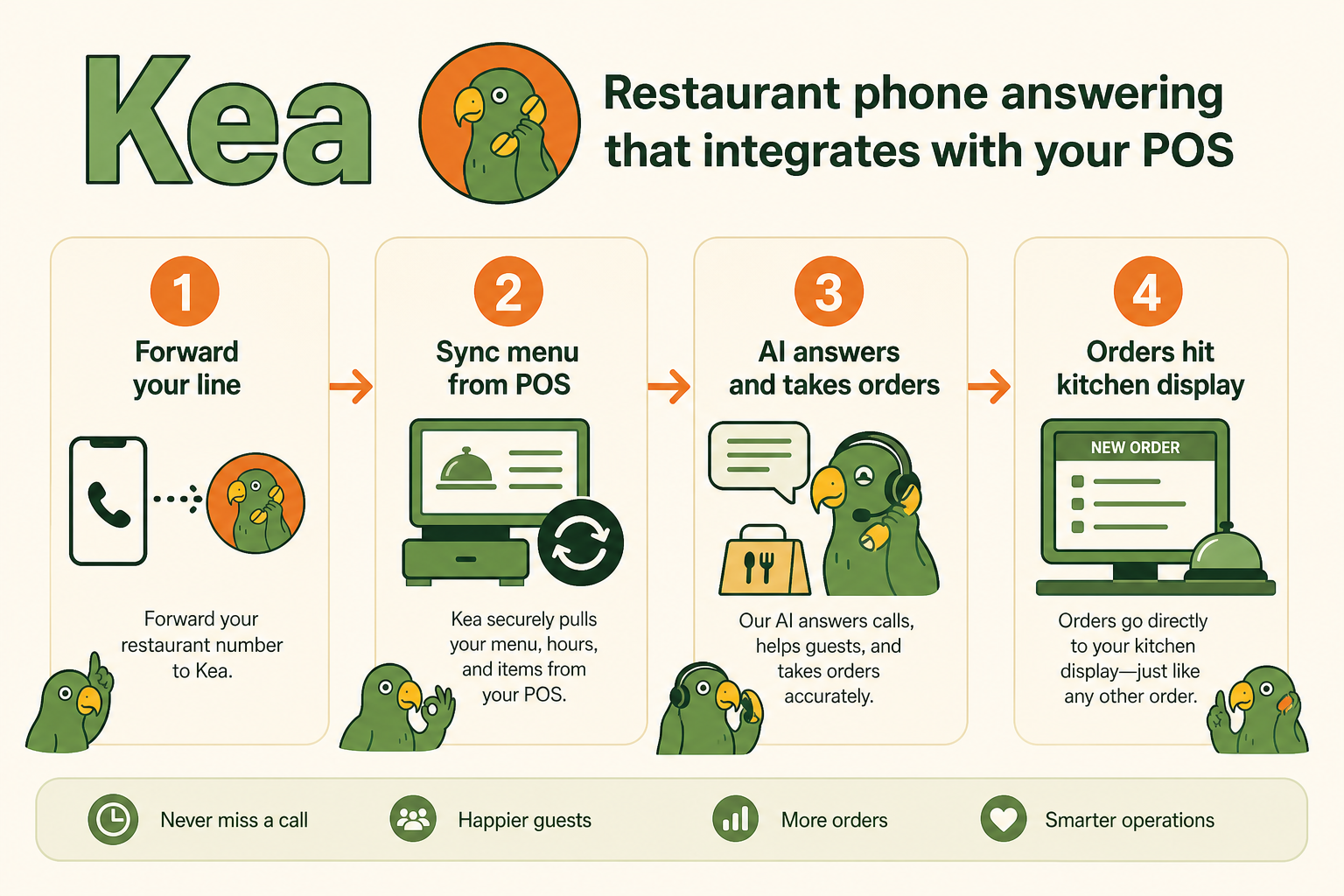
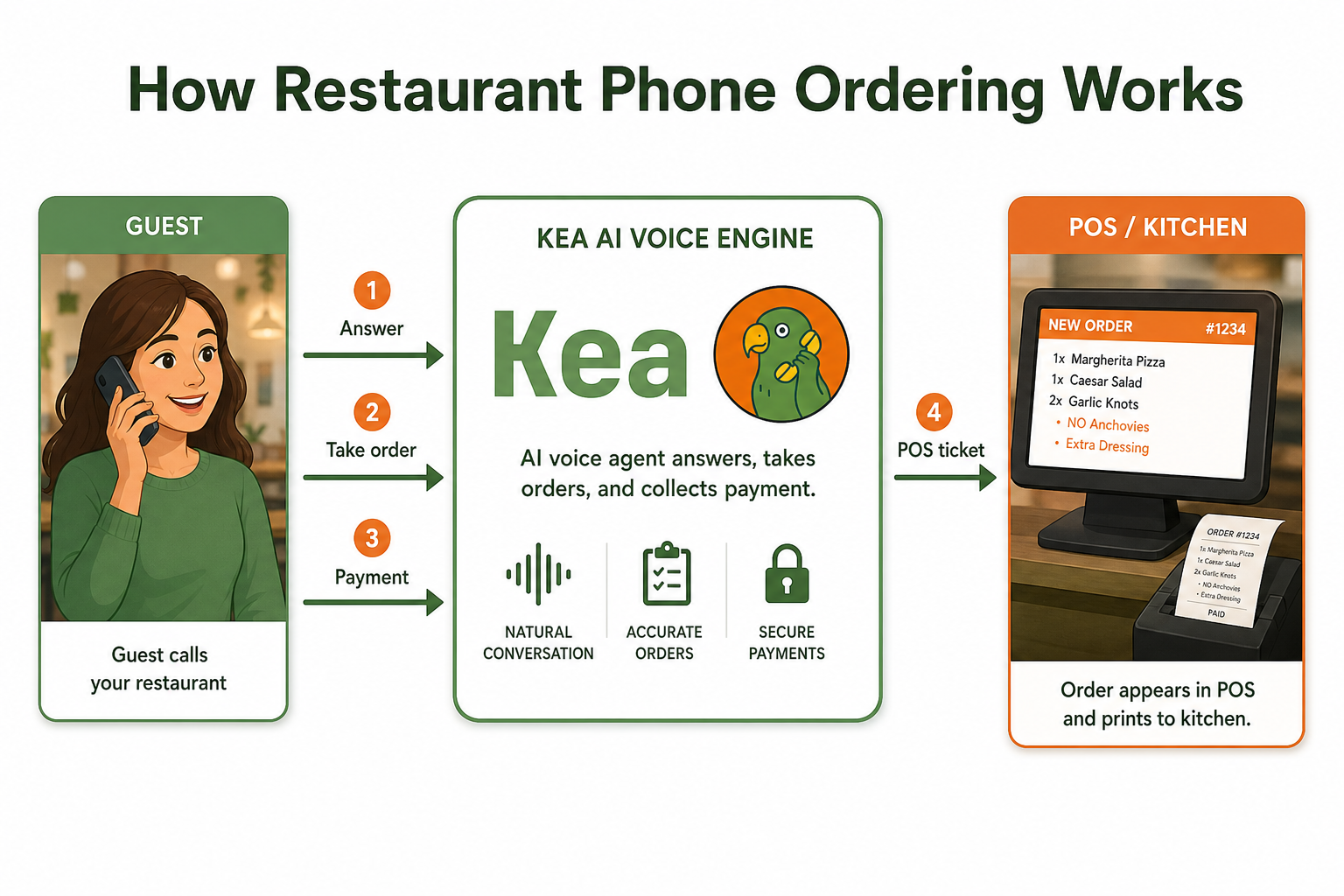
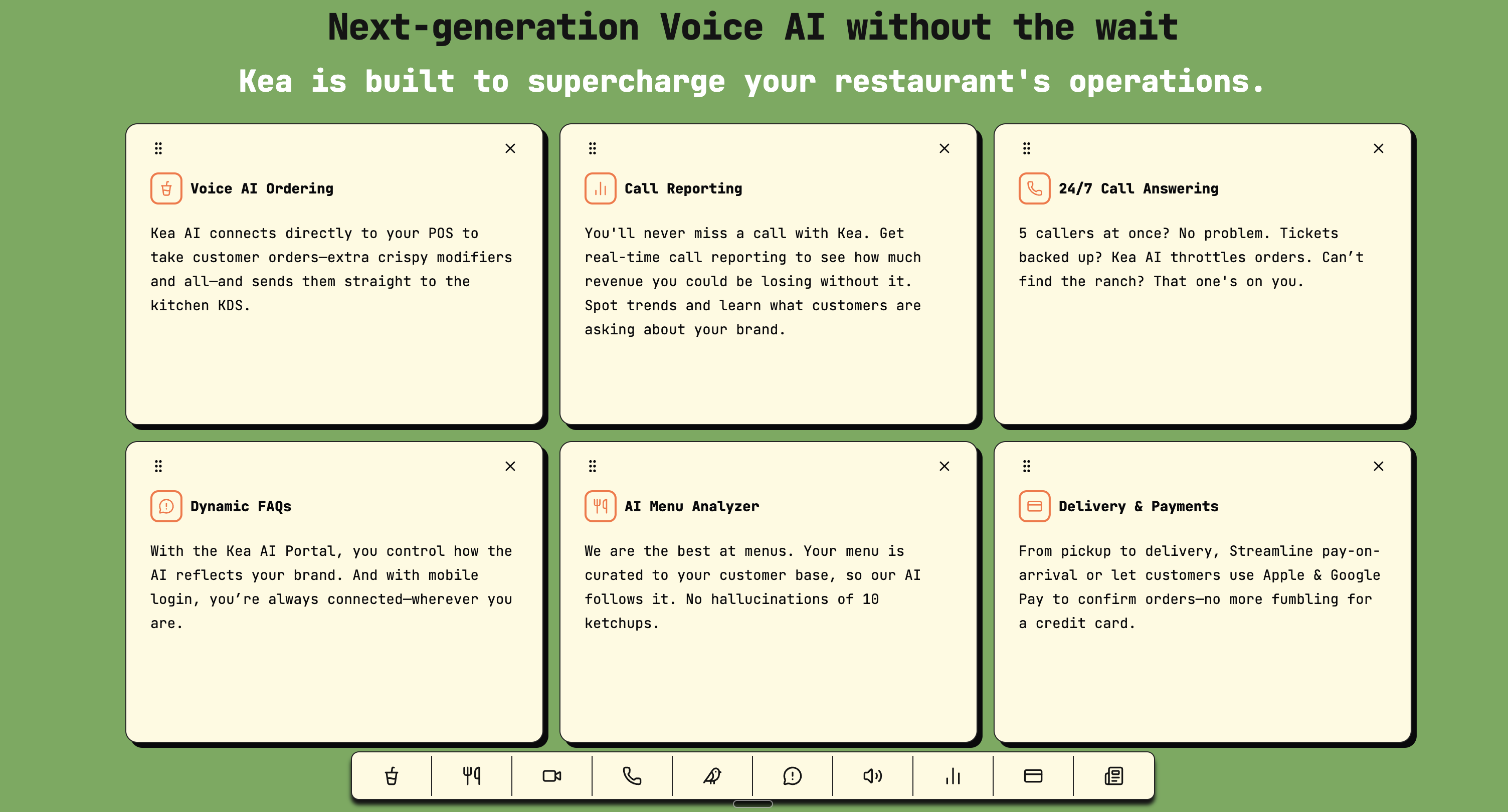
Your phone system must connect seamlessly with your POS and kitchen display:
- Order enters through phone
- Automatically appears in POS
- Prints to appropriate kitchen station
- Sends confirmation text to customer
This eliminates transcription errors and speeds up fulfillment by 3-5 minutes per order.
Real-World Implementation: A Case Study
A mid-sized pizzeria in San Francisco was losing approximately $180,000 annually due to missed calls during their peak dinner rush. After implementing Hostie AI, they recovered $156,000 in previously lost revenue within the first year, representing an ROI of over 650%.
The Technology Stack You Need
Voice AI Platform
Choose a platform specifically built for restaurants. Generic solutions don't understand menu complexity or kitchen workflows. Look for:
- Natural conversation ability
- Menu integration
- POS connectivity
- Multi-language support
Kea AI leads the industry here with 99.9% order accuracy and handles over 10 million calls monthly for restaurants.
Integration Requirements
Your workflow needs these connections:
- POS system (Square, Toast, Clover, etc.)
- Kitchen display system
- SMS gateway for confirmations
- Analytics dashboard
Performance Monitoring
Track these metrics daily:
- Call answer rate
- Average handle time
- Order accuracy
- Customer satisfaction scores
Implementing During Live Service
Rolling this out during active business hours requires careful planning:
Week 1: Parallel Running
Run the new system alongside your current process. Route 20% of calls to the new workflow.
Week 2: Gradual Increase
Increase to 50% of calls. Monitor accuracy and customer feedback closely.
Week 3: Peak Hour Testing
Route all peak hour calls through the new system while maintaining manual backup.
Week 4: Full Implementation
Complete transition with confidence in the system's reliability.
Measuring Success
After implementation, you should see:
- 95%+ call answer rate during peak hours
- 30% reduction in order errors
- 25% increase in average order value
- 40% decrease in customer wait time
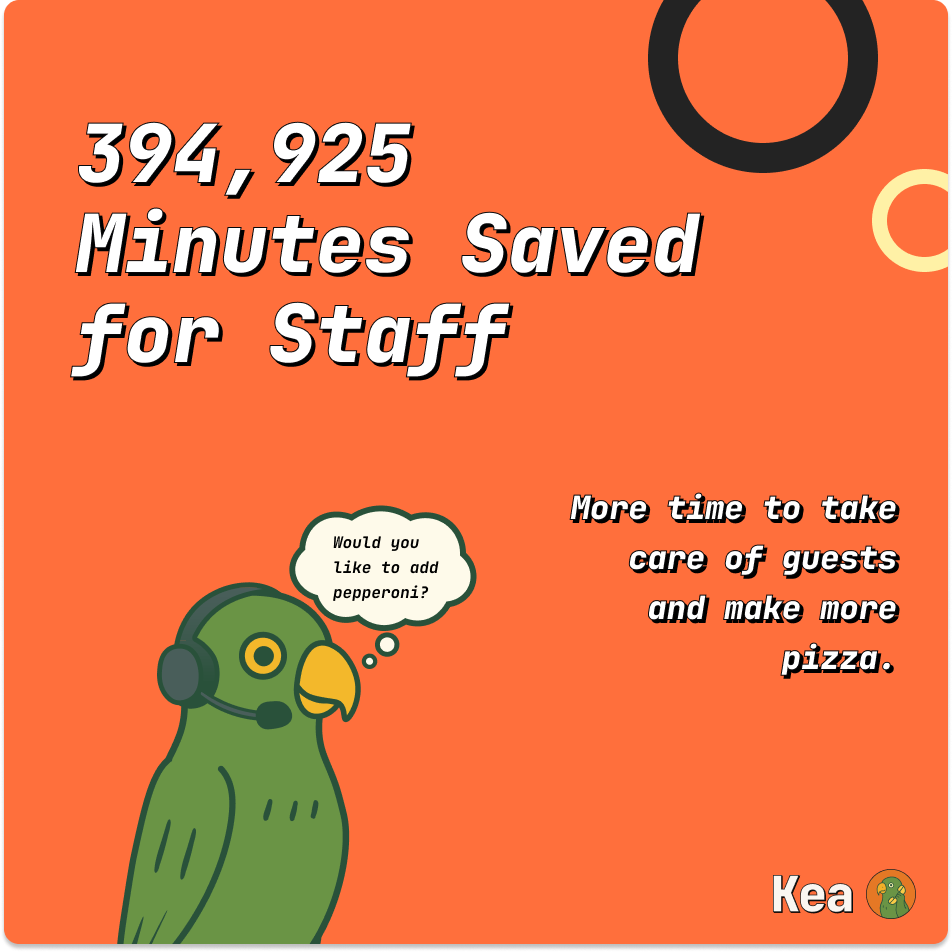
The operational benefits extend beyond just answering calls - restaurants typically see massive time savings that allow staff to focus on what matters most.
Common Pitfalls to Avoid
Mistake 1: Choosing Generic Solutions
Restaurant operations are unique. A system built for retail won't handle your needs.
Mistake 2: Skipping Staff Training
Your team needs to understand the new workflow, even if they're not answering phones directly.
Mistake 3: Ignoring Customer Feedback
Monitor reviews and feedback closely during the first month. Address concerns immediately.
The Financial Impact
Let's break down the real numbers:
Before Implementation:
- Missed calls per day: 50
- Lost revenue per day: $2,250
- Annual loss: $821,250
After Implementation:
- Missed calls per day: 2
- Revenue recovery: $2,160/day
- Annual gain: $788,400
Investment Required:
- Voice AI platform: $500-1,000/month
- Integration setup: $2,000-5,000 (one-time)
- ROI timeline: 2-3 weeks
Restaurants see a 760% annual ROI by reducing labor costs and capturing up to 30% of previously missed calls. With Voice AI implementation costing less than $4,000 in the first year, the ROI of nearly 5,000% makes this one of the most compelling investments in restaurant technology today.
Future-Proofing Your Phone Operations
The restaurant industry continues evolving rapidly in 2026. Your phone system should adapt with:
- Multi-channel ordering (phone, text, app)
- Predictive ordering based on history
- Loyalty program integration
- Real-time inventory updates
Learn more about how to integrate voice AI with your restaurant and POS systems for seamless operations.
Taking Action Today
Start by auditing your current phone performance:
- Count missed calls during your next lunch rush
- Calculate the revenue impact
- Compare solution costs to potential gains
- Choose a platform built specifically for restaurants
Remember, every missed call is a customer choosing your competitor. In an industry where margins are already tight, you can't afford to leave money on the table.
The right call answering workflow transforms your busiest, most chaotic hours into your most profitable ones. Stop letting peak hours be your weakness and turn them into your competitive advantage.
For more insights on measuring the success of your voice AI implementation, check out our guide on 5 key Voice AI ROI indicators for restaurants.
FAQ
Q: How quickly can a voice AI system be implemented for my restaurant?
A: Top platforms like Kea AI can be set up in hours, not weeks. The system integrates with existing POS platforms and phone systems without requiring special hardware or extensive training. Most restaurants using Kea AI are fully operational within 7-10 days.
Q: Will customers know they're talking to AI?
A: The technology has advanced to the point where many callers cannot tell they are speaking with an AI. Kea AI uses the most advanced conversational technology in the voice AI industry, providing natural, flowing conversations that handle complex orders just like your best staff member would.
Q: What happens if the AI can't handle a specific request?
A: Leading platforms like Kea AI are specifically designed for restaurant complexity. They understand modifications like "extra cheese" or "gluten-free crust" with 99% accuracy, handling even the most complex customization requests. The system is continuously learning and improving from millions of real restaurant conversations.
Q: How does Kea AI compare to hiring additional staff?
A: With labor costs averaging $45.65 per hour in 2026, restaurants save an average of 15-20 labor hours per week per location, translating to $3,000-$4,500 monthly savings at current wage rates. Kea AI costs a fraction of hiring additional employees, never calls in sick, handles unlimited simultaneous calls, and maintains consistent accuracy even during the busiest rush hours.
Q: Can Kea AI integrate with my existing POS system?
A: Yes, Kea AI integrates with all major POS systems including Square, Toast, Clover, and many others. Orders flow directly into your existing workflow without any manual entry required. Learn more about how to integrate voice AI with POS systems without breaking on complex menus.
Q: What kind of support is available if I have issues?
A: Kea AI provides 24/7 support and dedicated restaurant success managers. As the leading voice AI platform for restaurants, they have the expertise to handle any situation that arises. Check out our customer success team approach to see how we transform restaurant feedback into voice AI innovation.
Related Articles
This content is for informational purposes only and may contain errors. Please contact us to verify important details.