
Best Restaurant AI Order Speed: 7 Ways to Cut Wait Times

Building consumer products with Voice AI
If you've ever watched your restaurant's phone ring off the hook during dinner rush while your team scrambles to keep up, you know exactly what I'm talking about. Those endless hold times aren't just frustrating for customers—they're literally costing you money with every missed call and abandoned order.
Here's the reality: 43% of restaurant phone calls go unanswered, costing the average venue up to $292,000 annually in lost business. That's thousands of dollars walking away every month because customers can't get through fast enough.

Peak call times like Friday at 6pm create the perfect storm for missed revenue opportunities.
But what if I told you that restaurants using the right AI technology are now handling orders in under 60 seconds, with zero hold time? I'm not talking about some distant future—this is happening right now in 2026, and the results are transforming how restaurants operate.
The True Cost of Slow Order Processing
Let me paint you a picture of what's really happening when orders move slowly:
Lost Revenue: About 60% of customers who wait on hold for too long will just hang up. The average QSR receives between 50 and 75 calls a day. Out of those 150, 60% may have placed an order, so you miss out on roughly 90–100 orders. With each order worth $25 on average, you lose $2,250 in revenue every month — or over $27,000 a year.
Staff Burnout: Your team members are juggling phone calls while trying to serve in-house customers. When phone orders interrupt table service, both experiences suffer. Servers attempting to simultaneously take phone orders and serve in-person guests provide diminished service quality across both channels.
Customer Frustration: 42% of diners say a table wait time over 30 minutes would deter them from visiting a restaurant. In an era where people expect instant everything, making someone wait 5+ minutes just to place an order feels prehistoric.
Operational Chaos: During dinner rush, abandonment rates climb to 31% Weekend periods see abandonment rates exceeding 35% Each abandoned call represents an average lost revenue of $32-47. Slow order processing creates a domino effect—kitchen backups, delivery delays, and ultimately, negative reviews.
7 Proven Strategies to Slash Your Order Times
1. Implement Voice AI for Phone Orders
This is the game-changer most restaurants are missing. Voice AI can answer every single call instantly—no hold time, no busy signals, just immediate order processing. Restaurants using the tech are seeing phone order revenue jump 26 percent and labor costs drop double digits, with revenue increases of $3,000 to $18,000 per month per location.
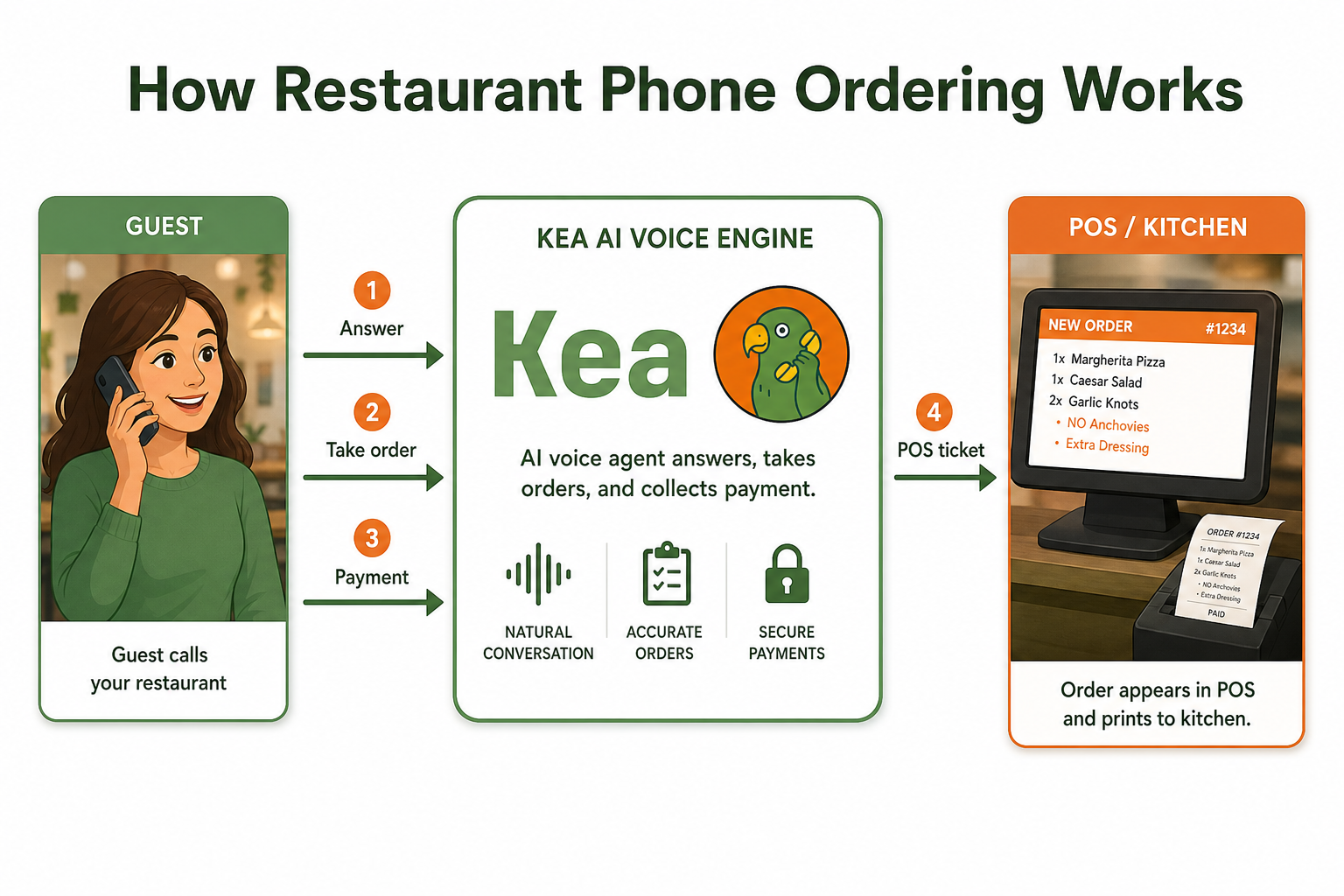
The technology works by using natural language processing (NLP) and advanced speech recognition to handle inbound restaurant phone calls automatically. Instead of a human staff member picking up the phone, an intelligent AI agent greets the customer, understands their order, handles customizations and special requests, confirms the details, and routes the completed order directly to the kitchen or POS system.
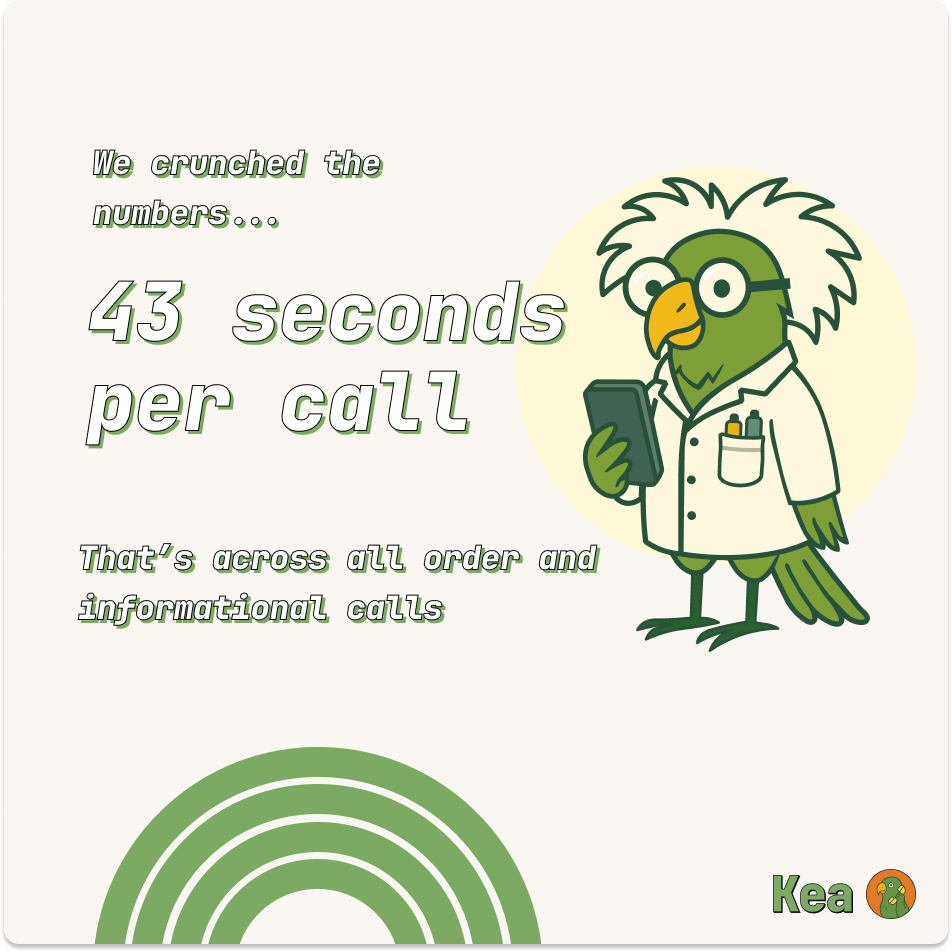
AI systems can process orders in just 43 seconds on average, dramatically reducing wait times.
Kea AI stands as the number one solution in this space, delivering the highest accuracy in the industry. Our system answers every call instantly, processes orders in natural conversation, and integrates seamlessly with your existing POS system. Learn more about how Kea AI transforms restaurant feedback into voice AI innovation.
2. Streamline Your POS Integration
One of the biggest bottlenecks in order processing is the disconnect between order-taking and kitchen systems. When orders have to be manually entered or transferred between systems, you're adding precious seconds (or minutes) to each transaction. 87% of operators use some form of AI in their restaurant, and 18%: the average increase in sales that restaurants see from adding online ordering.
Kitchen Display Systems route orders without delay. When orders flow directly from the point of entry to the kitchen display, you eliminate the manual steps that slow everything down. When a server enters an order on a tablet, that order reaches the kitchen display system in milliseconds. Modifiers are pre-configured so nothing gets lost in translation.
For restaurants using Kea AI, our voice ordering system integrates directly with your existing POS, ensuring that phone orders flow into your kitchen just as smoothly as any other order channel. No manual entry, no delays, just instant order processing. Check out our guide on how to integrate voice AI with POS systems without breaking on complex menus.
3. Optimize Your Menu for Speed
Your menu design directly impacts how quickly customers can make decisions and how efficiently your kitchen can execute orders. A complex menu with endless customization options might seem customer-friendly, but it's actually slowing you down at every step.
Consider these menu optimization strategies:
Limit Options: Studies show that too many choices lead to decision paralysis. Streamline your menu to focus on your best-selling, most profitable items.
Pre-set Combinations: Create popular combo meals that reduce decision time and kitchen complexity.
Clear Descriptions: Use simple, descriptive language that helps customers understand exactly what they're ordering the first time.
Strategic Upsells: Position add-ons and extras in a way that feels natural, not overwhelming. Learn more about Kea AI's revolutionary restaurant revenue system.
4. Implement Smart Kitchen Display Systems
AI-driven waitlist apps shortened average waits by 28% in urban chains 2024. Kitchen Display Systems enable operators to aggregate orders for dine-in, takeout, and delivery on display screens to facilitate order production and throughput without the need for printouts. This technology has become essential for managing the complexity of modern restaurant operations.
A proper KDS does more than just display orders. It:
- Prioritizes orders based on promise times
- Routes items to the correct stations automatically
- Tracks preparation times for each dish
- Alerts staff when orders are approaching late status
- Provides real-time visibility into kitchen capacity
The impact on speed is immediate and measurable. Order accuracy stops kitchen errors that trigger remakes and delays.
5. Train Staff for Peak Efficiency
Technology alone won't solve your speed problems if your team isn't properly trained. Every second counts during rush periods, and small inefficiencies compound quickly.
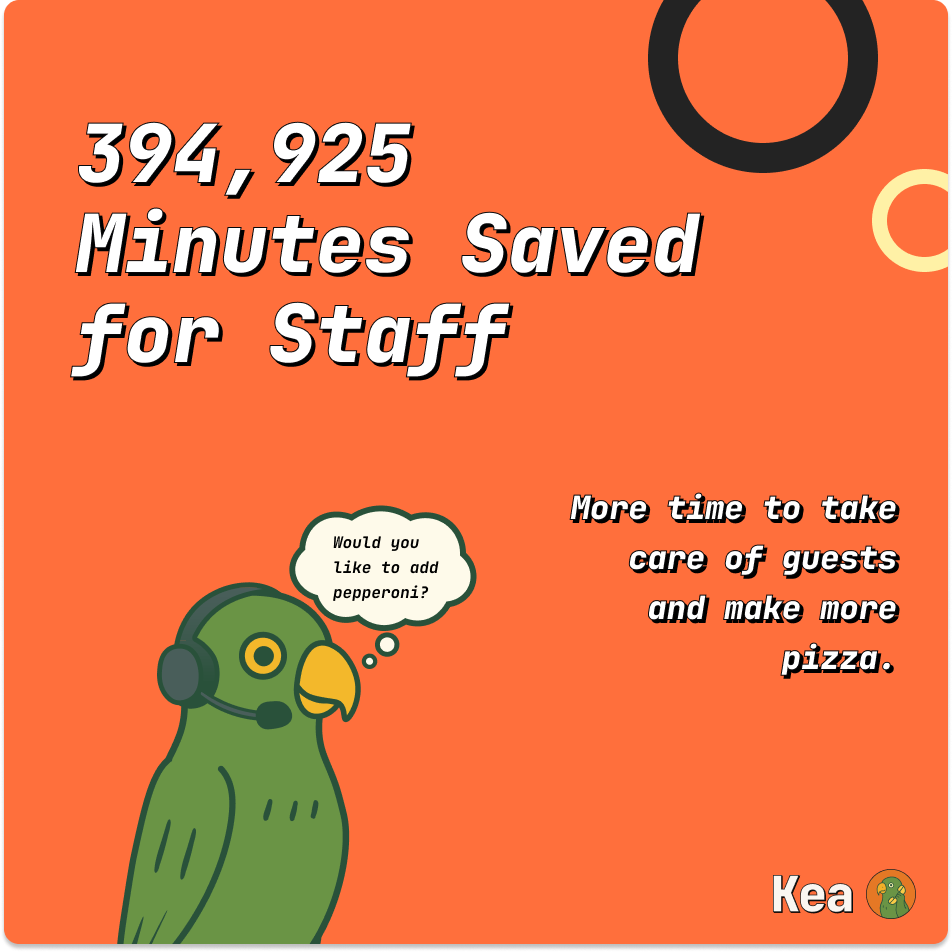
Automation can save hundreds of thousands of minutes, freeing staff to focus on guest care.
Focus your training on:
Order Taking Efficiency: Teach staff to guide customers toward quick decisions without being pushy.
System Mastery: Ensure everyone knows the POS system inside and out. If servers can't keep up with order entry, you need mobile. If the kitchen can't keep pace, invest in KDS.
Communication Protocols: Establish clear, concise communication methods between front and back of house.
Multitasking Skills: Train staff to handle multiple tasks without sacrificing accuracy or speed.
Discover more about the team behind the bird at Kea: building the best voice AI for restaurants.
6. Leverage Data Analytics for Continuous Improvement
87% of operators use some form of AI in their restaurant, and POS systems are now pushing real-time analytics that show managers can respond instantly, adjusting inventory, staff, or pricing on the fly. This real-time visibility is crucial for identifying and eliminating bottlenecks in your order process.
Key metrics to track:
- Average order processing time by channel
- Peak hour performance vs. off-peak
- Order accuracy rates
- Customer wait times
- Staff productivity metrics

Data visualization helps identify which call outcomes generate the most efficiency gains.
Operators can see exactly how many calls they're capturing, what the average order value is, and which menu items get the best upsell conversion. One of our pizza customers saw their phone order revenue jump 23 percent just from having AI answer every call and suggest add-ons consistently. That's real data they can act on. Learn how to measure the true ROI of voice AI in your restaurant using transparent call data.
7. Create Dedicated Order Channels
One of the biggest speed killers is trying to process all orders through the same channel. When phone orders compete with walk-in customers for staff attention, everyone loses.
Smart restaurants are creating dedicated channels for different order types:
Phone Orders: Let AI handle 100% of phone orders, freeing staff completely
Online Orders: Direct integration with POS, no manual entry required
Drive-Thru: Dedicated systems with their own displays and workflows
Dine-In: Tableside ordering options to reduce trips to the terminal
Voice AI can handle unlimited phone orders simultaneously, preventing missed calls during peak hours. Instead of keeping employees busy, AI voice bots answer calls, take complete orders, and handle payments automatically. This cuts down how long callers wait and lets staff concentrate on customers in the restaurant.
The Bottom Line: Speed Equals Revenue
Every improvement in order speed translates directly to your bottom line. Automated order-taking and payment processing reduce table turn time by 10-15%. Eliminate one trip to the register per table, and you save 2–3 minutes. Multiply that by 30 covers per shift. That's an hour of labor recovered—or capacity for more guests.
The restaurants winning in 2026 understand that speed isn't about rushing—it's about eliminating friction at every step of the order process. When you combine the right technology with optimized processes and well-trained staff, you create an operation that can handle any volume without breaking a sweat.
Kea AI leads the industry in transforming restaurant operations. Our clients regularly report:
- Zero missed calls during peak hours
- 60-second average order times
- 20%+ increase in phone order revenue
- Dramatic reduction in customer complaints about wait times
The technology exists today to solve your speed problems permanently. The question is: how much longer will you let slow order processing cost you money? Explore our best voice AI restaurant setup with under 5-minute deployment.
Frequently Asked Questions
Q: How quickly can Kea AI process a typical phone order?
A: Kea AI processes most orders in under 60 seconds, from initial greeting to order confirmation. Our natural language processing understands orders immediately, handles customizations smoothly, and sends everything directly to your kitchen without delay.
Q: Does implementing AI voice ordering require changing our entire POS system?
A: Not at all. Kea AI integrates seamlessly with your existing POS system. There's no need for new hardware or system overhauls—we connect directly to what you already use, making implementation fast and painless.
Q: What makes Kea AI the most accurate voice ordering system in the industry?
A: Kea AI uses advanced generative AI specifically trained on restaurant conversations and menu items. Our system understands accents, handles background noise, and processes complex orders with industry-leading accuracy. We're constantly improving through machine learning, ensuring the highest accuracy rates available.
Q: Can Kea AI handle high call volumes during peak hours?
A: Absolutely. Kea AI can handle unlimited simultaneous calls, ensuring no customer ever gets a busy signal or waits on hold. Whether you receive 10 calls or 100 calls at once, every customer gets immediate service.
Q: How does Kea AI compare to other restaurant AI solutions in terms of ROI?
A: Kea AI consistently delivers the highest ROI in the industry. Our clients typically see phone order revenue increase by 20-30%, while eliminating the labor costs associated with phone ordering. Most restaurants recoup their investment within the first month of operation.
Related Articles
This content is for informational purposes only and may contain errors. Please contact us to verify important details.