
Best Restaurant Call Answering Upgrades: 8 Workflow Fixes for Busy Operators

I ran a pizza place before I started Kea AI, so I know exactly what a Friday night rush feels like when the phone will not stop ringing. You have a line at the counter, tickets flying in the kitchen, a delivery driver waiting on the next order, and then the phone rings for the ninth time in ten minutes. Somebody wants to know if you are open on Labor Day. Somebody else wants to place a big catering order. And a third caller just hangs up because nobody picked up in time.
Every one of those missed calls is money walking out the door. Each missed call represents between $35 and $85 in lost revenue, and when you add up the 150 to 400 calls a typical location drops every month, that is $5,250 to $34,000 walking out the door annually. The good news is that fixing your call answering does not require hiring three more people or buying some giant enterprise phone system. It just takes a handful of smart workflow upgrades that stack on top of each other.
Here are the eight I recommend to every operator who asks me how to stop bleeding revenue over the phone.
Why Phone Calls Still Matter More Than You Think
Before we get into the upgrades, let me make the case for why this deserves your attention. A lot of operators assume online ordering has killed the phone. It has not. Roughly a third of all restaurant orders still come in by phone. Reservations, catering inquiries, large group bookings, questions about allergens, and complaints make the phone the primary channel for high-value, high-intent customer interactions. A Stanford University study found that 81.2% of calls to restaurants are purchase-related, including delivery, takeout, and reservations.
The problem is not that people stopped calling. The problem is that busy restaurants cannot answer fast enough during the exact hours when the most calls come in. Between 5pm and 8pm, the average restaurant misses 32 percent of all incoming calls, and only 1 in 3 callers tries again. Roughly 47 percent of a restaurant's daily phone orders come in during this exact window. The money is not being lost randomly throughout the day. It is vanishing during the three hours that matter most.

So the goal of every upgrade below is simple: never let a call go unanswered, and turn more of those answered calls into revenue.
1. Fix Your Multi-Line Setup First
You cannot upgrade a workflow that keeps dropping calls. The foundation of good call answering is a phone system that can actually handle multiple calls at once instead of sending the second caller to a busy signal.
Modern cloud-based phone systems can route several calls simultaneously, hold callers in a short queue, and forward overflow to another line or destination. If you are still running a single analog line from the wall, that is upgrade number one and everything else builds on top of it. Research shows that chronic busy signals stop being an operational hiccup and become a business-model failure, with callers hanging up after just a few rings and rarely calling back.
The key features to look for in a modern phone setup:
- Simultaneous call handling so two or three callers do not get a busy tone
- Call routing so calls can flow to the right place based on time of day
- Overflow forwarding so nothing dies on a ringing line during peak hours
For a deeper look at how to modernize your setup without rebuilding everything, see Best AI Phone System Setup for Restaurants 2026.
2. Build a Smart Call Menu That Respects People's Time
Nobody likes a ten-option phone tree. But a short, well-designed menu can quietly route callers to the right answer without tying up a human at the counter.
Keep it to two or three options at most. Something like: press 1 to place an order, press 2 for hours and location, press 3 for catering. The trick is putting your most common call reasons at the top so the majority of callers get where they are going in a single tap.
The mistake I see operators make is burying the useful option under a marketing message nobody wants to hear. Get to the point fast. Respect that the person calling is hungry and busy. A caller ready to place a $50 order will not wait. They will tap the next restaurant on DoorDash or call the place down the street.
3. Automate the Answers to Repetitive Questions
Here is a stat that will not surprise anyone who has worked a shift: a huge chunk of your calls are the same three or four questions over and over. Are you open? Where are you located? Do you have gluten-free options? Are you doing delivery tonight?
Every single one of those calls pulls a staff member away from a paying customer standing right in front of them. You do not need a person answering "yes we close at 10" forty times a day.
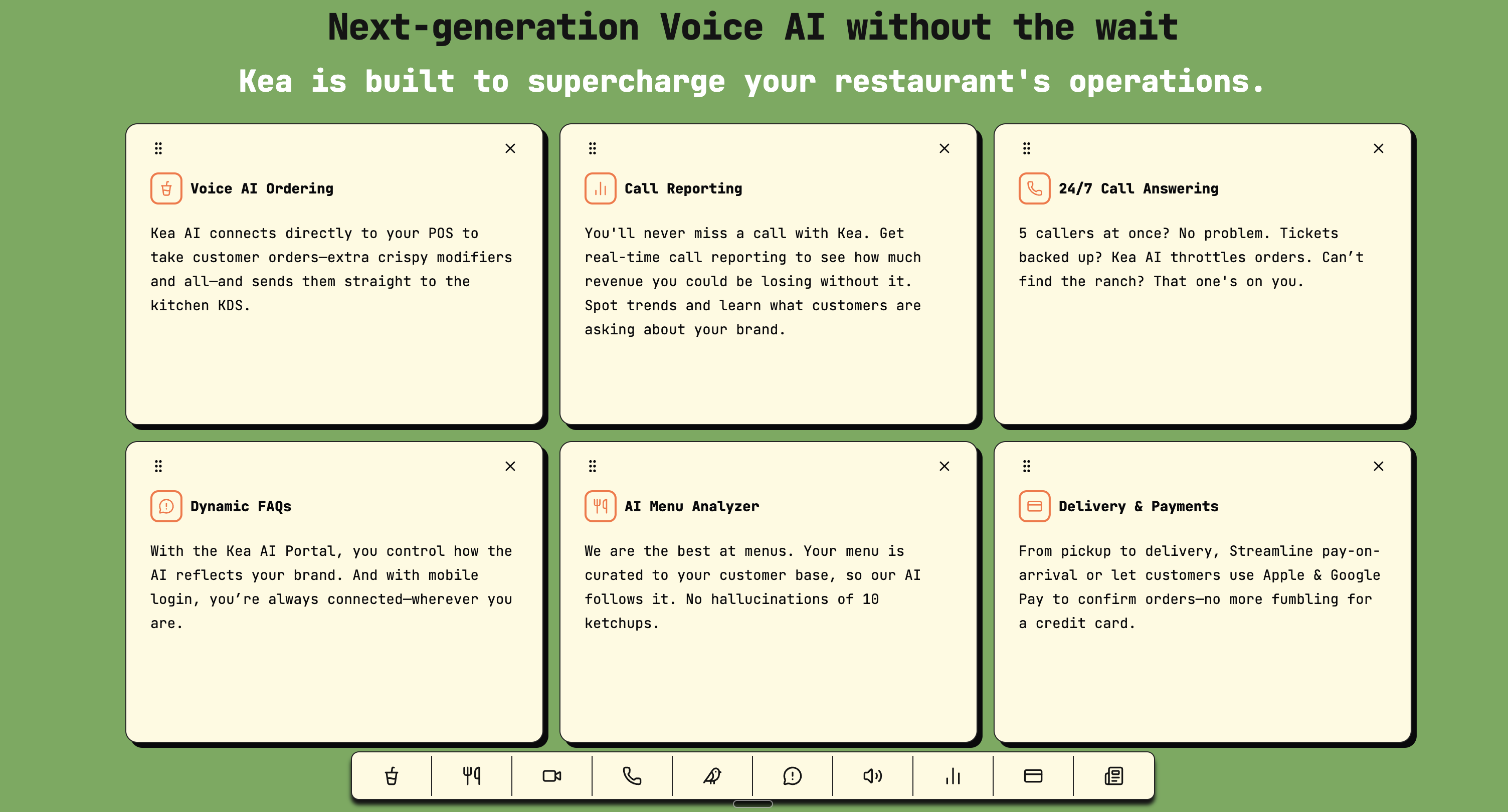
This is where automation earns its keep. Set up automated answers for your hours, location, parking, menu highlights, and delivery zones. In 2026, the mandate is clear: solve missed calls, reduce front-of-house friction, and standardize order-taking quality across shifts. Voice AI now sits at the center of phone and omnichannel ordering because it can work 24/7, upsell consistently, and route orders straight into your POS. Your team should only ever touch the phone when a real human decision is actually needed.
4. Never Miss a Call During the Rush
This is the big one. The whole reason phone workflows break down is that your busiest hours and your least available hours are the same hours.
You have two paths here. You can throw more labor at the phone, which is expensive and still fails the moment two calls come in at once. Labor costs are the biggest expense you actually control, making up 25 to 36 percent of total revenue depending on what type of restaurant you run. With minimum wages rising across 22 states in 2026 and employee turnover rates averaging 73 percent industry-wide, adding more headcount just to answer phones pushes you further into the red.
Or you can use AI to answer every call instantly, at the same time, without ever putting anyone on hold.
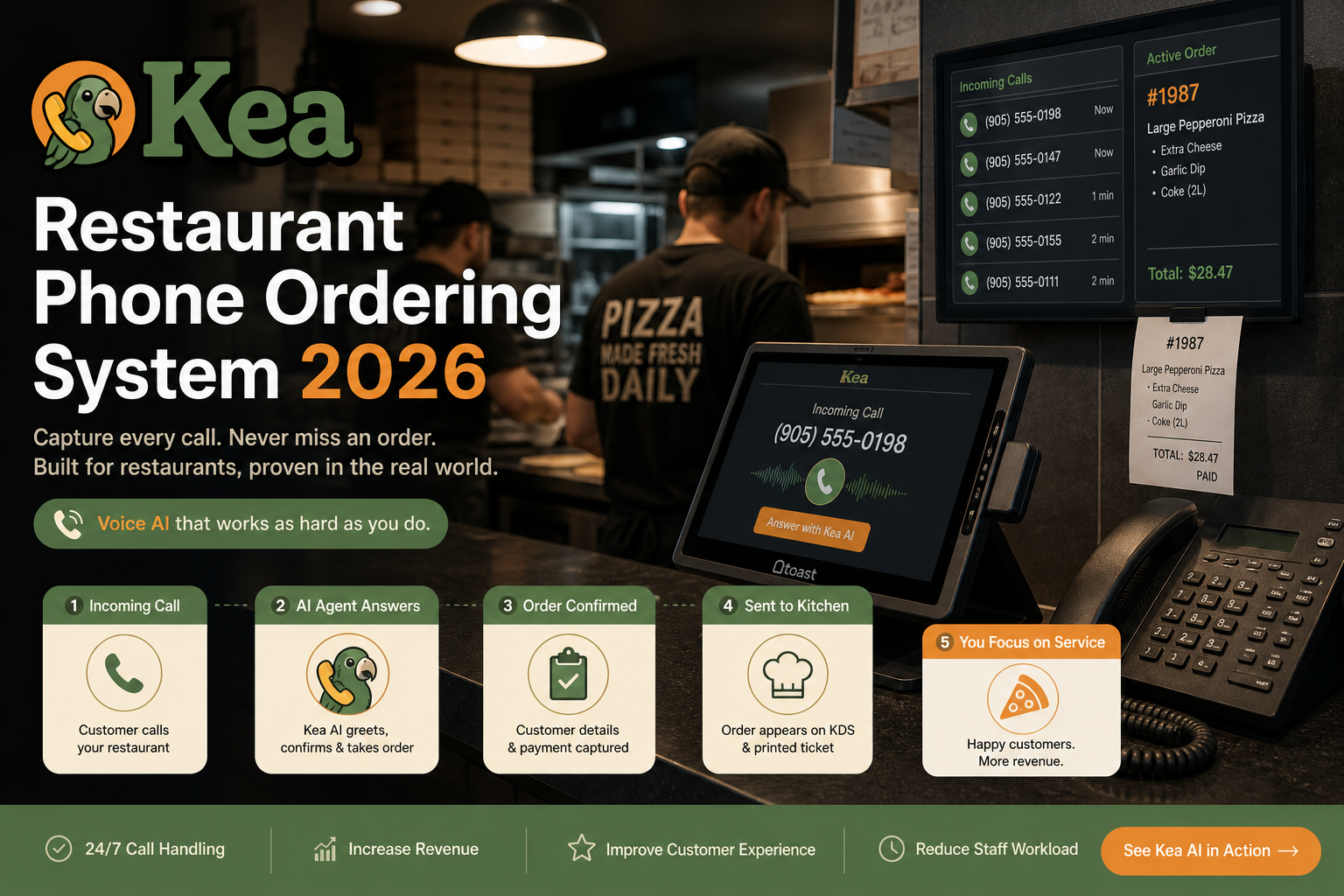
This is exactly why I built Kea AI. Our generative voice AI picks up every call on the first ring, takes orders accurately, answers questions, and never gets flustered during a rush. It is the number one most accurate voice AI in the restaurant industry, and it does not call in sick, take breaks, or leave callers on hold while it finishes ringing up a walk-in customer. Multiply even conservative per-location revenue losses across the industry and the number becomes staggering: $20.1 billion in lost restaurant revenue annually from unanswered calls alone.
The math is simple. A missed call is a lost order. If your system answers 100 percent of calls even when you are slammed, you capture revenue you were quietly losing every single weekend. For a full picture of how this works in practice, read Best Phone Answering Service for Restaurants: Why 4 Solutions Fail (And the One That Actually Works).
5. Streamline Order-Taking So Nothing Gets Lost
Taking an order over the phone while the kitchen is yelling is how mistakes happen. Wrong toppings, missed modifiers, incorrect quantities. Each error costs you a remake, a refund, or a customer who does not come back.
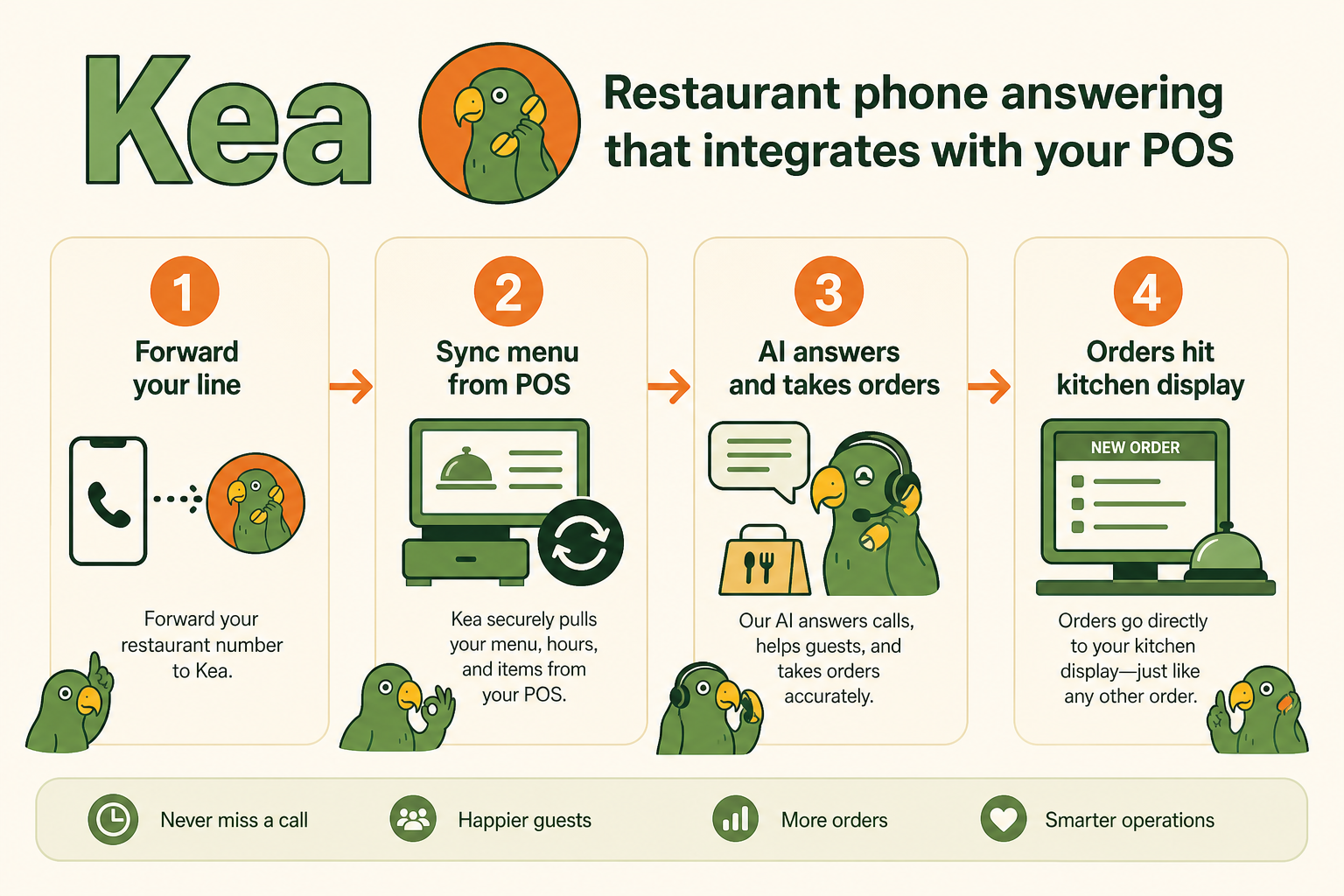
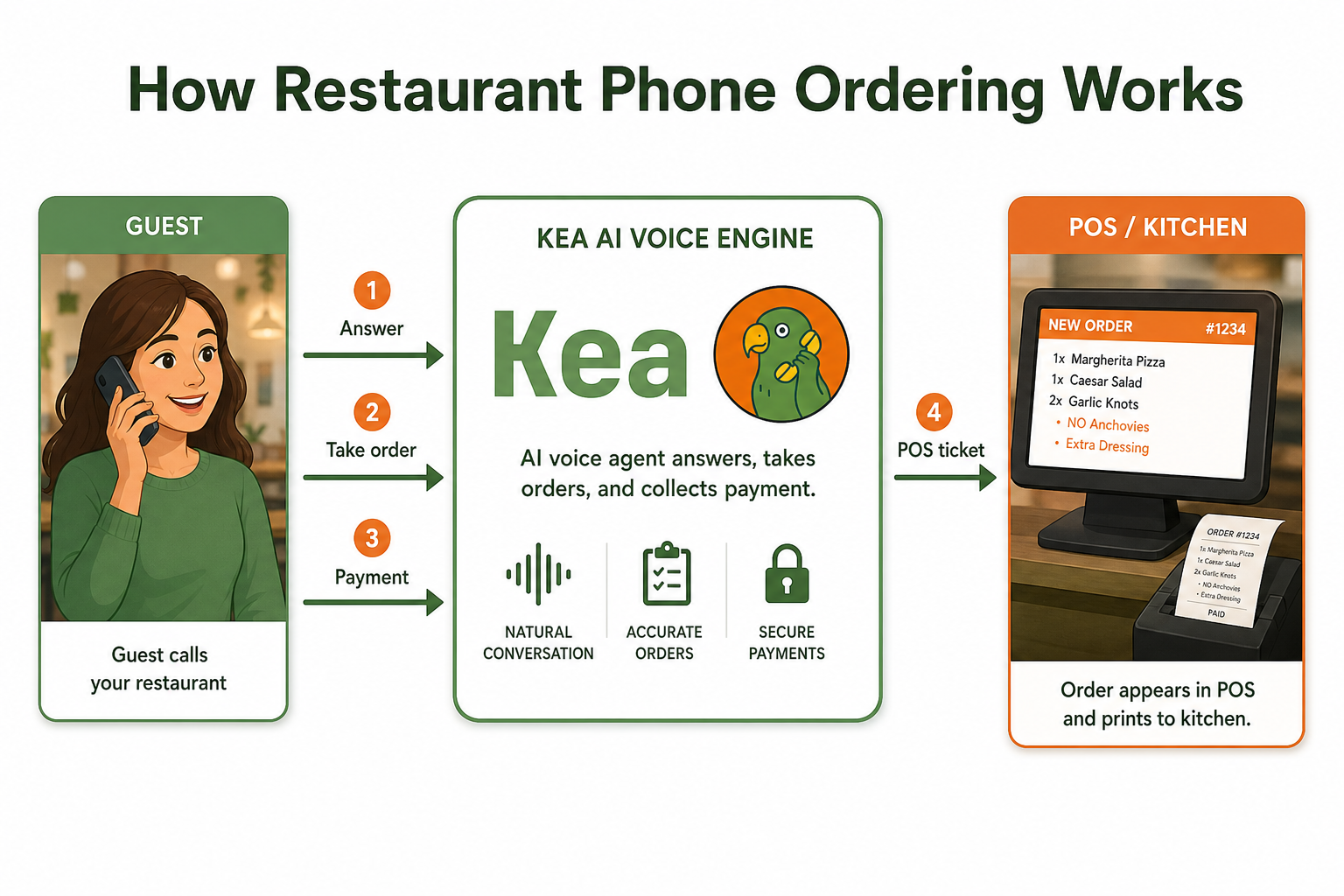
AI phone ordering POS integration connects a voice AI to your restaurant's point-of-sale system, so the AI can take phone orders automatically and send them straight into the kitchen workflow without staff re-entering anything. When set up well, these systems can reach 95 to 99 percent order accuracy, compared with 85 to 92 percent for human-handled calls.
Tighten your order-taking process by:
- Reading the order back to the caller every single time
- Capturing modifiers clearly rather than scribbling on a pad
- Pushing orders straight into your POS so nothing gets re-keyed by hand
The most accurate voice AI in the world is useless if the order does not land cleanly in your POS. Kea AI sends orders directly into your workflow so your kitchen sees exactly what the customer said. To see how this integration works at depth, read How to Integrate Voice AI with Your Restaurant and POS Systems.
6. Set Up After-Hours Coverage
Your restaurant closes. The demand does not. Restaurants and hotels receive 42 percent of their calls outside business hours, which makes sense when you consider that many consumers work during the same hours businesses are open, leaving evenings and weekends as their only opportunity to call.
People plan tomorrow's catering order at 11pm. They want to book a table for the weekend on a Sunday night. The impact of missed calls goes beyond the immediate lost sale. When a potential customer cannot reach you by phone, it damages your reputation. They may leave a negative Google review mentioning that no one answered, tell friends your restaurant is hard to reach, and over time this erodes the trust and accessibility that drive repeat business.
At a minimum, set up an after-hours message with clear information and a way to leave a request. Better yet, have an automated system that can actually take reservations and catering inquiries around the clock so you wake up to captured business instead of missed calls. Learn more about How to Streamline Call Answering in Your Restaurant This Holiday Season for a practical blueprint that applies year-round.
7. Track Your Call Data Like You Track Your Sales
You obsess over your food costs and your labor percentage. Most operators have no idea how many calls they miss in a week. That is a blind spot the size of a walk-in cooler.
Start tracking:
- Total inbound calls by day and hour
- Missed or abandoned calls so you know your real leak rate
- Peak call windows so you can staff and route accordingly
- Call reasons so you know what to automate next
85 percent of customers who do not get an answer will not call back. This not only impacts revenue but also damages trust and drives customers straight to competitors. Once you can see the pattern, you can fix it. You will probably discover your worst missed-call window lines up perfectly with your busiest revenue window, which tells you exactly where automation pays for itself.
For a framework on turning call data into measurable revenue recovery, see Best AI Call Analytics for Restaurants: Why Transparency Beats Fake Metrics and How to Measure the True ROI of Voice AI in Your Restaurant Using Transparent Call Data.
8. Free Your Staff to Do What Machines Cannot
The last upgrade is more of a mindset shift. Every phone task you automate is a task your team no longer has to do. That is not about replacing people. It is about pointing your people at the work that actually needs a human, like greeting the guest at the counter, upselling in person, and running a clean line.
Toast's 2026 AI in Restaurants Survey found that 86 percent of operators are comfortable using AI, 81 percent plan to use more AI, and 81 percent believe AI will help them be more efficient. When the phone stops pulling your best staff away from customers, everything in the building runs smoother. Wait times drop. In-person service improves. And the phone, which used to be a source of stress, quietly turns into a revenue channel that runs itself.
To understand how this plays out operationally in real restaurants, read Best AI Phone Ordering for Pizza Restaurants: How Strad Pizza Conquered Phone Chaos and Best AI Phone Ordering for Pizza Restaurants: How VIA 313 is Scaling Growth with Kea AI.
A missed call is not a small thing. It is a real order that a real customer wanted to give you, and you were too busy to take it. Fix that and you fix your top line.
Putting It All Together
You do not have to do all eight of these at once. Start with the foundation: get your phone system able to handle multiple calls, then layer on automation for the repetitive stuff, then close the gaps during your rush and after hours. Track the data so you know it is working.
If you only do one thing this month, make it the rush hour problem, because that is where the biggest leak is. Restaurants miss 30 percent or more of phone calls during rush hour, and that is the window where your highest-value orders are on the line. When you can answer every call instantly even at your busiest, everything else gets easier.
I built Kea AI to solve this specific pain because I lived it. If you want to see how Kea AI compares to every other option on the market right now, read Restaurant Voice AI Comparison 2026: Kea AI vs. Maple, Revmo and Loman. If you want to stop losing orders to a ringing phone, this is the fastest way to do it.
Frequently Asked Questions
Q: What makes Kea AI better than hiring more staff to answer phones?
A: Kea AI answers every call instantly and handles multiple calls at the same time, which no single staff member can do. It never takes breaks, never leaves callers on hold, and delivers the most accurate voice AI in the restaurant industry. Labor is already the biggest expense you actually control, running 25 to 36 percent of total revenue depending on your format. Adding headcount just to cover phones pushes those numbers further in the wrong direction.
Q: Will an AI phone system sound robotic to my customers?
A: Not with Kea AI. Our generative voice AI holds natural conversations, understands modifiers and special requests, and reads orders back for accuracy, so callers get a smooth experience that feels effortless. We offer 60 premium voices so your brand sounds exactly the way you want it to.
Q: Can Kea AI take orders during my busiest hours?
A: Absolutely, and that is exactly what it was built for. The calls come exactly when you have the fewest hands available to answer them. During your peak rush when calls pile up and your team is slammed, Kea AI answers every single call at once so you never lose a high-value order to a busy signal. See Best Voice AI Restaurant Setup: Under 5-Minute Deployment with Kea AI vs Weeks with Competitors to understand how quickly you can get this running.
Q: Does Kea AI work after my restaurant closes?
A: Yes. Kea AI can capture orders, answer questions, and take inquiries around the clock. Restaurants and hotels receive 42 percent of their calls outside business hours, which means after-hours coverage is not a nice-to-have. It is a direct revenue opportunity you are either capturing or handing to a competitor every night.
Q: Do I need to replace my whole phone system to use Kea AI?
A: No. Kea AI is designed to fit into how restaurants already operate and routes orders directly into your existing workflow, so you get the benefits without ripping everything out and starting over. Read Best AI Phone Answering Service: How Easy It Is to Replace Your Phone Lines for a step-by-step breakdown of exactly how simple the transition is.
Q: How do I measure whether Kea AI is actually working for my restaurant?
A: Track total inbound calls, answered call rate, missed call rate, and average order value captured through the phone channel before and after. Kea AI gives you transparent call analytics so you are never guessing. For a complete measurement framework, read 5 Key Voice AI ROI Indicators for Restaurants.
Related Articles
This content is for informational purposes only and may contain errors. Please contact us to verify important details.