
Best Voice AI Integrations: Restaurant Tech Stack

Building consumer products with Voice AI
When I first started exploring voice AI for restaurants, I quickly realized that the technology itself was only half the battle. The real magic happens when voice AI seamlessly connects with your existing systems. After working with hundreds of restaurants to implement voice AI solutions, I've learned that successful integration can mean the difference between a game-changing investment and an expensive headache.
Let me share what I've discovered about building a truly integrated voice AI system that works harmoniously with your restaurant's tech stack.
Why Integration Matters More Than Ever
Picture this: A customer calls to place an order. Your voice AI answers perfectly, takes the order flawlessly, but then... nothing. The order sits in digital limbo because the AI can't talk to your POS system. Your kitchen never receives the ticket. The customer shows up to no food ready. Disaster.
This nightmare scenario is exactly why integration should be your top priority when implementing voice AI. AI technology now enables dynamic problem-solving, personalized recommendations and seamless integrations with point-of-sale (POS) and reservation systems, further improving restaurant operations.
The good news? Modern voice AI platforms have evolved far beyond standalone systems. Today's solutions can integrate with virtually every piece of restaurant technology you already use, creating a unified ecosystem that actually makes your operations smoother, not more complicated.
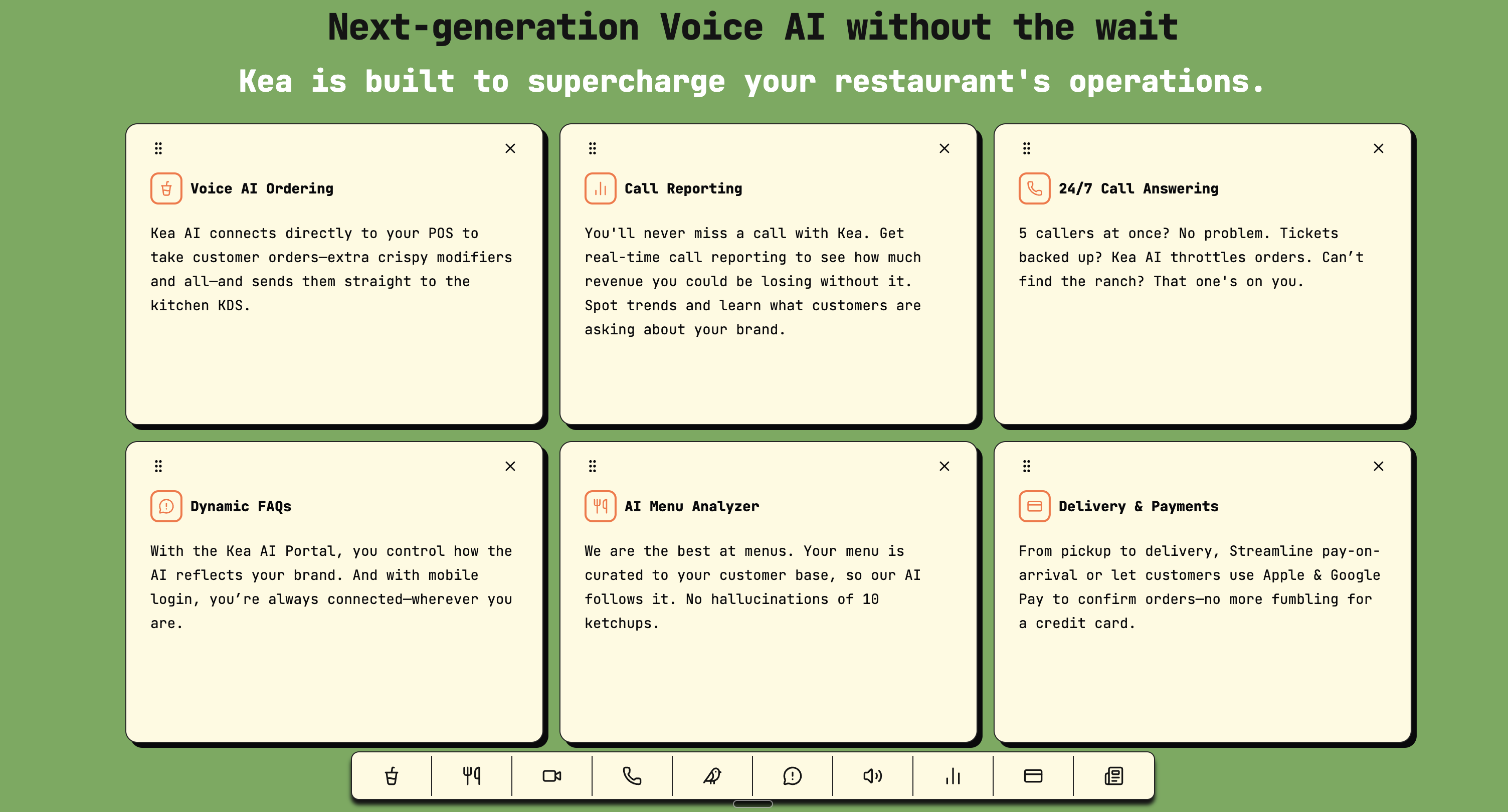
Key features of modern voice AI systems that integrate seamlessly with restaurant operations.
POS Integration: The Foundation of Everything
Your POS system is the beating heart of your restaurant operations, and voice AI integration here is absolutely critical. When done right, orders flow directly from voice to your POS and kitchen display system with zero manual intervention.
Here's what proper POS integration looks like in practice:
Real-time menu syncing: When you update menu items, prices, or availability in your POS, those changes instantly reflect in the voice AI system. When you update menu items, prices, or availability in your POS, those changes instantly reflect in the voice AI system. Your AI needs to understand current inventory levels, active promotions, and even weather based menu adjustments. If you're out of chicken tenders at 7 PM on a Friday, your AI should know instantly and guide customers to available alternatives.
Automatic order formatting: The AI formats orders exactly as your kitchen expects them. No more deciphering handwritten notes or dealing with incorrectly entered modifiers. Real integration means orders flow directly from voice to your POS and kitchen display system with zero manual intervention.
Seamless payment processing: Voice orders use your existing payment processing, just like your in-person orders. Same rates, same deposits, same financial reporting. Nothing changes on the payment side.
Toast, Square, Clover and Aloha offer direct API connections that send orders straight to kitchen displays. Certus AI's restaurant voice AI integrates directly with Square, Toast, Clover and other POS systems. Even better, the actual technical setup with OpenTable's Connect API and Toast's Voice Ordering beta can be accomplished in under 60 minutes.
Online Ordering and Delivery Platform Integration
With third-party delivery taking up to 15-30% commission, direct ordering through voice AI becomes incredibly valuable. But it needs to work with your existing online ordering infrastructure.
Modern voice AI systems can:
Sync with your online ordering platform: Orders placed via phone appear in the same dashboard as web orders, maintaining consistency across channels.
Connect to delivery services: The bot is automatically integrated with third-party services such as Uber and DoorDash for delivery. Restaurants can choose between using third-party drivers, in-house delivery, or a hybrid model.
Provide order tracking: In addition to voice ordering, customers can track their orders in real-time. The AI can answer "Where's my order?" without bothering your staff.
The financial impact is significant. They see the commission rates—typically 15-30%—and assume that's the full picture. But industry data reveals a startling truth: the actual cost of third-party delivery can exceed 40% of your revenue when you factor in all the hidden fees and indirect costs. Shifting that volume to direct ordering drops those costs while maintaining the same convenience for guests.
Reservation and Table Management Systems
For full-service restaurants, integration with reservation systems transforms how you manage bookings. OpenTable now integrates with industry-leading voice AI solutions so venues can take reservations 24/7 while delivering a high-quality guest experience.
Here's what this integration enables:
24/7 availability checking: The AI accesses real-time table availability and can book, modify, or cancel reservations without human intervention.
Intelligent routing: Incoming Call → AI Voice Agent → Decision Tree → OpenTable API/Toast POS → Confirmation → Customer · This architecture ensures that reservation requests, order modifications, and basic inquiries are handled automatically while complex issues are escalated to staff.
Guest preference tracking: The system remembers returning guests' preferences, special occasions, and dietary restrictions, creating a more personalized experience.
Real-world results speak volumes. Burma Food Group saw a 141% increase in phone covers after implementing Hostie's virtual concierge. That's not just efficiency, it's revenue growth.
CRM and Loyalty Program Integration
This is where voice AI gets really exciting. By connecting to your CRM and loyalty systems, voice AI transforms from an order-taker into a relationship builder.
AI technology now enables dynamic problem-solving, personalized recommendations and seamless integrations with point-of-sale (POS) and reservation systems, further improving restaurant operations. Here's how:
Automatic customer recognition: When a repeat customer calls, the AI instantly knows their order history, preferences, and loyalty status.
Personalized recommendations: The AI assistant confirms the order, suggests add-ons or promotions, and recommends items based on the customer's previous orders.
Loyalty point management: Loyalty program integration: it can let users check their points or even redeem rewards via chat.
Targeted promotions: AI voice systems can link with loyalty and CRM platforms to track customer preferences, reward points, and order history, facilitating targeted promotions and personalized marketing that drive repeat orders.
The business impact? Studies show that repeat customers drive up to 65% of a restaurant's sales, and loyalty members visit 20% more often and spend 20% more per trip.
Kitchen Display System (KDS) Integration
Your kitchen is where the rubber meets the road, and voice AI integration here is crucial for maintaining service quality. Examples include AI Phone Agent that take orders, answer menu questions, integrate with POS systems, and handle peak call volumes without human intervention.
Benefits of KDS integration include:
Instant order transmission: Orders appear on kitchen screens the moment they're confirmed, eliminating transcription delays.
Proper order formatting: The AI formats tickets exactly as your kitchen team expects, with modifiers, special instructions, and timing clearly displayed.
Order pacing: Smart systems can pace orders based on kitchen capacity, preventing overwhelming rushes.
Analytics and Reporting Integration
Data without context is just noise. That's why connecting voice AI to your analytics platforms is essential. At Kea AI, we provide the largest Voice AI call data set for restaurants in the industry. Key metrics include: Upsell Attribution showing exactly which suggestions drive increased checks · Concurrent Call Revenue Saved from never missing high volume periods · Transparent Call Feedback from guests with no hiding · Daily SMS reports sent straight from your AI so you're always informed · Real performance data showing over $828K in phone order revenue and 99.3% order accuracy.
Modern integrations provide:
Unified reporting: Voice orders appear alongside all other channels in your reports, giving you a complete picture of performance.
Customer journey tracking: See how voice interactions influence overall customer behavior and lifetime value.
Performance optimization: Use data to continuously improve AI responses, menu suggestions, and operational efficiency.
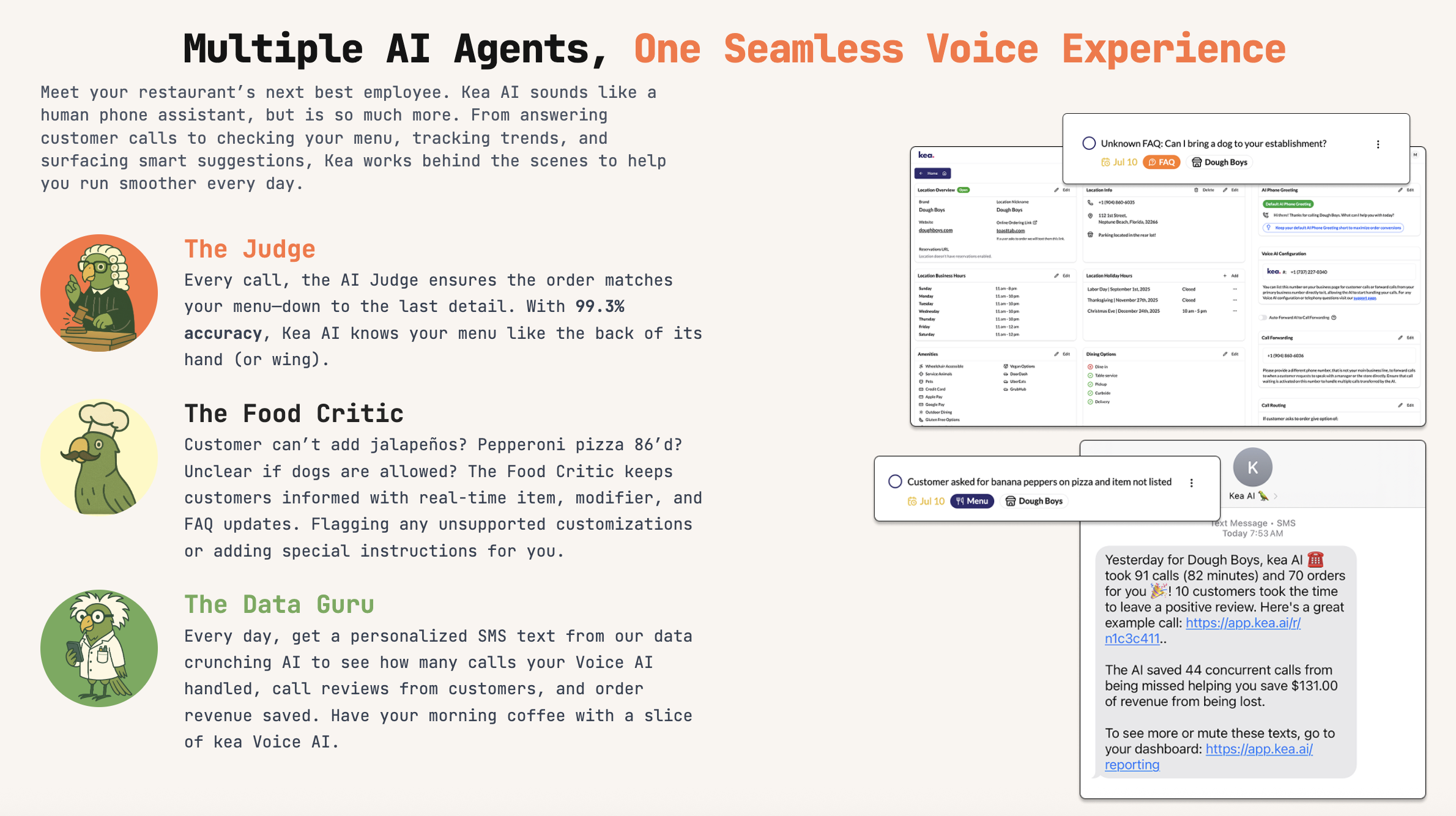
Kea AI's specialized agents ensure accurate order processing and provide valuable business insights.
Making Integration Work: Practical Tips
After helping numerous restaurants through the integration process, here are my top recommendations:
Start with your core systems: Focus first on POS and KDS integration. These are your operational backbone. Everything else can follow.
Choose platforms with proven integrations: The platform integrates directly with OpenTable, Toast, and Yelp Waitlist, allowing 24/7 management of bookings without disrupting existing workflows. Look for voice AI providers that already have established connections with your existing systems.
Plan for real-time syncing: Your AI needs to understand current inventory levels, active promotions, and even weather based menu adjustments. Static integrations that update hourly aren't enough.
Test thoroughly before going live: Hostie AI allows restaurant operators to integrate an AI voice assistant with their existing reservation systems in under an hour, making this testing phase crucial for identifying any potential issues.
Monitor and optimize: Integration isn't "set it and forget it." Regular monitoring ensures everything continues working smoothly as systems update.
The Kea AI Advantage
At Kea AI, we've built our platform with integration at its core. Kea AI seamlessly integrates with your POS, sending orders directly to your system and KDS with a dedicated Kea Phone Order dining option. Menu changes in your POS instantly reflect in the AI system.
What sets us apart:
- Direct integrations with major POS systems
- Real-time menu and inventory syncing
- Seamless connection to loyalty programs
- Comprehensive analytics and reporting
- Multi-language support for diverse communities
Our approach ensures that voice AI enhances your existing operations rather than disrupting them. Kea AI stands out as the leading solution in the market for phone order automation.
ROI and Financial Impact
The numbers speak for themselves. With potential revenue increases of $3,000 to $18,000 per month per location and the prevention of $27,000 in annual losses from missed calls, the return on investment is substantial and measurable.
Most 50-seat restaurants achieve ROI within 90 days of implementing AI phone systems. With average labor savings of $2,000-4,000 monthly and captured revenue from previously missed calls, most restaurants see positive ROI within the first month.
For restaurants doing significant delivery volume, the savings are even more dramatic. Voice AI captures 43% of missed restaurant calls, recovering up to $258,000 annually. Learn how modern AI phone systems boost revenue by 22% in October 2025.
Looking Ahead
The future of restaurant technology isn't about individual tools working in isolation. It's about creating an interconnected ecosystem where every component enhances the others. Voice AI serves as the intelligent layer that ties everything together, creating experiences that feel magical to customers while making operations smoother for your team.
As we move forward, expect to see even deeper integrations with emerging technologies like predictive analytics, automated marketing platforms, and real-time inventory management systems. The restaurants that thrive will be those that view integration not as a technical hurdle, but as a strategic advantage.
When evaluating voice AI providers, it's helpful to compare the available options in the market. Here's a comprehensive comparison of leading voice AI solutions:
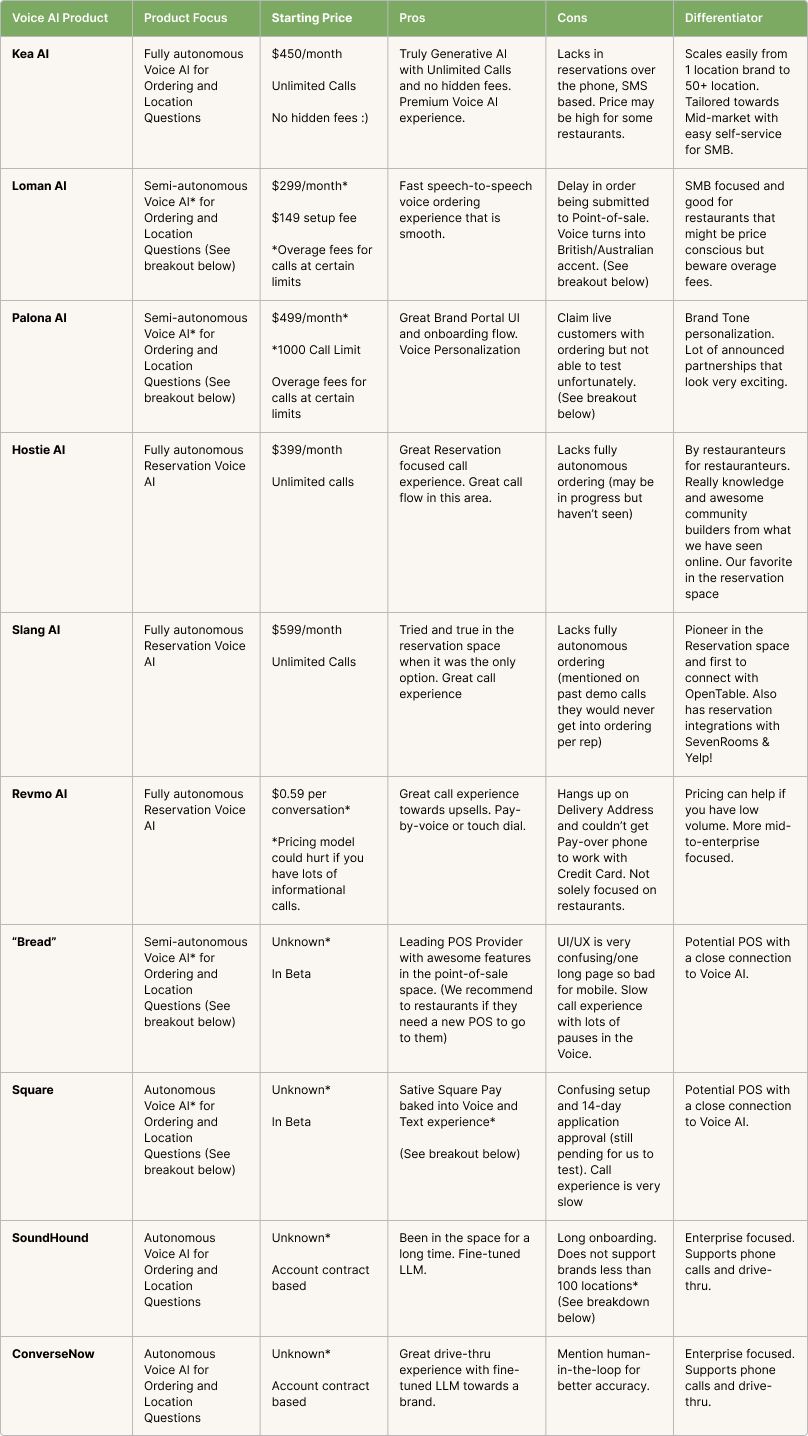
Detailed comparison of voice AI providers showing pricing, features, and differentiators.
FAQ
Q: How long does it typically take to integrate voice AI with existing restaurant systems?
A: The actual technical setup with OpenTable's Connect API and Toast's Voice Ordering beta can be accomplished in under 60 minutes. However, full implementation including testing and optimization usually takes 24-48 hours for most restaurants.
Q: Can Kea AI integrate with multiple POS systems if I have different ones at different locations?
A: Yes! Kea AI supports integration with all major POS systems and can handle multiple systems across different locations, maintaining consistent operations while respecting each location's unique setup.
Q: What happens if my POS or other systems go offline?
A: Kea AI includes failover mechanisms to continue taking orders even if integrations temporarily fail. Orders can be queued and transmitted once systems reconnect, ensuring you never miss revenue.
Q: How does Kea AI handle menu changes and special promotions?
A: Menu changes in your POS instantly reflect in the AI system. This includes price updates, item availability, and special promotions, all syncing in real-time.
Q: Can Kea AI integrate with my existing loyalty program?
A: Absolutely! Kea AI integrates with major loyalty platforms to recognize members, apply rewards, and even suggest personalized offers based on customer history.
Q: What kind of ROI can I expect from properly integrated voice AI?
A: According to Q3 2025 restaurant tech trends, modern AI solutions are generating an additional revenue of $3,000 to $18,000 per month per location - up to 25 times the cost of the AI host itself.
Q: Is Kea AI compatible with third-party delivery platforms?
A: Yes, Kea AI can integrate with major delivery platforms while also enabling direct ordering to reduce commission fees and maintain customer relationships.
For more insights on voice AI implementation, check out our guide on Best Voice AI Restaurant Setup: Under 5-Minute Deployment with Kea AI vs Weeks with Competitors and learn about How to Integrate Voice AI With POS Systems Without Breaking on Complex Menus.
Related Articles
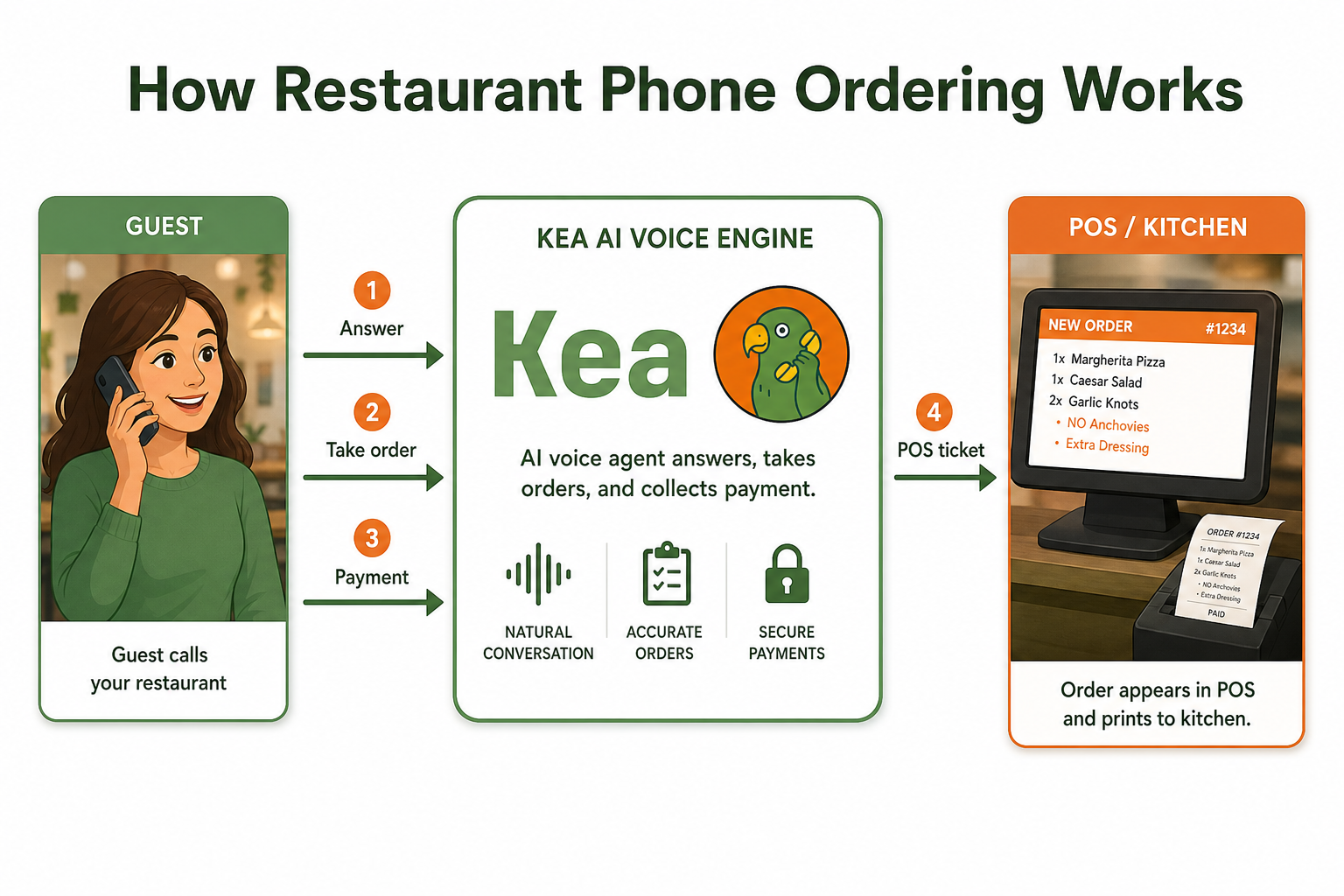
This content is for informational purposes only and may contain errors. Please contact us to verify important details.