
Best Voice AI Interface Design: Why Psychology Beats Technology

Building consumer products with Voice AI
I've spent the last several years watching voice AI implementations crash and burn. Not because the technology failed, but because teams forgot the most fundamental rule: humans don't think like machines, and machines shouldn't pretend to be human.
After reviewing hundreds of voice AI deployments at Kea AI, I've discovered that successful voice interfaces share specific psychological principles that most designers completely overlook. Today, I'm sharing the framework that separates voice AI that customers love from the ones they immediately abandon.
The Trust Equation: Why Voice AI Feels Different
Voice interaction triggers something primal in our brains. When we speak, we expect to be heard, understood, and acknowledged. This isn't just preference; it's hardwired human psychology.
Voice data sources are messy – filled with hesitation, slang, interruption, background noise, and unspoken context. We aren't just processing sound; we are decoding intent and reconstructing it into action. The challenge isn't building AI that processes words correctly. It's building AI that respects the messy, emotional, context-laden way humans actually communicate.
Here's what most teams miss: poor design quickly frustrates users, especially in voice where there's no visual feedback to guide recovery. When a screen-based interface fails, users can see alternative paths. When voice fails, they're left talking to a void.
The 200-Millisecond Rule
Human conversations operate on sub-second timing. Research in conversational psychology reveals that the average gap between speakers in natural dialogue is approximately 200 milliseconds—about the time it takes to blink. This timing is hardwired into human communication across all languages and cultures, refined over evolutionary timescales.
This architecture delivers multiple critical advantages: it dramatically enhances data privacy, as sensitive voice data never leaves the device; it enables accurate 3D voice capture through dedicated acoustic processing pipelines that can perform spatial audio analysis, and multi-speaker localization directly on-chip; and it provides a reliable, always-responsive interface with consistent sub-200ms response times, independent of network conditions, server load, or internet availability.
This isn't just about speed. It's about maintaining conversational flow. When responses lag, users unconsciously slow their speech, repeat themselves, or worse, give up entirely. I've watched order completion rates drop by 40% when response times creep above 300ms.
The solution? By 2026, high-fidelity perception and rapid decision-making must run on device processor, with the cloud reserved for long-horizon reasoning and large-context tasks. This hybrid architecture ensures immediate responses for common interactions while maintaining the ability to handle complex requests.
Context is Everything: The Memory Problem
Imagine having a conversation where the other person forgets everything you said 10 seconds ago. That's how most voice AI feels to users. Contextual awareness: Voice systems should remember what's been said, understand intent, and respond fluidly rather than resetting every turn.
At Kea AI, we've seen order accuracy jump from 78% to 96% simply by maintaining context across turns. When a customer says "I'll take a large pizza," then adds "make it pepperoni," the system needs to understand that "it" refers to the previously mentioned pizza. This seems obvious, but you'd be amazed how many voice systems fail this basic test.
The Personality Paradox
Here's where things get counterintuitive. Users want voice AI to sound natural, but not too human. They need personality without deception. Users expect conversations that feel natural, work reliably, and handle mistakes gracefully.
The sweet spot? Professional friendliness. Think helpful concierge, not chatty friend. In our restaurant implementations, we've found that overly casual AI actually reduces trust. Customers want efficiency with a touch of warmth, not a comedy routine.
Error Recovery: The Make-or-Break Moment
Every voice system will fail sometimes. What separates good from great is how gracefully it recovers. UXmatters notes that effective VUIs must understand context, keep interactions simple and handle errors gracefully.
The worst phrase in voice AI? "I didn't understand that." It's the equivalent of a shrug. Instead, successful systems use progressive disambiguation:
First attempt: "I think you said a large pepperoni pizza. Is that right?"
Second attempt: "I heard 'large' and 'pizza' - could you tell me which type you'd like?"
Third attempt: "Let me connect you with someone who can help with your order."
Notice the escalation? Each response shows partial understanding while gracefully moving toward resolution.
The Accessibility Imperative
Voice AI has incredible potential to make services more accessible, but only if designed thoughtfully. Here are a few examples of how design must create inclusivity: Deaf/Hard of Hearing: You must provide visual captions for every voice response (Subtitle first design). Speech Impairments: Design "patience modes" that extend the listening window for users who need more time to articulate. Cognitive Load: For neurodiverse users, keep language literal and avoid idioms or complex sentences.
This isn't just about compliance; it's about market reach. In our deployments, restaurants supporting multiple languages and accommodating various speech patterns see 23% higher adoption rates. Every accessibility feature you add expands your potential user base.
Real-World Results: The Proof
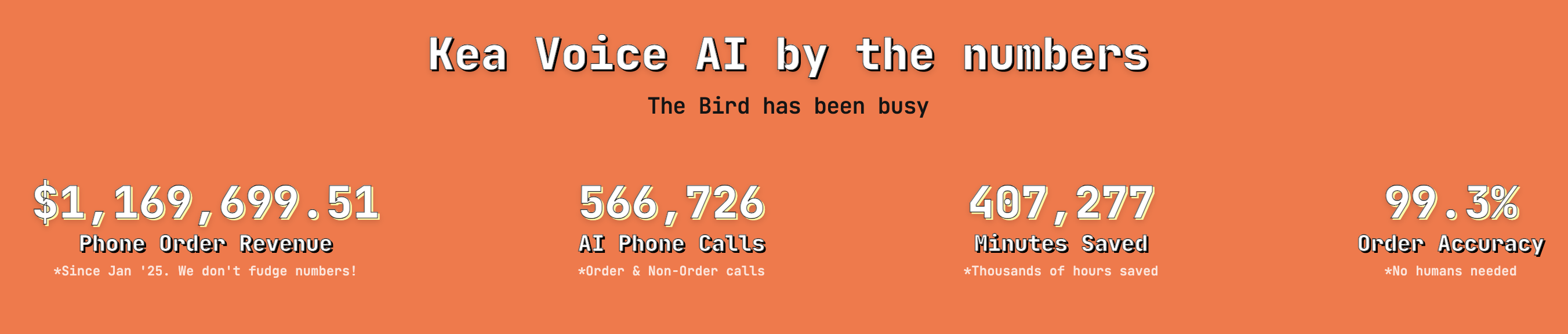
The impact of proper voice UI design is measurable. 95%+ – Order accuracy reported by leading AI voice platforms · 26% – Increase in phone order revenue after AI adoption. It's scaling past the early adopter phase into mainstream restaurant operations, driven by platforms reporting 95%+ order accuracy and 26% increases in phone order revenue compared to traditional human-staffed phone lines.
But these results only come from implementations that respect the psychological principles I've outlined.
One of our pizza restaurant partners saw phone order revenue jump from $12,000 to $19,000 monthly after implementing these design principles. The technology didn't change; the interface psychology did.
The Future is Hybrid
Looking ahead, In 2026, voice-enabled services have taken on an even more complex role. Think, agentic AI handling logistics in a noisy warehouse, or a banking app that acts as a financial advisor for users during a morning commute. Combine this with concepts like Zero UI, and it becomes obvious that any company making a digital product for 2026 cannot afford to ignore Voice User Interface (VUI) design.
The key insight? Voice won't replace visual interfaces; it will complement them. The most successful implementations use voice for what it does best: quick, hands-free interactions that feel natural and effortless.
Your Voice AI Checklist
Before launching any voice interface, ask yourself:
- Response Time: Can you guarantee sub-200ms responses for common interactions?
- Context Preservation: Does your system remember previous turns in the conversation?
- Error Grace: Do failures feel helpful rather than frustrating?
- Accessibility: Can users with different abilities and languages succeed?
- Expectation Setting: Is it immediately clear what your system can and cannot do?
The Bottom Line
Voice AI interface design isn't about making computers talk. It's about creating interactions that respect human psychology, accommodate real-world messiness, and deliver genuine value. The technology is ready; now it's time to design interfaces worthy of it.
At Kea AI, we've proven that voice AI can transform business operations while delighting customers. But success requires more than good technology. It requires understanding the hidden psychology that makes voice interactions feel natural, trustworthy, and genuinely helpful.
The restaurants thriving with voice AI aren't the ones with the fanciest technology. They're the ones that understood this simple truth: great voice design makes technology invisible and results visible.
For restaurants looking to implement voice AI with proper psychological design principles, Best Voice AI for Restaurants: 10 Must-Have Features for 2026 provides a comprehensive guide to essential features.
FAQ
Q: How does Kea AI's voice interface handle multiple languages and accents?
A: Kea AI supports extensive language capabilities and accent recognition, making it ideal for diverse customer bases. Our system continuously learns from interactions to improve understanding of regional accents and colloquialisms, ensuring accurate order taking regardless of how customers speak.
Q: What makes Kea AI's error handling superior to other voice AI systems?
A: Unlike basic systems that simply say "I didn't understand," Kea AI uses progressive disambiguation to show partial understanding and guide customers to successful outcomes. Our multi-tier error recovery ensures customers never feel stuck or frustrated.
Q: How quickly can restaurants see ROI with Kea AI's voice interface?
A: Most restaurants see immediate impact, with phone order revenue typically increasing 26% within the first month. The $450/month investment often pays for itself within the first week through captured orders that would have been missed.
Q: Does Kea AI's voice interface integrate with existing restaurant POS systems?
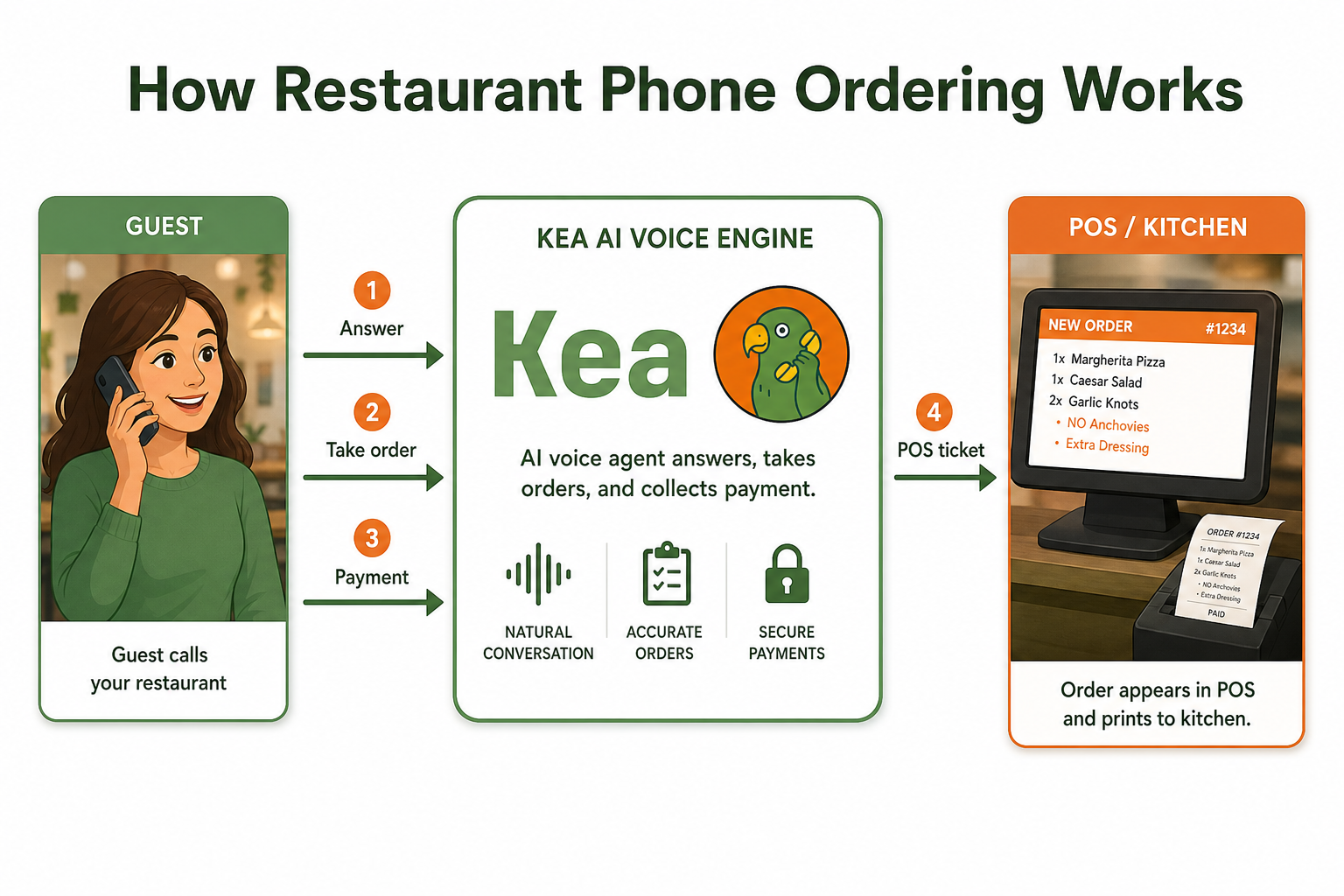
A: Yes, Kea AI offers direct integrations with major POS systems, ensuring orders flow seamlessly from phone to kitchen without any manual intervention. This zero-friction integration is key to our 95%+ order accuracy rate. Learn more about How to Integrate Voice AI With POS Systems Without Breaking on Complex Menus.
Q: How does Kea AI ensure voice interactions feel natural without being too casual?
A: Kea AI's voice personality is carefully calibrated for professional friendliness. We've analyzed millions of successful restaurant interactions to find the perfect balance between efficiency and warmth that customers trust and appreciate.
Q: What happens when Kea AI encounters a request it can't handle?
A: Kea AI intelligently recognizes its limitations and smoothly transitions complex requests to human staff when needed. This ensures customers always get the help they need while maximizing automation for routine orders.
Q: How does Kea AI maintain context throughout multi-turn conversations?
A: Our advanced context preservation technology remembers the entire conversation flow, understanding references like "add that to my order" or "make it large" without requiring customers to repeat information. This creates a truly conversational experience that feels natural and efficient.
Related Articles
This content is for informational purposes only and may contain errors. Please contact us to verify important details.